The pages of history are full of turning points which were often the result of cataclysmic events: the Wall Street Crash of 1929, the bombing of Pearl Harbour in 1941, the assassination of President John F Kennedy in 1963. But the turning point I wish to write about here didn’t quite happen that way. It was much more hidden, almost invisible until it was exposed in a very public way.
It was in my senior year at Tam High that I accidentally discovered the existence of a very secret subterranean activity. It was a slip of the tongue by a pretty young woman who sat on my right in Mister Kent’s morning art class, which first alerted me to something mysterious. We were all working on our water colour pictures and the pretty brunette on my right was telling us what she and her boyfriend had done on the weekend.
“We went to Sausalito,” she began in a distracted manner, “and scored a matchbox.” She suddenly stopped talking and muttered “shit!” I immediately asked what the matter was but she clammed up and said no more so I returned my attention to the picture I was paintng of Mead Theatre.
Mister Kent’s art class in Keyser Hall had a very relaxed atmosphere and I was surrounded by attractive young women so it was something I actually looked forward to. The silence of the room was altered by a gentle whisper from the young brunette. “You promise not to tell anyone?” she asked. “He made me promise not to talk about this.” The young lady on my left and I promised not to tell and she continued.
“We scored a matchbox. You know? Marijuana.”
This was heady stuff and, inside, my first reaction was one of terror, though I nodded sagely, as she continued to talk about this new alien activity. The subject of drugs and drug addiction was something that happened, metaphorically, on the other side of the tracks. I had been told cautionary tales by my father Blackie who had known singer Billie Holiday in New York, who was addicted to heroin. He also told me of a sailor on a ship who went bezerk with an axe because his supply had run out. Blackie and his shipmates overpowered the fellow and tied him to a mast. The Chronicle was full of news stories about drug addicts and the police but it was a world away from our lives. So to hear this young woman talking about marijuana was scary.
The jargon she spoke was new to me, using the word stoned to describe being high on weed, rather than drunk on alcohol. Turned on was a phrase I’d heard disc jockeys use on the radio but she used it as: turning on was getting high and she described marijuana cigarettes as joints.
It wasn’t long before I managed to get an invitation to join the pretty brunette and her sister at their mother’s house up on Lovell one Friday night where they were entertaining a guy I’d known in my younger years from Muir Beach. They talked about nothing but getting stoned all night and it opened my eyes to this secret society which existed here in Mill Valley as well as Sausalito and Marin City. More new jargon came my way: a head was someone who smoked weed and the word paranoid was used to describe feeling nervous. The evening’s chatter made me sit up and pay attention. Inherent in all the conversations I was listening to was the attitude that drinking was a drag and that smoking reefer was superior.
Every Friday night, except for this one, my brother Jim and I would join our friend Augie Belden at the apartment in Una Way that he shared with his mother. Mrs Belden would, without fail, spend the weekend somewhere north with her rich boyfriend and this vacuum was filled every Friday night by us getting drunk there and going to the local dance.
So I was privy to this new pot smoking scene but didn’t participate in it and it really was a secret society going on beneath the radar that most students at Tam responded to. It did, however come to the attention of the State Narcotics Bureau who sent an undercover agent into southern Marin to infiltrate the group who was dealing the grass. The agent drove a flashy GTO and befriended the relevant dealers at C’s Drive-In on Miller Avenue, where all the hard guys hung out. He also fanned out into Marin City and Sausalito making deals and gathering evidence.
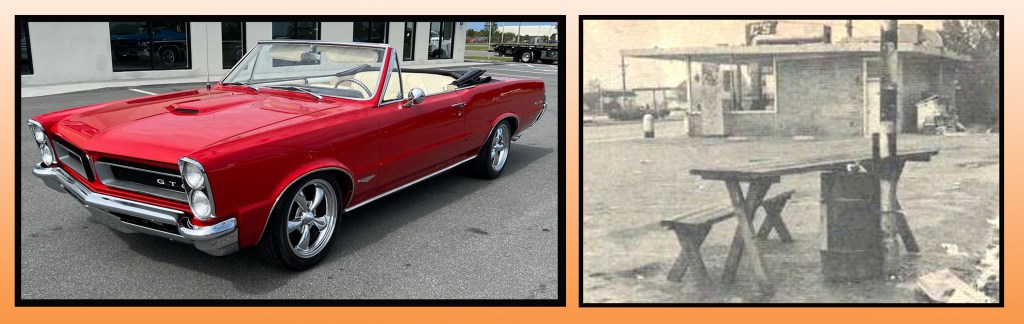
On the left a photo of a 1965 Pontiac GTO, a highly desirable vehicle at that time, which the undercover narcotics officer drove – and on the right a photo of C’s Drive-In on Miller Avenue.
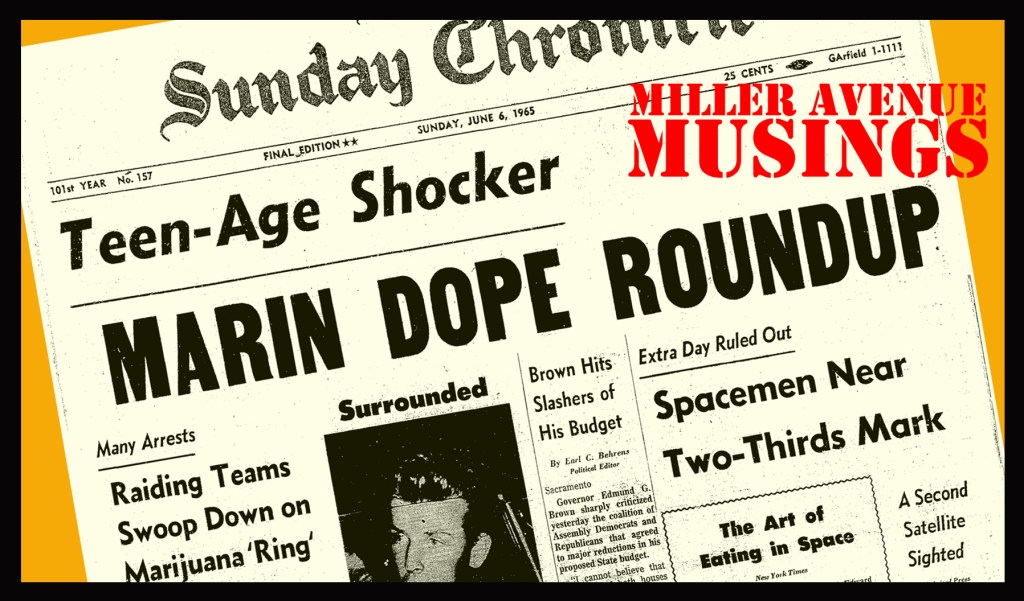
A few weeks before I graduated in the summer of 1965 they conducted a massive Saturday night raid which made front page news in the Sunday papers the next day. I was shocked to see a photo of Steve Nau on the front page of the Chronicle under the headline: Marin Dope Roundup. Steve was a kid we knew at Tam High who lived in Sausalito. A startled photo of Steve, being arrested at the Fireside Motel, was right in the middle of the front page. The Fireside, where my friends and I used to have pizza eating contests, was commandeered by the agents as their base for this coordinated raid. Dan Terzich, the Mill Valley Police chief, was part of the operation.
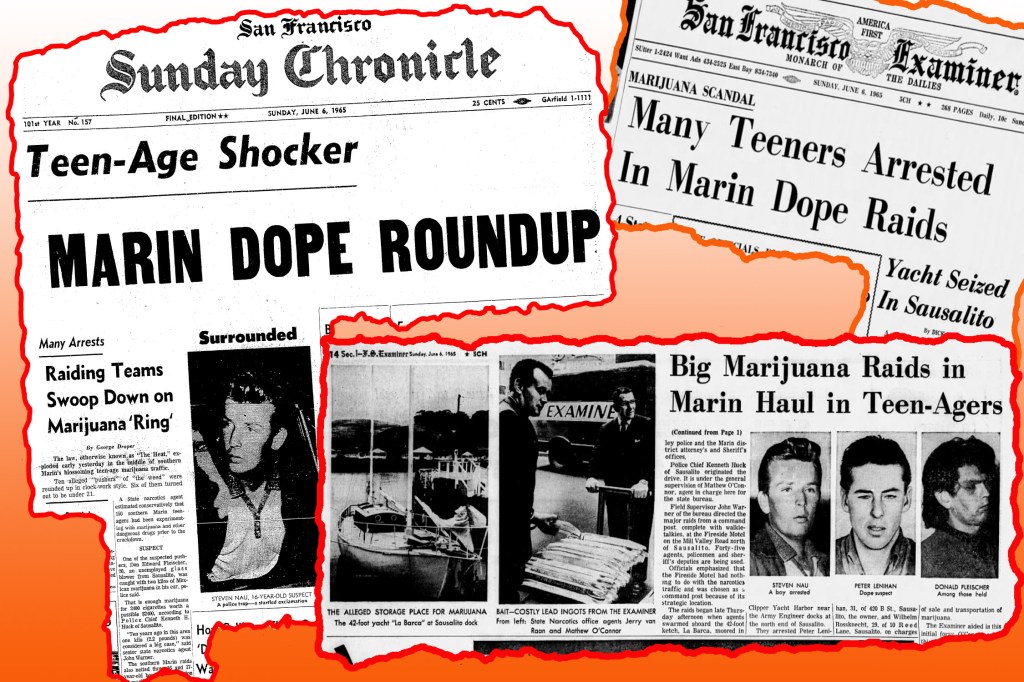
The front pages of the Sunday editions of the San Francisco Chronicle and The Examiner on the morning after the raid.
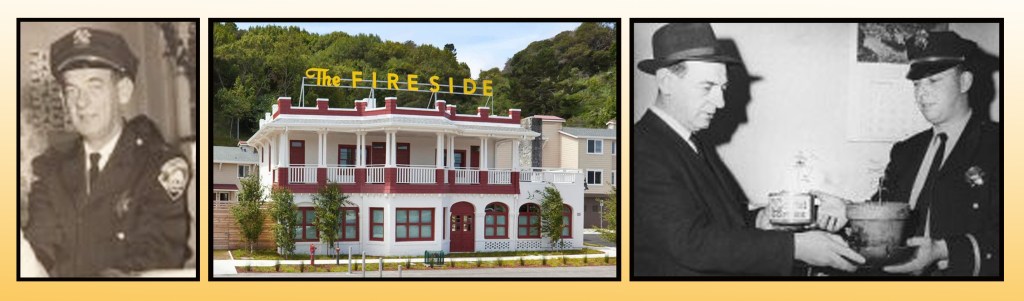
On the left a photo of Mill Valley police chief Dan Terzich in uniform. Centre is The Fireside Motel. On the right Chief Terzich examines a pot plant presented by his deputy.
It must be remembered just how important the print media was in 1965. San Francisco had two major newspapers: the Chronicle and the Examiner and both covered the raid on the front pages of their Sunday morning editions. The Independent Journal had coverage on the Monday as they didn’t put out a paper on Sunday at that time. The newspaper coverage would have been read all over Marin County.
The raid came as a huge shock and the newspapers kept the story alive for weeks after. Why Steve Nau’s name and photo was allowed to be used is a mystery. Steve was 16 at the time of his arrest and all the papers had a policy of only giving the names and addresses of those who were over 18. When Steve appeared back at school the following week, he told a group of us all about his arrest at the Fireside Motel and how the undercover agent who had trapped him, was put into custody and handcuffed along with the rest of them.
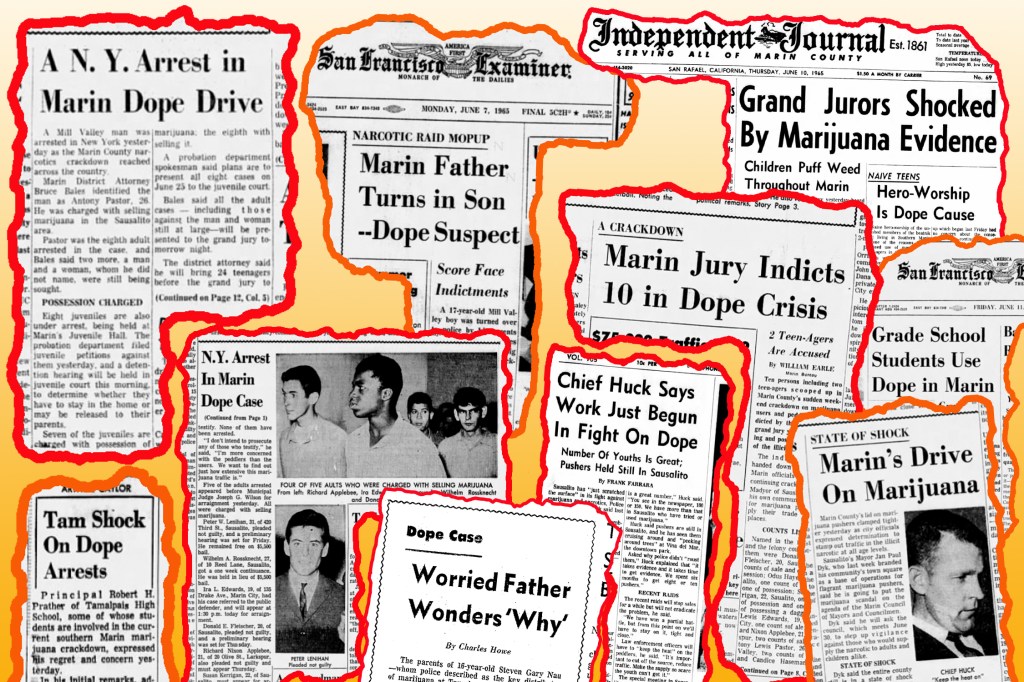
The newspaper coverage continued long after the initial arrests at The Fireside.
Mr Prather, our principal at Tam High, was soon being quoted in news stories after he announced that any students using or possessing marijuana near or on campus will be permanently excluded from the school. I have no memory of Mr Prather’s address to the student body about drugs but The Independent Journal reported him as saying: “Many of you seem to believe that the use of marijuana is not harmful to you, as you have been told that it is not a narcotic and is not addictive. While technically, this might be true, I would like to remind you that arsenic also is not a narcotic and is not addictive.” The next day the Chronicle quoted Mr Prather as saying that: “This problem belongs to the whole community. It is far bigger than just one group, and when an easy narcotics source comes along, it won’t be licked by one group alone.”
The continuing coverage in the newspapers was sensational and melodramatic in the style of Jack Webb on Dragnet or a Dick Tracy comic strip. “While Prather was speaking,” read the piece in the Chronicle, “Word came from New York that police there had arrested another suspect in the marijuana ring in Marin. Held in New York pending extradition proceedings was Anthony Pastor, 26, unemployed from Mill Valley. He had been sought on a warrant issued by the Marin County district attorney’s office late last week.”
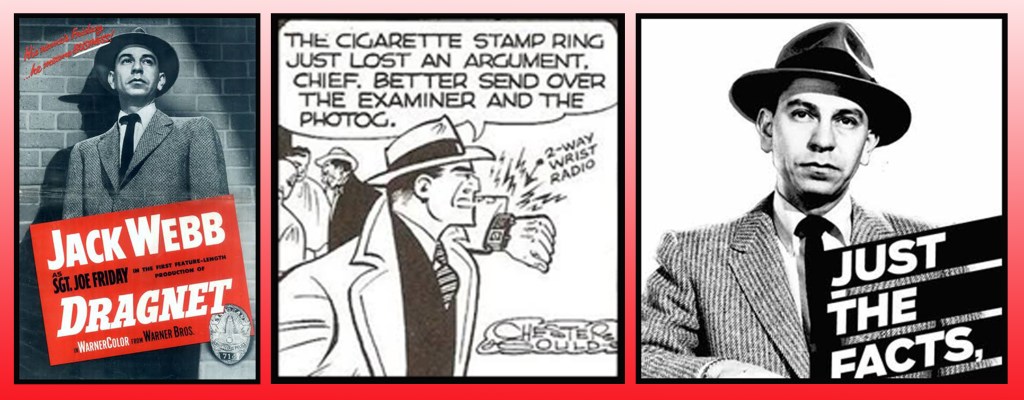
The newspaper coverage of the raid struck a tone rather like the TV show DRAGNET or the comic strip DICK TRACY.
The Chronicle ran a front page article titled Worried Father Wonders ‘Why’. It was an interview with Steve Nau’s father, Sidney, who was grief stricken at his son’s arrest. Sidney Nau was a longshore gang boss on the San Francisco waterfront. The reporter described him gazing out his window at the bay and clenching his fist when he described the long haired beatniks hanging out down in Sausalito’s park, Vina Del Mar. Mr Nau spent the interview wondering where he had gone wrong with his son and stating that he was standing by Steve.
Sausalito’s police chief, Kenneth H Huck, made headlines by announcing a two pronged attack on drug dealers, asking for more resources from the city council and a programme of education for parents. The curfew laws would be strictly enforced and any “questionable characters” seen in the company of juveniles would face arrest and possible prosecution for contributing to the delinquency of minors. Using pre-feminist syntax, chief Huck said: “We hope to educate the parent in the appearance of marijuana and narcotics so that he will be able to detect its use. We hope to work with the juvenile in showing him the hazards and the danger involved in use of narcotics.” Speaking to a group of 30 representatives of churches and service clubs at City Hall, Huck told them that he’d seen pushers operating in the downtown park Vina Del Mar: “peeking around trees. The major part of the problem is still before us. The amount of youth involved is a great number. You see in the newspaper, 100 or 150. We have more than that in Sausalito who have tried or used marijuana.”
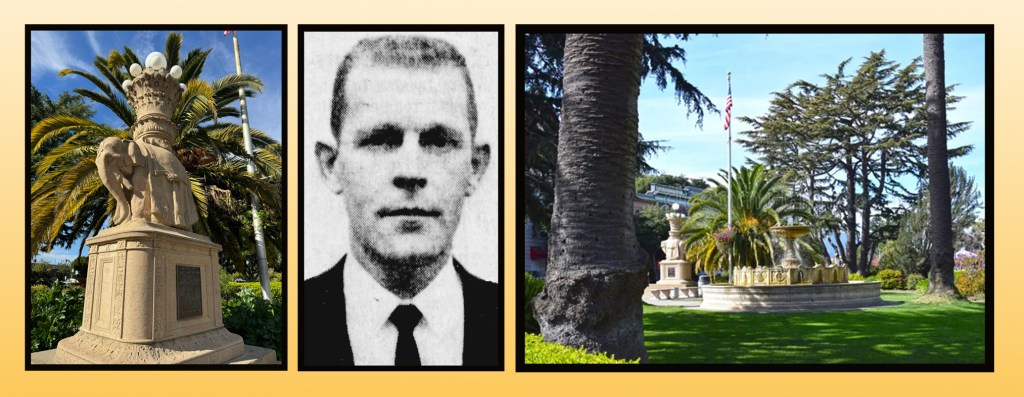
Sausalito’s downtown park, Vina Del Mar, and a photo of then Police Chief Kenneth H Huck.
Although I followed the news coverage to a certain extent, a combination of the excitement about graduation and the anticipation of my trip to sea eclipsed my interest in the dope raid and its consequences which continued to generate sensational news stories.
Two days after my graduation I was working as a mess boy on a Norwegian tanker steaming towards Yokohama. Ironically I shared a fo’c’sle with Kent Baldwin, a younger student from Tam High, but most of my socialising was done with non-Americans. I spent the entire summer on that ship. This was a huge change in my life and none of the things I had become used to as a young person would ever be the same again.
When I returned to Mill Valley I was a very changed person. I had been to Japan, Formosa and the Philippines. I had gone through the Panama Canal, visited New Orleans after Hurricane Betsy had ravaged the place, and finally signed off in the place of my birth, New York City. Before I contacted my relatives, I spent a week at the YMCA which later was made famous by the Village People. I learned first hand about loneliness in the big city and when I returned to my home town, I was much less confident and more introspective. But in addition to the changes within myself, the town I’d come back to was also different.
Tam High was not the same place I had graduated from a mere few months earlier. Most of the male students had long hair. Kaftans and beads were everywhere and clearly a majority of the students were now smoking marijuana. A friend of mine who was now a senior had, at the time of my graduation, sported a collegiate haircut. He now had long hair and looked like Sonny Bono, complete with flared trousers. And his girlfriend, in spite of having red hair, looked like Cher. He filled me in on the changes which had occurred in the youth culture of Mill Valley. He was now very much part of the new drug culture which had blossomed in Marin County.
I have no doubt that the purpose of the raid which the narcotics bureau pulled off in the summer of 1965 was to stamp out and put an end to the use of marijuana in southern Marin. The publicity surrounding the raid, however, seemed to have the effect of popularising marijuana with young people. I very much doubt that Madison Avenue could have done a better job of selling weed smoking to the teenagers of Mill Valley, Sausalito and Marin City. By the following year, the hippie era was well under way and the way of life I had grown up in was gone forever.
On my return to Mill Valley in September, 1965, I enrolled at College of Marin where I took journalism and worked on the newspaper, The Tower Times. All my friends were smoking dope and any resistance I’d had previously simply dissolved. I started getting stoned in a big way. My initial attempts at smoking grass while still in high school were not at all successful as I couldn’t appreciate the subtleties of its effect on me. But now I was getting loaded after the first toke was sucked into my lungs. Listening to music through a haze of green smoke was terrifically heightened. I would hang out with my friend Matt who lived on a houseboat in Larkspur. It was there that I discovered and listened over and over to the first Lovin’ Spoonful album.
I started doing a weekly comic strip in the college paper called Captain Campus. It was shamelessly influenced by the ABC television version of Batman which was wonderfully funny and its use of comic book graphics was so stylish. I stayed at the College of Marin for just one semester and the comic strip started out with a slightly amateur look but by the end had become professional looking.
I went to the Trips Festival at the Longshoreman’s Hall where I saw Bill Graham for the first time. He looked very straight with a Frankie Avalon hairdo but he mixed fluidly with the long haired rock musicians on the stage. Later I went to a gig at the Fillmore Auditorium and was amazed at the size of the dope smoking scene. I also saw the posters being done and thought to myself that I could do that kind of work so I put together a package of my comic strips and a psychedelic ad I’d done for a dance at College of Marin and sent it to Bill Graham at the Fillmore. About a week later Bill rang up and invited me to come see him at the Fillmore.
The cultural changes which had occurred between graduating from Tam in June of 1965 and one year later were astounding. The way of life I had experienced in my four years at Tamalpais High School was over. It would never be like that again.
Years later I was living and working in London when the film American Graffiti came out and I saw it at the ABC on Holloway Road. George Lucas directed and co-wrote it with Gloria Katz and Willard Huyck. The film reconstructed what my high school life was like brilliantly. I recognised every single character in the film, including myself. The hard guys, the rah-rahs, the cruising on 4th Street, the drive-ins and even someone getting pantsed. It was exactly how American teenage life was like before marijuana came along and took all the kids away.
We don’t normally choose what we’re nostalgic about but if I did have such a choice I would pick the way of life depicted in American Graffiti over the hippie era without a doubt.

Amazon USA
https://www.amazon.com/dp/B085QN73VQ
Amazon UK
https://www.amazon.co.uk/dp/B085QN73VQ

 Miller Avenue Musings
terrific- great social history & illuminating insights. Many thanks T
LikeLike