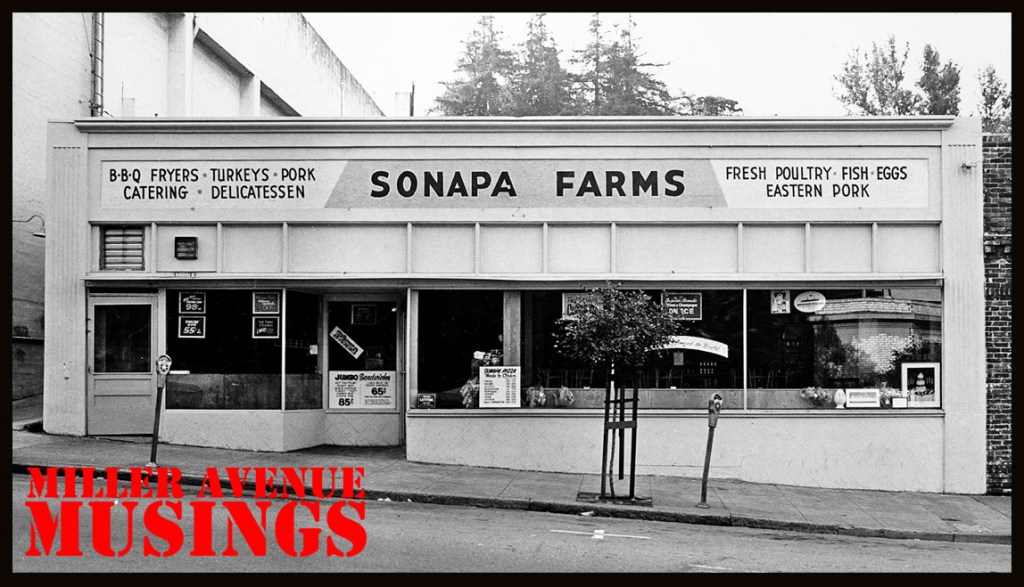
Photo courtesy of the Lucretia Little History Room, Mill Valley Public Library
The dearth of practical stores in today’s downtown Mill Valley, inspired me to compose my last column in which I took a walk up and down a stretch of Throckmorton, recalling some of the stores, restaurants and bars which have since vanished into the mists of history. So I’d like to continue my walkabout through the downtown Mill Valley of the 1950s and 60s.
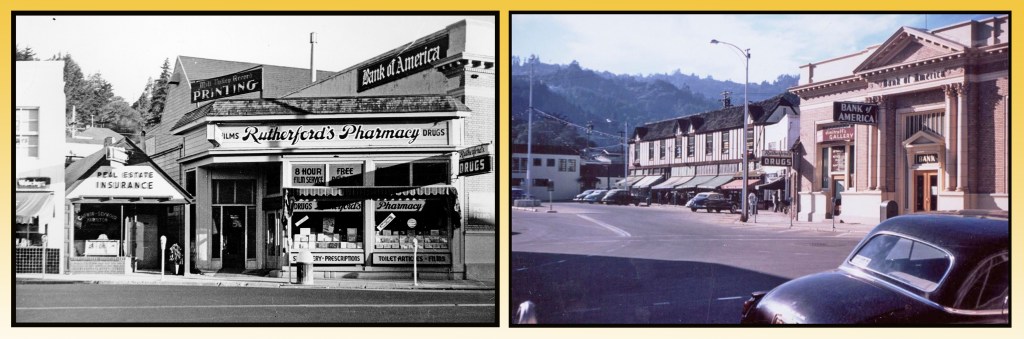
On the North side of Lytton Square was Rutherford’s Pharmacy (notice the sign advertising printing by the MV Record) right next to the Bank of America. Photos courtesy of the Lucretia Little History Room, Mill Valley Public Library
Starting on the corner by the Bus Depot, if you walked across Miller to Mayer’s and turned left, you’d come to Lockwood’s Pharmacy, which began dispensing prescriptions in 1905 from the very spot, if not the building, that Mayer’s was located.
Next door was Meyer’s Bakery which had a soda fountain. If I had a dime to spend, I’d sit at that counter drinking a delicious cherry Coke. They were famous for their cakes but I have to admit I never tried one, however Laurie Diederich, Deborah Owen and Norma Jean Powell have very fond memories of their chocolate seven layer cake. Geoffrey Spellman and Alan Eshleman remember that its name was the Dobosch Cake. It had dark chocolate icing and it alternated thin layers of cake with a delicious chocolate filling. Laurie and her friend Pamela Harris also recall encounters with the famous Goat Lady who would sit at the counter in Meyers’ Bakery having walked all the way from her farm which overlooked Richardson Bay.

A donkey drawn carriage advertising a barbecue in Boyle Park turns onto Miller, passing Meyer’s Bakery. On the right their famous Dobosch cake. Photos courtesy of the Lucretia Little History Room, Mill Valley Public Library
Further along Miller was a tool repair and rental shop run by Joe Eastburn. Both Philip Richardson and Peter Gardiner recall that the walls of this establishment were decorated with photos of naked women from the pages of Playboy and Stag Magazine. Also on the right was the Wells Fargo Bank and sometime during the 1950s, just beyond the bank, Men’s Mayer’s opened which was where we bought all our Cub Scout and Boy Scout uniforms and merit badges. When it opened, the store back on the corner became Women’s Mayer’s.
A bit further down Miller, just before you came to a set of steps which took you up to Ethel, was Brown’s Furniture Store. Brown’s was a popular and successful business, founded in 1927 by Lester Barnett Brown and his wife Tilly Brown. In addition to furniture of all kinds Brown’s also had a toy department which, according to Marguerite Finney, was something special: “But what about the toy department at Brown’s store. Upstairs. If I recall correctly it was magic.” But the Myers family never set foot in Brown’s. This was almost certainly because nothing in our house was new and the idea of purchasing brand new furniture never occurred to either of my parents.
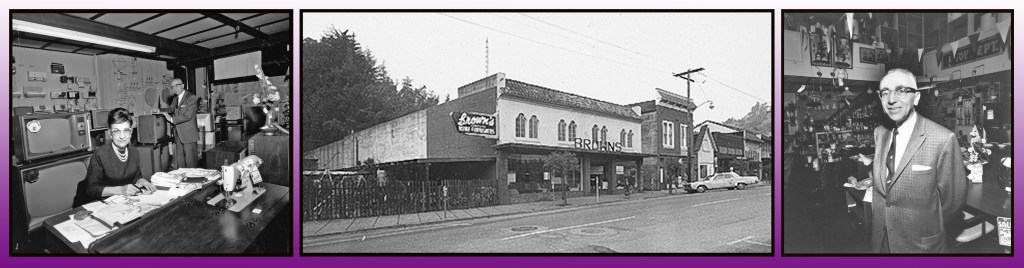
On the left Mr and Mrs Brown seemingly pricing items, the building on Miller Avenue and Mr Brown with the toy department above him. Photos courtesy of the Lucretia Little History Room, Mill Valley Public Library
Back on Throckmorton if you walked east from the Depot you’d come to a luncheon-restaurant which was called Stuyvesant’s during the 1950s. It was a very busy diner with a juke box which could be operated from individual stations positioned at each table and along the lunch counter. Each station or tabletop wallbox was encased in glass and had chrome plated selectors for turning the pages to choose whichever song you wanted to hear. It cost a nickel to play a record or you could hear three discs for a quarter. It could be Frank Sinatra singing Three Coins in the Fountain or Secret Love by Doris Day.
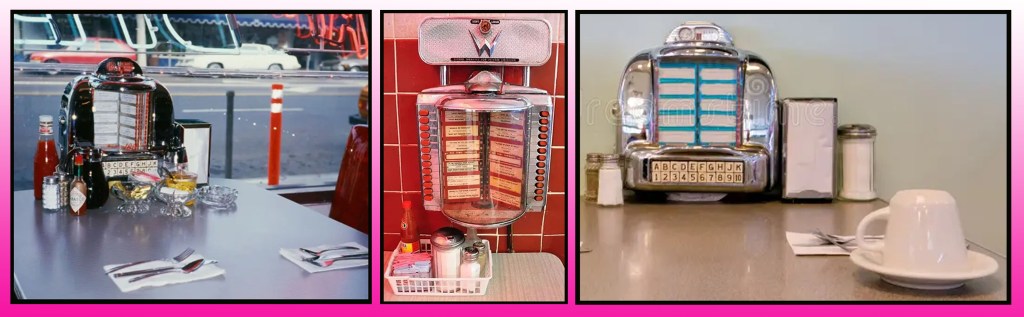
Three Tabletop Wallboxes like the ones which were found in Stuyvesant’s, later called Pat and Joe’s.
The food was good and not too expensive. For breakfast you could have a short stack of pancakes with bacon, eggs and maple syrup. Later in the day it might be a hamburger with French fries. When you first entered and sat down, the server would bring you a glass of ice water and coffee cups would be topped up throughout the day. As well as having a largely adult clientele, Stuyvesant’s was also a hangout for hard guys with greaser hairdos who would smoke cigarettes while nursing a cup of coffee.
Pat and Joe, who took over Stuyvesant’s in 1964 were a gay couple who had previously run the Jolly Coffee Shop which was housed in the Jolly Foods building down on Miller Avenue. Also in the building were Jolly Liquors and Marin Electronics. It was located at 393 Miller Avenue next to the Campbell-Bishop Chevrolet dealers.
My school friend Ed Smith worked for Pat and Joe washing dishes at the Jolly Coffee Shop for about six months.
“The place was a hangout for kids after school,” recalls Eddie. “Mike Cleland, Bonnie Komph, Mike Chirco, Jim Sender and their friends would come in almost every day and eat French fries with a ton of ketchup. Pat had a very pretty and sexy sister who was a waitress at the Jolly location. She wore very revealing blouses which helped her in getting big tips.”
His employment came to an abrupt halt in June of 1963 when a ferocious fire gutted the entire building. The Mill Valley Record described it as the “biggest blaze since 1929.” This referred to the famous forest fire on July 2nd, 1929 which covered Mount Tamalpais and burned for three days, devastating approximately 2,500 acres of timberland.

On the left is the Jolly Foods building after the fire had been put out and on the right a portion of it as it was before. Photos courtesy of the Lucretia Little History Room, Mill Valley Public Library
The Jolly Foods fire began early in the morning of Friday 28th June, 1963. It was first reported at 5.59am by produce clerk Luis Alvino when he turned up for work at Jolly Foods. He tried to fight the flames with an extinguisher before reporting it. Fire fighters from the Homestead station were first on the scene but were soon joined by units from Alto, Corte Madera Street and Sausalito.
The MV Record reported that “The roaring flames, which swept from the rear of the building to the front and could only be fought from the collapsing roof, also destroyed a portion of the Campbell-Bishop Chevrolet auto paint shop – but 60 new cars were rescued by a shuttle of salesmen who were called to duty by owner Merrold Campbell and sales manager Walter M. Brown.”

The view from the Campbell-Bishop Chevy dealer and the front page photo on the next week’s Mill Valley Record. Photo courtesy of the Lucretia Little History Room, Mill Valley Public Library
Eddie, whose family home was a few minutes away in Plymouth Circle, was soon on the scene: “The fire started supposedly in the grocery store and it destroyed pretty much everything except the concrete walls and foundation. There was a hardware store in the rear of the building, a liquor store and an apartment upstairs. I helped the lady that was living in the apartment get some of her belongings out before the whole thing burned up. I’m pretty sure I only made one trip because by that time the smoke had gotten too intense. I do remember running towards the creek where the smoke hadn’t gotten to yet and I was getting pretty close to being a victim of smoke inhalation. After that it was just too impossible to go back to her apartment. The Chevy dealership on the corner of Miller and La Goma was heavily damaged as well.”
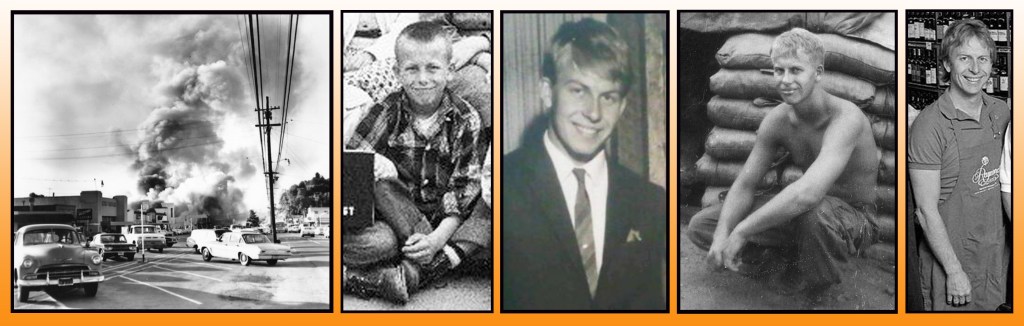
The view of the fire from north of Locust on Miller Avenue, then four pictures of my school friend Ed Smith: Eddie at Alto where we first met, in high school at Tam, in Vietnam as a soldier and working in a bottle shop in Marin. Ed now works as a professional photographer. Photo courtesy of the Lucretia Little History Room, Mill Valley Public Library
The MV Record reported that the “fire attracted hundreds of commuters and Mill Valleyans who rushed to congest Miller Avenue where police toiled valiantly to keep traffic moving. All officers were called on duty, Chief Dan Terzich reported.”
So Pat and Joe took over Stuyvesant’s the following year and my memory of them was that Joe, who mostly waited on tables, was very loud and demonstrative and that Pat, who was in the kitchen cooking, was quiet. I remember Joe taking no guff from the hard guys nursing their cups of coffee. Eddie confirms my memory of Joe being a bit loud and though he spoke in an openly effeminate way, his demeanour was tough and no nonsense.
As Throckmorton took a bend to the right you’d find Redhill Liquors which was run by Sy Weill who was often standing outside his store watching the world go by. A tall man with a bald head, Sy was always very well dressed and would nod in a friendly gesture to each person passing.
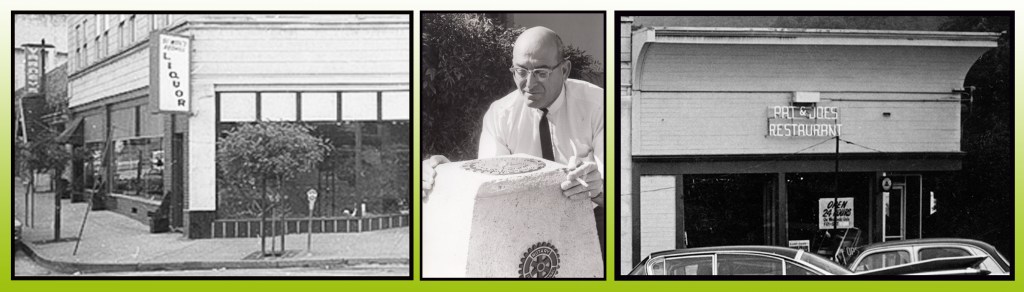
On the left a view of Varney’s and the sign for Redhill Liquor, run by Sy Weill pictured centre. On the right is Pat and Joe’s. Photos courtesy of the Lucretia Little History Room, Mill Valley Public Library
As Throckmorton began to move up the hill towards Blithedale, you’d come to Varney’s Hardware, the most popular hardware store in Mill Valley. Alex Call remembers that he bought his baseball mitts from Santa’s Toys on Miller but got his baseball bats from Varney’s. Bob Trapp on a MV Facebook page remembers: “My dad used to spend time in Varney’s while mom was shopping at the MV Market. He would gaze on all the tools, trying to think of what home project mom wanted him to do. I remember being able to buy nails, screws, etc. by the pound rather than in boxes of many.”
Sonapa Farms moved from their first shop up near The Office on Throckmorton, to another location on the same street just below the Sequoia Theatre. They had a lunch counter which ran along this massive window giving you a proper view of the top and bottom of the hill which ran down from Blithedale. My favourite lunch was a roast beef sandwich on rye bread which they served in a basket with a sliced dill pickle.
The next building as the hill became more pronounced was the Sequoia itself. The entire building had two alley ways on either side and two shops enclosed within it. The upper shop was, throughout the 1950s. Village Music where I spent an awful lot of time asking Sara Wilcox to play records for me.
And the Sequoia Theatre was a glorious place to view movies. That it’s been divided into two cinemas breaks my heart, for it was a beautifully designed space. As you entered from the street you passed the candy counter on the right and continued straight ahead up a short carpeted staircase which led you to a wall overlooking the downstairs seating area. Kids without adults had to sit downstairs. Upstairs was where adults sat and smoking was allowed. The front section of the upstairs seating was the loges, more comfortable and supposedly with a better view. When we went to the Sequoia as a family, my father Blackie never paid the extra money for the loges and we would sit in the last row against the back wall just under the projection booth.

On the left the exterior of the Sequoia in the tranquility of a weekday. On the right the baying crowd of kids lined up for the matinee. Photos courtesy of the Lucretia Little History Room, Mill Valley Public Library
The Saturday matinees were both a glorious cinematic experience and the very stuff of nightmares, due to the behaviour of the majority of the children attending. These kids regarded the matinee as their time out of the prison of parental authority and they did indeed run wild. Spitballs whizzed across the stalls as gangs of over exuberant children threw every kind of food stuff that the candy counter could provide. Their loud and raucous behaviour began as soon as they entered the downstairs auditorium and lasted through the cartoons and comedy. Ushers weilding flashlights tried valiantly to corral and control this wild animal of a crowd but, as I recall, they never succeeded. The noise was so loud that you could not hear what the characters on the screen were saying which meant that the first half hour of the show was totally inaudible.

Cartoon character Popeye, the 3 Stooges and Mighty Mouse.
They calmed down during the serial which always grabbed their attention. Each week we’d have a chapter of Batman, Flash Gordon or The Phantom. This was the main hook for me as each serial consisted of 15 chapters and the climax of each would be some dreadful calamity for the main protagonist. Throughout the week I would worry how the hero was going to get out of that one. The Phantom was about to be eaten by a crocodile or Batman fell off an impossibly tall building. I never got wise to this, not terribly artful, manipulation and, if I’m honest, it was the serials which kept me coming back.
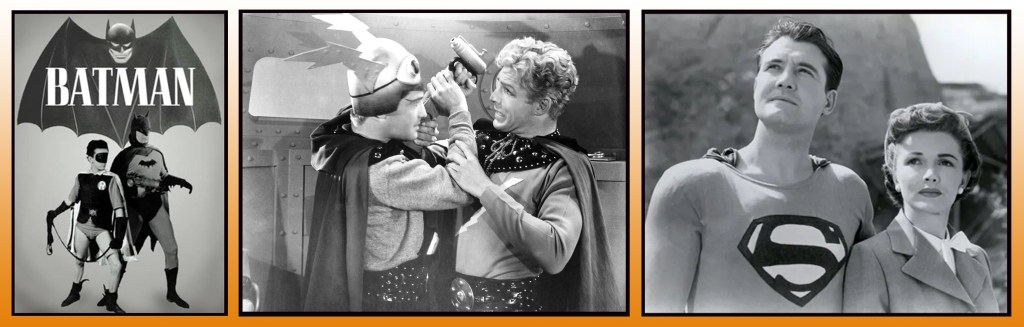
On the left the 1940s serial of Batman, then the 1930s Flash Gordon and as the 1940s crept into the 50s, Superman.
There was a break between the serial and the main feature which was always a picture of some quality but just a little bit old. In fact all the films, cartoons and comedies were dated.
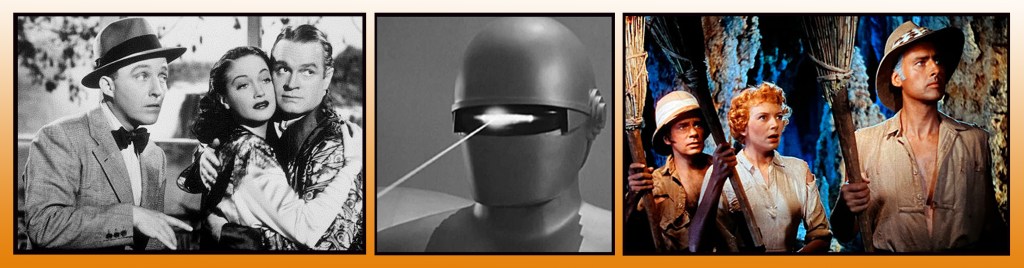
On the left: Crosby, Lamour and Bob Hope in ‘Road to Rio’, the robot Gort in ‘The Day The Earth Stood Still” and Richard Carlson, Deborah Kerr and Stewart Granger in ‘King Solomon’s Mines.’
Then the manager would come out and give away goody bags to those whose ticket stub was pulled out of the barrel. It was never mine. Birthdays were celebrated and then finally we got the main feature which might be a western, an exotic adventure film or, every so often, a science fiction movie. For all the penalty of the raucous behaviour, the Saturday matinee at the old Sequoia was a wonderful experience which I wouldn’t miss for all the tea in China. And I never did.
To be continued…
Amazon USA
https://www.amazon.com/dp/B085QN73VQ
Amazon UK
https://www.amazon.co.uk/dp/B085QN73VQ


