Back to the Waterfront

Somewhere in the midst of my comedown and the start of my depression, my childhood friend Robbie Bridges, appeared and invited me to go on a road trip to southern California.  Robbie was the son of Harry Bridges and he and I used to play together when we were very young.  After his parents’ divorce, he’d been living back east with his mother Nancy.  He was now based in San Francisco and doing some kind of a white collar job which was nothing to do with Harry or the longshore union.

   Robbie must have known what I’d been through the past few months but my memory of our drive down the coast was that we talked as if nothing had happened to me and I responded well to this.  Everybody around me at this time was treating me with tremendous delicacy and somehow Robbie not thinking there was anything wrong with me was liberating.  At one point he asked me to drive and I did.  It was an exciting moment of self discovery to learn that I actually knew how to drive a car.  

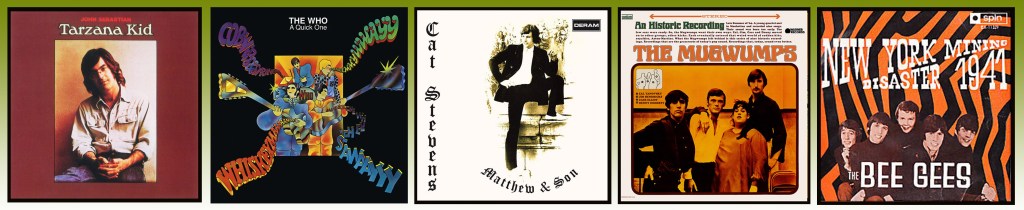
   He told me all about the pop music he was keen on.  He was particularly taken by The Who and told me about gigs he’d been to.  I cannot remember where we stayed on this trip but I think we were away from San Francisco for a few days.

   A little bit of logical thinking was seeping into my fevered brain.  The idea of a trip to England, became something I felt I had to do.  I knew that in order to get the money for such a journey, I would need to go back to work on the waterfront.  But to do that I would have to pull myself together and make accommodations with the world around me.  For someone who, a mere six weeks earlier, had been stomping around the psychiatric wards at Napa State Hospital insisting that John Lennon was in the next room, this was something of a tall order.  But at every point on my journey of madness, I had responded to the signals around me and the fact I had two contacts in London: my sister Nell and my friend Jo Bergman, I took as just such a signal.  It did, however, require some organisation on my part.

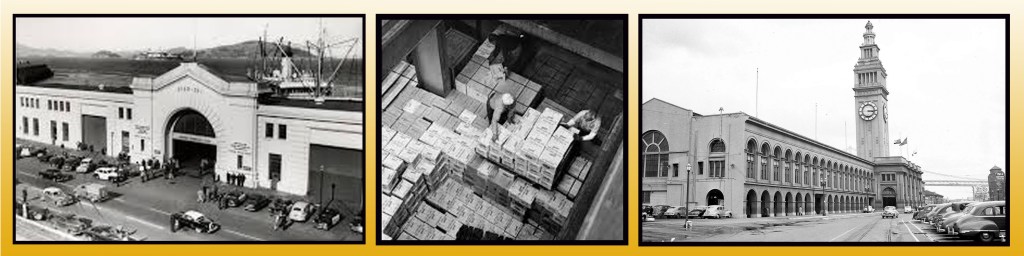
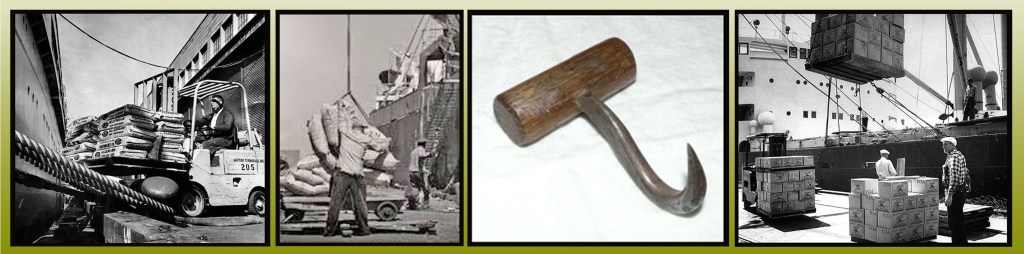
   That I had the opportunity to work on the waterfront as a ship’s clerk was a privilege indeed.  This privilege came to me as a result of being Blackie Myers’ son.  I was aware just how sought after the clerking jobs on the front were.  For starters they paid very well indeed and it could be more than a bit interesting, particularly when you worked down inside the hold of a cargo ship.  

   Had I never worked on the front before, the prospect of clerking would have terrified me, but the waterfront was a world I was familiar with having done it a fair bit.  However this time was different.  The recent experiences I’d been through had taken me into dimensions outside the social boundaries of normal society and I realised I’d have to conform to my father’s ways.  The first thing would be to cut my hair and dress in a sober manner.  There was a huge prejudice against long hairs on the front and, after several months of being a hippie mental patient, my hair was long indeed.  My father was a very respected guy up and down the Embarcadero and I knew that it would be disrespectful of me to behave in any way which upset or embarrassed him.

Blackie with his brothers Billie and Harvey in Brooklyn(left), Blackie at his desk in the NMU, and Blackie on Market Street with a seafaring friend.

   Also it was very important to be conscientious in the work, which wasn’t really that difficult but accuracy was essential.  Blackie always stressed the importance of doing your job to the best of your ability.  The reason he always gave for this was to protect the union.  After all that was his history.  He was a sailor by trade and had helped build the National Maritime Union which was no cake walk.  Whenever they tied up a ship and went on strike they were up against all the forces that the ship owners had at their disposal: the police, the national guard, and gangs of strike breakers known as Goon Squads.  The fight to build their union had been long and bloody.  A few of Blackie’s comrades had been killed in the struggle and while he and his sailors were building the NMU on the east coast, Harry Bridges was leading the longshore union on the west coast.   

From left: Blackie Myers, Harry Bridges, Vincent Hallinan.

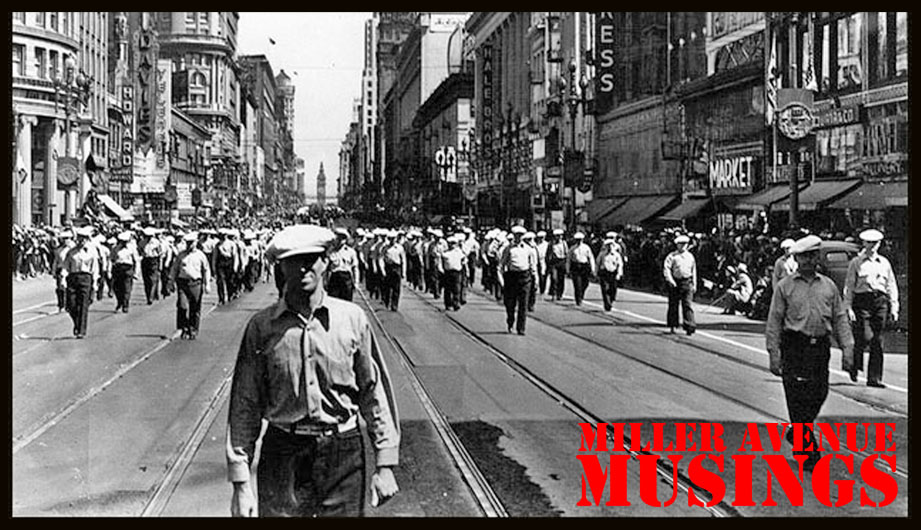
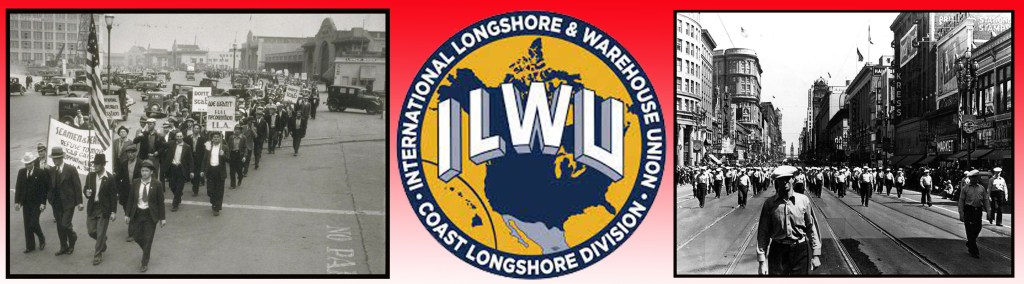
   The west coast longshore strike of 1934 was a crucial turning point for the American trade union movement.  The police, firing live rounds at the striking stevedores, injured many and killed two.  The union held a funeral march for the two dead men which processed up Market Street.  Thousands of people lined the street to watch.  This was a major factor which led to a general strike.

How the Hearst press Examiner reported the first days of the 1934 longshore strike.

   The 1934 strike was the beginning and the original union, the ILA, became the ILWU (International Longshore & Warehouse Union).  Their militancy improved working conditions and wages for ordinary labourers.  But it also made Harry a target.  Those that felt the working class should know their place conspired against him.  He was, after all, an Australian by birth, and the federal government would do their damndest to deport him.  But that was in the 1930s.

From left: the 1934 longshore strike, the ILWU logo, the longshoremen march up Market Street in 1939.

From left: Harry getting good news, speaking at a conference, and speaking to a large crowd in San Francisco.


   In 1952, the Myers family had travelled all the way from Connecticut to California because every job Blackie managed to get on the east coast would last only as long as it took the FBI to turn up and tell his employer what a dangerous radical he was.

   The last leg of our journey west was from Taos, New Mexico to Mill Valley.  All of us, Blackie, Beth, Nellie, Katie, Jimmy and I were bleary-eyed from the endless stretches of highway but when we crossed the Golden Gate Bridge and climbed Waldo Grade, the end was in sight.  Turning left off Miller Avenue at the 2am Club, we drove into Homestead Valley where a welcome party for us was in progress at Bob Robertson’s house.  Bob was an executive of the longshore union, the ILWU.  Every family friend we would know in the town we were destined to grow up in was there.  The Dreyfus family, the Hallinan family and the Bridges family along with the Goldblatts and the Cox’s.  It was such a friendly gathering of people and I instantly thought of all these folks as family.

   The reason we had come west was the possibility of work for Blackie on the San Francisco waterfront.  Harry Bridges and Blackie Myers were trade union comrades of old.  However it took some time before Black was allowed to work on the front.  With hindsight, I think the delay was possibly because Harry, with all the political persecution he was continuing to suffer, felt nervous about provoking the federal government.  After all Blackie had been a prominent trade unionist in New York and was an early target of the witch hunters.

Beth and Blackie pictured on the left in Connecticut in 1950 and on the right in San Francisco in the 1960s.

From left: Johnny Myers with Blackie in Manhattan, centre: Jimmy. Blackie & John, on the right Johnny, Blackie, Jim and Totem our cat.

   Harry was born in Melbourne, and had gone to sea at a young age, winding up working on the docks in San Francisco.  The federal government had tried repeatedly to prosecute and deport Harry, claiming he’d lied about not being a member of the Communist Party. 

   The propaganda of the post war anti-Communist era was very powerful indeed.  Hollywood fell in line with the government by creating a blacklist for writers, directors and actors who wouldn’t cooperate with the House Un-American Activities Committee.  The cooperation the committee required was to name names of those who either were Communists or fellow travellers.  The Hollywood Ten all went to prison, Alger Hiss too went to jail and in 1953 the Rosenbergs were executed for treason so by that time the terror in the country was pretty substantial.

The House Un-American Activities Committee featuring a young Richard Nixon on the right and J. Parnell Thomas in the centre.

Pressbook advertising for the 1951 Warner Brothers film ‘I Was A Communist For The F.B.I’

   For Americans who have grown up believing the propaganda of the McCarthy era, the image of a Communist was a ruthless person with shifty mannerisms and dishonest tendencies.  Many of my parents’ friends were actually party members but none of them behaved remotely like that.  Humour played a big role in most of those friendships.  

   Blackie had a mischievous sense of humour and was what he called a pork chop socialist.  Whatever put food on the table was what motivated him and he was always fair with others.  During the depression he found himself in a town where they had a fist fight contest with a prize of ten dollars for whoever won.  Handy with his fists, Blackie fought the guy and beat him, but then split the money with his opponent.  When I asked him if he was tougher than the other guy, his answer was: “No.  I was hungrier.”

   As kids, we always enjoyed Blackie’s performances.  He was a very good mimic and did a pitch perfect impersonation of Harry, who he always called The Nose. 

  There were party members who did behave in a stereotypical secretive way but none of my parents’ friends were like that at all.  One such person was our neighbour, Dennis Brogan’s grandmother Jean.  She used to bring us her copies of The People’s World newspaper and my memory of her was that she was completely humourless.  

   The American Communist Party became a political force in the early days of the Great Depression.  President Franklin Delano Roosevelt had no qualms about dealing with Communists.  His administration had many advisors from all avenues of left wing politics including the NMU, and Blackie was one of them.  A family friend, Albert Kahn, wrote in his book, High Treason, quoting FDR just after his electoral victory in 1932: “Coming back from the west last week, I talked to an old friend who runs a great western railroad.  ‘Fred,’ I asked him, ‘what are the people talking about out here?’  I can hear him answer even now.  ‘Frank,’ he replied, ‘I’m sorry to say that men out here are talking revolution.’”

   Blackie had gone to sea at age fourteen and became an able bodied seaman.  Following the Wall Street Crash of 1929 and the great depression it had caused, he was often out of work and would “grab a handful of boxcars” to get from one port to another in search of a ship to sign on.  The hiring halls in every port were referred to as Fink Halls as sailors would have to bribe the man handing out the jobs.  The pay was low and working conditions on the ships were often dangerous.  Blackie was a tough guy who during those years was both hungry and angry.  It wasn’t until he became involved with those working to organise as a union that he was able to channel his anger in a constructive way.  

   But the fights ahead were deadly dangerous as the shipowners perceived the formation of the union as a direct attack on their interests and deployed all their weapons.  The NMU organised strikes on the east coast and ports in the Gulf of Mexico and not one of them was won easily.  In addition to the brute force of the military, police and goon squads, the shipowners also had the help of press barons like William Randolph Hearst whose newspapers utilised highly effective anti-labour propaganda.  One of Hearst’s papers was the San Francisco Examiner, whose readers were told on a regular basis of what an enemy of the state, Harry Bridges was.  During the 1934 strike the Examiner described the strikers as rioters, and celebrated the National Guard and police as heroes defending decent citizens.  The fact that they were firing live rounds at unarmed workers was celebrated as protecting the interests of decent society.

   People who aren’t too clear on their history often mix up the House Un-American Activities Committee with the senate committee of Joe McCarthy but the two are separate.  The House Committee began stirring things up in 1947 while Joe McCarthy didn’t discover Anti-Communism as a cause until 1950.  Once he did, he went at it with a vengeance, grilling ordinary citizens on television about petitions they might have signed years before or meetings they may have attended.

   Blackie and Beth had been popular folks about town before he was blacklisted but after that, people they’d known pretty well would pass them on the streets of Manhattan without a glimmer of recognition.

  He told me later that he truly hadn’t seen the red scare coming.  But the signs were there.  As an advisor to the U.S. Government on labour relations during World War 2, he was sent into Germany with the occupying troops in 1945.  He told me he’d had a meeting with General Patton not long before the accident which killed him.  After they’d dealt with their business, Patton poured them each a snifter of the finest brandy and held his glass up in a toast, saying: “Now that this is over, we’re going to get you bastards.”  Black told me that he just laughed.  But soon after his return to the U.S. his passport was taken away from him.  A sailor without a passport cannot work as a seaman.

   The choreography of the cold war was designed with military precision and one of the most important weapons was propaganda.  Convincing the American public to forget about the Germans, Italians and Japanese being their enemy and to concentrate their fear on the Russians, was essential to this endeavour.  

   They were helped in no small part by the hearings held by HUAC and Senator McCarthy but also by Hollywood and those who controlled the media.  People with left wing or liberal tendencies during the 1930s and 40s suddenly found themselves perceived as highly suspicious individuals and began running for cover.  Many of them became stool pigeons and turned on their friends.  The fifth amendment, which protects citizens from incriminating themselves, was seen by the newspapers as an admission of guilt and people who took it often lost their jobs.

   But the machinations of the federal government didn’t work on my parents and their close friends and I grew up hearing fantastic trade union tales from the 1930s and 40s.

   So here I was, fresh out of Napa Hospital, preparing myself for going back to work on the waterfront and yet there were still a few hoops which I had to jump through.  True, I wasn’t over my crazyiness but was capable of putting on a reasonable appearance of “not so crazy.”  I continued taking Thorazine, but in smaller doses.  I went to the barber shop and got my hair cut short.  I started shaving regularly and dressing in a conservative way.  When Black was convinced I was okay he told me he’d had a word with Johnny Aitken who was the dispatcher in the hiring hall and when I felt up to it I could turn up for work.  

To be continued…

Amazon USA
https://www.amazon.com/dp/B085QN73VQ
Amazon UK
https://www.amazon.co.uk/dp/B085QN73VQ

“A Scramble For Guidance…”

Previously in Miller Avenue Musings:  My sister Nell had visited from London with her one year old son Poggy.  It was a very happy occasion and I made plans to go back to work on the San Francisco waterfront to save for a trip to London. 

All through my madness I’d been high as a kite, confident and sure of myself, but now the hubris began deserting me.  Doubt and darkness settled on my shoulders like ashes from above.  In coming down from the tremendous high of thinking I was the messiah, here to save the world, I kept on going down into what would prove to be a total nervous breakdown.  I had never contemplated such a fate and suddenly I was trapped within its walls.  There was no talking my way out of this one.  It wasn’t going to be better in the morning.  I gradually became separate from the world around me.

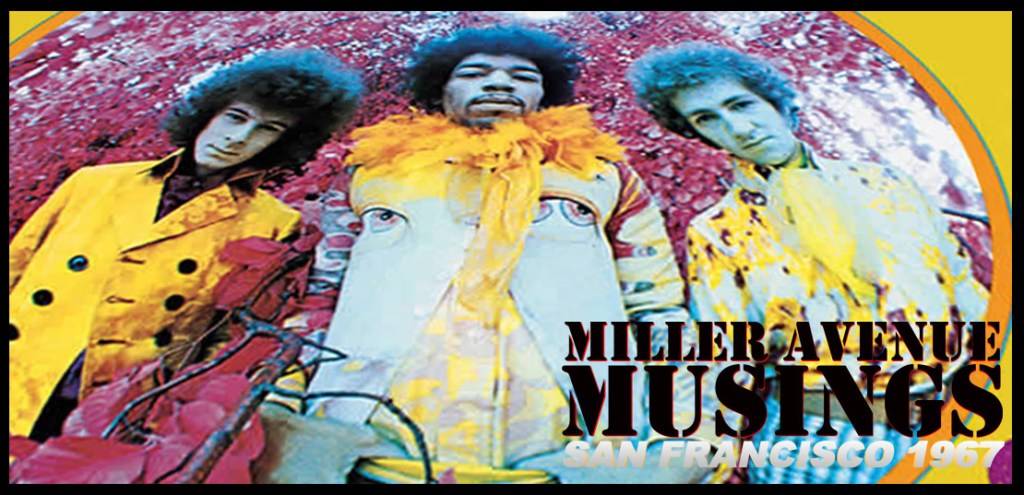
   There were still small slivers of light.  My old friend popular music continued to look after me.  The record player in my bedroom was constantly in use and I had a sizeable collection of LPs that I listened to.  Before I went crazy I had purchased the album Are You Experienced by the Jimi Hendrix Experience.  The Beatles record All You Need Is Love came into the Top 40 and I heard it on the radio but on my record player I listened to the Hendrix disc over and over.  

   The late Jimi Hendrix is mostly remembered for his electric guitar playing but as I listened over and over to that album I concentrated more on his words.  The subject matter in Hendrix’s lyrics dwelt on psychological problems, things I was beginning to experience.  One song was entitled Manic Depression and in it he described being unable to adapt to the world around him.  Manic depression was a concept I’d known nothing about.  I was, however, sliding into the grip of a severe manic depression.  So I immersed myself in the wailing music of the Jimi Hendrix Experience.   

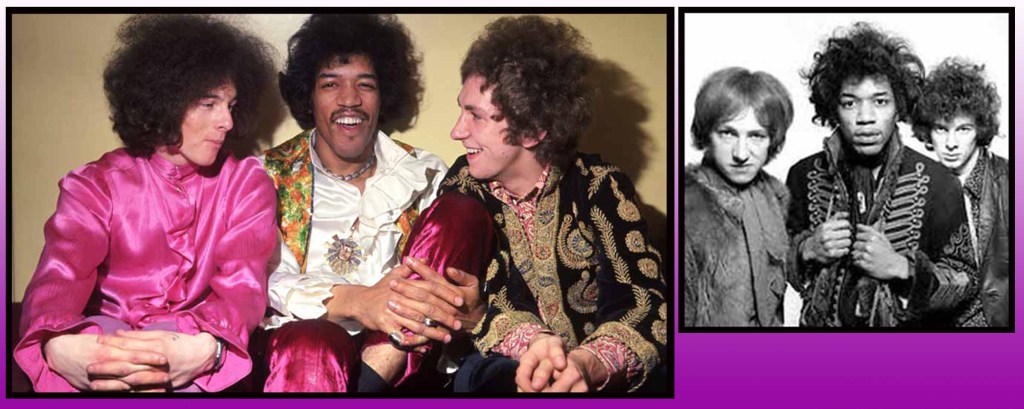
The Jimi Hendrix Experience featured bass player Noel Redding and drummer Mitch Mitchell.

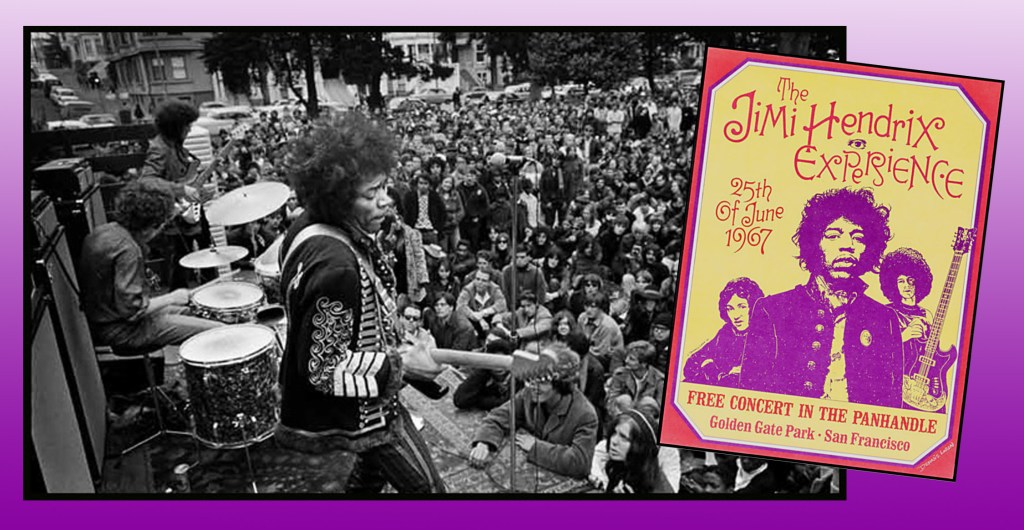
   When I first saw Hendrix’s trio play at the Fillmore and on a flat bed truck in the panhandle, his hit on the radio was Purple Haze.  Now when I listened, I heard his lyrics in a very different way.  Whatever the Purple Haze was, he didn’t seem happy that it was physically surrounding him and he plaintively cried “Help Me,” a few times during the song.  I didn’t wonder at the time if he too, had had a nervous breakdown but his lyrical disposition on that album’s material lead me to conclude that he had.  The song I Don’t Live Today articulated perfectly my mental condition in the months to come as the emotional distance between myself and the real world grew and grew.  

The image of the Jimi Hendrix Experience was carefully created and nurtured by their manager, ex-Animal, Chas Chandler.

     The world outside my bubble of depression continued to turn in spite of the fact that I knew nothing about it.  The Vietnam war was dividing the nation in a big way and President Johnson’s policy of bombing North Vietnam was losing him support within the Democratic Party.  After Johnson’s re-election as president in 1964, Bobby Kennedy resigned as his attorney general and became a critic of the Vietnam war.  I remember a good friend predicting that Bobby would make ending the war his cause as a pathway to the presidency.  Maybe that is what he would have done had he lived until the next election.  

   But for now Johnson was committed to bombing North Vietnam though, in the oval office, he seemed to be trapped between hawks and doves.  In early September he denied there was any division within his cabinet about war tactics.  The press was reporting that Defence Secretary Robert McNamara was in conflict with military chiefs who wanted him to escalate the bombing but at a hastily convened press conference Johnson denied this.  A reporter asked Johnson if McNamara had threatened to resign if the bombing was stepped up and the president described that as “absolutely” untrue.  “That is the most ridiculous report I have seen since I became president.”

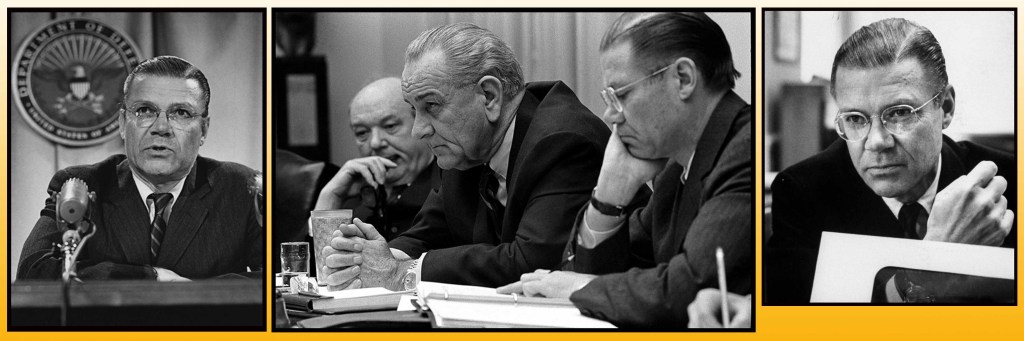
Three photos of President Johnson’s Secretary of Defense Robert McNamara. Pictured in the centre photo is Secretary of State Dean Rusk, Johnson and McNamara.

  But not all the criticism was coming from his own party.  George Romney, the Republican governor of Michigan became critical of the war.  Romney was positioning himself for the nomination to be the Republican presidential candidate in 1968 but he was not alone in that ambition.  Ronald Reagan, who had become governor of California also had his eye on this prize.  

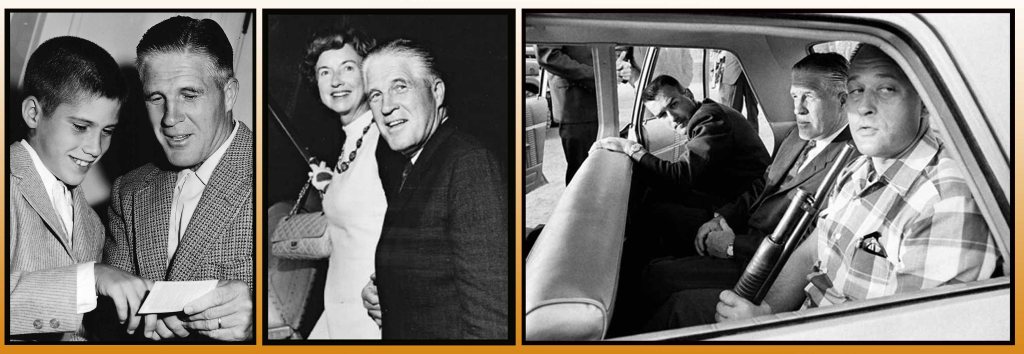
George Romney was the governor of Michigan who, along with Ronald Reagan, sought the Republican presidential nomination for 1968.

   In pursuit of the presidential nomination, Reagan stated that the U.S. should be prepared to use nuclear weapons in Vietnam, echoing opinions expressed by Barry Goldwater in 1964.  Such talk was popular with gung-ho supporters of the war.  As governor, Reagan was a passionate slasher of budgets and his recent cuts to the Medi-Cal program for the poor were ruled illegal by a superior court judge.  Blackie had met Reagan back when he was a Roosevelt liberal and judged him, at that time, to be a “phony.”  Of course Reagan had shed his liberal credentials in 1947 when the House Un-American Activities committee came to Hollywood.  He jumped on the anti-Communist bandwagon, testified to the committee and sang like a bird to the FBI naming many names.

   But that was 1947.  Twenty years later in 1967 and Reagan was now governor of California.  His rival Romney was out on the trail drumming up support for his own nomination and probably should have chosen a different venue for his outdoor breakfast than Watts, the area of Los Angeles which had seen serious race riots in 1965.  Two articulate young black men, Tom Jacquette and Lou Smith, grilled him relentlessly on several issues, one being his support for Ronald Reagan’s cuts to the Medicare programme.  The two young men put Romney squarely on the defensive.

Governor Romney with his son Mitt, his wife Lenore and sandwiched between two armed police officers as he visited the site of the Detroit riots in 1967.

   In early August, nineteen Tam High students from Marin City headed for Los Angeles to attend the second Watts Summer Festival held to commemorate the riots which had occurred there.  “The whole purpose of this trip,” said Lanny Berry, leader of the six-day trip, “Is to show the Negro kids how many constructive self-help programs have developed in Watts.  The festival is one of them.”

   Helping Berry organise the self-help trip was Douglas Quiett, also from Marin City, and now a group counsellor at Marin Juvenile Hall.  Quiett, had organised the picketing of two Mill Valley realtors for CORE in 1963 as they were not obeying the recently passed Rumford Fair Housing Act.  

   The forces of racial separation were not going to let the Rumford Act go unchallenged.  A group called Americans to Outlaw Forced Housing  initiated a petition to repeal the Rumford Act and the Marin County Real Estate Board decided to make the petitions available through their office.  Though their spokesperson denied that the board was endorsing or condemning the repeal initiative, their supply of the petitions was seen as an endorsement.  Enough white voters in Marin and other counties in California went to their real estate board offices to collect and sign the petitions which put Proposition 14 to repeal the Rumford Act on the ballot that November.  The proposition was then passed with a majority of over 1.5 million votes.

   The passage of Proposition 14 highlighted a deeply engrained racial bias in the white majority of the state of California.  The Los Angeles Times endorsed  it, saying that housing discrimination was a “basic property right.”

The fight to defeat Proposition 14 was ultimately unsuccessful.

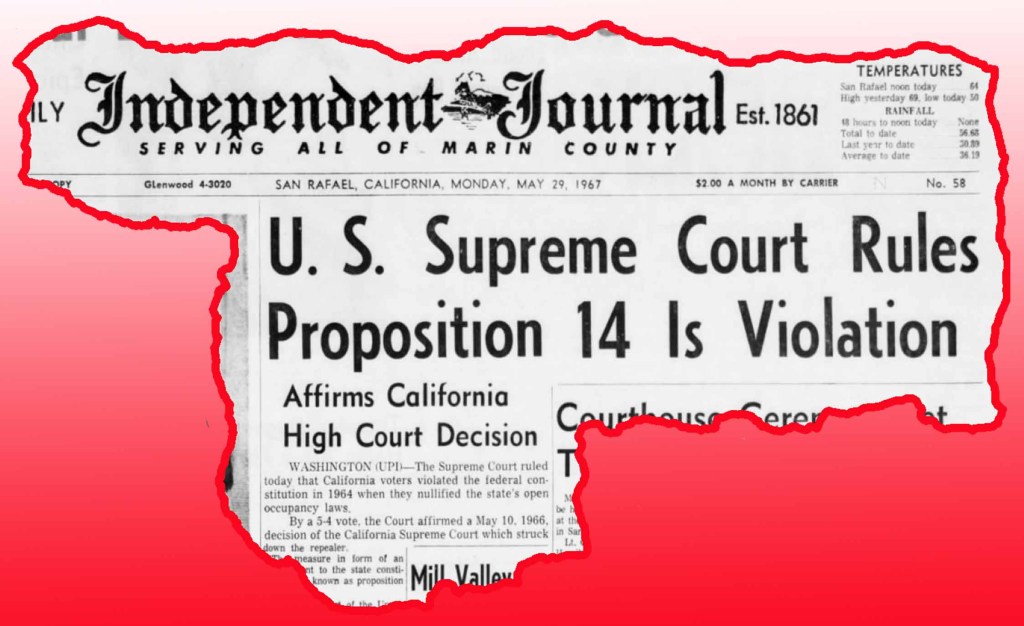
   However, Proposition 14’s passage into law hit two major obstacles.  First the California Supreme Court in May of 1966 overturned the measure and then the U.S. Supreme Court ruled in May of 1967 that California voters had violated the federal constitution in 1964 when they overturned the state’s open occupancy laws.

The Independent Journal’s headline announcing the U.S. Supreme Court’s decision that proposition 14 was a violation of the constitution.

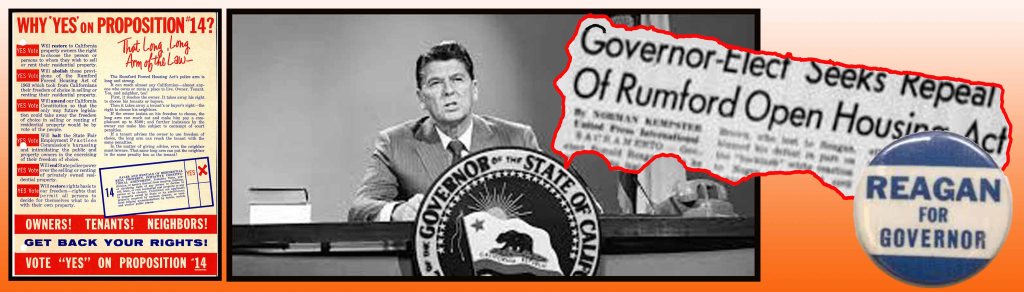
   Ronald Reagan, as part of his campaign for election as governor in 1966, had supported outright repeal of the Rumford Act.  In the light of the Supreme Court’s decision in Washington, he modified his approach.  Speaking to the California Real Estate Association at their conference he promised to work for repeal of the act or to change it to the point “where it was no longer discriminatory and oppressive.”  Reagan denied any racism on his part, saying that his objections to the act should not be taken “as endorsement of bigotry and prejudice or the practice of discrimination.”  However his words, objecting to the Rumford act, sent a coded message to white people all over the state who wanted to keep black people out of their whites only towns.

Ronald Reagan made his opposition to the Rumford Act a key part of his campaign to become Governor of California in 1966.

   Apart from the Collins family who lived high up on Summit Avenue, Mill Valley was just such a whites only town during my childhood there.  It wasn’t until I got to high school at Tam in 1961 that I encountered black students from Marin City.  The tough black guys congregated in the inner restaurant section of The Canteen, a building which stood across the street from the lower gate entrance to the back parking lot.  At recess, students who smoked all went through that lower gate to light their cigarettes off campus.  The white students stood around the front of the Canteen while the black students gathered inside the restaurant section.  This organic apartheid between tough white guys and their black counterparts meant they didn’t mix socially.    

   An appreciation of recent local history was not prevalent in Mill Valley at this time.  I had heard my parents say that Marin City came about as housing for ship builders during the war.  What I didn’t know was that prior to world war two there were no black people in Marin County at all and that many had come north from the deep south to work at Marinship during the war.  Once the war was over the employment vanished.  This migration probably explained why the kids from Marin City all spoke with southern accents.  

   On his first day as a freshman at Tam High, a good friend of mine from Mill Valley was attacked by a black male student in the boys’ locker room.  Thinking my friend had made rude remarks about him, the black fellow, who was bigger, punched him in the face repeatedly.

   During my sophomore year I shared a gym class with my good friend Jared Dreyfus.  At the end of class a black guy picked up Jared’s towel and walked to his locker.  Jared went over to him and said it was his towel.  The guy gave it to him and no more was thought of it.  When Jar and I left the locker room and came around the corner, there was this same black guy with two friends standing behind him.  “You called me a ni**er!” He shouted and threw a punch at Jar.  The punch landed on Jared’s arm as he raised the binder he was carrying to shield his face.  Jared shouted loudly: “I didn’t call you anything and I’m not going to hit you back!”  The guy made his accusation again and landed another punch followed by Jar repeating his shouted statement.  This went on for about four more punches.  Finally it stopped and the black student and his friends walked away.  

   The N word was highly emotive.  I recall one Sunday afternoon at the Sequoia when a group of about five black kids from Marin City attended for the movie that was on.  Sunday matinees at the Sequoia were never full and this group of black kids were pretty noisy so I could hear clearly what they were saying between bits of film.  They were using the N word a lot, calling each other by it.   But if a white person was to use that word there would be trouble.  Whenever there was racial tension at Tam High it usually started because someone had scrawled the N word on the inner wall of the Canteen.

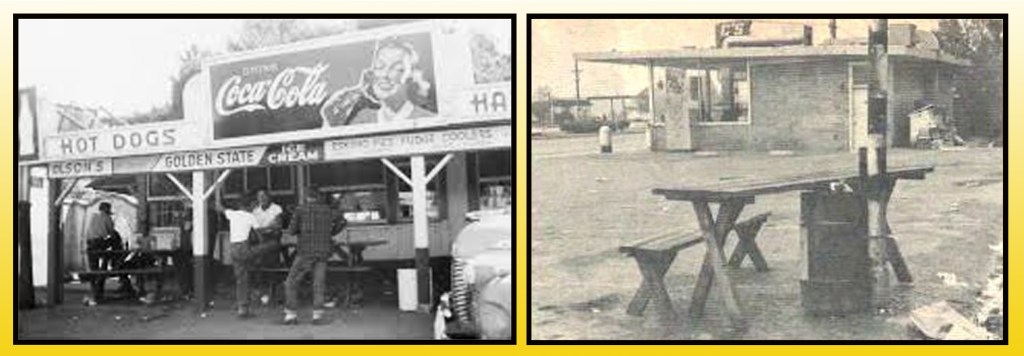
Two hangouts for tough students at Tam High. On the left is The Canteen and on the right is C’s Drive-In on Miller Avenue.

   C’s Drive-in, just up from Tam High on Miller Avenue, was where the tough white guys in Mill Valley hung out.  Most greasers drove their cars to C’s and when racial tension was in the air, the white tribe would gather at the drive-in.  If the fights occurred at school they were usually in the back parking lot near the Canteen.  And a fight would bring cop cars from all over the county with sirens wailing. 

   The N word was never uttered in the Myers household.  My mother Beth was a passionate anti-racist and would not tolerate such talk.  She had been to the deep south as a journalist and had actually witnessed lynchings of black people so she had no illusions about where the attitudes of racism could lead.  

   We always knew about the Collins family being the only black people in Mill Valley but, though Chuck Collins and I were the same age, I didn’t actually become friends with him until late in my time at Tam High.  Chuck didn’t speak with a southern accent like the kids from Marin City.  His dialect was the same as all the others in Mill Valley.  He had gone to Old Mill School at the same time that I went to Homestead.  When I finally did get to know Chuck, we had a conversation in which he told me just how painful it was to hear a white person use the N word.  I have never forgotten that conversation.  Also lodged in my memory is the Lenny Bruce routine he performed in a nightclub in which he used not only the N word but every offensive epithet to describe Jews, Italians, Puerto Ricans and any other minority group.  The point he was making was that if you took the poison out of the word you were left with just a word.  However what Chuck had said has kept me from ever using the N word.  

   But here I was listening over and over to the music of Jimi Hendrix.  I was looking for guidance in the words he sang: asking if I was experienced and somehow it seemed like a challenge.  I took his words about “coming across to him” as a dare to go to England.  I looked for guidance and somehow found it in the lyrics of Jimi Hendrix.

   But to get the money to travel to England I would have to go back to work on the waterfront and that meant getting myself into shape psychologically.  I had moved into a new phase of my craziness in which it became necessary to disguise my inner thoughts.  Blackie would have to be satisfied that I wasn’t crazy anymore and that wouldn’t be easy.

To be continued…

Amazon USA
https://www.amazon.com/dp/B085QN73VQ

Amazon UK
https://www.amazon.co.uk/dp/B085QN73VQ

A Descent Into Darkness

Previously in Miller Avenue Musings:  After spending several weeks as a day patient at a San Francisco clinic, I finally started coming down from the drug which drove me crazy.  Coco Cutler, a family friend with an interest in psychoanalysis, befriended me.

Unlike my parents, Coco could relate to the state of mind I was in.    She leant a sympathetic ear to me and it was a huge help.  I soon became a regular visitor to her apartment on top of Telegraph Hill.  I learned that she was plugged into the scene that Blackie’s friend Lew Welch was a part of.  Allen Ginsberg, Lawrence Ferlinghetti and Alan Watts were among her acquaintences.  But she was nothing like a beatnik at all.  Prim, proper, elegantly spoken and with a physical beauty which benefited from growing old gracefully.  

   Coco was, like all my parents’ friends, a person of the political left and had been married to another of my family’s acquaintances, Al Richmond, who wrote for the People’s World newspaper.  I never knew exactly what office job Coco did, but many times I saw her wearily climbing Telegraph Hill after a day’s work.

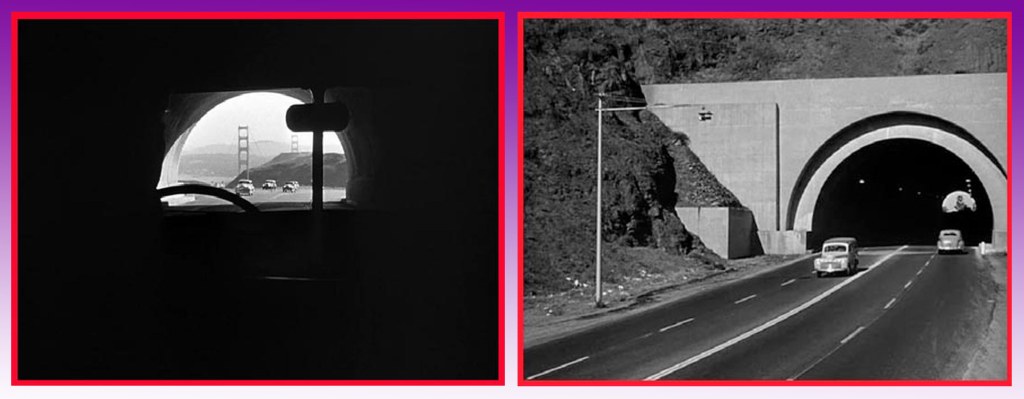
   Sometime in 1966 I discovered a small movie theatre in North Beach which showed a lot of old Humphrey Bogart pictures which   I had a particular fascination for.  I saw Casablanca, To Have And Have Not, Beat The Devil and a movie which completely entranced me because the opening scenes featured Marin County locations.  I’ve always found the joy of recognition to be a powerful emotion and the film Dark Passage began with an escape from San Quentin prison.  We saw the fingers of the escapee gripping the rim of a barrel he was inside of, on the back of a flat bed truck.  He made it rock back and forth as the truck drove away from the prison and the sound of police sirens began to wail in the distance.  The barrel then tumbled off the truck and rolled down a steep hill.  The escapee soon found beautiful Lauren Bacall who hid him in the back of her woodie vehicle.  Seeing the hills of Marin behind all this action was terribly exciting to me and soon Lauren Bacall’s woodie was going through the tunnel on Waldo Grade.  All the cars were from 1946.  She crossed the Golden Gate bridge, ending up at her apartment on Telegraph Hill.  At some time during a visit to Coco’s flat I must have mentioned this film and it transpired that she had seen them shoot a scene right outside her apartment.

When this film was shot there was only one two-way tunnel on Waldo Grade.

Ms Bacall’s woodie crosses the Golden Gate Bridge. We then see her apartment on Telegraph Hill.

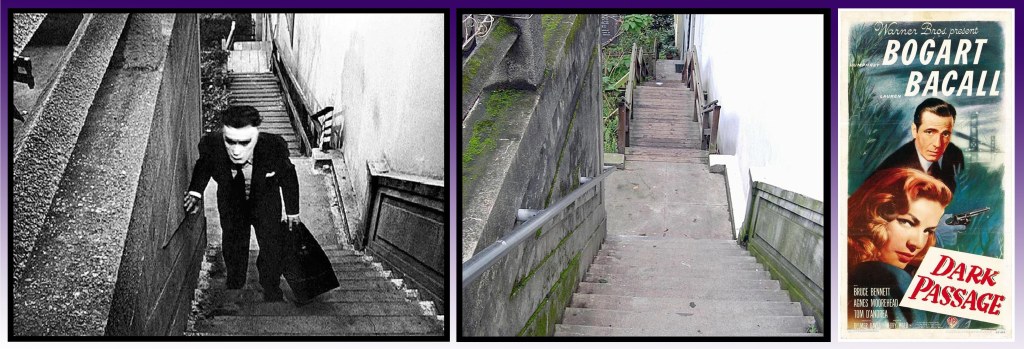
   The neat trick that Dark Passage pulled off was that we never saw Bogart’s face until he wound up having plastic surgery.  With a big bandage covering his face, he staggered up the steps at Filbert Street to Bacall’s apartment on Telegraph Hill.  This was the scene that Coco had witnessed the filming of.  She told me she felt very sorry for Bogart who had to repeat the climb many times as they shot take after take.  

On the left we see Bogart climbing the steps in 1946 and the same steps today.

   Dark Passage was an intricately plotted thriller which combined good writing with excellent acting.  Directed by Delmer Daves, it fell into a category that French film critics would, after World War 2, christen film noir.  This phrase described Hollywood films which were absorbed by darkness and pessimism.

   Darkness and pessimism were two realities that I was slowly descending into.  I had been incarcerated in Napa State Hospital from the middle of July until the first week of August when my father got me discharged because of a suicidal inmate who took against me.  All the time I was there and for many weeks after, I was in my own universe with practically no interest in or knowledge of what was going on out in the real world.  When I got back to my parents’ apartment, I didn’t read the Chronicle or watch the news.  I listened to pop music on the radio but that was the limit of my intake.

   By August the race riots across the country had simmered down and President Johnson established a senate judiciary committee to investigate the causes.  Michigan governor George Romney who, at the outbreak of the riots in Detroit, had asked Johnson to send federal troops to the city, now criticised the president for playing politics with the issue.  Romney, though a Republican with an eye on the presidential nomination of 1968, also came out against the Vietnam war.

   The summer of love was thought to be all flower children and peace.  However a pair of gruesome murders occurred which contradicted that image.  They involved both the Haight Ashbury community and Marin County.  The dead body of known drug dealer, Willam E. Thomas, referred to in the Haight as Superspade, was found trussed up in a khaki sleeping bag on a steep cliff near the Point Reyes Coast Guard station.  He had been stabbed in the chest and shot through the head.

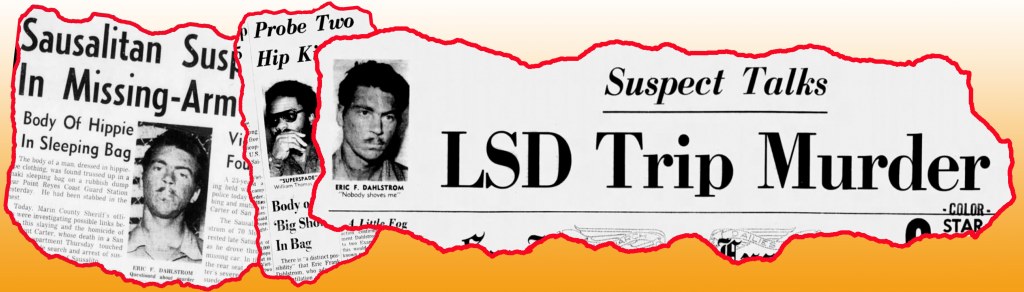
   Five days earlier the dead body of Haight drug dealer John Kent Carter, was discovered in his San Francisco apartment.  He was found  lying on a mattress with a dozen stab wounds and his right arm severed and missing.  San Francisco police issued an all points bulletin for the arrest of Eric Frank Dahlstrom, 23, of Sausalito.  Dahlstrom was well known as a motorcycle racer at tracks like Cotati and Vacaville.  He had a reputation for  superb skill and reckless behaviour.  Officers in Sausalito immediately checked his parents’ house on Monte Mar Drive and found Dahlstrom’s car in the garage with its licence plates missing.  It was nearly 11 pm on a Saturday night when the Sausalito police added Dahlstrom’s plate numbers to the APB for his arrest.  Twenty minutes later on a street in Sebastopol, patrolman Charles Baker spotted a car with those same plates.  He turned his red light on and pulled the car over.  Knowing the APB was for a murder, the officer approached the vehicle with his gun drawn.  Dahlstrom, however, surrendered without resistance.  In the back seat of the vehicle officers found, wrapped in blue suede, the severed forearm of John Kent Carter.

   Eric Dahlstrom was not shy about telling the story of Carter’s murder to assembled reporters at San Francisco police HQ.  He said that he had killed Carter while under the influence of LSD and that he had considered dismembering the body.  According to Helix, a Seattle underground newspaper, Dahlstrom was undergoing an “Olympics-calibre bummer caused, he believed, by inferior-quality acid” which Carter had sold him.  Offended, he went to Carter’s to discuss it.  During the discussion, Dahlstrom said, Carter shoved him.  “I got shoved,” he told reporters.  “Don’t nobody shove me.”  The Helix account continued: “Dahlstrom grabbed up a 12-inch kitchen knife and stabbed him rapidly 12 times, most of them fatally.  He undertook to dismember the body , but gave it up after neatly amputating the right arm above the elbow.  He wrapped the arm in blue suede and split with it, taking also a .38 pistol, $3,000 Carter had assembled to give to an acid wholesaler called Superspade.”

   At first it seemed that there might be a connection between the murder of Superspade and John Kent Carter but as time passed, investigators concluded that they were separate incidents.  Earlier that week Dahlstrom had been to Slide Ranch where he kept a motorcycle.  His behaviour was strange and he was asked to leave because he was “acting goofy.”

These murders inspired sensational headlines in the press.

   This story, which was covered extensively by all the bay area newspapers, passed me by completely.  Weekdays I spent at the clinic run by Dr. Weinberg which had a calming effect on me.  I attended my sessions at the clinic for four or five weeks and when that time was up, the darkness began to claim my soul.  My spirits had been fairly up beat until that time.  Coco’s friendship became very important to me during this time.

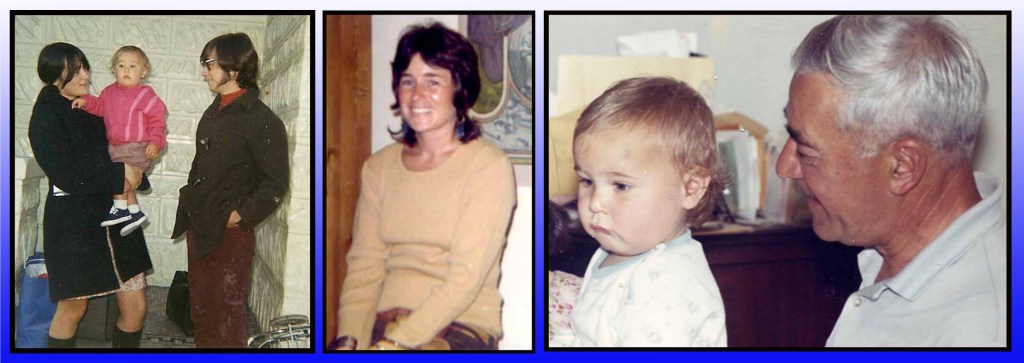
On the left is Dr Art Weinberg who ran the day clinic I attended. In the centre and right are two pictures of Coco Cutler in 1943 and 2002.

   Somewhere in the midst of all this, my sister Nell visited from London with her one year old son Michael who we all called ‘Poggy.’  He was a beautiful child and having him there took me out of myself which must have aided my recovery.  Nellie looked terrific and had taken to the role of young mother with gusto.  Nellie’s new motherhood forged a strong link with sister Kate who was so excited about young Michael/Pog.  During the few weeks they were with us, Poggy began to walk, a process which started as a balancing act between his two feet.  From my bedroom I would hear a single thump in the hall.  Then after a pause a second thump.  After a third thump I’d hear a series of them up to my bedroom door which he’d then push open.

   Young Poggy was also forming his first words.  While out walking with them one day, we found ourselves at the bottom of Russian Hill where Union meets Columbus.  The sight of a dog across the street in Washington Square caused Poggy to point and make a breathy sound similar to the noise we made as children to simulate gun fire.  It sounded like deoggggh.  It bore a striking resemblance to the word dog.  It was a very exciting moment.

On the left: Nellie, Pog and myself; My sister Katie; Poggy with my father Blackie.

   It was also exciting for me to see how animated my sister Katie was in becoming an auntie to little Pog.  Both my sisters had gone to university and dropped out after their second year.  Nell had gone to San Francisco State and Katie to University of California at Berkeley.

   My two sisters were very different people and until Nellie arrived for her visit it was Katie who had been such a good friend to me.  Practically every excursion I took in the city after I left Napa was in her company and she looked after me.

   When we were kids it was always Katie who was the peacemaker of the family.  Nellie and I were the temperamental two and brother Jim was kind of neutral.  Katie always looked on the bright side of any problem and usually found a happy solution.  

   Politics played a big role in all our lives.  The society we were growing up in was gripped by the anti-red hysteria of the McCarthy era.  Even being politically liberal was seen by the federal government as highly suspicious and my parents and all their close friends were far left of liberal.  So we were aware of a difference to most of the kids we went to school with.  Of the four of us only Nellie seemed to gravitate towards active political participation.  I was interested but seeing how the federal government operated scared me.  Family friends Fred Field, Alvah Bessie, and Vin Hallinan all did time in federal prison and I always worried that the same fate could take Blackie and Beth away from us.  The execution of the Rosenbergs in 1953 sent a shiver through people of the left and I found it terrifying.

   So the politics of the day affected each of us four Myers kids.  Jim wound up rebelling against my parents’ values by joining the army.  Once he was on the inside and realised what he’d done, he got himself involved in the stenography corps and never went to Vietnam.

Three photos of my brother Jim. On the left with myself and good friend Augie Belden. In the centre with our cat Totem and on the right a shot, later in life, with sister Kate and myself.

   Having Nellie around made me contemplate a trip to England.  All my travelling had been in the other direction, across the Pacific when in actual fact I had always longed to visit London.  Blackie said that when I was well enough I could go back to work on the waterfront, so a little bit of structure entered my life.  The idea of working on the front and saving enough to make a trip to England gave me a goal.

   When I was in high school, Nellie was sharing an apartment on Greenwich Street with like minded socialists who were politically active.  The two main issues they were most concerned about was racism and the war in Vietnam.  I remember going with Nellie to a demo at the Masonic Auditorium on California Street where an openly racist organisation was holding a conference.  It was night time and demonstrators were lying down in front of the vehicle exit to try and stop the people leaving in their cars.  I don’t recall exactly what played out.  I think an arrest was made but after some negotiation the demonstrators agreed to let the racists drive their cars out of the underground car park without fanfare.

   Nellie saw a lot of the Hallinan boys during this time and was involved in many demonstrations.  There were sit-ins at car showrooms on Van Ness, the Sheraton-Palace Hotel, Lucky Supermarkets and famously at Mel’s Drive-In on Geary.  Nellie got herself arrested on a few occasions.  Ringo and Dynamite Hallinan were often at the apartment on Greenwich Street.  

   Though Nellie and Katie had similar experiences with their time at university, Nellie gravitated towards politics and Katie, when she decided to drop out of Cal Berkeley, went to work in a bank in the financial district.  I remember that, in addition to renting an apartment with her boyfriend Lonnie, Katie actually got herself a credit card which was quite a first for someone from the Myers family.  Blackie had always been highly suspicious of the concept of credit, but I remember Katie being so matter-of-fact about the credit card and don’t recall any fuss about this with Blackie and Beth.  Katie was always highly responsible with both of them and they appreciated it.  It was just a decision on her part to improve the quality of her life.

   Nellie did, after she dropped out of SF State, go to work for a shipping company run by the Kiskaddens who were good friends of my parents.  When she eventually went east to visit family friends in and around New York, it was on one of Kiskadden’s Norwegian ships, The Torvanger, on which she made the final voyage to London.  This would be the very same ship that I went to sea on after I graduated from Tam High.  

  In London Nellie quickly found herself involved in left wing politics and met, fell in love with, and married Trevor Hyett. Trevor was the father of Michael/Pog who was visiting us in San Francisco.

   So these happy events occurred at the same time that I was beginning my descent into the deepest depression of my young life.

To be continued…

Amazon USA
https://www.amazon.com/dp/B085QN73VQ

Amazon UK
https://www.amazon.co.uk/dp/B085QN73VQ

Coming Down At Last

Previously in Miller Avenue Musings: while incarcerated in Napa, I saw my gay friend in the corridor with his arm in a sling and a bandaged wrist.  I asked what had happened and he began screaming at me, calling me a freak and telling me to stay away from him.

I wasn’t aware of my father Blackie’s presence at the hospital at all, but apparently he was there that day for, within the hour, I was discharged into his care.  I guess it was the fact that my friend attempted suicide, then turned on me in such a melodramatic fashion, which gave him concern for my safety.  

Black was instructed that I must be accompanied at all times and take my medication daily.  I was also not to smoke any weed or take any recreational drugs.  Things  moved quickly.  I gathered what few items I had with me and soon Blackie and I were checking out of Napa and cruising down the highway towards Marin and San Francisco.  

   Before long we were at 929 Union Street in San Francisco.  It had been about three weeks since my hospitalisation and the place was no different.  My bedroom was exactly as I’d left it.  Jar Dreyfus rang up and I took the phone in my room.  He wanted to know every detail of my adventure so I started at the beginning and told him about staying up all night talking with Wes Wilson, then being picked up by the Highway Patrol out on 101 the next morning.  I was delivering the facts in a straightforward manner, but Jared, from the beginning, began laughing heartily.  As I told him each new detail, his laughter became more raucous.  Why he should find my story so funny was a mystery to me, but being a natural performer, I found myself playing up to it: “Yeah but wait’ll you hear what happened next!”  I’m pretty sure that I gave him a full account of the past three weeks and he howled his way through all of it.  The phone call certainly lasted at least half an hour and Jared was still chortling as we wrapped things up.

   A few days later I was visited by Jan Kaufmann which was nice but I was still babbling about John Lennon and seeing her as somehow attached to me which hadn’t been the case since the summer of 1965.  She humoured me and it was a nice visit.

   I didn’t make many excursions out into San Francisco but those I can recall were with my sister Katie and her partner Lonnie.  I think my parents made a decision to fatten me up as I’d become awfully thin during my three weeks in Napa.  The fruit bowls in the kitchen were full of ripe bananas, nectarines and apples.  I was still convinced that I was the messiah but that delusion softened and became less urgent.  Also I simply kept it to myself.   

Three photos of me after my Napa incarceration. On the left, in front of SF City Hall, up on the roof at 929 Union Street and somewhere else in the city.

   I was still totally ignorant of what was happening in the wider world, knowing nothing of events in the news, domestic and from Vietnam.  In mid-August President Johnson made a statement about bombing raids near the Chinese border in Vietnam.  He said that the Peking government knows that the United States does not seek to widen the war in Vietnam.  “These air strikes are not intended as any threat to Communist China and they do not in fact pose any threat to that country.”  At the same time he stated that the Viet Cong now appears less anxious to engage American forces in ground combat.  Assessing the Vietnam situation at a White House news conference, Johnson said there had been a lull in both air and ground activity but added that this didn’t indicate any change in U.S. policy.  “So far as this government is concerned, our policy has not changed,” Johnson said.  “We are there to deter aggression.”

Two shots of LBJ leaving the White House and one of him towering over whoever he was telling a joke to.

   On the same day, as Johnson spoke in the White House, Dr. Martin Luther King addressed the Southern Christian Leadership Conference in Atlanta, Georgia, stating that he would not support President Johnson for re-election in 1968 unless he changed his Vietnam policy.  As a long time supporter of Johnson’s civil rights programmes, the statement marked a turning point for the veteran civil rights campaigner and Nobel Peace Prize winner.  He had never endorsed a political candidate before and gave no indication of which one he might back in 1968.

Martin Luther King and colleagues in conference with President Johnson at the White House.

   After a few weeks my parents found a day clinic through their Kaiser health plan.  I was with Blackie the day we visited the clinic where I would spend the next month or so as a day patient.  It was on an upper floor of a big building a few blocks from the Fillmore Auditorium, on the north side of Geary.  Dr. Weinberg was in charge of the clinic.  He was a short man like myself and very dynamic.  He had a crew cut and his eyes were engaging.  He had a physical resemblance to my school friend Tommy Harper.  He wore a long sleeved white shirt with a black tie and his sleeves were rolled up.  I liked him immediately.  He was straight talking and the first thing he told me was that he understood that I had been behaving in a crazy manner and had enough medication running through me to knock an ordinary person out cold.

   “The bad news, John,” he said, “Is that you won’t be able to smoke dope anymore.  But the good news is that this experience is going to make you 4F.”  4F was unfit for military service.  He also told me he was involved in the ‘Recall Reagan Committee,’ which meant that he was of the political left.  Dr. Weinberg showed me around the clinic which occupied an entire floor.  After the tour he said I should be there at 9am the following morning.

   By this time, the need for a chaperone seemed to dissolve as I don’t recall anyone accompanying me to the clinic.  I took the same buses there as I would to the Fillmore Auditorium.  I’d catch a 41 Union outside our apartment to Steiner Street, then transfer to the 22 Fillmore.

The Munis were my way of getting to and from the Day Clinic.

   When I first returned to the Union Street apartment, I was able to listen to KFRC again and catch up on the songs I’d missed while in Napa.  Light My Fire by The Doors was number one and the Beatles had a new single in the charts, All You Need is Love. Frankie Valli of the Four Seasons sang Can’t Take My Eyes Off You  and Diana Ross and The Supremes were in there with Reflections.  Ever since I was a little boy popular music had been a good friend to me and in this turbulent time of my life, it continued to be.  

   A record I particularly liked was The Letter by a group called The Box Tops who I never heard of again.  The song however was recorded later by Joe Cocker and others.  I liked the lyrics for its inventive use of air and train travel in an original way.

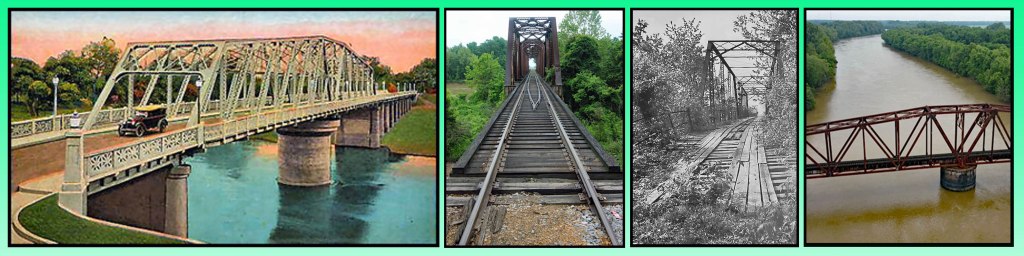
   But of all the records in the Top 40 as August became September, the one song which captured my soul and became the soundtrack to this phase of my long road to recovery was Ode to Billie Joe by Bobbie Gentry.  This record had a haunting quality with its simple musical landscape and enigmatic lyrics.  It evoked a world and way of life which was entirely alien to me.  The song spoke of a dusty Delta day with names like Choctaw Ridge and the Tallahatchie Bridge, providing a vision of caucasian farming life in the cotton fields of Mississippi.  The story mixed everyday chit-chat across a dinner table with news of a profound tragedy when Billie Joe McAllister jumped off the Tallahatchie Bridge.  I connected with this record on so many levels, as it seemed to embody the precarious psychological territory I was now entering.  I was not yet depressed but still exhilarated by my psychedelic experience.  Depression would come later and it would be powerful indeed.  Somehow this record predicted that reality.  I never owned a copy of Ode to Billie Joe, I only ever heard it on the radio but it would run through my head every day as I made my way to the clinic.

Bobbie Gentry performing and the central shot is her standing on the Tallahatchie Bridge in Mississippi.

The Tallahatchie Bridge which crosses the Yazoo River at different stages of its existence.

   On my first day I met the other patients, about twenty of them, both young men and women.  There were several doctors on hand and often small groups would convene in one of the many rooms.  One fellow I became friendly with was very preoccupied with guns.  At least talking about guns and acting out the use of them.  He would constantly describe how he would set up a particular brand of machine gun to mow down imaginary people.  He acted this scenario out many times and was quite specific when describing his weaponry, knowing brand names and other details.  I got the impression he was being funny, as he said all this with a wry smile.  But it was always the same joke.  Only the brand of machine gun occasionally changed.

   There was a very thin delicate young woman who was super sensitive and could cry at the drop of a pin.  Another patient was a tallish heavy set man who dressed in smart tweed sports jackets.   He also had extremely long coal black hair and was in the process of transitioning to become a woman.  One problem with this was that he had a very dark beard under his skin which he shaved close every day but his lower face was almost blue from the whiskers under the surface.  This did make the prospect of being convincing as a woman somewhat questionable.  He was having electrolysis sessions to remove his beard.

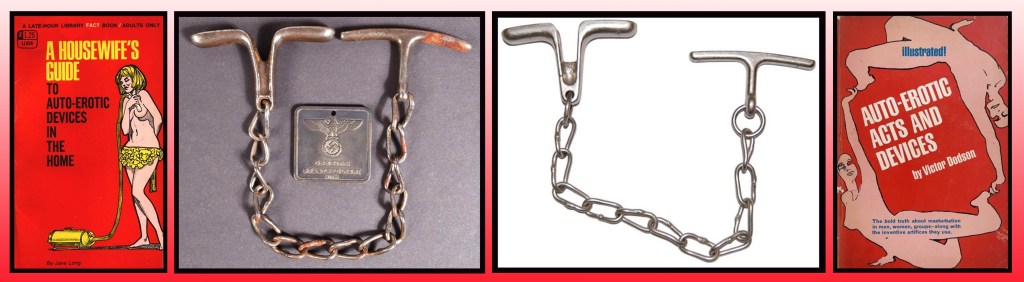
   There was a tall man who seemed a bit older than most of the patients, possibly in his thirties.  He had a copy of a paperback book about auto-erotics.  Auto-erotic was not  a phrase I had ever encountered before.  It was, I soon learned, a fancy way of saying masturbation.  I asked this guy about it and he immediately became aggressive.  He asked if I would like to participate in one of his sexual sessions.  When I declined his invitation he snarled at me to mind my own business.  He had more than a whiff of the Tenderloin district about him and after this encounter, I regarded him with caution.  

   Once a week Dr. Weinberg would chair a meeting of all the patients in which any topics could be discussed.  On the day of the meeting the auto-erotic guy brought a set of German handcuffs with him.  He was showing them around to people and the super sensitive young woman asked about them.  “Would you like to try them on?” he asked.  She said yes.  The cuffs were two interlocking metal pieces connected by a chain.  You would put the chain around the wrists, fit one metal piece into the other then twist the chain.  All eyes were on him as he put the cuffs around the girl’s very thin wrists.  All  went well until he twisted the chain and she screamed in agony, bursting into tears.  Dr. Weinberg was immediately on his feet.  He demanded that the guy leave the clinic at once and never come back or he’d call the police.  Mr. Tenderloin scurried away taking his German handcuffs with him.  He was never to be seen again.

Left and right two paperback books about auto-eroticism. The central pictures show German handcuffs. The ones on the left are from the Nazi era.

   Political correctness was a concept which had not yet been conceived in 1967, but Dr. Weinberg was definitely not politically correct.  He would always use the word ‘crazy’ rather than lofty psychiatric descriptions of psychological problems.  At another one of our meetings, the man transitioning to be a woman asked if he could wear a dress to the next meeting.  Dr. Weinberg said no.  The trans man asked why and he answered: “Because you make one hell of an ugly woman.”

   My days at the clinic continued to be interesting.  Because depression hadn’t yet gripped my soul, I was a fairly upbeat patient.  My friend with the gun fetish continued to act out his massacres which I confess I actually found very funny.  He would mime the assembling of the weaponry in great detail and once the imaginary machine gun was loaded, he would then give a totally committed performance of blasting whoever the recipient was to smithereens with visual flourishes and audibly interesting sound effects.   The trans man continued to complain about not being able to wear a dress to meetings and on journeys home from the clinic, Ode To Billie Joe was invariably running through my head.  

   Gradually I was coming down from my long drawn out high.  I was still convinced of my messianic mission but not so stridently.  At my parents’ flat, things were a little constrained as both Blackie and Beth were worried that I’d get involved in pot smoking again.  Blackie told me that after my incarceration, he’d been visited by two narcotics agents who had been tracking the drug that I took.  At the time I didn’t believe him as I thought he was just trying to scare me, but after reading Matthew Baggott’s article on STP, I am now more inclined to think Blackie was telling me the truth.  The STP piece informed me about narcotics agents tracing the drug’s route through the Haight Ashbury district.  

   As I started my descent from the giddy heights of early in the summer, depression slowly began to creep up on me.  My confidence, which had been so strong throughout the entire adventure, also began deserting me.  

   During this time, my father took to referring to young people who engaged in drug taking of any kind (so most of my friends) as “sick.”  If ever I said anything weird to him he’d quickly retort: “Johnny stop that.  You’re talking like those sick guys.”

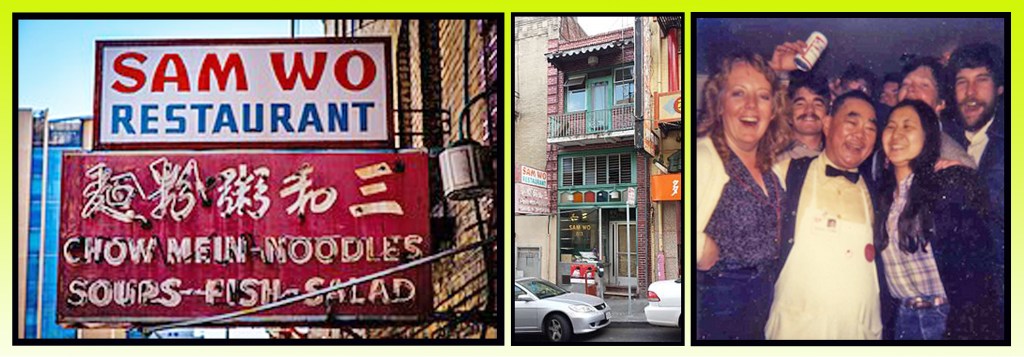
   At some point my parents’ friend Coco Cutler invited me to have dinner in Chinatown with her.  She took me to a restaurant on Washington Street called Sam Wo.  We walked through the slightly grubby kitchen on the ground floor and climbed the steps to the second floor.  Coco clearly knew this place well and it later became a favourite with all my family, but this was my first visit.  The waiter, recognising Coco, pointed to a table and shouted, rather rudely, “You sit there!”  He was Edsel Ford Fung and his rudeness was a bit of showmanship which clearly was as popular as the delicious noodle dishes they served.  They had a dumb waiter to send the dishes upstairs.  I had beef chow mein and we drank lots of tea.  Edsel Ford Fung gave us chopsticks with our meal, which I had never used before.  Coco taught me how to eat with them which was life-changing in itself.   

Sam Wo, the famous Chinese restaurant on Washington Street. On the right is Edsel Ford Fung at his retirement party.

   Coco was well aware of what I was going through.  Poor Blackie and Beth didn’t have a clue how to deal with me but Coco did and I found her easy to talk to.  She lived in a beautiful apartment at the top of Telegraph Hill with a stunning view of the Bay Bridge.  Unlike my parents she was interested in and knew a lot about psychoanalysis and, as I was moving into a phase of losing my ability to converse, she was a good person to be talking to.

To be continued…

Amazon USA
https://www.amazon.com/dp/B085QN73VQ

Amazon UK
https://www.amazon.co.uk/dp/B085QN73VQ

The Summer America Burned

Previously in Miller Avenue Musings: While incarcerated in Napa State Hospital in the summer of 1967, I tried a door which wasn’t locked and wandered away, getting on a bus which took me through the countryside.

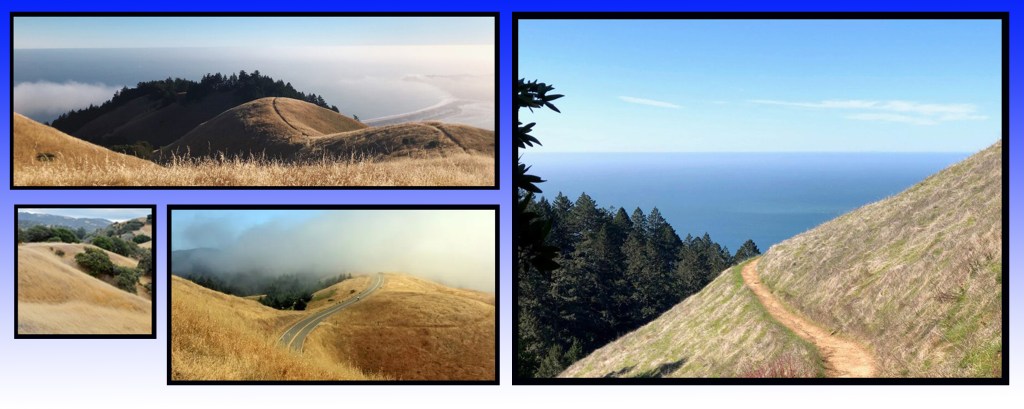
In the summer months, Northern California is peppered with golden hills covered in long grass, bleached white by the sun.  We passed many such hills as I sat in the back of the bus watching the scenery go by.  Eventually we came to a small town, the name of which I cannot remember.  The bus driver pulled up in front of a depot and announced that it was the end of the line so I got off and had a wander around.  It was a beautiful summer’s day and the town was very pretty indeed.  Finding a bench, I sat down and watched the world go by.  I wasn’t aware of days of the week at this time but I’d guess it was a weekday as people were going about their business, shopping, delivering and all the various activities you would see in a small town.  There was a grocery store, a book shop, a cafe as well as a bank, sturdily enclosed in a solid brick building.  

   Before long I became aware of a man in a suit and tie standing near the bench I was sitting on.  He seemed to be checking a piece of paper then looking up towards me.  He then spoke.  He asked if my name was John Myers, and I answered yes.  He was a police officer and it was his assignment to find me and return me to the hospital.  He sat down and explained that a car would be coming for us pretty soon.  He was a really nice guy and we talked about his job as a cop.  Though I had some very delusional ideas, my natural ability to communicate in a conversational manner had not deserted me.  This fellow told me about his caseload which he simply couldn’t get under control because as soon as he started to make headway with one thing, another demand on his time would interfere.  As a result he had a constant treadmill of unfinished business.

   We sat on the bench talking for about twenty minutes until the car arrived to take me back.  Our conversation continued on the ride back to the hospital where he delivered me to my ward, said his goodbyes and was gone.  The man in charge of the ward was normally a very friendly fellow but on this occasion he was extremely angry with me for wandering off.  To be honest it wasn’t even something I had meant to do.  He grabbed my upper arm and dug his thumbnail into my flesh as he demanded that I promise not to do it again.  Though his grip was painful I ignored the pain and didn’t react to it.  I simply smiled at him until he let go.  I then promised not to wander off again, which, in turn, made him smile.

   In my ward there were only men.  The hospital clearly had a separate accommodation for women.  I don’t recall any of the patients who I didn’t get on with.  There was the older fellow who slept in the next bed to me as well as a slightly camp gay guy who was a bit of a hippie.  We talked about dope a lot and he had a good sense of humour as I recall.  It’s a bit ironic that I should have accidentally escaped because I really didn’t mind being there at all.

   One day my sister Katie visited with her boyfriend (soon to be husband) Lonnie.  My father Blackie was with them and we had a good visit though Katie remembers me as heavily sedated.  She also said that my medication caused me to have moments of losing muscular and verbal control.  We’d be walking about the place, talking, and my words would suddenly become garbled.  At the same time my arm and leg would go slack and I’d drag myself along for a bit.  Then I’d regain control until it happened again.  Apparently it happened several times during their visit.

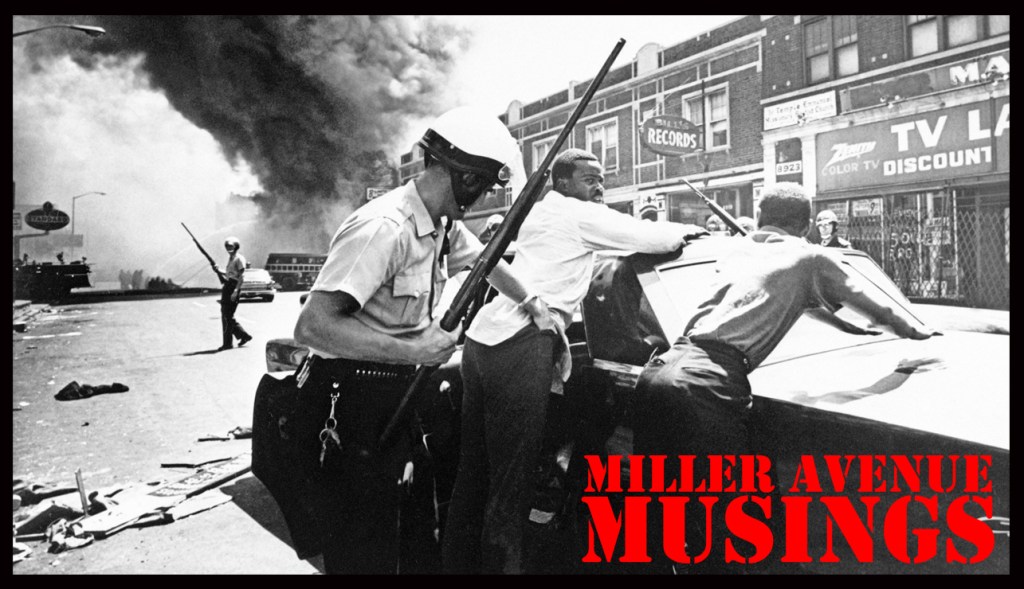
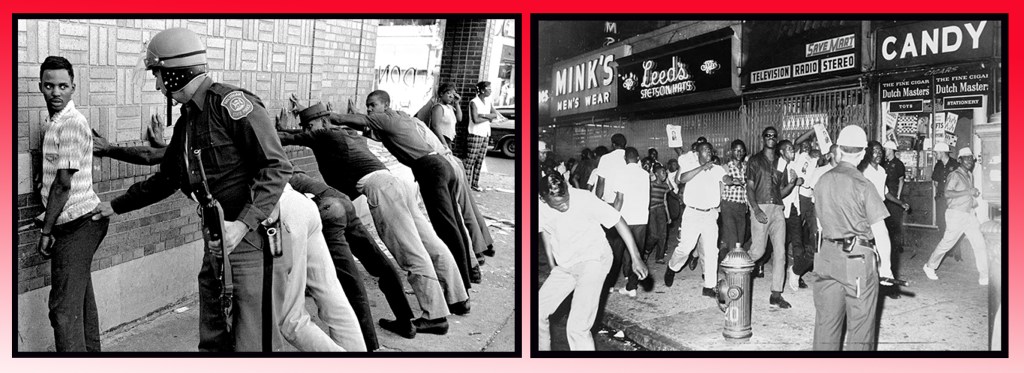
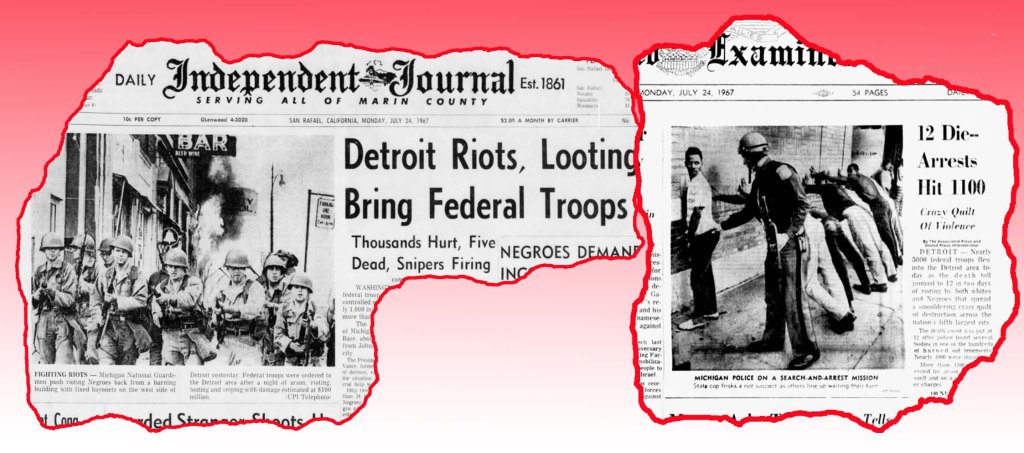
   While I was leading a confined existence inside Napa State Hospital, the news, national and international, was very traumatic.  The rioting which had exploded in New Jersey sparked further conflict in other places like Minneapolis, Harlem, and Youngstown, Ohio.  The next city to explode on the scale of Newark was Detroit, Michigan.  Rioting broke out after the police raided an after-hours drinking club and the word spread that officers had handcuffed a black teenager then kicked him down some stairs.  This was the spark that lit the fuse and set the black community rioting, but as it spread, white people joined in.  While fires raged and looting escalated, Governor George Romney asked President Johnson to send federal troops into the area which he did.  By the time things cooled down, the death toll had soared to 36 over three days.  Even Dr. Martin Luther King supported the use of federal troops in quelling the violence in Detroit.  “There’s no question,” he said, “that when a riot erupts, it has to be halted.”  King sent a telegram to President Johnson stating that unless Congress acted to create jobs for black people, the rioting would spread.  “A riot is the language of the unheard – that last desperate act – when the Negro says,  ‘I’m tired of living like a dog’.”

Two reports of the Detroit riots in the Independent Journal and San Francisco Examiner.

   The violent anger of black Americans which had exploded so dramatically in Newark and Detroit rippled across the country in smaller skirmishes at many locations.  It even manifested itself in  Marin City.  In the early hours of a week night in late July, a car drove slowly past the Marin City fire station and someone in the car aimed a pistol at the station and fired a shot.  Two Highway Patrolmen cruising nearby heard the radio report and gave chase to the sniper vehicle down Drake Avenue.  Halting the car near Cole Drive, the patrolmen stepped from their vehicle.  Suddenly gun shot came from the darkness behind them.  As they turned to see where the shots came from, the sniper’s car sped off.  The two officers radioed for help and moved their patrol car 200 feet from the scene.  Then a heavier caliber rifle opened up on them from the high rise housing and the two officers exchanged gunfire with the snipers.  Sheriff’s deputies and Highway Patrol officers then arrived at speed with red lights flashing and sirens blaring.  Sheriff’s deputies reported scattered gun fire from the housing development but no one was injured.


News of the Marin City incident along with the latest from Detroit.

   The following night a black male teenager who lived on Cole Drive, was wandering about, brandishing a hand gun.  He shot first at a building and then at a passing sheriff’s patrol car.  The first bullet he fired passed through a wooden wall and hit two people asleep in their beds.  One was a 6 year old girl and the other was the girl’s 62 year old grandfather.  The bullet first hit the grandfather, passing through his right calf, then through the girl’s right forearm, lodging in her left shoulder, shaking her awake screaming.  The teenage shooter then fired four or five shots at the patrol car but was felled by one of several deputies on foot patrol who shot him in the left hip.  The teenage shooter and the 6 year old girl were both taken to Marin General Hospital while the grandfather was driven to a medical facility in San Francisco.  

   Marin City was where the black community lived in our county.  It sat at the bottom of Waldo Grade between Sausalito and Tam Valley.  Although it was only a mile and a bit from Mill Valley, it was a world away from that almost entirely white town.  In the north of the United States at this time, there was no segregation like they had in the deep south but there was an economic apartheid which kept black people out of white neighbourhoods.  

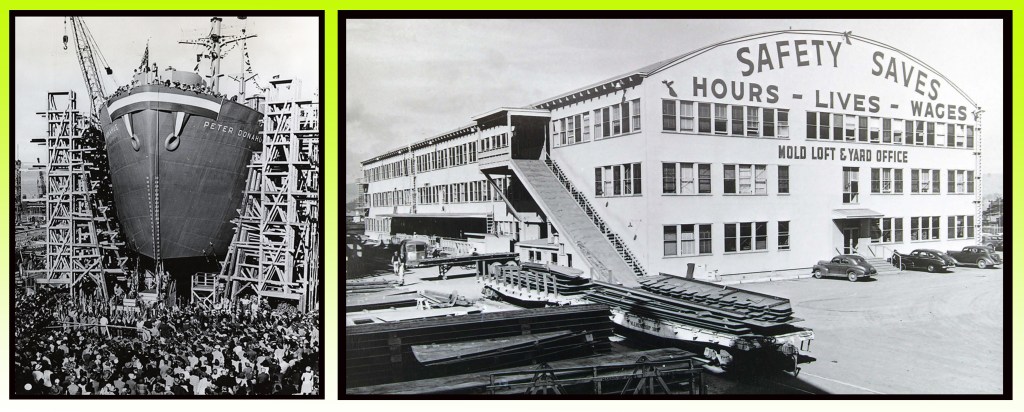
   The housing at Marin City was constructed during World War 2 to accommodate the workers at the massive MarinShip yards which the federal government contracted the Bechtel Company to build in Sausalito.  They turned out Liberty Ships and tankers for the war effort and needed labourers around the clock.  African Americans came north in search of well paid employment.  They came primarily from Louisiana, Arkansas and Mississippi.  But when the war ended, MarinShip closed and the employment came to an end.  Marin had always been a white county but now it had a black community within it.

Some images of Marinship, the federal government’s ship building facility in Sausalito during World War 2. It produced many Liberty ships and tankers for the war effort.

   The Collins family were the only black people to live in Mill Valley when I was growing up.  Dr Daniel Collins, a prominent dentist, actually bought his house direct from the previous owners rather than going through one of the realtors in town.  He side stepped the main gate keepers who kept Mill Valley white.

   In June,1963, the Rumford Fair Housing Act was passed by the California Legislature.  It banned racial, religious and ethnic discrimination in the sale and rental of housing.  This new law was soon to be tested by the Congress of Racial Equality (CORE) in Mill Valley.  On Saturday, 16th November, 1963, a total of 75 persons picketed Walburn Realty at 90 East Blithedale.  Douglas Quiett, chairman of the Marin branch of CORE charged that Mrs Walburn had told a black woman she didn’t have an apartment for rent, but later showed it to two white women.  The Independent Journal reported that “Among the picketers was Dr Daniel A Collins, newly appointed to the state board of education and a Mill Valley resident.”

   A group called Americans to Outlaw Forced Housing  initiated a petition to repeal the Rumford Act and the Marin County Real Estate Board took the decision to make the petitions available through their office.  Though their spokesperson denied that the board was endorsing or condemning the repeal initiative, their supply of the petitions was seen as an endorsement.

   “Yesterday’s stand taken by the real estate board on the Rumford Act,” said Douglas Quiett of CORE, “should make clear to everybody in Marin that we have a legitimate protest.  The board won’t announce its ‘official’ position on the initiative, and yet it will make petitions available at its office.  This simply means that many real estate brokers in this county don’t want a fair housing law.”  As Marin CORE entered its third weekend of picketing the realtor’s office, the dispute intensified.  But four weeks later they ended their picket after reaching an agreement with Walburn Realty.  “We have reached agreement on four of our five proposals to Mrs Walburn,” said Douglas Quiett.

The picketing of Walburn Realty in Mill Valley was regularly reported in the Independent Journal.

   However CORE now began picketing Ted Gibson Realtor at 328 Miller Avenue.  In November 1963, a black family went to Gibson asking to see a home advertised in a newspaper.  They were told the house was sold and none other was available in the price class.  A white couple, an hour later, was shown the first house plus several others in the price range, claimed Quiett.

   After three sessions of negotiations with Gibson and his attorney, Albert Bianchi, CORE decided to picket.  Gibson, said Bianchi, had agreed not to practice discrimination but refused CORE’s demand that he display a sign that he is a ‘fair opportunity broker.’  Bianchi likened the demand to a merchant being required to place in his store window a sign saying ‘I am not a Communist.’

   Meanwhile enough white people in Marin and other California counties went to their local real estate board offices to collect and sign those petitions which put Proposition 14 on the ballot in November.  That proposition was for the repeal of the Rumford Act.  In the eleventh month of 1964 it was passed with a majority of over 1.5 million votes.  

   The Independent Journal reported: “Californians have made known their opposition to state laws banning discrimination in housing, but the final word on the boiling controversy probably will come in the courts.”

   When Dr Collins bought his house in Mill Valley in 1952 for $20,000, he dealt direct with Mrs Faltin, the woman who sold it.  “By this time,” said Dr Collins, “She had begun to get calls from some of the local real estate dealers, giving her a bad time.  They were harsh with her for selling her property to a n——r.  She said, ‘Why don’t you come up and have lunch with Dr and Mrs Collins before you pass judgment on them?’  They were too much cowards to do that.  They would not confront either of us, but just began to badger Mrs Faltin.  She said it made no difference to her.  She liked us, she thought we were first-class citizens, and she was delighted to sell us her house.  And so she did.”

Two photos of Dr Daniel A Collins on the left and his son Chuck Collins on the right. Chuck was in my year at Tam High.

   About a week before the family moved in, Dr Collins received a call from a representative of the realtors, passing on the message that they would buy the house at a good profit for him.  He told them that the only offer he would consider would be for them to double the price he paid.  He received no further calls.

   “I saw myself at that time getting $20,000 net profit, free of tax,” said Dr Collins.  “And I could go somewhere else and buy a house.  But they weren’t that brave.  They were just a bunch of bullshitters, a bunch of cowards looking for a sucker.  They weren’t willing to pay the price of their prejudice.”

   But I was thinking of none of this.  Not the racist practices of Mill Valley realtors.  I wasn’t even aware of the riots in Newark or Detroit.  Or the snipers in Marin City or the daily death toll from the war in Vietnam.  I was just taking my doses of thorazine and thinking that John Lennon must be in the next room.  Each day passed with a similarity to the day before and the day after.

   One morning I saw my gay friend in the corridor with his arm in a sling.  The wrist on that arm was heavily bandaged.  I asked him what had happened.  He glared at me malevolently then he began shrieking: “Get away from me you freak!  Don’t you come anywhere near me!  Get away from me!”

   I shrank back from him, stunned by his outburst.  The bandage on his wrist looked like he had slit his wrist.

To be continued…

Amazon USA
https://www.amazon.com/dp/B085QN73VQ

Amazon UK
https://www.amazon.co.uk/dp/B085QN73VQ

Being Taken Into Custody

Previously in Miller Avenue Musings:  It is the summer of 1967 in Mill Valley where I have stayed up all night talking with poster artist Wes Wilson.

As I left Wes and Eva’s house on Locust Avenue it was a beautiful summer’s morning.  The sun shone brightly in a clear blue sky.  Taking a left through their garden gate, I walked up the hill to Blithedale where I turned right, heading in an easterly direction.   

   My madness had evolved.  I was now convinced that I was a messiah, put on this earth to solve all the problems of humankind.  If that seems a slightly tall order for a drug crazed twenty year old hippie, it was.  But in my fevered state of mind, it all made perfect sense.   Important people would be landing at the airport in San Francisco and driving north on Highway 101.  My thinking was that I must meet them at the highway.

   At the junction of Blithedale and Camino Alto, I cut through the railroad tracks where I had walked to and from school at Alto and Edna Maguire so many times as a kid.  I was excited by the idea of meeting all these people who clearly had the best interests of the planet earth in their hearts and minds.  Amongst their number was, I felt certain, The Beatles, or at least John Lennon, if not all four.  I had the entire LP of Sgt Pepper dancing through my head at this time and felt certain that they would be part of this mobilisation.  Another tall order, I grant you, but making perfect sense to me in my ridiculous state of mind.

   I walked along the tracks until they met Lomita then turned right and headed for the highway.  At the overpass, I positioned myself on the sidewalk overlooking the northbound traffic.  The rush hour had begun and the southbound traffic was one huge slow moving mass but I was totally oblivious to it.  I kept my gaze focussed on the horizon where the highway snaked to the left at Richardson Bay.  I was in a very calm state and kept a beady eye on the traffic.  I must have been there about an hour because a Highway Patrol officer had spotted me 45 minutes earlier and when he saw me again, he stopped to talk to me.  My state of mind was to accept everything I encountered and the Highway Patrol officer was very friendly as I recall.  I told him I’d finally had a good trip on acid and probably babbled something about the caravan of vehicles coming from the airport.  He told me he would be taking me to the county jail in San Rafael and that he’d have to handcuff me which I accepted.  I then sat in the back of his vehicle as he drove us north to the county jail which was underneath the San Rafael courthouse. 

   I had been booked into Marin County jail the previous year when I was arrested in Mill Valley for being in a car where marijuana was found.  I spent one extremely miserable night in the communal male cell and it had been a bleak and depressing experience.  This time, however, they simply put me in a room where I waited until the ambulance guys got there.  Before too long they arrived and I was strapped onto a stretcher with wheels.  

   The guy who sat in the back of the ambulance with me as we drove north towards Napa must have heard many a mad person quack on about saving the world.  Perhaps he secretly hoped that one of them would reveal a great truth, for he pumped me with very specific questions all the way to Napa.  Sadly I cannot recall his questions but I definitely formed the opinion that he was hedging his bets in case one of these crazy patients turned out to be the real messiah.

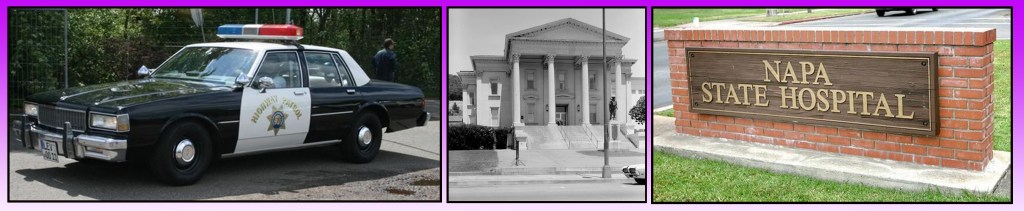
From left: a California Highway Patrol car, the Marin County Court House and the entrance to Napa State Hospital.

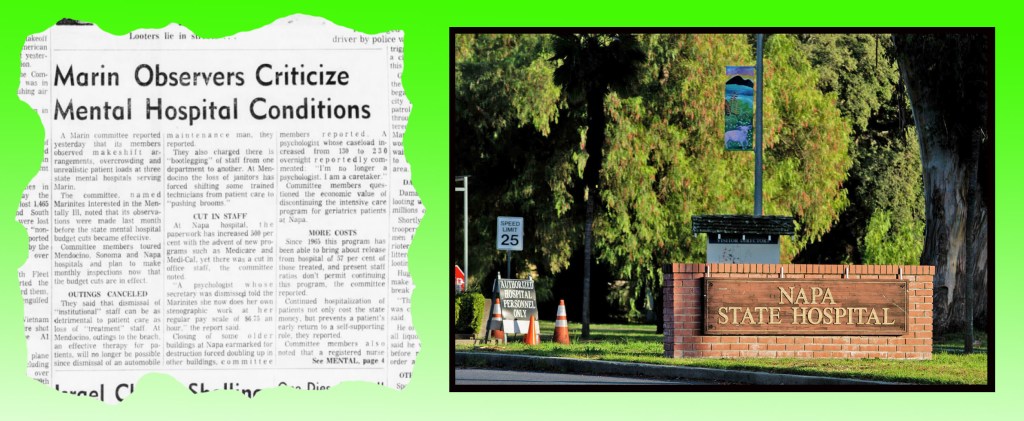
   Ever since childhood I remember that the word ‘Napa’ was synonymous with crazy people.  My father Blackie had a vast vocabulary of slang nicknames which he used to describe practically all things.  A mental hospital would be a laughin’ academy in his colourful lexicon.  Yet most of the people I befriended there were surprisingly normal seeming.  I was given a bed in what looked like an ordinary hospital ward.  The guy in the next bed on my right was very nice and we became friends.  We never discussed why we were there.  To be honest I had no idea why I was there.  It was just an interesting experience I was going through.  I accepted everything that came my way.

    Almost immediately I was given medication which I think was Thorazine and the nurses would come to me with pills several times a day.

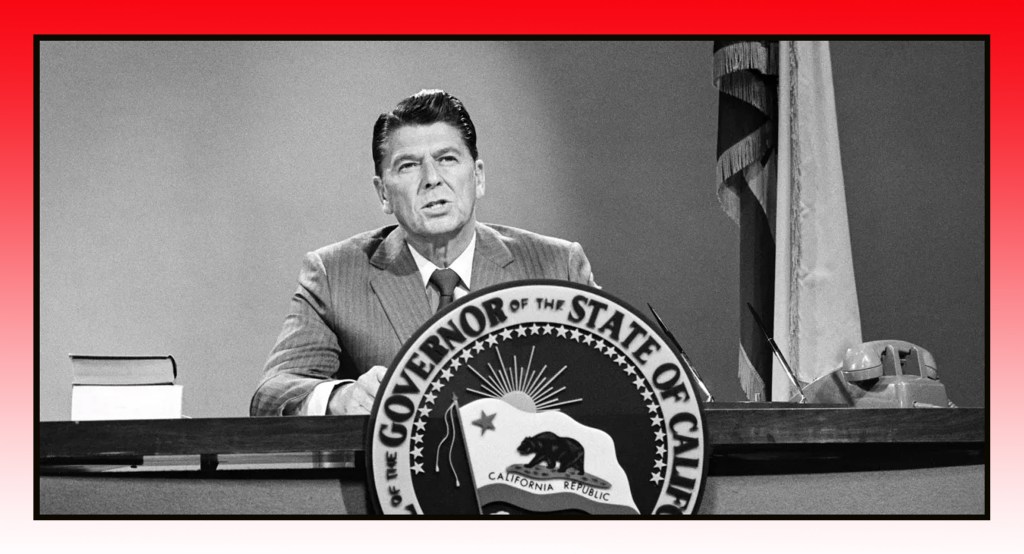
   The staff were very friendly and I soon learned from them that their already difficult jobs had been made much harder by the budget cuts introduced by the recently elected California governor, Ronald Reagan.  Reagan had targeted mental health and higher education for his budget cuts and the impact was being felt.  

Ronald Reagan, elected as Governor of California in 1966.

   His election as governor the previous year had been the first step in what he and his financial backer, car dealer Holmes Tuttle, saw as the road to the White House.  Reagan’s victory in California was a sign of what was to come in America.  His speech in support of Barry Goldwater in 1964 had put him on the political map.  The senator from Arizona ran unsuccessfully against Lyndon Johnson for the presidency and advocated the use of nuclear weapons in the war in Vietnam.  Reagan made similar statements once he was in the governor’s mansion.  So now, with actual power, he set about his attack on university students and the mentally ill.

Three faces of Ronald Reagan.

   A committee called Marinites Interested in the Mentally Ill made a report.  Its members observed overcrowding and unrealistic patient loads at three state mental hospitals serving Marin County.  The group toured Mendocino, Sonoma and Napa hospitals and now that Reagan’s budget cuts were beginning to bite, they planned to make monthly inspections.  The Marinites complained that dismissal of institutional and treatment staff was detrimental to patient care.  At Mendocino they noted that outings to the beach, an effective therapy for patients, would no longer happen since the dismissal of an automobile maintenance man.  The loss of janitors had meant trained technicians switched from patient care to cleaning up with brooms.  A registered nurse was pressed into service pushing a food cart, “when she is needed by patients,” the report stated.

   At Napa hospital, the paperwork had increased by 500% due to new programmes like Medicare and Medi-Cal yet the budget cuts got rid of so many office staff that psychiatric workers were doing their own stenographic work as well as their main jobs.  One of the psychologists whose caseload had increased overnight from 130 to 230 complained: “I’m no longer a psychologist.  I am a caretaker.”

A newspaper article about the Marinites and the leafy entrance to the hospital.

   So the staff at Napa were overstretched.  One economy measure was to close the laundry one day a week, but this meant they couldn’t provide the optimum number of bed and diaper changes for their patients.  I don’t recall a staff member being unfriendly but they were all overworked and a bit distracted.  My time at Napa was interesting and I don’t remember any boredom or depression on my part.  It was all an enormous adventure and I was enjoying it.  

   Outside the walls of Napa State Hospital there was a lot going on in the world.  In Vietnam the Viet Cong launched a huge rocket attack on the enormous US air base at Da Nang, killing 13 and wounding 173 others.  The rockets, fired with deadly accuracy from a nearby mountain, set the air base ablaze, destroying three barracks and a score of aircraft worth an estimated $48 million.  War on the streets of the USA erupted in Newark, New Jersey as National Guardsmen and police battled black rioters firing rifles and submachine guns.  For the first time the guardsmen were using live ammunition which brought the death toll to 16 people killed.  Later in the summer, rioting would also break out in Detroit, Michigan.  I, however, was aware of none of this.  If I was going to save the world it was going to have to be without knowing what the hell was going on in the world.

Two newspaper clippings. On the left the Viet Cong attack on the US Air Base in Da Nang and on the right the rioting in Newark.

   That I had been picked up by the Highway Patrol on the overpass was reported in the Independent Journal, the afternoon newspaper in Marin County.  The news item about me was tucked away on page eleven under the headline: ‘Admitted LSD Taker Is Held.’  The article was wrong about the time of day.  The reporter must have misheard the Highway Patrol officer and written it as evening whereas it was very early in the morning.

   One subscriber who saw the story was Nona Kaufmann.  Mrs Kaufmann was alarmed to read about me and brought it to the attention of her daughter Janice.  Jan and I had dated at Tam High and I knew her mother fairly well.  The Kaufmanns lived in Strawberry on the other side of the highway.  

   I had first met Jan one evening in the back seat of a VW Beetle driven by Mark Symmes.  Mark, who was accompanied by a young woman in the front passenger seat, drove us up Edgware to the junction of four corners where there was a big space to park.  I have no memory of why I was in the back seat next to Janice, who I did not know.  I also don’t recall who the young lady with Mark was, but once he’d parked the vehicle, they began making out.  I turned to the young woman on my right and instantly found myself in a passionate embrace.  This was the start of a pretty steady relationship which lasted the rest of my time at Tamalpais High.  Without realising it, I fell in love with Jan.  The reason I didn’t realise it was that I was constantly putting on a front as a lady’s man at school with much flirtation.  I wasn’t aware that I subconsciously put Janice on a pedestal while other women were, I felt, there to be treated in a cavalier fashion.

   I remember Jan asking me what I was going to do with my life and it concerned her that I had no idea.  I remember her father Stephen becoming alarmed at the fact that I bought an expensive sweater for her at Christmas from J Magnin’s in San Francisco.  “This seems serious,” Jan quoted Mr Kaufmann as saying.  

   When I went to sea right after my graduation it was actually my first proper time away from home and I returned, a very changed person, to a Mill Valley which had been transformed.  Most young people were now smoking marijuana, in stark contrast to what the place was like only a few months before.  The short haircuts which were part of a uniform look for young men was no longer the norm as most guys had long hair.  One school friend who had previously looked very collegiate, now resembled Sonny Bono of Sonny and Cher.  He talked of the hidden drug messages in Bob Dylan’s lyrics and how the name “The Lovin’ Spoonful” referred to heroin use.  He spoke enthusiastically of all this as if drug use was a political movement.

   I fell out of touch with Janice during this period.  At the time I was picked up by the Highway Patrol, she was a student at UC Davis and was shown the I-J article by her mother on a weekend visit home.

   Jan visited me at Napa which must have been very strange for her.  She was directed to my ward where she found me surrounded by a group of men, all eager to talk to someone.  These guys apparently were pretending to take their medication rather than actually swallowing the pills.  They offered handfuls of tablets to Jan.  Two of them told her they behaved crazy to avoid being put in jail.  Jan and I wandered through the restricted outdoor area followed, she remembers, by “this posse of fellows.”  Though these guys were not taking their medication, I clearly was, as Jan remembers me as medicated but delusional.  I talked about saving the world with John Lennon and John Sebastian.  This crazy notion took quite a bit of time to fade from my conscious mind.  Looking back on it, I’m truly grateful to Jan for visiting me at the hospital.  She was and still is a good friend.

   One thing I didn’t know at the time was that my father Blackie was there at the hospital almost every day of my three week incarceration.  He did make appearances when others visited, like my sister Kate, but I had no idea of his presence on a day to day basis.

   I was a very passive patient who, when instructed to do something by the staff would oblige.  On occasion strange impulses would appear within me like suddenly taking all my clothes off and standing naked in the corridor.  This didn’t happen often but when it did, a staff member would arrive and gently tell me to put my clothes back on, which I did.  I remember being locked in an empty hall where I walked up and down singing my pretty near perfect imitation of John Lennon doing Day In The Life from the Sgt Pepper album.  

   There was no radio at Napa, so the three weeks I spent there I didn’t hear the Top 40.  I missed the fact that Light My Fire by the Doors climbed the hit parade as did the ghastly San Francisco by Scott McKenzie.  I never heard Up Up and Away by the Fifth Dimension or Don’t Sleep in the Subway by Petula Clark.  I was stuck with Sgt Pepper going through my head.  

   In the hospital every door to the outside world was locked and in that way, all of us patients were prisoners.  I got into the habit of trying every door in case it wasn’t locked.  One morning I turned the knob on a door leading out into the garden and found that it opened.  I walked out and closed the door behind me.  I found myself on a neatly trimmed lawn.  I walked across the grass and kept going.  I passed administrative looking buildings and eventually came to a street.  I turned left and walked until I arrived at a bus stop.  I don’t believe I was there long for very soon a bus arrived.  I got on and for some reason I wasn’t challenged to produce a ticket or money.  So I found a seat in the rear of the bus and sat down, looking out the window and watching the beautiful scenery go by.  I had no idea where I was going.

To be continued.

Amazon USA
https://www.amazon.com/dp/B085QN73VQ
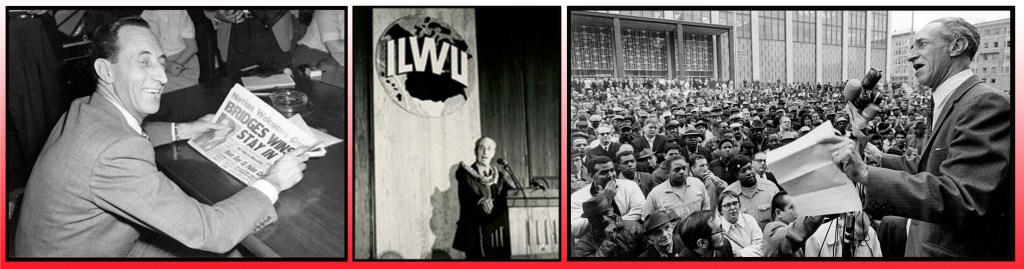

Amazon UK
https://www.amazon.co.uk/dp/B085QN73VQ

Talking All Night in Mill Valley

Previously in Miller Avenue Musings:  It is the summer of 1967 in San Francisco and I, having taken the drug STP, have flipped out and gone crazy.

In the second day of my madness I returned to my parents’ apartment on Union Street after a visit to Bob McClay’s office.  I don’t remember if it was my parents or myself that contacted Wes Wilson but I do remember that he arrived in the late afternoon and drove me back to his house in Mill Valley.

   He and his wife Eva, who’d recently given birth to their son Colin, lived in a nice house on Locust Avenue just below East Blithedale.  The house was set back from the road and as you entered from the street through a gate you followed the path through a pretty lawn.

Three photos of Wes with his wife Eva (and baby Colin) at different stages of their life together.

   Eva was in bed breast feeding her baby.  After saying hello, Wes and I went upstairs to his studio.  He lit a joint and we started talking.  He engaged in every topic I raised and questioned me in depth.  He clearly was interested in what I had to say whereas most of my friends had, by this time, started making excuses to avoid talking to me.  It was as though all the doors in my mind had flown open at once and I stammered from subject to subject with great haste, but Wes took each subject I touched on and examined it forensically.

   By the summer of 1967 Wes Wilson was the most prominent of the psychedelic poster artists working on the San Francisco scene.  Before I knew him, his posters had inspired me to send off samples of my own work to Bill Graham which got me my first job for him, painting the boards at the top of the stairs at the Fillmore which advertised the coming attractions.  Bill could only confirm his bookings two weeks in advance so I was always doing my boards that far ahead.

   The first time I met Wes was on one of his Friday afternoon deliveries of that week’s Fillmore posters.  He’d come up the stairs carrying a sizeable brown package full of posters, fresh from the printer.  Bill would get his ladder out and staple about seven of them along the wall above the staircase.  Wes was a very friendly fellow in contrast to Bill who was all business and brusque in his presence.  Bonnie and Jim Haynie seemed to like Wes a lot but Bill, who never interfered with Wes’s way of working, would stare at the new poster and say nothing.  

   On that first occasion I was all over Wes with questions about how he did his work.  I was quite surprised to learn that he worked small and enlarged: meaning that his art work was smaller than the printed poster.  He was very encouraging to me and talked about his desire to purchase an airbrush when he could afford it.  I had never heard of such a thing and even after I examined one down at Flax’s, I still had no idea what you did with it.  

   The first Wes Wilson poster I ever saw was while I was a student at College of Marin, doing my comic strip Captain Campus in the Tower Times.  The headline was Batman with a cartoon of Batman and Robin advertising three nights of gigs at the Fillmore which Bill Graham was producing with Quicksilver Messenger Service and The Great Society.  Also advertised were “Batman movies chapters 1 – 2 – 3.”  The great success of the ABC Television series  Batman starring Adam West had spawned a craze for everything to do with the caped crusader and the three chapters in question were from the 1940s serials which I had seen at the Sequoia’s Saturday matinees as a kid.  I’d recently sat through a showing of all of them at a North Beach cinema thinking they would be as good as I’d recalled but sadly, seeing them all in one sitting, they were numbingly dull.  One advantage of the very funny new TV series was how good the costumes were.  In the cheapo 1940s serials they were dreadful.

From left: Lewis Wilson as Batman in the 1940s serial; Adam West as Batman in the 1966 TV show; Wes Wilson’s poster; Title card for the 1940s serial.

   The next poster by Wes to catch my attention was a brightly coloured orange and red design in which the letters fit stylishly into the shape of a human head.  Headlined a “Blues-Rock Bash” it featured The Paul Butterfield Blues Band and the Jefferson Airplane.  Again this was a Bill Graham production happening one night in a gymnasium and two nights at the Fillmore.  I think it was this poster which convinced me that I could do this and inspired me to write to Bill.

Three early Wes Wilson posters. The middle one inspired me to think I could do this kind of art work.

   By the time I finally started working at the Fillmore, Wes had done so many posters that it could already be considered a body of work.  Of course he was also still doing artwork for Bill’s rivals over at the Avalon Ballroom, the Family Dog.  Bill paid him on time and didn’t interfere with his concepts, unlike Chet Helms over at the Avalon, and this eventually made him work exclusively for the Fillmore while an artist named Stanley Mouse took over the Avalon work.  

   Wes had designed the original logo for the Family Dog.  Ever since I was a young boy I’ve been a fan of good logos.  Be it for Warner Brothers, Chevrolet Motors or Coca Cola, it was a subject on which I had very strong opinions and the Family Dog logo was, in my opinion, an excellent piece of work.  A good logo must travel, meaning that it looks good big or small and is always familiar whenever you see it.  The Family Dog logo adorned all the Avalon posters done by Wes, Mouse and all the others who followed them.

From left: The Family Dog logo that Wes designed; A poster he designed for a gig at the Avalon; Wes with his son Jason in 1987 – the two painted this enlarged version of the poster to be displayed in the Hard Rock Cafe in San Francisco.

   Wes got his start in the design business when he was living at the very bohemian Wentley Hotel on the fringes of the Tenderloin district in San Francisco.  A friend introduced him to someone who was running a print shop for an insurance firm and was on the hunt for an artist with design skills.  This guy was impressed by his drawings and they went into business together as Contact Printing.  Wes was doing the layouts and handling the printing as well.  A personal project he produced at this time was the “Are We Next?” posters.   He had them printed and took several over to Berkeley for a big anti-Vietnam War rally at which he saw Allen Ginsberg.  The famous beat poet told him he thought the imagery of a swastika lodged within the stars and stripes was “too paranoid.”

From left: Wes pictured with his poster “Are We Next?”; the poster itself; Wes signing copies at a poster convention years later.

   Wes was later visited by a delegation from the Anti-Defimation League who were concerned that the poster might be anti semitic.  Wes assured them it wasn’t, introducing them to his wife Eva.  “She’s Jewish,” he said.  “I love her dearly.  We’re having a baby soon.  Her father was a screenwriter.  One of the blacklisted Hollywood Ten.”  By the time they left they were satisfied that Wes was not a Nazi sympathiser.

   Somewhere along the line at Contact Printing, Wes did the posters for the Trips Festival at the Longshoreman’s Hall which brought him to the attention of Chet Helms.  Chet ran The Family Dog, which was producing weekend concerts at Bill Graham’s Fillmore Auditorium.  He and Graham would produce alternate weekends.  Wes did the poster for what turned out to be a sold out sensation featuring the Butterfield Blues Band.

Three early Family Dog posters by Wes Wilson.

   The business arrangement between Chet Helms and Bill Graham came to a shuddering halt after Graham got up early the Monday morning after the sold out weekend and phoned Albert Grossman in New York to negotiate an exclusive deal for himself to promote all future Butterfield shows.  When Helms realised what Bill had done he dissolved their partnership and started doing shows at the Avalon.  While painting my boards at the Fillmore I heard all Bill’s phone calls as he wasn’t remotely shy and retiring and one thing he’d say many times was: “What Chet doesn’t realise is that you’ve got to get up in the morning.”

   My first day working at the Fillmore was just after the Andy Warhol weekend. Bonnie MacLean told me all about it and Wes’s poster for that event is one of my favourites.  If you look on the Wes Wilson website he tells an amusing tale about Andy Warhol paying him a visit at the house on Locust.  They were both interviewed on a radio station in San Francisco and afterwards Warhol asked Wes where he could find some “fun” activity.  The only suggestion he could come up with was paying him a visit in Mill Valley to talk about art.  “Andy looked so utterly bored at that prospect,” said Wes, “that my impression was that he would not be taking me up on my offer – but I passed him my address and phone number just in case.”  Exhausted from several late night poster jobs, Wes drove home and went straight to bed.  About 8pm he was woken by strangers at his front door asking if this was Wes Wilson’s place.  Wes was in his pyjamas as a stream of creatures, including Andy Warhol spilled out of a limousine parked in the street and proceeded to party.

Three Wes Wilson posters for Bill Graham at the Fillmore Auditorium.

   One artist that Wes introduced me to was the German illustrator Heinrich Kley.  He used Kley’s pen and ink drawings of turtles playing musical instruments on his poster for the band The Turtles who appeared at the Fillmore in July, 1966.  This inspired me to purchase a book of his drawings which were wonderfully surreal.  Kley drew beautiful pen and ink drawings of various animals doing improbable things.  Elephants ice skating, alligators dancing with bears, and the turtles which Wes had used, playing stringed instruments and a tambourine.

Another three Fillmore posters for Bill Graham including the one on the right featuring illustrations by Heinrich Kley.

   Wes introduced a style of lettering that I thought he’d simply invented, but subsequently learned that it was based on a typeface crafted by Austrian painter and graphic designer Alfred Roller at the beginning of the 20th century.  The first time I saw this style of lettering was on one my favourite posters by Wes: a double bill of Jefferson Airplane and the Grateful Dead at the Fillmore.  This poster also taught me what Wes was up to with his airbrush.  It featured two photos of the bands which were outlined in a cloud like halftone shape which had clearly been achieved with the airbrush.  I also believe that this was the first time Wes had used bleed for its borders.  Whereas all his previous posters had white borders, the navy blue background of this one bled off beyond the trim marks.  With a few exceptions, Wes continued to bleed his borders for the rest of the posters he did for Bill Graham.

Three Fillmore posters featuring the lettering style of Alfred Roller.

   Wes continued to use the Alfred Roller style of lettering and it is associated with his work.  His illustrations were also very striking.  Many artful nude females adorned several of the posters and to my mind they all resembled Eva.  Wes had a command of colour which was impressive.  For the Fillmore and Avalon posters he rarely used more than two colours and how he used them was interesting.  For the “Sin Dance” poster for the Family Dog he only had red and green but by printing most of the red over the green it gave a black and by having the logo reversed out of the red it made it white.  So the effect was four colours rather than the  two actually used.  

   Of course Wes understood the printing process thoroughly and was able to innovate, often pushing his printers to try things they normally wouldn’t do.  When he designed the poster for The Association with the flaming letters, the printer rang him up to say that they were getting a little white line around the letters.  Wes had a look and decided it was an attractive effect.

   The relationship with Bill Graham eventually turned sour.  Usually Bill was very honourable about paying people on time and in full but he did suffer occasional spasms of greed.  The late Jim Haynie remembers him regularly violating the fire regulation limit to sneak more paying customers into the Fillmore often via the fire escape.  It soon became clear that the sales of his posters were a going concern.  When I asked my friend John Goddard, who ran Village Music in Mill Valley, how many Fillmore posters and handbills he sold, his reply was:  “More than you would think.”  People were now collecting them.  

   Wes had been copyrighting each poster as it came out but Bill wanted to formalise the arrangement with a contract.  So Bill and Wes sat down and worked out a deal.  They drew up a contract which Wes signed, granting him 6% per poster.  “But then he broke the agreement right away,” said Wes.  “An article came out in TIME Magazine reporting that he’d sold 100,000 posters.”  So Wes went to see him with a few friends demanding his royalties.  He said he was due $6,000 on one particular poster.  “He got all upset,” remembers Wes, “And we went from being friends in the morning to being enemies that afternoon.”

   Although Wes was a political pacifist, he, like Graham, had been in the military and could fight.  When things got heated with Bill he suggested that they step outside and settle things with fisticuffs.  “Bill Graham said okay to that,” said Wes.  “And as we walked out the door onto the sidewalk, Bill quickly turned around, locked the door behind him and disappeared up the stairs.  From that day on, he continued to cheat me out of lots of money by not honouring our honestly agreed-to and mutually signed agreement.”

   Wes sought advice from a few lawyers and they all said that because he’d left his signed contract in Bill’s trust without a copy of his own, he might as well forget it.  “Bill had shown himself to be a lying crook rather than an honest person,” said Wes.  “That’s how I lost all of my respect for Bill Graham.”

Three photos of Wes Wilson throughout the years.

   This incident must have occurred after I had visited Bill at the Fillmore in mid 1968 on my return from a European trip.  I wanted to get royalties on my four Fillmore posters.  He went upstairs to look at the books and returned to write me a cheque for a few hundred dollars.

   But back in the summer of 1967, as Wes and I talked through the night up in his studio, such concerns were not on the table.  We talked about everything from societal politics to human sexuality.  Finally as the sun started rising Wes excused himself and went to bed.  I walked out on their front porch as the first light of morning settled gently over the beautiful lowlands of Mill Valley.  The fever in my brain convinced me that something important was happening.  People were coming from all over the world to meet me.  I walked down the path to the wooden gate and, opening it, stepped onto the sidewalk of Locust then up to East Blithedale.  The sun was now coming up as I headed towards Highway 101 with a great sense of purpose.

To be continued…

Amazon USA
https://www.amazon.com/dp/B085QN73VQ
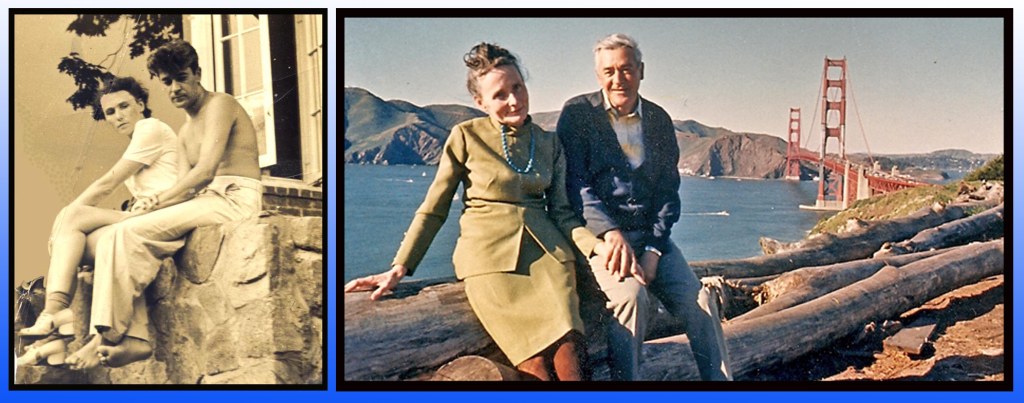

Amazon UK
https://www.amazon.co.uk/dp/B085QN73VQ

A Flip of the Lid, chapter 8

It was July, 1967 in San Francisco and I was now in my second day of madness, having taken what I believe was a dose of the dangerous drug STP.  I was possessed by a conviction that there was someone coming to see me who I was meant to meet.  Having gone to the Haight Ashbury district with my father Blackie in the hope of meeting this person, I gave up after half an hour of wading through an ocean of hippies.  Back at our apartment in North Beach, I decided to go out for a walk.

   I wandered down Union Street to Washington Square and turned right on Columbus, passing many Italian restaurants, crossing Broadway with its topless nightclubs and City Lights, the best bookshop in North Beach.  I made my way to the mini flat-iron Columbus Tower building on the corner of Kearny.  There was a Zim’s Burger bar on the ground floor which I always enjoyed eating at.  But a Zim’s burger was not of interest to me on this occasion.  I made my way up to the second floor and paid a visit to Bob McClay at the Tempo office.  I had met Bob through my friend Jo Bergman who was working with him and Sue Cox at Tempo earlier in the year.  

   Tempo was a tip sheet for top 40 radio stations and it was owned by legendary disc jockey ‘Big Daddy’ Tom Donahue.  Sue and Bob had produced the weekly tip sheet and Jo answered the phones and ran the office.  

Three photos of Bob McClay and a visual of the TEMPO Top 40 tip sheet

   Sue (now Susan Kirk) remembers: “McClay wrote the articles choosing whatever topic he deemed current and important about the music scene.  I chose the new records and reviewed the latest hits and artists.  We mailed 45’s from the week’s pick to over one hundred radio stations across the US and around the world.  DJ’s didn’t have access fast enough like we did so we really did radio a great service.  The artists benefited from what we did, getting their latest recordings on the air.”

   Tom Donahue had hired Sue, she remembers, because she had “a great ear for hits and Tom knew it.  As a boss Tom was exacting in what he wanted but was pretty hands off.  My dear friend Carl Scott who knew Tom well moved into the office above Tempo in Columbus Tower.”  

San Francisco DJ “Big Daddy” Tom Donahue pictured in centre with record producer Phil Spector and Righteous Brothers vocalist Bill Medley.

   Bob McClay was also now presenting a regular program on FM Radio KMPX.  I had visited him at the studio on Green Street about a month earlier while he did one of his shows.  I’d never been in a radio studio before and enjoyed chatting with him while the records played.  Clearly Bob had some experience in this line of work.  He was much more of a disc jockey than Larry Miller who I had first listened to on the station.

   In fact KMPX, which started its hippie output with Miller early in 1967, had now been transformed by Tom Donahue.  KMPX, had previously specialised in foreign language programming and had sold Larry Miller the graveyard slot of midnight to 6am.  His radio voice was friendly and unpretentious and the records he played were an interesting mix of folk, rock and blues which soon attracted a sizeable hippie audience for the FM station.  There was at this time a big distinction between AM and FM radio.  AM had a larger wavelength whereas FM stations were less mainstream.

   So Tom Donahue went to the management of KMPX and proposed that he would present the eight to midnight slot and that they should switch to 24 hours of the kind of music that Miller was playing.  They agreed and Bob McClay was one of the people Donahue recruited to the station.

From left: Bob McClay, Larry Miller, Tom Donahue at KMPX and at KYA with John Lennon.

   Though I was a regular listener to Miller’s show on KMPX I still listened to Top 40 which at this time was KFRC.  I had listened to pop music stations ever since I first discovered Radio KOBY in 1956 when I was nine years old.  Early Elvis, Pat Boone and Harry Belafonte hits kept me listening.  1950s pop was a very  broad church incorporating Perry Como, Rosemary Clooney and the big band sound of Elmer Bernstein. That station carried me through grade school into junior high when it was superseded by KEWB.  They played hits like Bobby Darin’s Mack The Knife, Poison Ivy by the Coasters and Misty by Johnny Mathis.  After The Beatles came along in 1964 and dominated the charts for a long time, KEWB suddenly found it had a rival in KYA.  Soul came into the mix with two stations: KDIA and KSOL.  From 1966 on it was KFRC that I listened to and by this time most soul artists were making the charts: Aretha Franklin, Marvin Gaye, The Four Tops, James Brown, Stevie Wonder and many more all crossed over to become Top 40 stars.  And up until his departure in 1965, Tom Donahue was one of the most popular DJs on KYA.

   Of course Donahue was an old fashioned Disc Jockey who had “Top 40” running through his veins.  Back when he was on KYA he would rattle off patter like: “It’s 2.20 KYA Home of the Hits time here at twelve sixty on your radio dial and here’s Sam Cooke with…”  But now on the hip FM station, he slowed things right down with his mellifluous deep voice: “You’re listening to KMPX where we’re changing the world.  That’s right man, we’re changing the world.”

From left: Tom Donahue when he first arrived at KYA in 1961, with Bill Graham in the late 1960s and a ticket for the final Beatles concert which he produced.

   An extremely big man in every sense, Donahue established himself as a DJ during the 1950s on station WIBG in Philadelphia.  In 1961, in the wake of the payola investigations which damaged many of the reputations of East Coast DJs, Donahue arrived at KYA in San Francisco where he was an instant hit.  In partnership with fellow DJ Bobby Mitchell, he formed Tempo Productions, putting on record hops and concerts.  They branched out into other businesses, forming a record company, opening a North Beach night club and investing in thoroughbred horse racing.  Donahue departed KYA in 1965 but stayed on in San Francisco to oversee his many business interests which included producing The Beatles final ever concert at Candlestick Park on August 29th, 1966.

From left: Ralph Gleason with the Beatles, Paul McCartney and Joan Baez, Lennon, Harrison & McCartney going on stage at Candlestick Park.

   Sue Cox remembers that she, McClay and Bobby Mitchell were all involved in the production of that final Beatles performance.  “Carl Scott and I stood 50 feet from the stage on the ground and wept together when they ended the concert.”

From left: The Fab Four crossing the baseball field, a poster for the event, Sue Cox pictured with Ringo and Wes Wilson’s poster for the concert.

   I never got to know Tom Donahue but met him in McClay’s office a few times.  Extremely tall and physically very weighty, I would see him around town, sometimes visiting Bill Graham at the Fillmore.  He made the transition from fast talking top 40 DJ to mellow presenter of folk and rock album tracks on FM radio.  Having grown a beard sometime during his tenure at KYA, Big Daddy now had very long hair as well but he didn’t convince my hippie friends in Marin that he was one of them.  

   All my friends and I were in our early twenties and considered the age of thirty to be very old indeed.  One friend sarcastically listed the three most important people in the hippie scene: “Bill Graham, Tom Donahue and Ralph Gleason.”  Bill was 36, Tom Donahue was 39 and Ralph Gleason, the jazz critic on the Chronicle was 50.

   Bob McClay, however, was a different kind of person altogether.  He was much more of a genuine enthusiast than a businessman.  Both McClay and Donahue were older than me and had been part of the beat generation.  Of course smoking weed had been going on forever but it always occurred in the mysterious world of beatniks and jazz musicians.  It wasn’t until the hippie era that it came out into the open.  I remember a pre-hippie article in MAD Magazine in 1960 in which Wally Wood drew fabulous pictures for a hip version of The Night Before Christmas.  It featured a Santa Claus with dark glasses and a very thin cigarette between his lips.  It opened with:  ’Twas the night before Christmas, and all thru the pad, Not a hipster was stirring, not even old Dad.  The chimney was draped in that stocking routine, in hopes that the fat man would soon make the scene.

A few of the fabulous illustrations by Wallace Wood for MAD Magazine’s hip version of The Night Before Christmas from 1960.

   In fact when my friend Jo Bergman first introduced me to Bob McClay we quickly discovered that we shared a passion for the cartoons of Wallace Wood in MAD Magazine.  Hanging out in Bob’s office was a fun way to spend time as he seemed able to do his work while chatting.  All the record companies would send them free discs which were scattered all over the place.  

   Among the discs which Bob gave me was John Sebastian’s first solo album called Tarzana Kid and, being a devoted Sebastian fan, I loved it.  He also gave me an LP of The Mugwumps, a band which preceded both the Lovin’ Spoonful and the Mamas and Papas.  It featured Denny Doherty, Cass Elliot, Zal Yanofsky, Jim Hendricks and John Sebastian and my favourite track was their vocal harmony performance of the old Coasters song Searchin’.  Another gift from McClay was an LP of British Cat Stevens which I loved.  I was particularly taken by I Love My Dog.  An album by The Who entitled A Quick One had the terrific song Boris The Spider.  McClay also introduced me to the Bee Gees with their single New York Mining Disaster 1941.  I had never heard of them and they sang just like The Beatles.

From left: John Sebastian’s Tarzana Kid, The Who’s A Quick One, Cat Stevens, The Mugwumps and the Bee Gees.

   Another person I encountered, both in Bill Graham’s little office at the Fillmore and at Bob McClay’s place was the photographer Jim Marshall.  Although I was in the same room with Marshall many times, he never spoke to me and never acknowledged my presence.  He was rather loud and opinionated.  There didn’t seem to be any subject on which this guy did not have an opinion.  While sitting in Graham’s office talking at him he constantly took photos of Bill. He did the same thing with Bob McClay.  

   While clicking snaps of McClay one afternoon, he mentioned John Philips of The Mamas and Papas.  Marshall had witnessed Philips refusing to sign autographs for some fans and describing such activity as “chicken shit.”  Marshall then railed against such attitudes: “That’s the price you pay,” he thundered in his overly audible manner.  “It comes with the territory.”  Whether or not he shared this opinion with Philips is  not known.  He then derided Marty Balin for describing the thrill of performing as like having sex.  He was basically a show business photographer who was in San Francisco at this time because it was the place to be.  I don’t recall Bill Graham or Bob McClay saying much in Marshall’s presence.  I think they would just quietly nod in agreement with whatever stridently stated opinions he would offer and get on with what they were doing as he snapped pictures of them.

Three shots of photographer Jim Marshall, in the centre with Ralph Gleason and the Beatles at Candlestick Park.

   So I paid a visit to Bob McClay in my now crazy state of mind.  Sue had left Tempo to be Music Director at Radio KRLA and had taken Jo with her.  Jo was filling time until Mick Jagger was ready for her to return to London to run the Rolling Stones’ office.  I’m now grateful that Jo and Sue weren’t there as it must have become immediately clear to Bob that I was not in my right mind.  I have no recollection of what nonsense I talked on this occasion but he skilfully managed to get rid of me without any unpleasantness.

   Back out on the street I walked up Columbus avenue, crossing Broadway where the Condor Club featured topless star Carol Doda, famous for having silicone implants to enlarge her breasts.  I knew this part of town pretty well.  Whenever I was working all night on a poster, I would take a break in the early hours and walk down to Broadway, observing the hustlers outside each club.  I was under 21 and looked much younger so they never tried to hustle me.  

   I did once visit one of these clubs to discuss doing a poster for them.  It was lunchtime and these two hefty expensively dressed men sat at a table with me while they ate their delicious looking steaks.  I had brought a layout pad with some sketches on it which they looked at as they chewed their medium rare beef.  I was reminded of a Dean Martin and Jerry Lewis movie called 3 Ring Circus in which Jerry, who was starving hungry, is being talked at by a circus boss who is eating his delicious breakfast of bacon and eggs.  As the boss talked he waved his bacon laden fork around in the air.  Lewis’s eyes and face moved with the bacon as the boss waved the fork.  Of course I wasn’t starving but it was a drag watching these two gangsters eat their succulent steaks in front of me without offering so much as a cup of coffee.  My father Blackie drummed into me that you should never eat in front of people without offering to share what you had.  This attitude was almost certainly a product of his experience of the depression, but these two goombahs suffered no such inhibition.  I never did do a poster for them.

   So I continued walking up Columbus towards Union Street.  By now I was in my second day of acting strangely and Blackie and Beth must have been very concerned about my mental health.  They had many close friends to turn to and I suspect that they contacted Alvah Bessie, a writer who they’d known for years. Alvah had fought in the Abraham Lincoln Brigade in the Spanish Civil War and been one of the Hollywood Ten who went to prison in the early 1950s for defying the House UnAmerican Activities Committee.  Blacklisted like my parents, Alvah had carved out a job for himself at the Hungry i nightclub as stage manager and host introducing such acts as Mort Sahl and Lenny Bruce.  

   Alvah’s daughter Eva was married to Fillmore poster artist Wes Wilson.  I don’t remember if I called Wes or if my parents did.  All I recall is Wes arriving at the apartment on Union Street and driving me back to their house in Mill Valley.  

To be continued. . . 

Amazon USA
https://www.amazon.com/dp/B085QN73VQ


Amazon UK
https://www.amazon.co.uk/dp/B085QN73VQ

The Summer of Love – Ch 7 – Going Off The Rails

During the Summer of Love in 1967, I flipped out on what I have always assumed was the drug LSD.  I truly went nuts and was picked up by the Highway Patrol out on the Tiburon Overpass and incarcerated in Napa State Hospital for 3 weeks.  In attempting to write about this experience many years later, I’ve done a great deal of research into the hippie phenomenon of that time and came across a drug which had its heyday in that summer of love.  It was called STP.

   The only thing I knew about the drug STP was what some hippie guy said over the microphone at a concert up at the Mountain Theatre which featured Eric Burdon.  This guy announced to the audience: “Eric Burdon is on STP.”

   This made no great impact on me at the time.  STP was the famous name of a car engine oil product but was borrowed for the monicker of this particular drug.  Years later, after reading an online article entitled: Learning about STP by Matthew J Baggott, I started to wonder about the drug that had knocked me off my rocker all those years ago.  This exhaustive essay started me thinking that maybe it was actually STP and not LSD that sent me off the rails in 1967.  I do know that another friend who took the same drug as I did, also had a very bad experience with it.

   STP, according to Baggott’s article “had a chemical structure like a hybrid of the stimulant amphetamine and the psychedelic mescaline.”  He went on to explain that it appealed to local acid producer Stanley Owsley as it could be “a gateway drug for ‘speed freaks’ to switch from addictive amphetamines to nonaddictive psychedelics.”

   It was Owsley who produced the first batches of STP which were devoured in the Haight Ashbury district.  The underground newspapers The Berkeley Barb and the San Francisco Oracle praised the new drug as a legal alternative to LSD (California had outlawed LSD in October, 1966).  Owsley even distributed it free at the Summer Solstice celebration in Golden Gate Park on 21st June, 1967.  It was after this event that the adverse reactions to STP began to appear.  According to Baggott: “The first case of STP intoxication seen at the Haight Ashbury Free Medical Clinic was a nineteen year old man who sought help after being up for two days.”  On that same evening, more than twenty three STP patients were treated at the clinic.  The clinic ultimately saw thirty two patients and another thirteen were treated at the SF General Hospital over the next few days.  Dr David E Smith, the Haight clinic’s founder, believed that for every patient who sought treatment, another thirty nine were riding out bad trips in the community.

Two photos inside the Haight Ashbury Free Medical Clinic and one of their posters warning about STP. The eagle eyed amongst you might spot the photo from my Yardbirds poster on the wall in the photo on the right.

   Joining up with colleague Frederick Meyers, a UC Medical Centre pharmacologist, Smith and he held a press conference in June to warn of the dangers of STP.  In the press conference, Meyers and Smith stated that the greatest danger was that “giving chlorpromazine, the drug usually prescribed as an antidote for bad LSD trips, intensifies the potentially fatal side effects of STP.”  This fact inspired a sensational headline in the SF Chronicle: “A Warning on New Drug – STP Can Be Lethal.”

Two articles in the press about the dangers of STP and a photo of the Haight Ashbury Free Medical Clinic.

   But as all these events were unfolding down in the Haight Ashbury district of San Francisco, I was sitting at my drawing board up in North Beach trying to think of ideas for posters.  I quickly executed the logo of my signature as Tom Connell had suggested for I was pursuing my poster business idea with him.   In addition to regular weed smoking, I was still pining for a good experience with LSD and it wasn’t long before I found myself across the Golden Gate Bridge in Marin County where I acquired a capsule of acid.  

   There was a drinks party I attended at the Dreyfus household in Mill Valley.  Babbie and Barney Dreyfus knew how to throw a good bash and their house up in Blithedale Canyon was packed with interesting people, all getting plastered.  I found myself in conversation with Jared’s new partner Val, a good looking young woman from London.  Having now lived most of my adult life in London I am seriously embarrassed to report that I was insisting on doing bad imitations of English accents in her presence and she was patiently correcting me, insisting that no such accents existed.

   I don’t believe that Jar and Val had yet married but they soon did and went onto have two sons, Adam and Christian.  In the early to mid 1970s we had a good visit in London where I first met the boys and she probably doesn’t remember correcting my ghastly British accents.  

   After the party was over I stayed the night, crashing on their sofa and decided to take my capsule of LSD.  It was a very mild dose which, nonetheless, kept me up all night.  There was, adjacent to the Dreyfus living room, a large porch enclosed by windows with views of the sizeable garden below.  There were a few whicker chairs and several large plants in pots which I spent a good deal of time exploring.  For some reason I had the Jimi Hendrix single Purple Haze pounding through my head.  I guess I had been listening to it a lot and I very much liked that the instrumentation conjured up an image of large iron machinery at work.

The Jimi Hendrix Experience performing in the panhandle of Golden Gate Park. I witnessed this show from the street above.

  So this music played in my head over and over.  When the sun came up I heard Jar’s dad Barney coming downstairs for his breakfast before heading to the city for a day’s work at his office.

   The previous year Barney had helped me out of a jam when I had been arrested in Mill Valley for a marijuana offence and he dispatched one of his lawyers to sort things out.

   Not long after Barney had gone, I left the Dreyfus house and walked downtown.  I felt good.  It was said by people in my circle that one should let at least twelve days pass between LSD trips so your system could be cleansed of the drug.  So I was content that I would not be taking any acid again until such time had passed.  The sky was blue and the sun shone as I walked down West Blithedale towards the Bus Depot.  I made my way onto Miller Avenue and just past Brown’s Department Store, I stuck out my thumb.  Hitch-hiking was the way I commuted between Marin and San Francisco.  Before long I got a lift all the way into the city.

   Back at my drawing board in North Beach I sketched ideas for posters along the lines that Tom Connell and I had discussed.  It was on the second day of my LSD abstinence that a close friend from Mill Valley turned up at my parents’ apartment.  He had some acid and wanted me to take it with him.  I knew that I should wait out the full twelve days but he showed me two chunky white tablets. I wavered.  On a whim I decided to take it.  I got us glasses of water from the kitchen and we swallowed the pills.  The now familiar swirling visuals set in immediately. We decided to go to Mill Valley.  As we left the apartment, we stood for a moment on the steps leading down to Union Street.  I said to my friend: “We are gods visiting this planet.”  This marked the beginning of the madness which consumed my soul in the coming weeks.  We got in his VW Beetle and drove over to Marin.

   We went someplace on the lower slopes of Mount Tam where a group of our friends were sitting under a tree surrounded by hills covered in the long grass, bleached white by the summer sun.  In one of my mother Beth’s books she referred to “the warm hills of Marin” and it was this long grass which made that image so right.  I don’t remember which friends were there or what I said to them but I’m certain it was something weird.  The swirling visuals of the acid we’d taken wore off pretty quickly but the state of mind I found myself in persisted.

Some samples of Marin County grass in the summer.

   When I returned to North Beach in the evening I had become convinced that I was waiting for someone to arrive.  I looked out my bedroom window onto Union Street and watched strangers come and go as the darkness settled over Russian Hill.  I was in the grip of a premonition that someone was coming to see me.  It was now dark outside as I descended the steep staircase to the front door and opened it.  I stood at the top of the steps leading down to the street and gazed below.  I was jittery and nervous about the arrival which I felt was imminent.  The street lights came on.

   I stayed out in front of the apartment for about half an hour then came inside but decided to leave the front door open.  I climbed the stairs and sat down on the top step.  After awhile my mother Beth appeared and asked why the front door was open.  I said that I was expecting someone but she protested that any visitor could ring the bell and that it was dangerous to leave the front door open at night.  I walked down and closed it.

   The next day I expressed a need to go to the Haight Ashbury to meet the person that I felt I was meant to meet.  My father Blackie decided to accompany me.  I can only guess that my folks sensed that something was not right.  Perhaps they were humouring me, going along with my notion that someone was coming.  

   I wasn’t used to being accompanied by Blackie anywhere at this time.  We took a couple of buses to get to Haight Street which was packed with hippie pedestrians and it’s safe to say that Blackie was completely out of his element.  He hated long hair on men and he didn’t like the drug culture.  After all, the hippie phenomenon was barely two years old at this time and I think it had taken his generation by surprise.  When I was growing up, drug activity was a thing you’d read about in newspapers and it was something which was always happening on the other side of the tracks.  Not in our lives.  But ever since the big bust at Tamalpais High School in June 1965, it had invaded the American middle class in a big way.  Puff the Magic Dragon had clearly arrived and taken a sizeable proportion of the children away.  And now clearly I was one of those children.

Haight Stree in the summer of 1967.

   Blackie and Beth were not at all typical American parents and the irony was that I really never had much to rebel against in my family because my parents were such rebels themselves.  Both my folks had turned their backs on their religious backgrounds: Beth was an American Irish Catholic and Blackie had a Protestant father and a Catholic mother.  They had each gravitated to the political left and devoted their lives to furthering the cause of socialism.  When the anti-red witch-hunts began in the post-war period, they paid a heavy price for their beliefs.  Blacklisted out of his trade as a merchant seaman, my father was unable to hold a job down for more than a few months on the east coast as the FBI would turn up, informing his employer that he was a dangerous radical.  This was the reason my family drove across the country as it was implied that he could get work on the San Francisco waterfront through Harry Bridges and his longshore union the ILWU.

   Whatever the reasons, the work on the waterfront didn’t materialise until we’d been in Marin County for almost four years.  Blackie worked on the Golden Gate Bridge, he delivered dry cleaning and whatever else that brought the groceries home.  

   It may well have been the severity with which the federal government came down on Vin Hallinan for defending Harry in his 1949 court case which delayed his employment on the waterfront.  Vin was first sentenced to six months for contempt of court and later to eighteen months for income tax evasion.  I now wonder if the board members at the ILWU figured that letting Blackie work on the front would further provoke the government.  After all, before he was blacklisted, Blackie was a very prominent and popular trade union leader who regularly featured in the media.  I remember Black telling me that he simply didn’t see the red scare coming.  One day he and Beth were well known folks about town in Greenwich Village and the next people they knew well would pass them on the street without a glimmer of recognition.  They went from minor celebrities to pariahs practically overnight.

   One thing which always surprised me about Black was that none of the hardship thrust upon him seemed to make him an outraged person.  He’d get cross about political things he didn’t agree with and phony politicians would always inspire one of his colourfully caustic comments, but he was not a bitter man at all.

   So here he was, accompanying his twenty year old son, who was  in the early stages of a psychotic state, on a cockeyed visit to the centre of the hippie scene in San Francisco.  Haight Street was throbbing with long haired freaks of all ages.  Lifeless looking young people sat on the sidewalk as hippie drug dealers whispered coded pitches to passing strangers.  Young men and women sold copies of the San Francisco Oracle, a hippie newspaper.  A steady refrain of: “Spare change?” echoed throughout the atmosphere.  After about half an hour of wading through this long haired horde, we gave up and made our way back to North Beach.

On the left a shop called Head Quarters followed by photos of three different people selling The Oracle and an Oracle cover.

   To be honest I didn’t understand my conviction that I had to meet someone, so what the hell Blackie made of it, I have no idea.  Once back in North Beach I had a phone call with Tom Connell who told me that he had secured the financing to proceed with the poster business but I was in another zone altogether.  He asked if I had thought of new ideas for posters and it was not something that I was even thinking about.  All that seemed important to me was meeting these people that I was meant to meet.  Tom told me that he had found a few other poster artists willing to do the work and, as he sensed that I wasn’t in my right mind, he said that he was going ahead with me or without me.  In my right mind I’d have been very upset by this and would have tried to mend the situation but in my frenzied state it was totally irrelevant to me.

   I went out for a walk, taking Union down to Columbus.  As I got to Washington Square I turned right.  

To be continued

Amazon USA
https://www.amazon.com/dp/B085QN73VQ
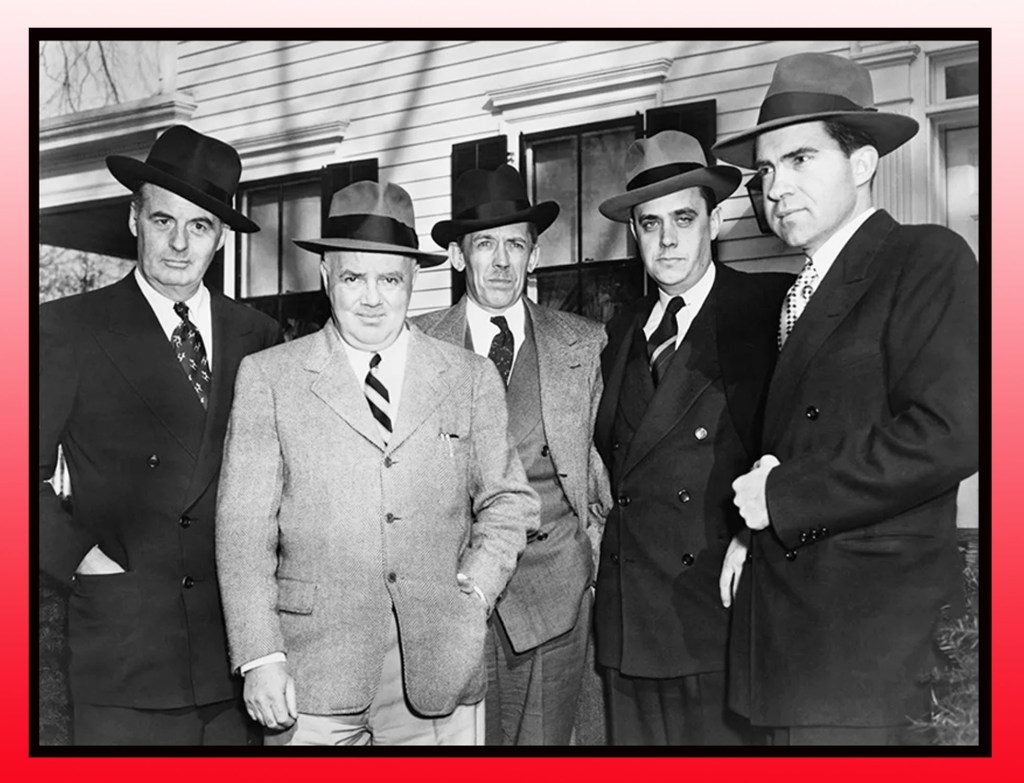

Amazon UK
https://www.amazon.co.uk/dp/B085QN73VQ

The Summer of Love. Chapter 6

By the summer of 1967 my thinking was pretty muddled.  My use of marijuana was ridiculously constant as was my smoking of ordinary cigarettes and my lifestyle was truly unhealthy.  I still harboured an ambition to have a good trip on LSD.  I had struck up a kind of business partnership with Tom Connell to produce psychedelic posters and this gave me a confidence for the future.  The war in Vietnam was happening on the other side of the world yet it was a presence in my consciousness.  I was a 20 year old male American and like many of my fellow Tam High graduates, I knew that eventually I would be called up by the draft board.  I had no game plan for this.  
   My good friend Ed Smith, who was drafted that year, told me many years later that the options seemed to be: going to college, going to Canada, going to jail or going in the army and quite probably to Vietnam.  People who were politically active like Ringo Hallinan added another option: fighting to end the war. 
Vietnam was now a major preoccupation in the media.  Daily graphic horror stories of bloodshed on both sides filled television screens across the land as the American war escalated.  David Harris, president of the student body at Stanford dropped out to fight the war and eventually went to prison for refusing to fight in Vietnam.  He was romantically linked to folk singer Joan Baez who was still politically engaged unlike her previous pal Bob Dylan who was now a hero to the dope smoking hippie movement.
   My brother Jim, partly as a way of dealing with Eddie Smith’s four choices and partly as an act of rebellion against my parents’ left wing politics, had joined the army.  He waited for his 18th birthday so that he didn’t need their permission.  I remember tearfully trying to talk Jim out of it but he had made his decision and stubbornly stuck to it.  It must have been a very bitter pill for Blackie and Beth that Jimmy joined the army but they seemed to accept it.
   My parents and all their close friends were adamantly opposed to the Vietnam war just as they had been against the war in Korea.  The analysis on the left was that the second world war had shown the political establishment that war was good for business.  So to keep the economy on a war footing they chose the Russians as the new enemy for Americans to fear.  They set about convincing the American public with powerful propaganda which was aided by the televised congressional witch hunts of HUAC and later Senator McCarthy.  The prosecutions and convictions of the Hollywood 10, Alger Hiss and the execution of the Rosenbergs augmented the feeling of terror in the land.  But that was in the 1950s.  Now in the mid-60s there was a new generation that questioned American imperialism and capitalism itself.  
   On the waterfront Blackie steadfastly refused to work across the bay in Oakland at the military bases and he was always very disappointed when those ship’s clerks who he had sponsored to work on the front took the highly lucrative labour across the bay once they made the B List.  Some of these clerks would work as many as seven days a week.  Black described them as “hungry.”
   So when brother Jim made a stopover in Seattle en route to his posting in Korea, I flew up and had a good visit with him.  I was very relieved that he was not being sent to Vietnam.  I stayed overnight in his hotel room and after breakfast the next day we said our goodbyes.  I then took the shuttle to the airport to fly back to San Francisco.   
   As I boarded my flight and turned right to enter the cabin I saw that the plane was packed with uniformed American army personnel.  I was suddenly seized with panic.  Here I was, a long haired hippie amongst all these crew-cut soldiers.  My reaction was, of course, ludicrous.  They were all young Americans about my age and I’m sure I would have got on fine but my thinking at the time was that they would be hostile.  I turned to the stewardess and asked if I could take a later flight.  She said yes and I made my way back to the departure lounge where I was told the next flight would be in a few hours.
   At this time of my life I’d had very little experience of airports  and while, later on, I would be sure to take a book to read, I had nothing to occupy my time.  Perhaps it was this which made me approachable.  A very friendly young man introduced himself to me and engaged me in conversation.  He was a devout Christian and spent the next few hours doing his very best to convert me.  We spoke of many things profound and light.  It wasn’t at all dull, as conversations go, but by the time my flight was boarding, I was still an atheist.
   As the summer of 1967 rolled on, the state of California, which had been Democrat controlled for as long as I could remember was now in the hands of an extremely conservative administration.  The previous November had seen the election of Ronald Reagan as governor which was the first time a politician from the extreme right had broken through. 


   Reagan, a movie actor, had been a lifelong Democrat and FDR supporter up until the post-war period.  When the House UnAmerican Activities Committee came to Hollywood in 1947, he jumped on the anti-Communist bandwagon and named names.  My father Blackie had met Reagan during his years as a trade union organiser and described him as a phoney.  In Blackie’s rather strict moral code, being a phoney was bad enough but to be a fink, naming people to the Committee, put him beyond the pale.  He detested Ronald Reagan.
   The new governor of California had become a darling of the extreme right wing of the Republican Party.  In 1964 Barry Goldwater ran for president on a pro-Vietnam War platform and who should be there to make a televised speech on his behalf but Reagan.  Goldwater lost big to incumbent Lyndon Baines Johnson but Reagan’s speech at the Republican convention put the faded movie star on the conveyer belt which ultimately took him to the governor’s mansion.
   He was up against Pat Brown who had been governor for many years and had even beat Richard Nixon in the previous election.  In eighth grade my class took a field trip from Edna Maguire School to Sacramento and while we were having lunch on the lawn by the capitol building, I suddenly spotted Governor Brown walking on the lawn.  At this time Vin Hallinan was defending a prisoner on Death Row named Alex Robillard.  So I walked up to Brown and asked him what was going to happen to Robillard.  The governor put his hand on my head, gazed up at the sky and said: “Well son, I’m afraid he’s going to have to die.”
   Reagan’s campaign stressed law and order which, after the Watts riots in 1965, was a popular stance with white middle class voters.  His support for the Vietnam war and his promise to lower taxes also appealed to them.  The California electorate swung his way after Brown made the mistake of comparing Reagan to John Wilkes Booth, the ex-actor who had assassinated President Lincoln.  According to the Independent Journal, more than half of Marin County voters came out for Reagan. 
   Once in office in Sacramento the new governor began cutting budgets and getting bullish about the student demonstrations on the UC campus at Berkeley.  He targeted Berkeley in particular as it was where the Free Speech movement led by Mario Savio had made headlines in newspapers coast to coast.  
   My flight from Seattle was incident-free and when we landed, I returned to my parents’ apartment on Russian Hill.  I had become more than a bit remote from my parents Blackie and Beth.  The wayward approach I seemed to take in my lifestyle must have mystified them.  But my wayward approach had its genesis in their lack of interest in my education when I was younger.  I never learned how to work at things I was not interested in which seems to be a necessary part of the educational process.  During my time at Tam High, my then girlfriend Janice Kaufman asked me what I planned to do with my life and quite frankly there was no plan at all.  When I graduated all my friends went off to college or joined the army and I went to sea.  I was seeking adventure.
   Tom Connell had suggested that I design a logo of my signature and I got down to work on it.  I remember the time that I changed my signature which read: John H. Myers from a ‘J’ with a rounded top to one in the style of John Hancock.  It was while I was in high school and my algebra teacher, Mr Davlin, used to read off the names of the marked homework sheets as he handed them back and when he got to mine he’d always say something like: “John H. Misshmeervuh.”
   It wasn’t long before I was back in Mill Valley getting high.  I made my way to the lady folksinger’s house in Strawberry.  She was always welcoming of a house full of young dope smoking fools.  It was with her and a few others that I attended another rock concert at the Mountain Theatre up on Mount Tam.  Top of the bill was Eric Burdon of The Animals.  The audience wasn’t as big as it had been for The Doors so there was plenty of room to move around.  The Master of Ceremonies was a British guy, possibly in his 50s with longish grey hair and a beard.  My folksinger friend told me that he operated an English style pub in Tiburon.  
   At some point in the proceedings a long haired fellow walked up to the microphone on the stage and spoke, amplified, to the audience:  “Eric Burdon is on STP.  It’s beautiful.”  This was the first time I had ever heard of this drug.  STP was a well known oil product for cars but clearly the hippie fellow was talking about a psychedelic.
   The front page of the Chronicle always had a story about LSD at this time.  One such article on the front page was all about a guy named Owsley who was supposed to be manufacturing the strongest acid in the Bay Area.  LSD had been made illegal in the state on 6th October, 1966.

Owsley Stanley III pictured with Jerry Garcia and Phil Lesh.

   Eric Burdon finally did appear and I don’t recall being very taken by his performance but I got chatting with a pretty young hippie woman and wound up that evening at her apartment in the Haight-Ashbury and who should be there but the older English guy who had been presenting the concert at the Mountain Theatre.  He was very engaging and clearly was having a fine time with his pick of beautiful young women.  In fact the whole scene in the Haight seemed to be a bit of a candy store for older men in search of younger female company.  I got the impression that this guy had been able to re-invent himself in America and the hippie thing, which was only a few years old, must have seemed like the icing on the cake.  I stayed the night and made my way back to North Beach in the morning.
   At this time most of the San Francisco bands lived in the Haight district.  The Quicksilver Messenger Service had a house there as did Jefferson Airplane and the Grateful Dead. 

Jefferson Airplane in the Haight district.

The Grateful Dead in the Haight Ashbury.

I remember being surprised one day at the Fillmore as the Dead arrived at the band room with a huge entourage and among them was a schoolmate of mine from Tam High, named Susila Ziegler.  I knew her as Suzanne.  She was a beautiful blonde who lived, I think, up in Scott Highlands so it was surprising to see her in the very bohemian company of the Dead.  “I’m Bill’s old lady,” she told me meaning Bill Kreutzman, the drummer of the band.  There was another person who I saw regularly with the Dead who was very loud and used to construct meaningless sentences a lot: “There are ball bearings in my soup!”  I kept seeing this guy a lot as he was always coming and going with the Dead and one day I was talking with Bill Graham when he walked by.  “Do you know who that is?” he asked.  I answered I didn’t and he told me it was Owsley.
   The previous year I remember seeing author Ken Kesey at the time he was famously on the run from the law.  He was standing by the Merry Pranksters bus which was parked on the corner of Steiner Street.  I recognised him from photos in the Chronicle.  He had very short hair and was dressed casually but was wearing brogues which were an unnaturally bright orange colour.

From left: author Ken Kesey, Merry Pranksters bus and Kesey inside it.
   Kesey had been involved in The Trips Festival which was the very first manifestation of the psychedelic dance concerts which Bill Graham and Chet Helms later produced.  The venue for The Trips Festival was the Longshoreman’s Hall down near Fisher-man’s Wharf.  It was early in 1966 and I attended.  It was the first time I ever saw Bill Graham who struck me as having a very serious face juxtaposed with a Frankie Avalon hairdo.  This was where the first light shows were tried out, later to be perfected at the Fillmore and Avalon Ballrooms.

Early poster art for The Trips Festival and a photo of Quicksilver Messenger Service playing at it.


   But that was back at the beginning of the scene and now was the summer of 1967.  I had not a clue that I was on the brink of the biggest disaster of my young life.

To be continued…

Amazon USA
https://www.amazon.com/dp/B085QN73VQ


Amazon UK
https://www.amazon.co.uk/dp/B085QN73VQ