“A Scramble For Guidance…”

Previously in Miller Avenue Musings:  My sister Nell had visited from London with her one year old son Poggy.  It was a very happy occasion and I made plans to go back to work on the San Francisco waterfront to save for a trip to London. 

All through my madness I’d been high as a kite, confident and sure of myself, but now the hubris began deserting me.  Doubt and darkness settled on my shoulders like ashes from above.  In coming down from the tremendous high of thinking I was the messiah, here to save the world, I kept on going down into what would prove to be a total nervous breakdown.  I had never contemplated such a fate and suddenly I was trapped within its walls.  There was no talking my way out of this one.  It wasn’t going to be better in the morning.  I gradually became separate from the world around me.

   There were still small slivers of light.  My old friend popular music continued to look after me.  The record player in my bedroom was constantly in use and I had a sizeable collection of LPs that I listened to.  Before I went crazy I had purchased the album Are You Experienced by the Jimi Hendrix Experience.  The Beatles record All You Need Is Love came into the Top 40 and I heard it on the radio but on my record player I listened to the Hendrix disc over and over.  

   The late Jimi Hendrix is mostly remembered for his electric guitar playing but as I listened over and over to that album I concentrated more on his words.  The subject matter in Hendrix’s lyrics dwelt on psychological problems, things I was beginning to experience.  One song was entitled Manic Depression and in it he described being unable to adapt to the world around him.  Manic depression was a concept I’d known nothing about.  I was, however, sliding into the grip of a severe manic depression.  So I immersed myself in the wailing music of the Jimi Hendrix Experience.   
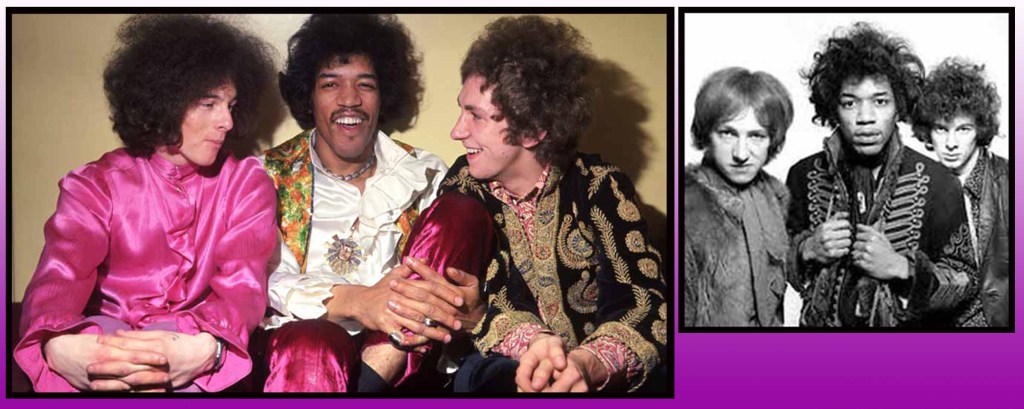
The Jimi Hendrix Experience featured bass player Noel Redding and drummer Mitch Mitchell.

   When I first saw Hendrix’s trio play at the Fillmore and on a flat bed truck in the panhandle, his hit on the radio was Purple Haze.  Now when I listened, I heard his lyrics in a very different way.  Whatever the Purple Haze was, he didn’t seem happy that it was physically surrounding him and he plaintively cried “Help Me,” a few times during the song.  I didn’t wonder at the time if he too, had had a nervous breakdown but his lyrical disposition on that album’s material lead me to conclude that he had.  The song I Don’t Live Today articulated perfectly my mental condition in the months to come as the emotional distance between myself and the real world grew and grew.  

The image of the Jimi Hendrix Experience was carefully created and nurtured by their manager, ex-Animal, Chas Chandler.

     The world outside my bubble of depression continued to turn in spite of the fact that I knew nothing about it.  The Vietnam war was dividing the nation in a big way and President Johnson’s policy of bombing North Vietnam was losing him support within the Democratic Party.  After Johnson’s re-election as president in 1964, Bobby Kennedy resigned as his attorney general and became a critic of the Vietnam war.  I remember a good friend predicting that Bobby would make ending the war his cause as a pathway to the presidency.  Maybe that is what he would have done had he lived until the next election.  

   But for now Johnson was committed to bombing North Vietnam though, in the oval office, he seemed to be trapped between hawks and doves.  In early September he denied there was any division within his cabinet about war tactics.  The press was reporting that Defence Secretary Robert McNamara was in conflict with military chiefs who wanted him to escalate the bombing but at a hastily convened press conference Johnson denied this.  A reporter asked Johnson if McNamara had threatened to resign if the bombing was stepped up and the president described that as “absolutely” untrue.  “That is the most ridiculous report I have seen since I became president.”
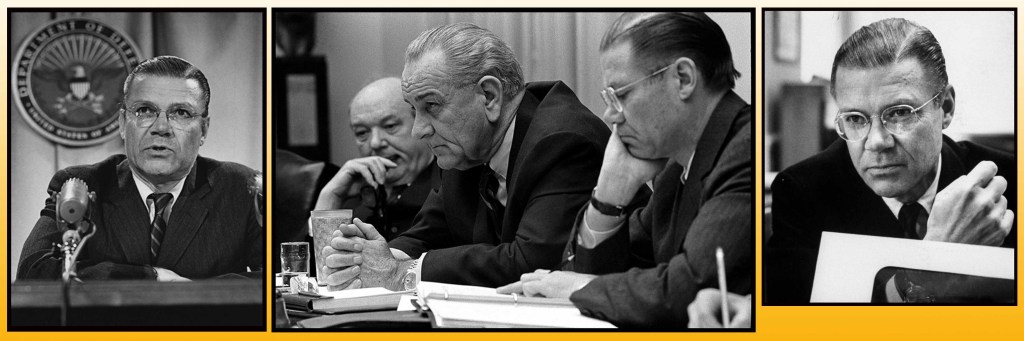
Three photos of President Johnson’s Secretary of Defense Robert McNamara. Pictured in the centre photo is Secretary of State Dean Rusk, Johnson and McNamara.

  But not all the criticism was coming from his own party.  George Romney, the Republican governor of Michigan became critical of the war.  Romney was positioning himself for the nomination to be the Republican presidential candidate in 1968 but he was not alone in that ambition.  Ronald Reagan, who had become governor of California also had his eye on this prize.  

George Romney was the governor of Michigan who, along with Ronald Reagan, sought the Republican presidential nomination for 1968.

   In pursuit of the presidential nomination, Reagan stated that the U.S. should be prepared to use nuclear weapons in Vietnam, echoing opinions expressed by Barry Goldwater in 1964.  Such talk was popular with gung-ho supporters of the war.  As governor, Reagan was a passionate slasher of budgets and his recent cuts to the Medi-Cal program for the poor were ruled illegal by a superior court judge.  Blackie had met Reagan back when he was a Roosevelt liberal and judged him, at that time, to be a “phony.”  Of course Reagan had shed his liberal credentials in 1947 when the House Un-American Activities committee came to Hollywood.  He jumped on the anti-Communist bandwagon, testified to the committee and sang like a bird to the FBI naming many names.

   But that was 1947.  Twenty years later in 1967 and Reagan was now governor of California.  His rival Romney was out on the trail drumming up support for his own nomination and probably should have chosen a different venue for his outdoor breakfast than Watts, the area of Los Angeles which had seen serious race riots in 1965.  Two articulate young black men, Tom Jacquette and Lou Smith, grilled him relentlessly on several issues, one being his support for Ronald Reagan’s cuts to the Medicare programme.  The two young men put Romney squarely on the defensive.
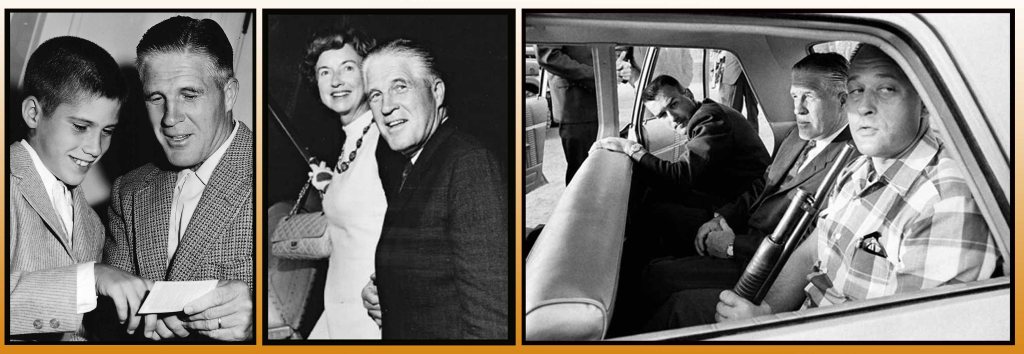
Governor Romney with his son Mitt, his wife Lenore and sandwiched between two armed police officers as he visited the site of the Detroit riots in 1967.

   In early August, nineteen Tam High students from Marin City headed for Los Angeles to attend the second Watts Summer Festival held to commemorate the riots which had occurred there.  “The whole purpose of this trip,” said Lanny Berry, leader of the six-day trip, “Is to show the Negro kids how many constructive self-help programs have developed in Watts.  The festival is one of them.”

   Helping Berry organise the self-help trip was Douglas Quiett, also from Marin City, and now a group counsellor at Marin Juvenile Hall.  Quiett, had organised the picketing of two Mill Valley realtors for CORE in 1963 as they were not obeying the recently passed Rumford Fair Housing Act.  

   The forces of racial separation were not going to let the Rumford Act go unchallenged.  A group called Americans to Outlaw Forced Housing  initiated a petition to repeal the Rumford Act and the Marin County Real Estate Board decided to make the petitions available through their office.  Though their spokesperson denied that the board was endorsing or condemning the repeal initiative, their supply of the petitions was seen as an endorsement.  Enough white voters in Marin and other counties in California went to their real estate board offices to collect and sign the petitions which put Proposition 14 to repeal the Rumford Act on the ballot that November.  The proposition was then passed with a majority of over 1.5 million votes.

   The passage of Proposition 14 highlighted a deeply engrained racial bias in the white majority of the state of California.  The Los Angeles Times endorsed  it, saying that housing discrimination was a “basic property right.”

The fight to defeat Proposition 14 was ultimately unsuccessful.

   However, Proposition 14’s passage into law hit two major obstacles.  First the California Supreme Court in May of 1966 overturned the measure and then the U.S. Supreme Court ruled in May of 1967 that California voters had violated the federal constitution in 1964 when they overturned the state’s open occupancy laws.
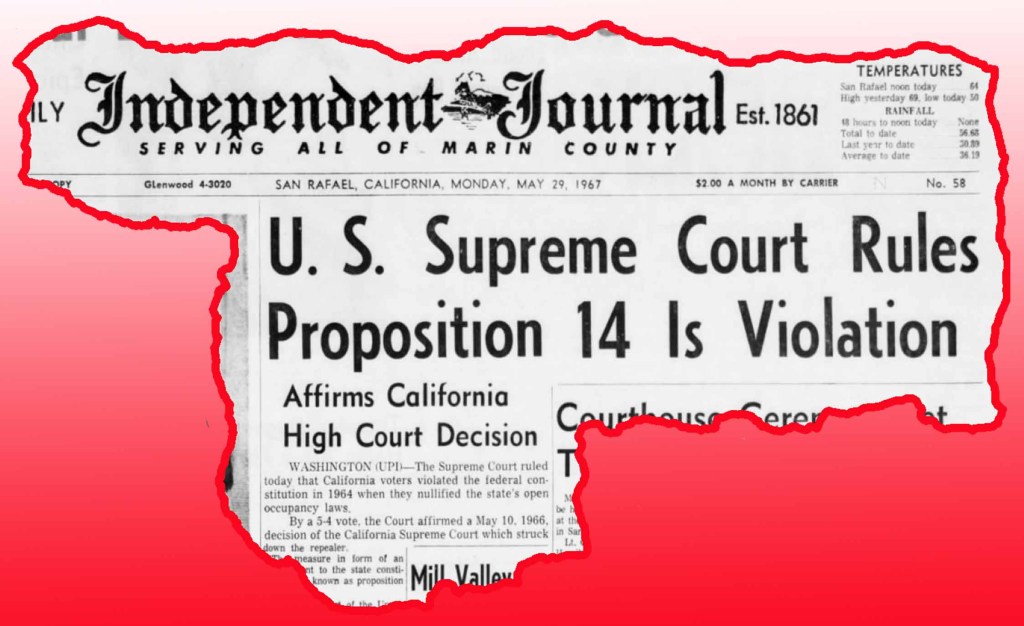
The Independent Journal’s headline announcing the U.S. Supreme Court’s decision that proposition 14 was a violation of the constitution.

   Ronald Reagan, as part of his campaign for election as governor in 1966, had supported outright repeal of the Rumford Act.  In the light of the Supreme Court’s decision in Washington, he modified his approach.  Speaking to the California Real Estate Association at their conference he promised to work for repeal of the act or to change it to the point “where it was no longer discriminatory and oppressive.”  Reagan denied any racism on his part, saying that his objections to the act should not be taken “as endorsement of bigotry and prejudice or the practice of discrimination.”  However his words, objecting to the Rumford act, sent a coded message to white people all over the state who wanted to keep black people out of their whites only towns.
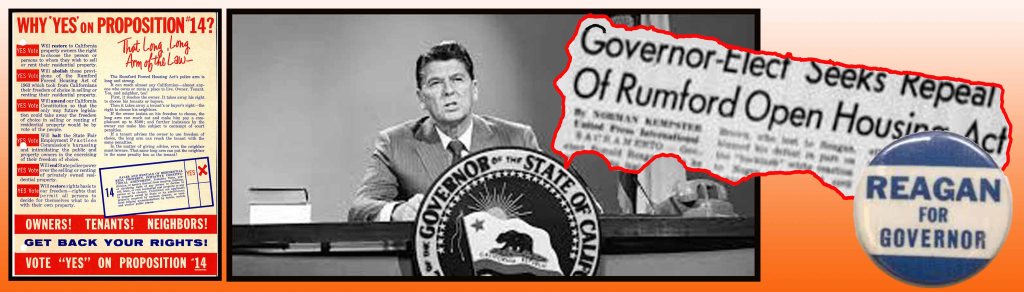
Ronald Reagan made his opposition to the Rumford Act a key part of his campaign to become Governor of California in 1966.

   Apart from the Collins family who lived high up on Summit Avenue, Mill Valley was just such a whites only town during my childhood there.  It wasn’t until I got to high school at Tam in 1961 that I encountered black students from Marin City.  The tough black guys congregated in the inner restaurant section of The Canteen, a building which stood across the street from the lower gate entrance to the back parking lot.  At recess, students who smoked all went through that lower gate to light their cigarettes off campus.  The white students stood around the front of the Canteen while the black students gathered inside the restaurant section.  This organic apartheid between tough white guys and their black counterparts meant they didn’t mix socially.    

   An appreciation of recent local history was not prevalent in Mill Valley at this time.  I had heard my parents say that Marin City came about as housing for ship builders during the war.  What I didn’t know was that prior to world war two there were no black people in Marin County at all and that many had come north from the deep south to work at Marinship during the war.  Once the war was over the employment vanished.  This migration probably explained why the kids from Marin City all spoke with southern accents.  

   On his first day as a freshman at Tam High, a good friend of mine from Mill Valley was attacked by a black male student in the boys’ locker room.  Thinking my friend had made rude remarks about him, the black fellow, who was bigger, punched him in the face repeatedly.

   During my sophomore year I shared a gym class with my good friend Jared Dreyfus.  At the end of class a black guy picked up Jared’s towel and walked to his locker.  Jared went over to him and said it was his towel.  The guy gave it to him and no more was thought of it.  When Jar and I left the locker room and came around the corner, there was this same black guy with two friends standing behind him.  “You called me a ni**er!” He shouted and threw a punch at Jar.  The punch landed on Jared’s arm as he raised the binder he was carrying to shield his face.  Jared shouted loudly: “I didn’t call you anything and I’m not going to hit you back!”  The guy made his accusation again and landed another punch followed by Jar repeating his shouted statement.  This went on for about four more punches.  Finally it stopped and the black student and his friends walked away.  

   The N word was highly emotive.  I recall one Sunday afternoon at the Sequoia when a group of about five black kids from Marin City attended for the movie that was on.  Sunday matinees at the Sequoia were never full and this group of black kids were pretty noisy so I could hear clearly what they were saying between bits of film.  They were using the N word a lot, calling each other by it.   But if a white person was to use that word there would be trouble.  Whenever there was racial tension at Tam High it usually started because someone had scrawled the N word on the inner wall of the Canteen.
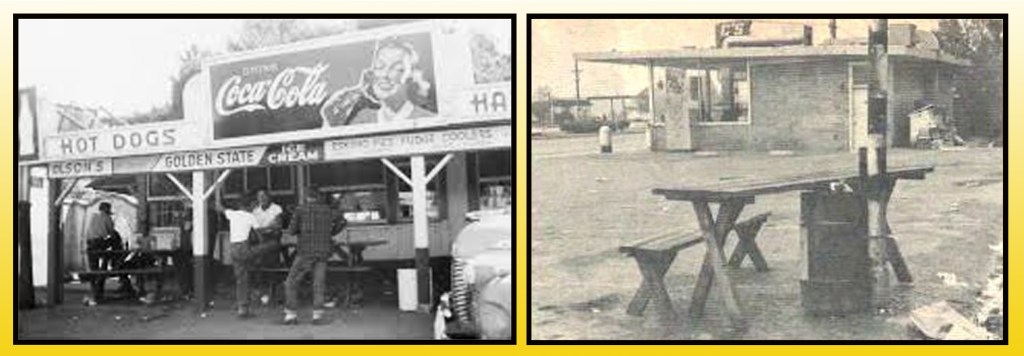
Two hangouts for tough students at Tam High. On the left is The Canteen and on the right is C’s Drive-In on Miller Avenue.

   C’s Drive-in, just up from Tam High on Miller Avenue, was where the tough white guys in Mill Valley hung out.  Most greasers drove their cars to C’s and when racial tension was in the air, the white tribe would gather at the drive-in.  If the fights occurred at school they were usually in the back parking lot near the Canteen.  And a fight would bring cop cars from all over the county with sirens wailing. 

   The N word was never uttered in the Myers household.  My mother Beth was a passionate anti-racist and would not tolerate such talk.  She had been to the deep south as a journalist and had actually witnessed lynchings of black people so she had no illusions about where the attitudes of racism could lead.  

   We always knew about the Collins family being the only black people in Mill Valley but, though Chuck Collins and I were the same age, I didn’t actually become friends with him until late in my time at Tam High.  Chuck didn’t speak with a southern accent like the kids from Marin City.  His dialect was the same as all the others in Mill Valley.  He had gone to Old Mill School at the same time that I went to Homestead.  When I finally did get to know Chuck, we had a conversation in which he told me just how painful it was to hear a white person use the N word.  I have never forgotten that conversation.  Also lodged in my memory is the Lenny Bruce routine he performed in a nightclub in which he used not only the N word but every offensive epithet to describe Jews, Italians, Puerto Ricans and any other minority group.  The point he was making was that if you took the poison out of the word you were left with just a word.  However what Chuck had said has kept me from ever using the N word.  

   But here I was listening over and over to the music of Jimi Hendrix.  I was looking for guidance in the words he sang: asking if I was experienced and somehow it seemed like a challenge.  I took his words about “coming across to him” as a dare to go to England.  I looked for guidance and somehow found it in the lyrics of Jimi Hendrix.

   But to get the money to travel to England I would have to go back to work on the waterfront and that meant getting myself into shape psychologically.  I had moved into a new phase of my craziness in which it became necessary to disguise my inner thoughts.  Blackie would have to be satisfied that I wasn’t crazy anymore and that wouldn’t be easy.

To be continued…
Amazon USA
https://www.amazon.com/dp/B085QN73VQ
Amazon UK
https://www.amazon.co.uk/dp/B085QN73VQ

A Descent Into Darkness

Previously in Miller Avenue Musings:  After spending several weeks as a day patient at a San Francisco clinic, I finally started coming down from the drug which drove me crazy.  Coco Cutler, a family friend with an interest in psychoanalysis, befriended me.

Unlike my parents, Coco could relate to the state of mind I was in.    She leant a sympathetic ear to me and it was a huge help.  I soon became a regular visitor to her apartment on top of Telegraph Hill.  I learned that she was plugged into the scene that Blackie’s friend Lew Welch was a part of.  Allen Ginsberg, Lawrence Ferlinghetti and Alan Watts were among her acquaintences.  But she was nothing like a beatnik at all.  Prim, proper, elegantly spoken and with a physical beauty which benefited from growing old gracefully.  

   Coco was, like all my parents’ friends, a person of the political left and had been married to another of my family’s acquaintances, Al Richmond, who wrote for the People’s World newspaper.  I never knew exactly what office job Coco did, but many times I saw her wearily climbing Telegraph Hill after a day’s work.

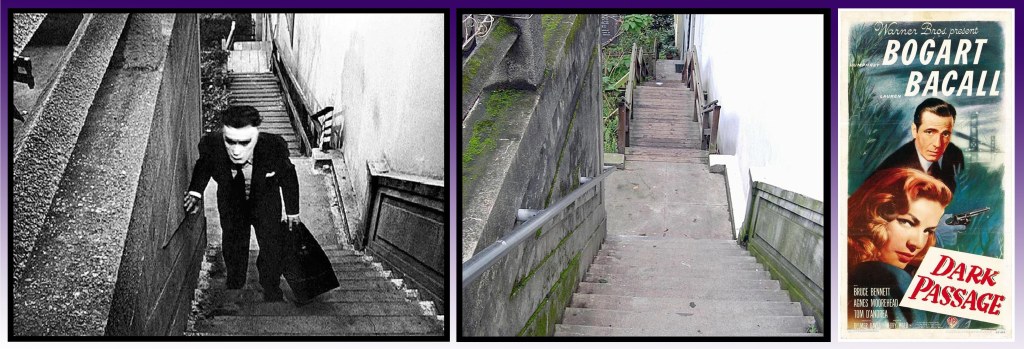
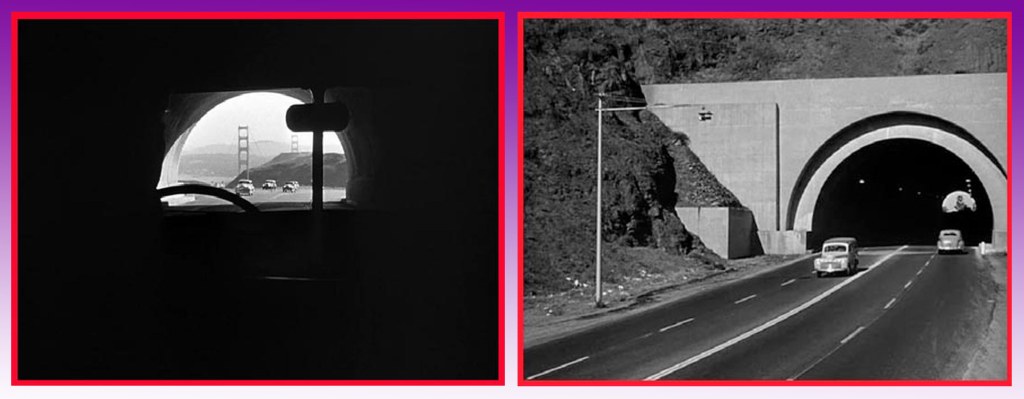
   Sometime in 1966 I discovered a small movie theatre in North Beach which showed a lot of old Humphrey Bogart pictures which   I had a particular fascination for.  I saw Casablanca, To Have And Have Not, Beat The Devil and a movie which completely entranced me because the opening scenes featured Marin County locations.  I’ve always found the joy of recognition to be a powerful emotion and the film Dark Passage began with an escape from San Quentin prison.  We saw the fingers of the escapee gripping the rim of a barrel he was inside of, on the back of a flat bed truck.  He made it rock back and forth as the truck drove away from the prison and the sound of police sirens began to wail in the distance.  The barrel then tumbled off the truck and rolled down a steep hill.  The escapee soon found beautiful Lauren Bacall who hid him in the back of her woodie vehicle.  Seeing the hills of Marin behind all this action was terribly exciting to me and soon Lauren Bacall’s woodie was going through the tunnel on Waldo Grade.  All the cars were from 1946.  She crossed the Golden Gate bridge, ending up at her apartment on Telegraph Hill.  At some time during a visit to Coco’s flat I must have mentioned this film and it transpired that she had seen them shoot a scene right outside her apartment.

When this film was shot there was only one two-way tunnel on Waldo Grade.

Ms Bacall’s woodie crosses the Golden Gate Bridge. We then see her apartment on Telegraph Hill.

   The neat trick that Dark Passage pulled off was that we never saw Bogart’s face until he wound up having plastic surgery.  With a big bandage covering his face, he staggered up the steps at Filbert Street to Bacall’s apartment on Telegraph Hill.  This was the scene that Coco had witnessed the filming of.  She told me she felt very sorry for Bogart who had to repeat the climb many times as they shot take after take.  

On the left we see Bogart climbing the steps in 1946 and the same steps today.

   Dark Passage was an intricately plotted thriller which combined good writing with excellent acting.  Directed by Delmer Daves, it fell into a category that French film critics would, after World War 2, christen film noir.  This phrase described Hollywood films which were absorbed by darkness and pessimism.

   Darkness and pessimism were two realities that I was slowly descending into.  I had been incarcerated in Napa State Hospital from the middle of July until the first week of August when my father got me discharged because of a suicidal inmate who took against me.  All the time I was there and for many weeks after, I was in my own universe with practically no interest in or knowledge of what was going on out in the real world.  When I got back to my parents’ apartment, I didn’t read the Chronicle or watch the news.  I listened to pop music on the radio but that was the limit of my intake.

   By August the race riots across the country had simmered down and President Johnson established a senate judiciary committee to investigate the causes.  Michigan governor George Romney who, at the outbreak of the riots in Detroit, had asked Johnson to send federal troops to the city, now criticised the president for playing politics with the issue.  Romney, though a Republican with an eye on the presidential nomination of 1968, also came out against the Vietnam war.

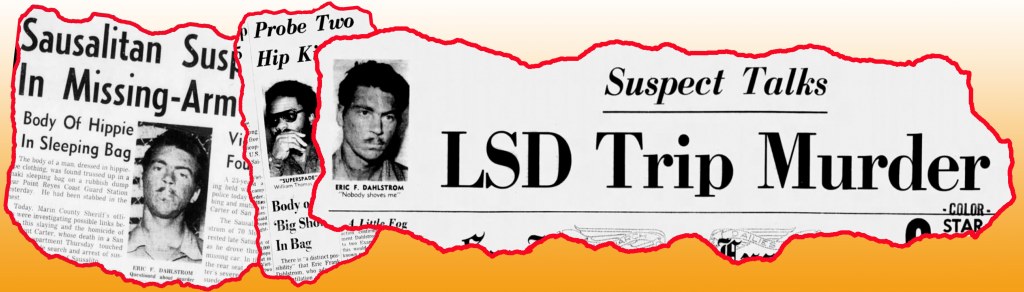
   The summer of love was thought to be all flower children and peace.  However a pair of gruesome murders occurred which contradicted that image.  They involved both the Haight Ashbury community and Marin County.  The dead body of known drug dealer, Willam E. Thomas, referred to in the Haight as Superspade, was found trussed up in a khaki sleeping bag on a steep cliff near the Point Reyes Coast Guard station.  He had been stabbed in the chest and shot through the head.

   Five days earlier the dead body of Haight drug dealer John Kent Carter, was discovered in his San Francisco apartment.  He was found  lying on a mattress with a dozen stab wounds and his right arm severed and missing.  San Francisco police issued an all points bulletin for the arrest of Eric Frank Dahlstrom, 23, of Sausalito.  Dahlstrom was well known as a motorcycle racer at tracks like Cotati and Vacaville.  He had a reputation for  superb skill and reckless behaviour.  Officers in Sausalito immediately checked his parents’ house on Monte Mar Drive and found Dahlstrom’s car in the garage with its licence plates missing.  It was nearly 11 pm on a Saturday night when the Sausalito police added Dahlstrom’s plate numbers to the APB for his arrest.  Twenty minutes later on a street in Sebastopol, patrolman Charles Baker spotted a car with those same plates.  He turned his red light on and pulled the car over.  Knowing the APB was for a murder, the officer approached the vehicle with his gun drawn.  Dahlstrom, however, surrendered without resistance.  In the back seat of the vehicle officers found, wrapped in blue suede, the severed forearm of John Kent Carter.

   Eric Dahlstrom was not shy about telling the story of Carter’s murder to assembled reporters at San Francisco police HQ.  He said that he had killed Carter while under the influence of LSD and that he had considered dismembering the body.  According to Helix, a Seattle underground newspaper, Dahlstrom was undergoing an “Olympics-calibre bummer caused, he believed, by inferior-quality acid” which Carter had sold him.  Offended, he went to Carter’s to discuss it.  During the discussion, Dahlstrom said, Carter shoved him.  “I got shoved,” he told reporters.  “Don’t nobody shove me.”  The Helix account continued: “Dahlstrom grabbed up a 12-inch kitchen knife and stabbed him rapidly 12 times, most of them fatally.  He undertook to dismember the body , but gave it up after neatly amputating the right arm above the elbow.  He wrapped the arm in blue suede and split with it, taking also a .38 pistol, $3,000 Carter had assembled to give to an acid wholesaler called Superspade.”

   At first it seemed that there might be a connection between the murder of Superspade and John Kent Carter but as time passed, investigators concluded that they were separate incidents.  Earlier that week Dahlstrom had been to Slide Ranch where he kept a motorcycle.  His behaviour was strange and he was asked to leave because he was “acting goofy.”

These murders inspired sensational headlines in the press.

   This story, which was covered extensively by all the bay area newspapers, passed me by completely.  Weekdays I spent at the clinic run by Dr. Weinberg which had a calming effect on me.  I attended my sessions at the clinic for four or five weeks and when that time was up, the darkness began to claim my soul.  My spirits had been fairly up beat until that time.  Coco’s friendship became very important to me during this time.

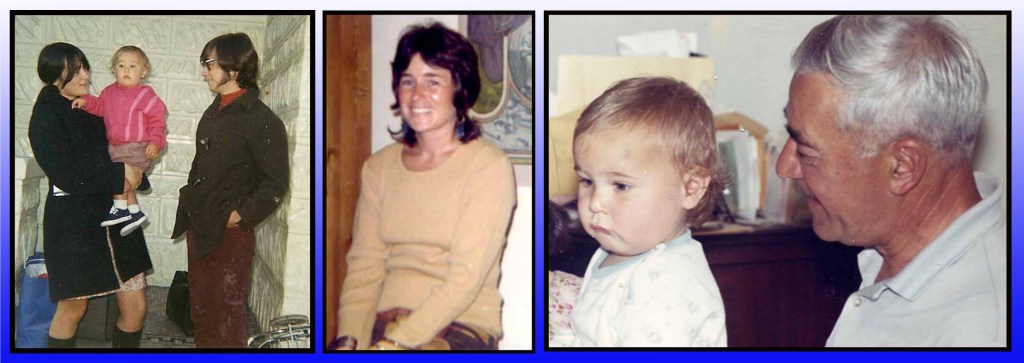
On the left is Dr Art Weinberg who ran the day clinic I attended. In the centre and right are two pictures of Coco Cutler in 1943 and 2002.

   Somewhere in the midst of all this, my sister Nell visited from London with her one year old son Michael who we all called ‘Poggy.’  He was a beautiful child and having him there took me out of myself which must have aided my recovery.  Nellie looked terrific and had taken to the role of young mother with gusto.  Nellie’s new motherhood forged a strong link with sister Kate who was so excited about young Michael/Pog.  During the few weeks they were with us, Poggy began to walk, a process which started as a balancing act between his two feet.  From my bedroom I would hear a single thump in the hall.  Then after a pause a second thump.  After a third thump I’d hear a series of them up to my bedroom door which he’d then push open.

   Young Poggy was also forming his first words.  While out walking with them one day, we found ourselves at the bottom of Russian Hill where Union meets Columbus.  The sight of a dog across the street in Washington Square caused Poggy to point and make a breathy sound similar to the noise we made as children to simulate gun fire.  It sounded like deoggggh.  It bore a striking resemblance to the word dog.  It was a very exciting moment.

On the left: Nellie, Pog and myself; My sister Katie; Poggy with my father Blackie.

   It was also exciting for me to see how animated my sister Katie was in becoming an auntie to little Pog.  Both my sisters had gone to university and dropped out after their second year.  Nell had gone to San Francisco State and Katie to University of California at Berkeley.

   My two sisters were very different people and until Nellie arrived for her visit it was Katie who had been such a good friend to me.  Practically every excursion I took in the city after I left Napa was in her company and she looked after me.

   When we were kids it was always Katie who was the peacemaker of the family.  Nellie and I were the temperamental two and brother Jim was kind of neutral.  Katie always looked on the bright side of any problem and usually found a happy solution.  

   Politics played a big role in all our lives.  The society we were growing up in was gripped by the anti-red hysteria of the McCarthy era.  Even being politically liberal was seen by the federal government as highly suspicious and my parents and all their close friends were far left of liberal.  So we were aware of a difference to most of the kids we went to school with.  Of the four of us only Nellie seemed to gravitate towards active political participation.  I was interested but seeing how the federal government operated scared me.  Family friends Fred Field, Alvah Bessie, and Vin Hallinan all did time in federal prison and I always worried that the same fate could take Blackie and Beth away from us.  The execution of the Rosenbergs in 1953 sent a shiver through people of the left and I found it terrifying.

   So the politics of the day affected each of us four Myers kids.  Jim wound up rebelling against my parents’ values by joining the army.  Once he was on the inside and realised what he’d done, he got himself involved in the stenography corps and never went to Vietnam.

Three photos of my brother Jim. On the left with myself and good friend Augie Belden. In the centre with our cat Totem and on the right a shot, later in life, with sister Kate and myself.

   Having Nellie around made me contemplate a trip to England.  All my travelling had been in the other direction, across the Pacific when in actual fact I had always longed to visit London.  Blackie said that when I was well enough I could go back to work on the waterfront, so a little bit of structure entered my life.  The idea of working on the front and saving enough to make a trip to England gave me a goal.

   When I was in high school, Nellie was sharing an apartment on Greenwich Street with like minded socialists who were politically active.  The two main issues they were most concerned about was racism and the war in Vietnam.  I remember going with Nellie to a demo at the Masonic Auditorium on California Street where an openly racist organisation was holding a conference.  It was night time and demonstrators were lying down in front of the vehicle exit to try and stop the people leaving in their cars.  I don’t recall exactly what played out.  I think an arrest was made but after some negotiation the demonstrators agreed to let the racists drive their cars out of the underground car park without fanfare.

   Nellie saw a lot of the Hallinan boys during this time and was involved in many demonstrations.  There were sit-ins at car showrooms on Van Ness, the Sheraton-Palace Hotel, Lucky Supermarkets and famously at Mel’s Drive-In on Geary.  Nellie got herself arrested on a few occasions.  Ringo and Dynamite Hallinan were often at the apartment on Greenwich Street.  

   Though Nellie and Katie had similar experiences with their time at university, Nellie gravitated towards politics and Katie, when she decided to drop out of Cal Berkeley, went to work in a bank in the financial district.  I remember that, in addition to renting an apartment with her boyfriend Lonnie, Katie actually got herself a credit card which was quite a first for someone from the Myers family.  Blackie had always been highly suspicious of the concept of credit, but I remember Katie being so matter-of-fact about the credit card and don’t recall any fuss about this with Blackie and Beth.  Katie was always highly responsible with both of them and they appreciated it.  It was just a decision on her part to improve the quality of her life.

   Nellie did, after she dropped out of SF State, go to work for a shipping company run by the Kiskaddens who were good friends of my parents.  When she eventually went east to visit family friends in and around New York, it was on one of Kiskadden’s Norwegian ships, The Torvanger, on which she made the final voyage to London.  This would be the very same ship that I went to sea on after I graduated from Tam High.  

  In London Nellie quickly found herself involved in left wing politics and met, fell in love with, and married Trevor Hyett. Trevor was the father of Michael/Pog who was visiting us in San Francisco.

   So these happy events occurred at the same time that I was beginning my descent into the deepest depression of my young life.

To be continued…

Amazon USA
https://www.amazon.com/dp/B085QN73VQ
Amazon UK
https://www.amazon.co.uk/dp/B085QN73VQ

A Flip of the Lid, chapter 8

It was July, 1967 in San Francisco and I was now in my second day of madness, having taken what I believe was a dose of the dangerous drug STP.  I was possessed by a conviction that there was someone coming to see me who I was meant to meet.  Having gone to the Haight Ashbury district with my father Blackie in the hope of meeting this person, I gave up after half an hour of wading through an ocean of hippies.  Back at our apartment in North Beach, I decided to go out for a walk.

   I wandered down Union Street to Washington Square and turned right on Columbus, passing many Italian restaurants, crossing Broadway with its topless nightclubs and City Lights, the best bookshop in North Beach.  I made my way to the mini flat-iron Columbus Tower building on the corner of Kearny.  There was a Zim’s Burger bar on the ground floor which I always enjoyed eating at.  But a Zim’s burger was not of interest to me on this occasion.  I made my way up to the second floor and paid a visit to Bob McClay at the Tempo office.  I had met Bob through my friend Jo Bergman who was working with him and Sue Cox at Tempo earlier in the year.  

   Tempo was a tip sheet for top 40 radio stations and it was owned by legendary disc jockey ‘Big Daddy’ Tom Donahue.  Sue and Bob had produced the weekly tip sheet and Jo answered the phones and ran the office.  

Three photos of Bob McClay and a visual of the TEMPO Top 40 tip sheet

   Sue (now Susan Kirk) remembers: “McClay wrote the articles choosing whatever topic he deemed current and important about the music scene.  I chose the new records and reviewed the latest hits and artists.  We mailed 45’s from the week’s pick to over one hundred radio stations across the US and around the world.  DJ’s didn’t have access fast enough like we did so we really did radio a great service.  The artists benefited from what we did, getting their latest recordings on the air.”

   Tom Donahue had hired Sue, she remembers, because she had “a great ear for hits and Tom knew it.  As a boss Tom was exacting in what he wanted but was pretty hands off.  My dear friend Carl Scott who knew Tom well moved into the office above Tempo in Columbus Tower.”  

San Francisco DJ “Big Daddy” Tom Donahue pictured in centre with record producer Phil Spector and Righteous Brothers vocalist Bill Medley.

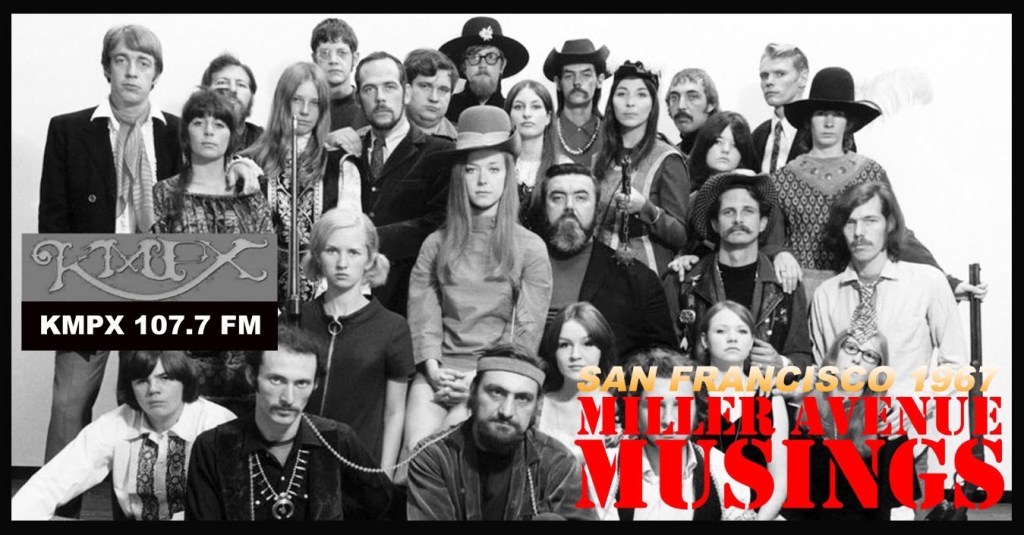
   Bob McClay was also now presenting a regular program on FM Radio KMPX.  I had visited him at the studio on Green Street about a month earlier while he did one of his shows.  I’d never been in a radio studio before and enjoyed chatting with him while the records played.  Clearly Bob had some experience in this line of work.  He was much more of a disc jockey than Larry Miller who I had first listened to on the station.

   In fact KMPX, which started its hippie output with Miller early in 1967, had now been transformed by Tom Donahue.  KMPX, had previously specialised in foreign language programming and had sold Larry Miller the graveyard slot of midnight to 6am.  His radio voice was friendly and unpretentious and the records he played were an interesting mix of folk, rock and blues which soon attracted a sizeable hippie audience for the FM station.  There was at this time a big distinction between AM and FM radio.  AM had a larger wavelength whereas FM stations were less mainstream.

   So Tom Donahue went to the management of KMPX and proposed that he would present the eight to midnight slot and that they should switch to 24 hours of the kind of music that Miller was playing.  They agreed and Bob McClay was one of the people Donahue recruited to the station.

From left: Bob McClay, Larry Miller, Tom Donahue at KMPX and at KYA with John Lennon.

   Though I was a regular listener to Miller’s show on KMPX I still listened to Top 40 which at this time was KFRC.  I had listened to pop music stations ever since I first discovered Radio KOBY in 1956 when I was nine years old.  Early Elvis, Pat Boone and Harry Belafonte hits kept me listening.  1950s pop was a very  broad church incorporating Perry Como, Rosemary Clooney and the big band sound of Elmer Bernstein. That station carried me through grade school into junior high when it was superseded by KEWB.  They played hits like Bobby Darin’s Mack The Knife, Poison Ivy by the Coasters and Misty by Johnny Mathis.  After The Beatles came along in 1964 and dominated the charts for a long time, KEWB suddenly found it had a rival in KYA.  Soul came into the mix with two stations: KDIA and KSOL.  From 1966 on it was KFRC that I listened to and by this time most soul artists were making the charts: Aretha Franklin, Marvin Gaye, The Four Tops, James Brown, Stevie Wonder and many more all crossed over to become Top 40 stars.  And up until his departure in 1965, Tom Donahue was one of the most popular DJs on KYA.

   Of course Donahue was an old fashioned Disc Jockey who had “Top 40” running through his veins.  Back when he was on KYA he would rattle off patter like: “It’s 2.20 KYA Home of the Hits time here at twelve sixty on your radio dial and here’s Sam Cooke with…”  But now on the hip FM station, he slowed things right down with his mellifluous deep voice: “You’re listening to KMPX where we’re changing the world.  That’s right man, we’re changing the world.”

From left: Tom Donahue when he first arrived at KYA in 1961, with Bill Graham in the late 1960s and a ticket for the final Beatles concert which he produced.

   An extremely big man in every sense, Donahue established himself as a DJ during the 1950s on station WIBG in Philadelphia.  In 1961, in the wake of the payola investigations which damaged many of the reputations of East Coast DJs, Donahue arrived at KYA in San Francisco where he was an instant hit.  In partnership with fellow DJ Bobby Mitchell, he formed Tempo Productions, putting on record hops and concerts.  They branched out into other businesses, forming a record company, opening a North Beach night club and investing in thoroughbred horse racing.  Donahue departed KYA in 1965 but stayed on in San Francisco to oversee his many business interests which included producing The Beatles final ever concert at Candlestick Park on August 29th, 1966.

From left: Ralph Gleason with the Beatles, Paul McCartney and Joan Baez, Lennon, Harrison & McCartney going on stage at Candlestick Park.

   Sue Cox remembers that she, McClay and Bobby Mitchell were all involved in the production of that final Beatles performance.  “Carl Scott and I stood 50 feet from the stage on the ground and wept together when they ended the concert.”

From left: The Fab Four crossing the baseball field, a poster for the event, Sue Cox pictured with Ringo and Wes Wilson’s poster for the concert.

   I never got to know Tom Donahue but met him in McClay’s office a few times.  Extremely tall and physically very weighty, I would see him around town, sometimes visiting Bill Graham at the Fillmore.  He made the transition from fast talking top 40 DJ to mellow presenter of folk and rock album tracks on FM radio.  Having grown a beard sometime during his tenure at KYA, Big Daddy now had very long hair as well but he didn’t convince my hippie friends in Marin that he was one of them.  

   All my friends and I were in our early twenties and considered the age of thirty to be very old indeed.  One friend sarcastically listed the three most important people in the hippie scene: “Bill Graham, Tom Donahue and Ralph Gleason.”  Bill was 36, Tom Donahue was 39 and Ralph Gleason, the jazz critic on the Chronicle was 50.

   Bob McClay, however, was a different kind of person altogether.  He was much more of a genuine enthusiast than a businessman.  Both McClay and Donahue were older than me and had been part of the beat generation.  Of course smoking weed had been going on forever but it always occurred in the mysterious world of beatniks and jazz musicians.  It wasn’t until the hippie era that it came out into the open.  I remember a pre-hippie article in MAD Magazine in 1960 in which Wally Wood drew fabulous pictures for a hip version of The Night Before Christmas.  It featured a Santa Claus with dark glasses and a very thin cigarette between his lips.  It opened with:  ’Twas the night before Christmas, and all thru the pad, Not a hipster was stirring, not even old Dad.  The chimney was draped in that stocking routine, in hopes that the fat man would soon make the scene.

A few of the fabulous illustrations by Wallace Wood for MAD Magazine’s hip version of The Night Before Christmas from 1960.

   In fact when my friend Jo Bergman first introduced me to Bob McClay we quickly discovered that we shared a passion for the cartoons of Wallace Wood in MAD Magazine.  Hanging out in Bob’s office was a fun way to spend time as he seemed able to do his work while chatting.  All the record companies would send them free discs which were scattered all over the place.  

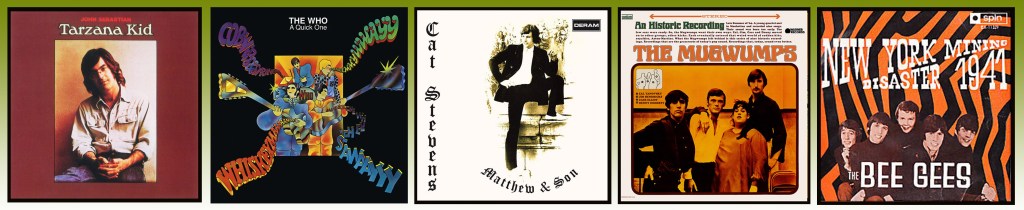
   Among the discs which Bob gave me was John Sebastian’s first solo album called Tarzana Kid and, being a devoted Sebastian fan, I loved it.  He also gave me an LP of The Mugwumps, a band which preceded both the Lovin’ Spoonful and the Mamas and Papas.  It featured Denny Doherty, Cass Elliot, Zal Yanofsky, Jim Hendricks and John Sebastian and my favourite track was their vocal harmony performance of the old Coasters song Searchin’.  Another gift from McClay was an LP of British Cat Stevens which I loved.  I was particularly taken by I Love My Dog.  An album by The Who entitled A Quick One had the terrific song Boris The Spider.  McClay also introduced me to the Bee Gees with their single New York Mining Disaster 1941.  I had never heard of them and they sang just like The Beatles.

From left: John Sebastian’s Tarzana Kid, The Who’s A Quick One, Cat Stevens, The Mugwumps and the Bee Gees.

   Another person I encountered, both in Bill Graham’s little office at the Fillmore and at Bob McClay’s place was the photographer Jim Marshall.  Although I was in the same room with Marshall many times, he never spoke to me and never acknowledged my presence.  He was rather loud and opinionated.  There didn’t seem to be any subject on which this guy did not have an opinion.  While sitting in Graham’s office talking at him he constantly took photos of Bill. He did the same thing with Bob McClay.  

   While clicking snaps of McClay one afternoon, he mentioned John Philips of The Mamas and Papas.  Marshall had witnessed Philips refusing to sign autographs for some fans and describing such activity as “chicken shit.”  Marshall then railed against such attitudes: “That’s the price you pay,” he thundered in his overly audible manner.  “It comes with the territory.”  Whether or not he shared this opinion with Philips is  not known.  He then derided Marty Balin for describing the thrill of performing as like having sex.  He was basically a show business photographer who was in San Francisco at this time because it was the place to be.  I don’t recall Bill Graham or Bob McClay saying much in Marshall’s presence.  I think they would just quietly nod in agreement with whatever stridently stated opinions he would offer and get on with what they were doing as he snapped pictures of them.

Three shots of photographer Jim Marshall, in the centre with Ralph Gleason and the Beatles at Candlestick Park.

   So I paid a visit to Bob McClay in my now crazy state of mind.  Sue had left Tempo to be Music Director at Radio KRLA and had taken Jo with her.  Jo was filling time until Mick Jagger was ready for her to return to London to run the Rolling Stones’ office.  I’m now grateful that Jo and Sue weren’t there as it must have become immediately clear to Bob that I was not in my right mind.  I have no recollection of what nonsense I talked on this occasion but he skilfully managed to get rid of me without any unpleasantness.

   Back out on the street I walked up Columbus avenue, crossing Broadway where the Condor Club featured topless star Carol Doda, famous for having silicone implants to enlarge her breasts.  I knew this part of town pretty well.  Whenever I was working all night on a poster, I would take a break in the early hours and walk down to Broadway, observing the hustlers outside each club.  I was under 21 and looked much younger so they never tried to hustle me.  

   I did once visit one of these clubs to discuss doing a poster for them.  It was lunchtime and these two hefty expensively dressed men sat at a table with me while they ate their delicious looking steaks.  I had brought a layout pad with some sketches on it which they looked at as they chewed their medium rare beef.  I was reminded of a Dean Martin and Jerry Lewis movie called 3 Ring Circus in which Jerry, who was starving hungry, is being talked at by a circus boss who is eating his delicious breakfast of bacon and eggs.  As the boss talked he waved his bacon laden fork around in the air.  Lewis’s eyes and face moved with the bacon as the boss waved the fork.  Of course I wasn’t starving but it was a drag watching these two gangsters eat their succulent steaks in front of me without offering so much as a cup of coffee.  My father Blackie drummed into me that you should never eat in front of people without offering to share what you had.  This attitude was almost certainly a product of his experience of the depression, but these two goombahs suffered no such inhibition.  I never did do a poster for them.

   So I continued walking up Columbus towards Union Street.  By now I was in my second day of acting strangely and Blackie and Beth must have been very concerned about my mental health.  They had many close friends to turn to and I suspect that they contacted Alvah Bessie, a writer who they’d known for years. Alvah had fought in the Abraham Lincoln Brigade in the Spanish Civil War and been one of the Hollywood Ten who went to prison in the early 1950s for defying the House UnAmerican Activities Committee.  Blacklisted like my parents, Alvah had carved out a job for himself at the Hungry i nightclub as stage manager and host introducing such acts as Mort Sahl and Lenny Bruce.  

   Alvah’s daughter Eva was married to Fillmore poster artist Wes Wilson.  I don’t remember if I called Wes or if my parents did.  All I recall is Wes arriving at the apartment on Union Street and driving me back to their house in Mill Valley.  

To be continued. . . 

Amazon USA
https://www.amazon.com/dp/B085QN73VQ


Amazon UK
https://www.amazon.co.uk/dp/B085QN73VQ

The Summer of Love – part 1

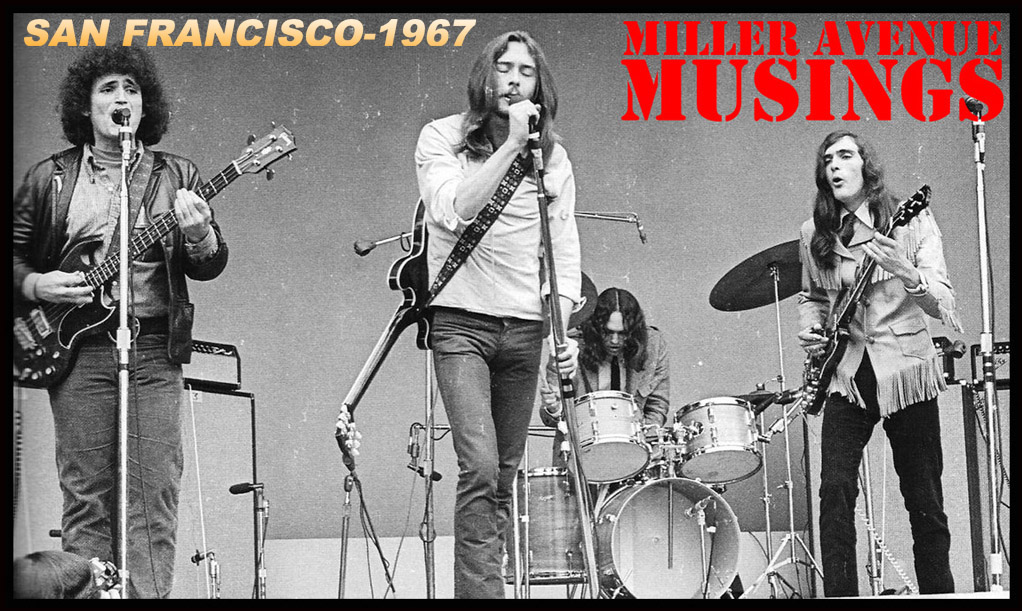
Pictured above are The Quicksilver Messenger Service

There was a song which was released as a single in May of 1967 by Scott MacKenzie.  It was entitled San Francisco (Be sure to wear some flowers in your hair).  It went into the charts nationally and also became an international hit.  All of my friends were avid listeners to the popular music of the day and yet I never heard a single one of them enthuse about Scott MacKenzie or his song.  I heard it on the radio and regarded it as a purely commercial pop record cashing in on the hippy scene in the Bay Area.  And yet whenever there’s a television or radio documentary about the Haight Ashbury in that year this is the song that’s always trotted out to accompany it.

   It was written and produced by John Philips of the Mamas and Papas.  The tune was catchy enough but the lyrics were a bit worthy with references to all the “gentle people” to be found in the city by the bay.  True there were many Be-ins and Love-ins that year which is what the song was on about.  But there was a dark side to the hippy phenomenon as well with regular reports in the Chronicle about overdosed dead bodies collapsed in doorways along Haight Street.  The name Charles Manson was unknown then but he too resided in the Haight Ashbury district at that time with his ‘family’ which, along with him, would become infamous in just a few years time.

   The summer of 1967 in San Francisco became known as the summer of love.  The hippy happening was at its height with young people from all over the United States and the world arriving on Haight Street every day, possibly encouraged by Scott MacKenzie and his wretched song.  

   For me, however, as the summer of love reached its peak, I went off the rails on a psychedelic substance and wound up incarcerated in a psychiatric hospital.  I was twenty years old and, as a result, my memories of that year are skewed by this experience.  With hindsight, I was headed for psychological trouble with or without LSD but that doesn’t alter the fact that I flipped out on acid.  And I do know from others that it was a particularly bad batch.

   Working for Bill Graham at the Fillmore Auditorium provided an exciting window on the emerging San Francisco rock scene which had, by 1967, become world famous.  I returned from a trip abroad in January and rang up Bill at the Fillmore to let him know I was back in town and available for any poster work he needed.  I had only been away a few months but things had changed dramatically.  The scene had become nationally and internationally renowned with reporters from all over the world turning up to write about Haight-Ashbury and the music it had spawned.  The two biggest bands, Jefferson Airplane and The Grateful Dead were becoming very famous indeed and there was a gaggle of new poster artists in town.  Before it was Wes Wilson, Mouse and a few others but now psychedelic artwork was everywhere and the advertising industry had begun imitating the lettering style that Wes had made popular with his poster art.  Also Bill Graham was different.  He too was in the process of becoming a celebrity. 

   I went in to see Bill and Bonnie at the Fillmore and he seemed more polished somehow.  He was certainly better dressed, sporting a snappy green suede jacket.  He was now mixing with famous people in the music business and the glow was rubbing off on him a bit.  Enjoying his suede jacket he asked Bonnie if she thought it made him look like a ‘rock mogul.’  

   He’d been back east and seen a special preview of the soon to be released Don’t Look Back, a documentary on Bob Dylan, by D.A. Pennebaker.  He gave his verdict loudly: “Bob Dylan is an asshole!  Albert Grossman steals the show.”  Dylan’s manager, Grossman, is seen in the film prodding London impresario Tito Burns to get more money for Bob.  Bill had become friendly with Grossman after negotiating with him for an exclusive deal on the Butterfield Blues Band.  

   I overheard Bill giving an interview in his tiny office at the Fillmore to a reporter from Time Magazine.  When the article came out, he was furious with the way the guy had written about him.   He felt misrepresented.

   The job Bill gave me was a poster design for a weekend show featuring The Blues Project, Jimmy Reed, John Lee Hooker and the Stu Gardner Trio.  I was very excited about doing this poster and, following my old pattern, I walked up Russian Hill to the corner store where I bought a pack of cigarettes and a Cadbury’s chocolate bar.  I started work about 8pm in the kitchen at my parents’ apartment on Union Street and worked through the night.  I drew a picture of a black male blues musician playing a harmonica which stretched off into the distance and swerved around in a liquid shape to frame the lettering.  On the top of the harmonica I drew a keyboard being played by musicians.  I had a drummer and depicted the vibrations his drumsticks created.  I also did cartoons of Paul Butterfield, Bob Dylan, Pig Pen and Jerry Garcia.  Down below was a black street scene with people dancing and in the right hand corner stood a white police officer with a billy club observing them.  The police officer was not sympathetically drawn.  He looked mean and intolerant.  I was trying to put the blues into a political context.

   All of this appeared on a light green background with the letters coming out white.  I delivered the artwork to the printer and thought no more about it until I wandered into the Fillmore that Friday night.  Being apologetic was not a quality I was used to seeing in Bill Graham but that is exactly how he approached me as I walked up the stairs.  “After all the trouble I’ve had with the police,” he said, “I simply couldn’t allow that picture of the cop to be on the poster.  It would be a red rag to a bull.  I’m sorry but the printer and I had to change your artwork.”

   What he and the printer had done was to black out the entire street scene as well as all the musicians playing.  The only bit of my work remaining was the blues player, the harmonica and the lettering.  To be honest it looked very good.  It was dark blue with a lighter blue for the harp player who was reversed out of the background with the lettering in white.

On the left is the original poster and on the right is what Bill Graham and the printer cooked up.

   The trouble with the police that Bill was referring to had occurred at the Fillmore before I came along.  I remember reading about raids on the hall by the police in the Chronicle before I knew him so I was aware of the reality he was dealing with.  The police definitely harassed him in the early days and the memory of those encounters clearly lingered.  For me the abiding recollection of my poster being changed was the diplomatic way in which Bill had explained it to me.  He was a very persuasive person. 

   Being part of the furniture at the Fillmore meant I got very used to seeing the bands up close and becoming familiar with them and their repertoire.  Quicksilver Messenger Service was a five piece unit which featured John Cipollina on lead guitar.  Cipollina had been in my sister Katie’s class at Old Mill School.   I remember being impressed by their image.  Both lead singer/guitarist Gary Duncan and Cipollina had long straight hair and wore dark cowboy hats making the band look like a gang of wild west outlaws.  For some numbers Duncan would slide his guitar strap around so that his instrument was on his back and he’d beat a cowbell with a drumstick.  As with all the bands at the Fillmore these guys were constantly stoned on weed.

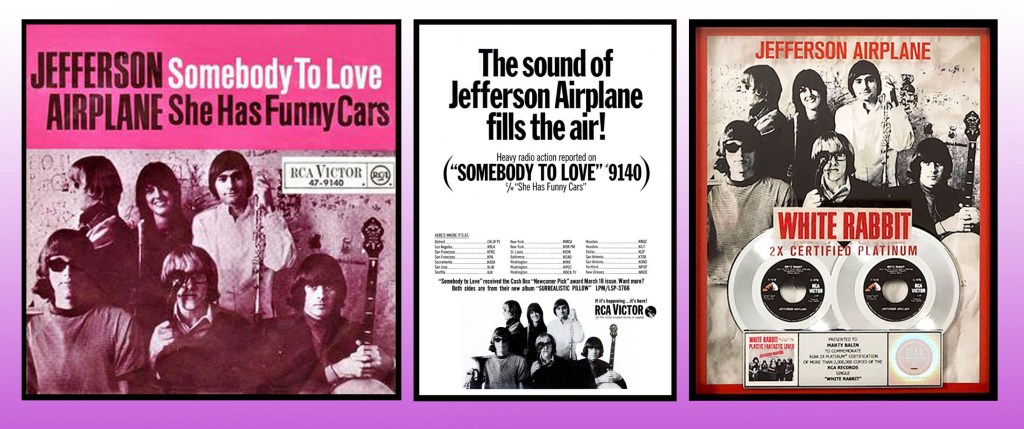
   I didn’t get to know members of Jefferson Airplane until they changed female vocalist.  Originally Signe Andersen was in the band but at some point during my time at the Fillmore she left and was replaced by Grace Slick who I had seen performing with her band The Great Society.  Grace was a very beautiful woman, good musician and terrific singer.  She was also a very nice person, at least to me.  They used to rehearse at the Fillmore in the afternoons and I was always impressed that they would lug their own gear up the stairs.  Early on Bonnie MacLean had introduced me to Marty Balin and I would have regular chats with him in the foyer of the Fillmore while painting my boards.  Another local band, Sopwith Camel, had a hit record on the radio entitled Hello Hello, which Marty described as “a piece of shit.”  The fact that it was being played on KFRC irritated him.  “We’ve got to get a single out,” he said.

RCA ad art for singles by Jefferson Airplane.

   In addition to Marty Balin I became friendly with their drummer Spencer Dryden.  I remember one day taking a ride down into the Tenderloin district with Spencer in his VW Beetle.  His ashtray was heaving with roaches and cigarette butts.  He lit up an enormous joint as we sped down Geary.  By the time we hit the Tenderloin I was seriously stoned.  Spencer went into some building while I loitered on the street and was soon approached by this smiling black guy in a leather jacket.  “Hey little brother,” he said.  “You want something good?”  He opened a shiny pouch  with three or four enormous fat joints wrapped in bright yellow cigarette paper.  When he realised he wasn’t going to make a sale he moved on quickly.  Then Spencer came out and we drove back to the Fillmore.  I don’t remember why I was along for the ride but I was.  

   My favourite musician in the Airplane was Jorma Kaukonen whose guitar playing was so exotic.  His riffs had something of the Arabian Nights about them.  I never spoke to Jorma but he and Bill had a conversational rapport which was interesting.  He was regularly sitting in Graham’s tiny office just talking.  Bill didn’t shoot the breeze with many people but Jorma was an exception.

   The other band I became very familiar with was The Grateful Dead.  Bass player Phil Lesh and I regularly had a chat as he was a fan of the EC horror comics of the early 1950s and had seen my cartoon of the Old Witch in a comic strip I had done for one of the psychedelic newspapers.  On an evening at the Fillmore I would often go up to the band room and just hang around.  I did an awful lot of hanging around at the Fillmore.  One afternoon up there I saw Pig Pen and Bob Weir leafing through binders with plastic window pages containing black and white 8×10 photographs of good looking women.  

   Like Jorma in the Airplane, I truly enjoyed watching and listening to Jerry Garcia play the guitar.  He seemed to physically propel himself forward with each note he played which was hypnotic to observe.  Garcia was probably the most friendly person on that scene.  He seemed so approachable.  I never engaged Jerry in conversation but he’d always say hello to me.  

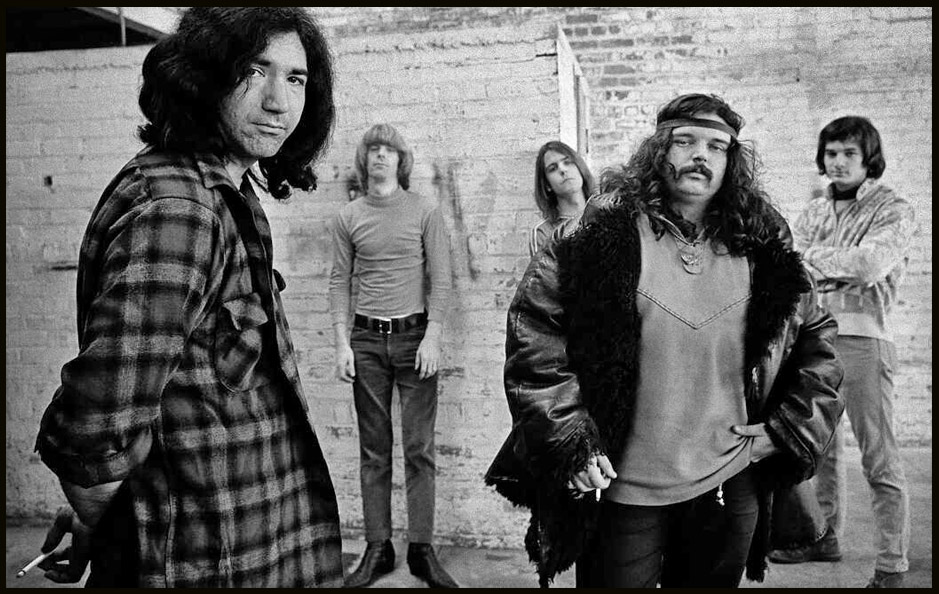
   The look of the Grateful Dead was something to send shivers down the spines of most middle class parents.  Very long hair on guys who didn’t really have the right kind of hair to be that long with the exception of Bob Weir.  The Dead had the Haight Ashbury lifestyle written all over them.  One of the funniest numbers in every one of their sets was when Pig Pen (aka Ron Mckernan) would come out from behind his electric keyboard and sing Good Mornin’ Little School Girl.  He had a terrific blues voice and the sight of him with his long hair and beard singing: “Tell your mama and papa, that I’m a little school boy too,” was such a contradiction that it made me laugh every time.

Members of The Grateful Dead, from left: Jerry Garcia, Phil Lesh, Bob Weir, Ron (Pig-Pen) McKernan, Bill Kreutzmann

   Bill Graham kept a cowbell and drumstick in his office and when the Dead were doing their second set of the evening he’d bring them out and go to the side of the stage behind the amplifier and accompany them rhythmically.  I never saw him do this with any other bands.

Bill Graham at the side of the Fillmore stage accompanying The Dead with cowbell. From left: Bob Weir, Pig Pen and Bill Graham.

   The band room was guarded during gigs by Dicken Scully whose brother Rock was one of the Dead’s two managers (the other was Danny Rifkin).  Dicken was tall, thin, wore glasses and had long blond hair.  He was a very nice guy to me but was very strict about who got beyond that door.  Lots of people tried to get past Dicken but unless he knew you had a genuine connection to one of the bands playing he was resolutely firm in denying access.

   One thing that hanging around the Fillmore did for me was to feed the fantasy of becoming a performer myself.  I was much too shy to get up on a stage and sing but it was an aspiration which grew as I clearly had the talent and a good singing voice.  On long walks home from the Fillmore I would compose my own songs.  My route home took me down Geary to Van Ness.  I’d then turn left on Polk Street and walk however many blocks to Union.  Then I’d turn right, going up and over Russian Hill until I reached my parents’ apartment.  The walk took me about forty minutes which was just long enough to write a song and once inside I’d scribble the words down on a piece of art work.  I had a big professional drawing board in my bedroom and was constantly doodling.

   Hanging around the Fillmore was not like having a social life for all my real friends were across the Golden Gate Bridge in Mill Valley.  Every opportunity I had to go there was seized upon with enthusiasm.  My mode of transport was hitch hiking.  I’d put my thumb out on Lombard street and within half an hour I would be walking down Miller Avenue.  I’d make my way to one of many houses where, invariably,  I’d get loaded on weed with my friends who were all indulging in this activity.  As I’d walk in, I’d be handed a lit joint and away we’d go.  The music on the record player could be Dylan’s Blonde On Blonde or Revolver by The Beatles.  A lid of grass sat in a plastic bag on a table surrounded by packets of Rizla cigarette papers.  We’d roll skinny little joints, light them and suck the smoke deep into our lungs.  We would then hold our breath as long as we could and finally release the smoke in a mighty dizzy exhalation.  Much of the conversation which followed was whispered by people holding their breath.

   This was the way of life I had embraced.  Being loaded meant that everything was either interesting or funny.  The smallest detail in a work of art became something enormous and recorded music seemed that much more exciting.  One negative side of being stoned so often was my tendency to talk about creative things I might do rather than actually doing them.  

To be continued...

Amazon USA

Amazon UK