A Descent Into Darkness

Previously in Miller Avenue Musings:  After spending several weeks as a day patient at a San Francisco clinic, I finally started coming down from the drug which drove me crazy.  Coco Cutler, a family friend with an interest in psychoanalysis, befriended me.

Unlike my parents, Coco could relate to the state of mind I was in.    She leant a sympathetic ear to me and it was a huge help.  I soon became a regular visitor to her apartment on top of Telegraph Hill.  I learned that she was plugged into the scene that Blackie’s friend Lew Welch was a part of.  Allen Ginsberg, Lawrence Ferlinghetti and Alan Watts were among her acquaintences.  But she was nothing like a beatnik at all.  Prim, proper, elegantly spoken and with a physical beauty which benefited from growing old gracefully.  

   Coco was, like all my parents’ friends, a person of the political left and had been married to another of my family’s acquaintances, Al Richmond, who wrote for the People’s World newspaper.  I never knew exactly what office job Coco did, but many times I saw her wearily climbing Telegraph Hill after a day’s work.

   Sometime in 1966 I discovered a small movie theatre in North Beach which showed a lot of old Humphrey Bogart pictures which   I had a particular fascination for.  I saw Casablanca, To Have And Have Not, Beat The Devil and a movie which completely entranced me because the opening scenes featured Marin County locations.  I’ve always found the joy of recognition to be a powerful emotion and the film Dark Passage began with an escape from San Quentin prison.  We saw the fingers of the escapee gripping the rim of a barrel he was inside of, on the back of a flat bed truck.  He made it rock back and forth as the truck drove away from the prison and the sound of police sirens began to wail in the distance.  The barrel then tumbled off the truck and rolled down a steep hill.  The escapee soon found beautiful Lauren Bacall who hid him in the back of her woodie vehicle.  Seeing the hills of Marin behind all this action was terribly exciting to me and soon Lauren Bacall’s woodie was going through the tunnel on Waldo Grade.  All the cars were from 1946.  She crossed the Golden Gate bridge, ending up at her apartment on Telegraph Hill.  At some time during a visit to Coco’s flat I must have mentioned this film and it transpired that she had seen them shoot a scene right outside her apartment.
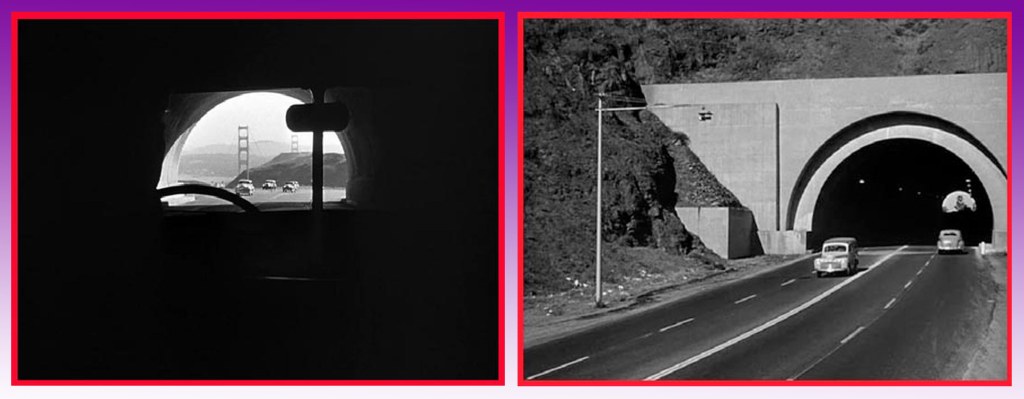
When this film was shot there was only one two-way tunnel on Waldo Grade.

Ms Bacall’s woodie crosses the Golden Gate Bridge. We then see her apartment on Telegraph Hill.

   The neat trick that Dark Passage pulled off was that we never saw Bogart’s face until he wound up having plastic surgery.  With a big bandage covering his face, he staggered up the steps at Filbert Street to Bacall’s apartment on Telegraph Hill.  This was the scene that Coco had witnessed the filming of.  She told me she felt very sorry for Bogart who had to repeat the climb many times as they shot take after take.  
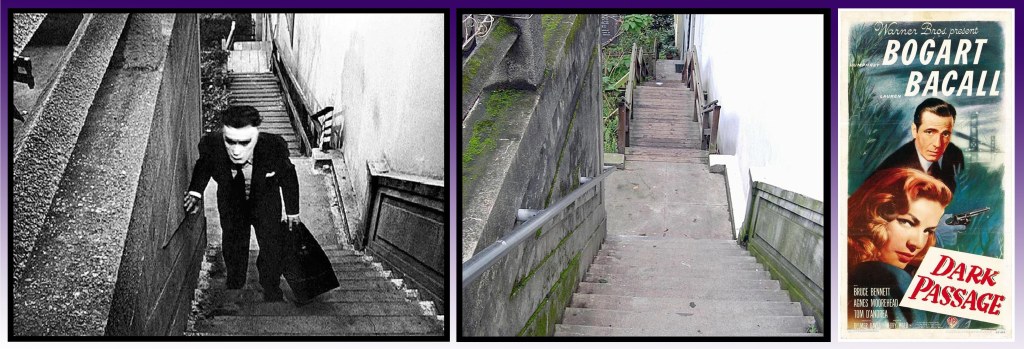
On the left we see Bogart climbing the steps in 1946 and the same steps today.

   Dark Passage was an intricately plotted thriller which combined good writing with excellent acting.  Directed by Delmer Daves, it fell into a category that French film critics would, after World War 2, christen film noir.  This phrase described Hollywood films which were absorbed by darkness and pessimism.

   Darkness and pessimism were two realities that I was slowly descending into.  I had been incarcerated in Napa State Hospital from the middle of July until the first week of August when my father got me discharged because of a suicidal inmate who took against me.  All the time I was there and for many weeks after, I was in my own universe with practically no interest in or knowledge of what was going on out in the real world.  When I got back to my parents’ apartment, I didn’t read the Chronicle or watch the news.  I listened to pop music on the radio but that was the limit of my intake.

   By August the race riots across the country had simmered down and President Johnson established a senate judiciary committee to investigate the causes.  Michigan governor George Romney who, at the outbreak of the riots in Detroit, had asked Johnson to send federal troops to the city, now criticised the president for playing politics with the issue.  Romney, though a Republican with an eye on the presidential nomination of 1968, also came out against the Vietnam war.

   The summer of love was thought to be all flower children and peace.  However a pair of gruesome murders occurred which contradicted that image.  They involved both the Haight Ashbury community and Marin County.  The dead body of known drug dealer, Willam E. Thomas, referred to in the Haight as Superspade, was found trussed up in a khaki sleeping bag on a steep cliff near the Point Reyes Coast Guard station.  He had been stabbed in the chest and shot through the head.

   Five days earlier the dead body of Haight drug dealer John Kent Carter, was discovered in his San Francisco apartment.  He was found  lying on a mattress with a dozen stab wounds and his right arm severed and missing.  San Francisco police issued an all points bulletin for the arrest of Eric Frank Dahlstrom, 23, of Sausalito.  Dahlstrom was well known as a motorcycle racer at tracks like Cotati and Vacaville.  He had a reputation for  superb skill and reckless behaviour.  Officers in Sausalito immediately checked his parents’ house on Monte Mar Drive and found Dahlstrom’s car in the garage with its licence plates missing.  It was nearly 11 pm on a Saturday night when the Sausalito police added Dahlstrom’s plate numbers to the APB for his arrest.  Twenty minutes later on a street in Sebastopol, patrolman Charles Baker spotted a car with those same plates.  He turned his red light on and pulled the car over.  Knowing the APB was for a murder, the officer approached the vehicle with his gun drawn.  Dahlstrom, however, surrendered without resistance.  In the back seat of the vehicle officers found, wrapped in blue suede, the severed forearm of John Kent Carter.

   Eric Dahlstrom was not shy about telling the story of Carter’s murder to assembled reporters at San Francisco police HQ.  He said that he had killed Carter while under the influence of LSD and that he had considered dismembering the body.  According to Helix, a Seattle underground newspaper, Dahlstrom was undergoing an “Olympics-calibre bummer caused, he believed, by inferior-quality acid” which Carter had sold him.  Offended, he went to Carter’s to discuss it.  During the discussion, Dahlstrom said, Carter shoved him.  “I got shoved,” he told reporters.  “Don’t nobody shove me.”  The Helix account continued: “Dahlstrom grabbed up a 12-inch kitchen knife and stabbed him rapidly 12 times, most of them fatally.  He undertook to dismember the body , but gave it up after neatly amputating the right arm above the elbow.  He wrapped the arm in blue suede and split with it, taking also a .38 pistol, $3,000 Carter had assembled to give to an acid wholesaler called Superspade.”

   At first it seemed that there might be a connection between the murder of Superspade and John Kent Carter but as time passed, investigators concluded that they were separate incidents.  Earlier that week Dahlstrom had been to Slide Ranch where he kept a motorcycle.  His behaviour was strange and he was asked to leave because he was “acting goofy.”
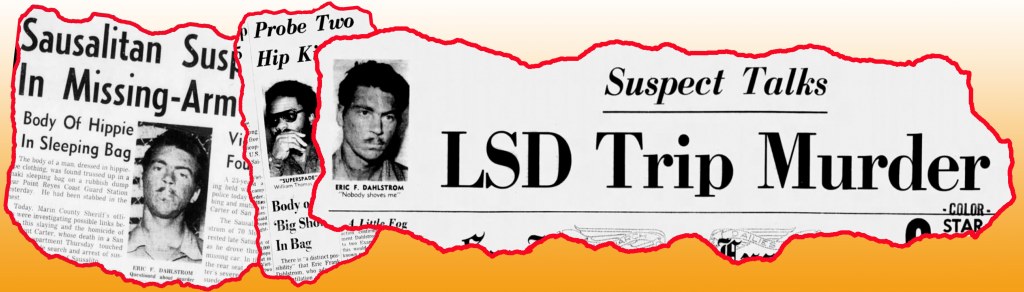
These murders inspired sensational headlines in the press.

   This story, which was covered extensively by all the bay area newspapers, passed me by completely.  Weekdays I spent at the clinic run by Dr. Weinberg which had a calming effect on me.  I attended my sessions at the clinic for four or five weeks and when that time was up, the darkness began to claim my soul.  My spirits had been fairly up beat until that time.  Coco’s friendship became very important to me during this time.

On the left is Dr Art Weinberg who ran the day clinic I attended. In the centre and right are two pictures of Coco Cutler in 1943 and 2002.

   Somewhere in the midst of all this, my sister Nell visited from London with her one year old son Michael who we all called ‘Poggy.’  He was a beautiful child and having him there took me out of myself which must have aided my recovery.  Nellie looked terrific and had taken to the role of young mother with gusto.  Nellie’s new motherhood forged a strong link with sister Kate who was so excited about young Michael/Pog.  During the few weeks they were with us, Poggy began to walk, a process which started as a balancing act between his two feet.  From my bedroom I would hear a single thump in the hall.  Then after a pause a second thump.  After a third thump I’d hear a series of them up to my bedroom door which he’d then push open.

   Young Poggy was also forming his first words.  While out walking with them one day, we found ourselves at the bottom of Russian Hill where Union meets Columbus.  The sight of a dog across the street in Washington Square caused Poggy to point and make a breathy sound similar to the noise we made as children to simulate gun fire.  It sounded like deoggggh.  It bore a striking resemblance to the word dog.  It was a very exciting moment.
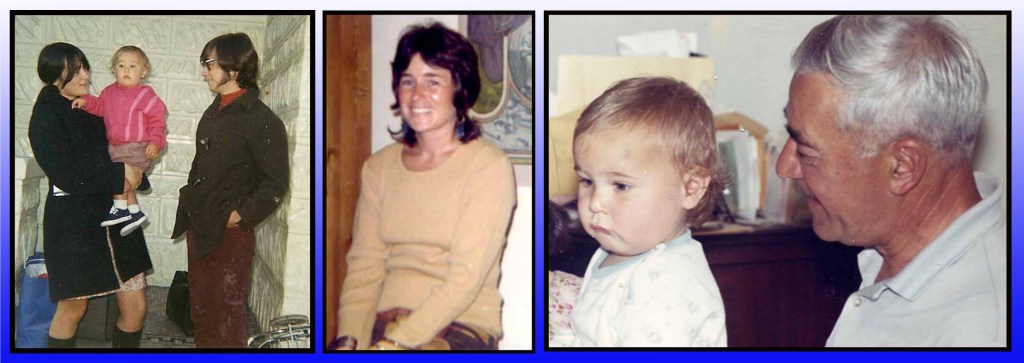
On the left: Nellie, Pog and myself; My sister Katie; Poggy with my father Blackie.

   It was also exciting for me to see how animated my sister Katie was in becoming an auntie to little Pog.  Both my sisters had gone to university and dropped out after their second year.  Nell had gone to San Francisco State and Katie to University of California at Berkeley.

   My two sisters were very different people and until Nellie arrived for her visit it was Katie who had been such a good friend to me.  Practically every excursion I took in the city after I left Napa was in her company and she looked after me.

   When we were kids it was always Katie who was the peacemaker of the family.  Nellie and I were the temperamental two and brother Jim was kind of neutral.  Katie always looked on the bright side of any problem and usually found a happy solution.  

   Politics played a big role in all our lives.  The society we were growing up in was gripped by the anti-red hysteria of the McCarthy era.  Even being politically liberal was seen by the federal government as highly suspicious and my parents and all their close friends were far left of liberal.  So we were aware of a difference to most of the kids we went to school with.  Of the four of us only Nellie seemed to gravitate towards active political participation.  I was interested but seeing how the federal government operated scared me.  Family friends Fred Field, Alvah Bessie, and Vin Hallinan all did time in federal prison and I always worried that the same fate could take Blackie and Beth away from us.  The execution of the Rosenbergs in 1953 sent a shiver through people of the left and I found it terrifying.

   So the politics of the day affected each of us four Myers kids.  Jim wound up rebelling against my parents’ values by joining the army.  Once he was on the inside and realised what he’d done, he got himself involved in the stenography corps and never went to Vietnam.

Three photos of my brother Jim. On the left with myself and good friend Augie Belden. In the centre with our cat Totem and on the right a shot, later in life, with sister Kate and myself.

   Having Nellie around made me contemplate a trip to England.  All my travelling had been in the other direction, across the Pacific when in actual fact I had always longed to visit London.  Blackie said that when I was well enough I could go back to work on the waterfront, so a little bit of structure entered my life.  The idea of working on the front and saving enough to make a trip to England gave me a goal.

   When I was in high school, Nellie was sharing an apartment on Greenwich Street with like minded socialists who were politically active.  The two main issues they were most concerned about was racism and the war in Vietnam.  I remember going with Nellie to a demo at the Masonic Auditorium on California Street where an openly racist organisation was holding a conference.  It was night time and demonstrators were lying down in front of the vehicle exit to try and stop the people leaving in their cars.  I don’t recall exactly what played out.  I think an arrest was made but after some negotiation the demonstrators agreed to let the racists drive their cars out of the underground car park without fanfare.

   Nellie saw a lot of the Hallinan boys during this time and was involved in many demonstrations.  There were sit-ins at car showrooms on Van Ness, the Sheraton-Palace Hotel, Lucky Supermarkets and famously at Mel’s Drive-In on Geary.  Nellie got herself arrested on a few occasions.  Ringo and Dynamite Hallinan were often at the apartment on Greenwich Street.  

   Though Nellie and Katie had similar experiences with their time at university, Nellie gravitated towards politics and Katie, when she decided to drop out of Cal Berkeley, went to work in a bank in the financial district.  I remember that, in addition to renting an apartment with her boyfriend Lonnie, Katie actually got herself a credit card which was quite a first for someone from the Myers family.  Blackie had always been highly suspicious of the concept of credit, but I remember Katie being so matter-of-fact about the credit card and don’t recall any fuss about this with Blackie and Beth.  Katie was always highly responsible with both of them and they appreciated it.  It was just a decision on her part to improve the quality of her life.

   Nellie did, after she dropped out of SF State, go to work for a shipping company run by the Kiskaddens who were good friends of my parents.  When she eventually went east to visit family friends in and around New York, it was on one of Kiskadden’s Norwegian ships, The Torvanger, on which she made the final voyage to London.  This would be the very same ship that I went to sea on after I graduated from Tam High.  

  In London Nellie quickly found herself involved in left wing politics and met, fell in love with, and married Trevor Hyett. Trevor was the father of Michael/Pog who was visiting us in San Francisco.

   So these happy events occurred at the same time that I was beginning my descent into the deepest depression of my young life.

To be continued…

Amazon USA
https://www.amazon.com/dp/B085QN73VQ

Amazon UK
https://www.amazon.co.uk/dp/B085QN73VQ

Being Taken Into Custody

Previously in Miller Avenue Musings:  It is the summer of 1967 in Mill Valley where I have stayed up all night talking with poster artist Wes Wilson.

As I left Wes and Eva’s house on Locust Avenue it was a beautiful summer’s morning.  The sun shone brightly in a clear blue sky.  Taking a left through their garden gate, I walked up the hill to Blithedale where I turned right, heading in an easterly direction.   

   My madness had evolved.  I was now convinced that I was a messiah, put on this earth to solve all the problems of humankind.  If that seems a slightly tall order for a drug crazed twenty year old hippie, it was.  But in my fevered state of mind, it all made perfect sense.   Important people would be landing at the airport in San Francisco and driving north on Highway 101.  My thinking was that I must meet them at the highway.

   At the junction of Blithedale and Camino Alto, I cut through the railroad tracks where I had walked to and from school at Alto and Edna Maguire so many times as a kid.  I was excited by the idea of meeting all these people who clearly had the best interests of the planet earth in their hearts and minds.  Amongst their number was, I felt certain, The Beatles, or at least John Lennon, if not all four.  I had the entire LP of Sgt Pepper dancing through my head at this time and felt certain that they would be part of this mobilisation.  Another tall order, I grant you, but making perfect sense to me in my ridiculous state of mind.

   I walked along the tracks until they met Lomita then turned right and headed for the highway.  At the overpass, I positioned myself on the sidewalk overlooking the northbound traffic.  The rush hour had begun and the southbound traffic was one huge slow moving mass but I was totally oblivious to it.  I kept my gaze focussed on the horizon where the highway snaked to the left at Richardson Bay.  I was in a very calm state and kept a beady eye on the traffic.  I must have been there about an hour because a Highway Patrol officer had spotted me 45 minutes earlier and when he saw me again, he stopped to talk to me.  My state of mind was to accept everything I encountered and the Highway Patrol officer was very friendly as I recall.  I told him I’d finally had a good trip on acid and probably babbled something about the caravan of vehicles coming from the airport.  He told me he would be taking me to the county jail in San Rafael and that he’d have to handcuff me which I accepted.  I then sat in the back of his vehicle as he drove us north to the county jail which was underneath the San Rafael courthouse. 

   I had been booked into Marin County jail the previous year when I was arrested in Mill Valley for being in a car where marijuana was found.  I spent one extremely miserable night in the communal male cell and it had been a bleak and depressing experience.  This time, however, they simply put me in a room where I waited until the ambulance guys got there.  Before too long they arrived and I was strapped onto a stretcher with wheels.  

   The guy who sat in the back of the ambulance with me as we drove north towards Napa must have heard many a mad person quack on about saving the world.  Perhaps he secretly hoped that one of them would reveal a great truth, for he pumped me with very specific questions all the way to Napa.  Sadly I cannot recall his questions but I definitely formed the opinion that he was hedging his bets in case one of these crazy patients turned out to be the real messiah.

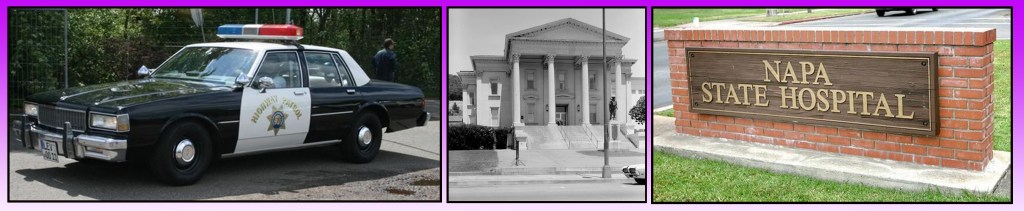
From left: a California Highway Patrol car, the Marin County Court House and the entrance to Napa State Hospital.

   Ever since childhood I remember that the word ‘Napa’ was synonymous with crazy people.  My father Blackie had a vast vocabulary of slang nicknames which he used to describe practically all things.  A mental hospital would be a laughin’ academy in his colourful lexicon.  Yet most of the people I befriended there were surprisingly normal seeming.  I was given a bed in what looked like an ordinary hospital ward.  The guy in the next bed on my right was very nice and we became friends.  We never discussed why we were there.  To be honest I had no idea why I was there.  It was just an interesting experience I was going through.  I accepted everything that came my way.

    Almost immediately I was given medication which I think was Thorazine and the nurses would come to me with pills several times a day.

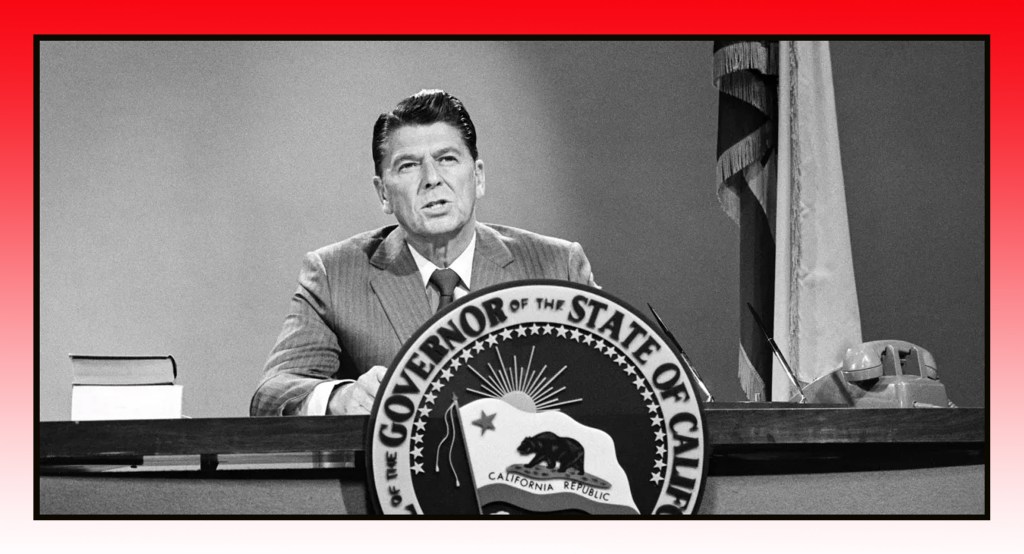
   The staff were very friendly and I soon learned from them that their already difficult jobs had been made much harder by the budget cuts introduced by the recently elected California governor, Ronald Reagan.  Reagan had targeted mental health and higher education for his budget cuts and the impact was being felt.  

Ronald Reagan, elected as Governor of California in 1966.

   His election as governor the previous year had been the first step in what he and his financial backer, car dealer Holmes Tuttle, saw as the road to the White House.  Reagan’s victory in California was a sign of what was to come in America.  His speech in support of Barry Goldwater in 1964 had put him on the political map.  The senator from Arizona ran unsuccessfully against Lyndon Johnson for the presidency and advocated the use of nuclear weapons in the war in Vietnam.  Reagan made similar statements once he was in the governor’s mansion.  So now, with actual power, he set about his attack on university students and the mentally ill.

Three faces of Ronald Reagan.

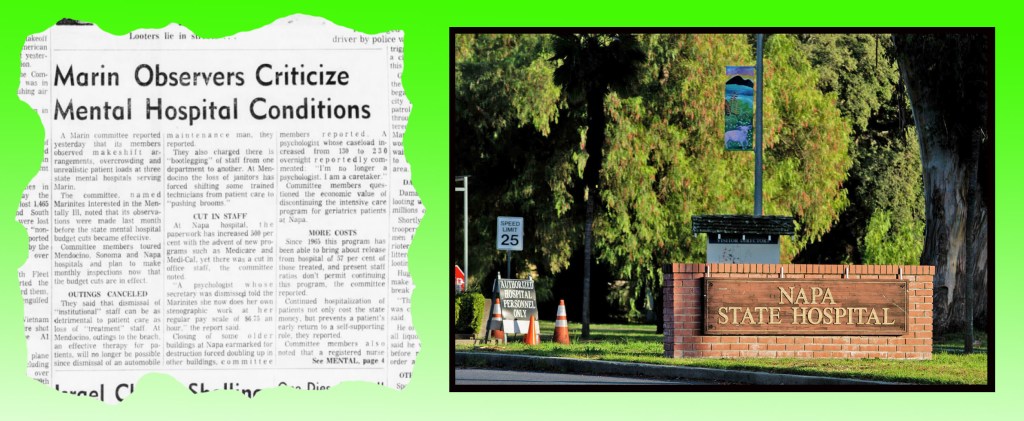
   A committee called Marinites Interested in the Mentally Ill made a report.  Its members observed overcrowding and unrealistic patient loads at three state mental hospitals serving Marin County.  The group toured Mendocino, Sonoma and Napa hospitals and now that Reagan’s budget cuts were beginning to bite, they planned to make monthly inspections.  The Marinites complained that dismissal of institutional and treatment staff was detrimental to patient care.  At Mendocino they noted that outings to the beach, an effective therapy for patients, would no longer happen since the dismissal of an automobile maintenance man.  The loss of janitors had meant trained technicians switched from patient care to cleaning up with brooms.  A registered nurse was pressed into service pushing a food cart, “when she is needed by patients,” the report stated.

   At Napa hospital, the paperwork had increased by 500% due to new programmes like Medicare and Medi-Cal yet the budget cuts got rid of so many office staff that psychiatric workers were doing their own stenographic work as well as their main jobs.  One of the psychologists whose caseload had increased overnight from 130 to 230 complained: “I’m no longer a psychologist.  I am a caretaker.”

A newspaper article about the Marinites and the leafy entrance to the hospital.

   So the staff at Napa were overstretched.  One economy measure was to close the laundry one day a week, but this meant they couldn’t provide the optimum number of bed and diaper changes for their patients.  I don’t recall a staff member being unfriendly but they were all overworked and a bit distracted.  My time at Napa was interesting and I don’t remember any boredom or depression on my part.  It was all an enormous adventure and I was enjoying it.  

   Outside the walls of Napa State Hospital there was a lot going on in the world.  In Vietnam the Viet Cong launched a huge rocket attack on the enormous US air base at Da Nang, killing 13 and wounding 173 others.  The rockets, fired with deadly accuracy from a nearby mountain, set the air base ablaze, destroying three barracks and a score of aircraft worth an estimated $48 million.  War on the streets of the USA erupted in Newark, New Jersey as National Guardsmen and police battled black rioters firing rifles and submachine guns.  For the first time the guardsmen were using live ammunition which brought the death toll to 16 people killed.  Later in the summer, rioting would also break out in Detroit, Michigan.  I, however, was aware of none of this.  If I was going to save the world it was going to have to be without knowing what the hell was going on in the world.

Two newspaper clippings. On the left the Viet Cong attack on the US Air Base in Da Nang and on the right the rioting in Newark.

   That I had been picked up by the Highway Patrol on the overpass was reported in the Independent Journal, the afternoon newspaper in Marin County.  The news item about me was tucked away on page eleven under the headline: ‘Admitted LSD Taker Is Held.’  The article was wrong about the time of day.  The reporter must have misheard the Highway Patrol officer and written it as evening whereas it was very early in the morning.

   One subscriber who saw the story was Nona Kaufmann.  Mrs Kaufmann was alarmed to read about me and brought it to the attention of her daughter Janice.  Jan and I had dated at Tam High and I knew her mother fairly well.  The Kaufmanns lived in Strawberry on the other side of the highway.  

   I had first met Jan one evening in the back seat of a VW Beetle driven by Mark Symmes.  Mark, who was accompanied by a young woman in the front passenger seat, drove us up Edgware to the junction of four corners where there was a big space to park.  I have no memory of why I was in the back seat next to Janice, who I did not know.  I also don’t recall who the young lady with Mark was, but once he’d parked the vehicle, they began making out.  I turned to the young woman on my right and instantly found myself in a passionate embrace.  This was the start of a pretty steady relationship which lasted the rest of my time at Tamalpais High.  Without realising it, I fell in love with Jan.  The reason I didn’t realise it was that I was constantly putting on a front as a lady’s man at school with much flirtation.  I wasn’t aware that I subconsciously put Janice on a pedestal while other women were, I felt, there to be treated in a cavalier fashion.

   I remember Jan asking me what I was going to do with my life and it concerned her that I had no idea.  I remember her father Stephen becoming alarmed at the fact that I bought an expensive sweater for her at Christmas from J Magnin’s in San Francisco.  “This seems serious,” Jan quoted Mr Kaufmann as saying.  

   When I went to sea right after my graduation it was actually my first proper time away from home and I returned, a very changed person, to a Mill Valley which had been transformed.  Most young people were now smoking marijuana, in stark contrast to what the place was like only a few months before.  The short haircuts which were part of a uniform look for young men was no longer the norm as most guys had long hair.  One school friend who had previously looked very collegiate, now resembled Sonny Bono of Sonny and Cher.  He talked of the hidden drug messages in Bob Dylan’s lyrics and how the name “The Lovin’ Spoonful” referred to heroin use.  He spoke enthusiastically of all this as if drug use was a political movement.

   I fell out of touch with Janice during this period.  At the time I was picked up by the Highway Patrol, she was a student at UC Davis and was shown the I-J article by her mother on a weekend visit home.

   Jan visited me at Napa which must have been very strange for her.  She was directed to my ward where she found me surrounded by a group of men, all eager to talk to someone.  These guys apparently were pretending to take their medication rather than actually swallowing the pills.  They offered handfuls of tablets to Jan.  Two of them told her they behaved crazy to avoid being put in jail.  Jan and I wandered through the restricted outdoor area followed, she remembers, by “this posse of fellows.”  Though these guys were not taking their medication, I clearly was, as Jan remembers me as medicated but delusional.  I talked about saving the world with John Lennon and John Sebastian.  This crazy notion took quite a bit of time to fade from my conscious mind.  Looking back on it, I’m truly grateful to Jan for visiting me at the hospital.  She was and still is a good friend.

   One thing I didn’t know at the time was that my father Blackie was there at the hospital almost every day of my three week incarceration.  He did make appearances when others visited, like my sister Kate, but I had no idea of his presence on a day to day basis.

   I was a very passive patient who, when instructed to do something by the staff would oblige.  On occasion strange impulses would appear within me like suddenly taking all my clothes off and standing naked in the corridor.  This didn’t happen often but when it did, a staff member would arrive and gently tell me to put my clothes back on, which I did.  I remember being locked in an empty hall where I walked up and down singing my pretty near perfect imitation of John Lennon doing Day In The Life from the Sgt Pepper album.  

   There was no radio at Napa, so the three weeks I spent there I didn’t hear the Top 40.  I missed the fact that Light My Fire by the Doors climbed the hit parade as did the ghastly San Francisco by Scott McKenzie.  I never heard Up Up and Away by the Fifth Dimension or Don’t Sleep in the Subway by Petula Clark.  I was stuck with Sgt Pepper going through my head.  

   In the hospital every door to the outside world was locked and in that way, all of us patients were prisoners.  I got into the habit of trying every door in case it wasn’t locked.  One morning I turned the knob on a door leading out into the garden and found that it opened.  I walked out and closed the door behind me.  I found myself on a neatly trimmed lawn.  I walked across the grass and kept going.  I passed administrative looking buildings and eventually came to a street.  I turned left and walked until I arrived at a bus stop.  I don’t believe I was there long for very soon a bus arrived.  I got on and for some reason I wasn’t challenged to produce a ticket or money.  So I found a seat in the rear of the bus and sat down, looking out the window and watching the beautiful scenery go by.  I had no idea where I was going.

To be continued.

Amazon USA
https://www.amazon.com/dp/B085QN73VQ

Amazon UK
https://www.amazon.co.uk/dp/B085QN73VQ