Being Taken Into Custody

Previously in Miller Avenue Musings:  It is the summer of 1967 in Mill Valley where I have stayed up all night talking with poster artist Wes Wilson.

As I left Wes and Eva’s house on Locust Avenue it was a beautiful summer’s morning.  The sun shone brightly in a clear blue sky.  Taking a left through their garden gate, I walked up the hill to Blithedale where I turned right, heading in an easterly direction.   

   My madness had evolved.  I was now convinced that I was a messiah, put on this earth to solve all the problems of humankind.  If that seems a slightly tall order for a drug crazed twenty year old hippie, it was.  But in my fevered state of mind, it all made perfect sense.   Important people would be landing at the airport in San Francisco and driving north on Highway 101.  My thinking was that I must meet them at the highway.

   At the junction of Blithedale and Camino Alto, I cut through the railroad tracks where I had walked to and from school at Alto and Edna Maguire so many times as a kid.  I was excited by the idea of meeting all these people who clearly had the best interests of the planet earth in their hearts and minds.  Amongst their number was, I felt certain, The Beatles, or at least John Lennon, if not all four.  I had the entire LP of Sgt Pepper dancing through my head at this time and felt certain that they would be part of this mobilisation.  Another tall order, I grant you, but making perfect sense to me in my ridiculous state of mind.

   I walked along the tracks until they met Lomita then turned right and headed for the highway.  At the overpass, I positioned myself on the sidewalk overlooking the northbound traffic.  The rush hour had begun and the southbound traffic was one huge slow moving mass but I was totally oblivious to it.  I kept my gaze focussed on the horizon where the highway snaked to the left at Richardson Bay.  I was in a very calm state and kept a beady eye on the traffic.  I must have been there about an hour because a Highway Patrol officer had spotted me 45 minutes earlier and when he saw me again, he stopped to talk to me.  My state of mind was to accept everything I encountered and the Highway Patrol officer was very friendly as I recall.  I told him I’d finally had a good trip on acid and probably babbled something about the caravan of vehicles coming from the airport.  He told me he would be taking me to the county jail in San Rafael and that he’d have to handcuff me which I accepted.  I then sat in the back of his vehicle as he drove us north to the county jail which was underneath the San Rafael courthouse. 

   I had been booked into Marin County jail the previous year when I was arrested in Mill Valley for being in a car where marijuana was found.  I spent one extremely miserable night in the communal male cell and it had been a bleak and depressing experience.  This time, however, they simply put me in a room where I waited until the ambulance guys got there.  Before too long they arrived and I was strapped onto a stretcher with wheels.  

   The guy who sat in the back of the ambulance with me as we drove north towards Napa must have heard many a mad person quack on about saving the world.  Perhaps he secretly hoped that one of them would reveal a great truth, for he pumped me with very specific questions all the way to Napa.  Sadly I cannot recall his questions but I definitely formed the opinion that he was hedging his bets in case one of these crazy patients turned out to be the real messiah.
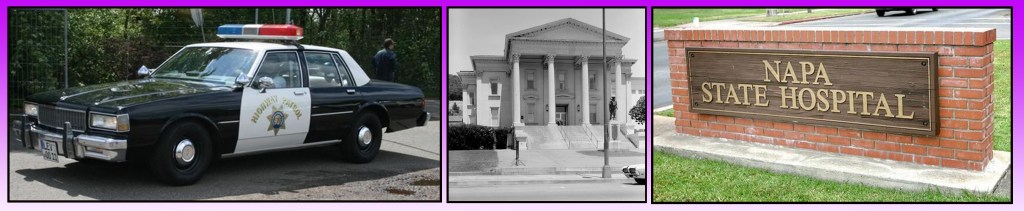
From left: a California Highway Patrol car, the Marin County Court House and the entrance to Napa State Hospital.

   Ever since childhood I remember that the word ‘Napa’ was synonymous with crazy people.  My father Blackie had a vast vocabulary of slang nicknames which he used to describe practically all things.  A mental hospital would be a laughin’ academy in his colourful lexicon.  Yet most of the people I befriended there were surprisingly normal seeming.  I was given a bed in what looked like an ordinary hospital ward.  The guy in the next bed on my right was very nice and we became friends.  We never discussed why we were there.  To be honest I had no idea why I was there.  It was just an interesting experience I was going through.  I accepted everything that came my way.

    Almost immediately I was given medication which I think was Thorazine and the nurses would come to me with pills several times a day.

   The staff were very friendly and I soon learned from them that their already difficult jobs had been made much harder by the budget cuts introduced by the recently elected California governor, Ronald Reagan.  Reagan had targeted mental health and higher education for his budget cuts and the impact was being felt.  
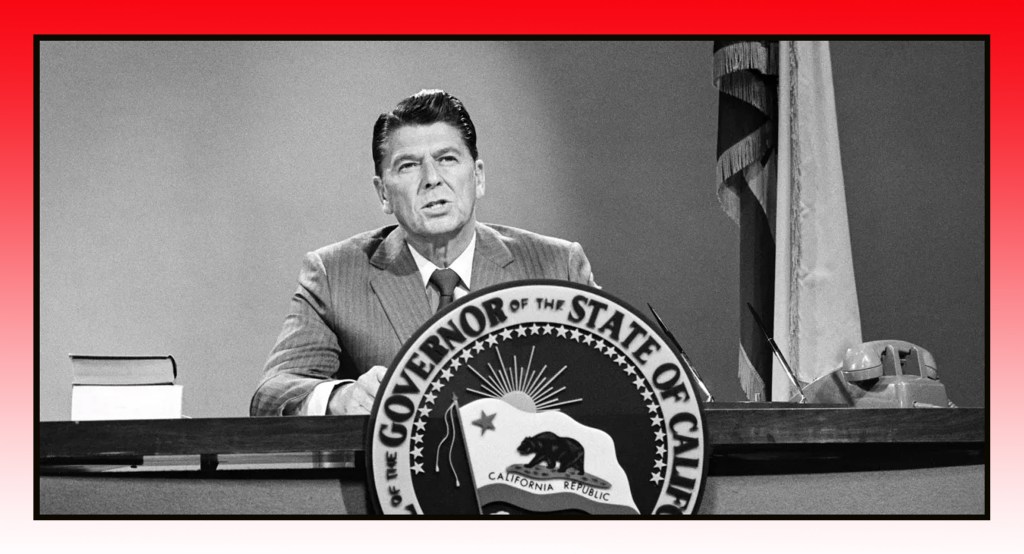
Ronald Reagan, elected as Governor of California in 1966.

   His election as governor the previous year had been the first step in what he and his financial backer, car dealer Holmes Tuttle, saw as the road to the White House.  Reagan’s victory in California was a sign of what was to come in America.  His speech in support of Barry Goldwater in 1964 had put him on the political map.  The senator from Arizona ran unsuccessfully against Lyndon Johnson for the presidency and advocated the use of nuclear weapons in the war in Vietnam.  Reagan made similar statements once he was in the governor’s mansion.  So now, with actual power, he set about his attack on university students and the mentally ill.

Three faces of Ronald Reagan.

   A committee called Marinites Interested in the Mentally Ill made a report.  Its members observed overcrowding and unrealistic patient loads at three state mental hospitals serving Marin County.  The group toured Mendocino, Sonoma and Napa hospitals and now that Reagan’s budget cuts were beginning to bite, they planned to make monthly inspections.  The Marinites complained that dismissal of institutional and treatment staff was detrimental to patient care.  At Mendocino they noted that outings to the beach, an effective therapy for patients, would no longer happen since the dismissal of an automobile maintenance man.  The loss of janitors had meant trained technicians switched from patient care to cleaning up with brooms.  A registered nurse was pressed into service pushing a food cart, “when she is needed by patients,” the report stated.

   At Napa hospital, the paperwork had increased by 500% due to new programmes like Medicare and Medi-Cal yet the budget cuts got rid of so many office staff that psychiatric workers were doing their own stenographic work as well as their main jobs.  One of the psychologists whose caseload had increased overnight from 130 to 230 complained: “I’m no longer a psychologist.  I am a caretaker.”
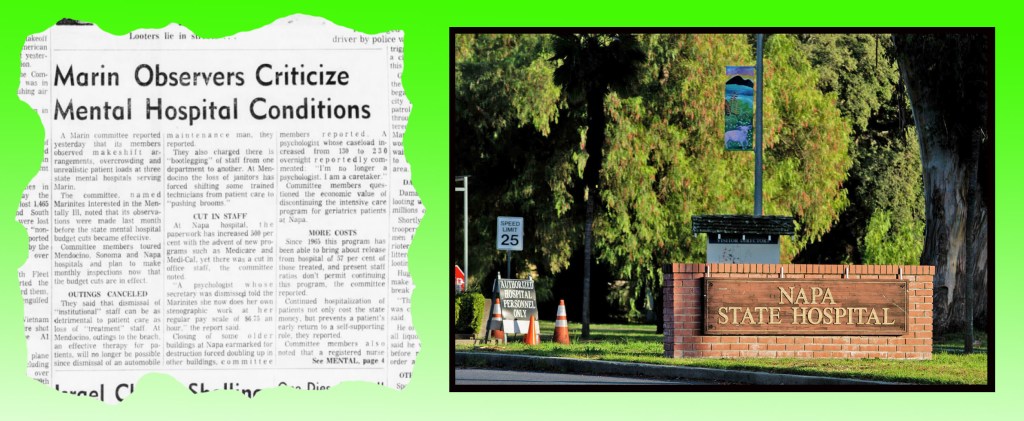
A newspaper article about the Marinites and the leafy entrance to the hospital.

   So the staff at Napa were overstretched.  One economy measure was to close the laundry one day a week, but this meant they couldn’t provide the optimum number of bed and diaper changes for their patients.  I don’t recall a staff member being unfriendly but they were all overworked and a bit distracted.  My time at Napa was interesting and I don’t remember any boredom or depression on my part.  It was all an enormous adventure and I was enjoying it.  

   Outside the walls of Napa State Hospital there was a lot going on in the world.  In Vietnam the Viet Cong launched a huge rocket attack on the enormous US air base at Da Nang, killing 13 and wounding 173 others.  The rockets, fired with deadly accuracy from a nearby mountain, set the air base ablaze, destroying three barracks and a score of aircraft worth an estimated $48 million.  War on the streets of the USA erupted in Newark, New Jersey as National Guardsmen and police battled black rioters firing rifles and submachine guns.  For the first time the guardsmen were using live ammunition which brought the death toll to 16 people killed.  Later in the summer, rioting would also break out in Detroit, Michigan.  I, however, was aware of none of this.  If I was going to save the world it was going to have to be without knowing what the hell was going on in the world.

Two newspaper clippings. On the left the Viet Cong attack on the US Air Base in Da Nang and on the right the rioting in Newark.

   That I had been picked up by the Highway Patrol on the overpass was reported in the Independent Journal, the afternoon newspaper in Marin County.  The news item about me was tucked away on page eleven under the headline: ‘Admitted LSD Taker Is Held.’  The article was wrong about the time of day.  The reporter must have misheard the Highway Patrol officer and written it as evening whereas it was very early in the morning.

   One subscriber who saw the story was Nona Kaufmann.  Mrs Kaufmann was alarmed to read about me and brought it to the attention of her daughter Janice.  Jan and I had dated at Tam High and I knew her mother fairly well.  The Kaufmanns lived in Strawberry on the other side of the highway.  

   I had first met Jan one evening in the back seat of a VW Beetle driven by Mark Symmes.  Mark, who was accompanied by a young woman in the front passenger seat, drove us up Edgware to the junction of four corners where there was a big space to park.  I have no memory of why I was in the back seat next to Janice, who I did not know.  I also don’t recall who the young lady with Mark was, but once he’d parked the vehicle, they began making out.  I turned to the young woman on my right and instantly found myself in a passionate embrace.  This was the start of a pretty steady relationship which lasted the rest of my time at Tamalpais High.  Without realising it, I fell in love with Jan.  The reason I didn’t realise it was that I was constantly putting on a front as a lady’s man at school with much flirtation.  I wasn’t aware that I subconsciously put Janice on a pedestal while other women were, I felt, there to be treated in a cavalier fashion.

   I remember Jan asking me what I was going to do with my life and it concerned her that I had no idea.  I remember her father Stephen becoming alarmed at the fact that I bought an expensive sweater for her at Christmas from J Magnin’s in San Francisco.  “This seems serious,” Jan quoted Mr Kaufmann as saying.  

   When I went to sea right after my graduation it was actually my first proper time away from home and I returned, a very changed person, to a Mill Valley which had been transformed.  Most young people were now smoking marijuana, in stark contrast to what the place was like only a few months before.  The short haircuts which were part of a uniform look for young men was no longer the norm as most guys had long hair.  One school friend who had previously looked very collegiate, now resembled Sonny Bono of Sonny and Cher.  He talked of the hidden drug messages in Bob Dylan’s lyrics and how the name “The Lovin’ Spoonful” referred to heroin use.  He spoke enthusiastically of all this as if drug use was a political movement.

   I fell out of touch with Janice during this period.  At the time I was picked up by the Highway Patrol, she was a student at UC Davis and was shown the I-J article by her mother on a weekend visit home.

   Jan visited me at Napa which must have been very strange for her.  She was directed to my ward where she found me surrounded by a group of men, all eager to talk to someone.  These guys apparently were pretending to take their medication rather than actually swallowing the pills.  They offered handfuls of tablets to Jan.  Two of them told her they behaved crazy to avoid being put in jail.  Jan and I wandered through the restricted outdoor area followed, she remembers, by “this posse of fellows.”  Though these guys were not taking their medication, I clearly was, as Jan remembers me as medicated but delusional.  I talked about saving the world with John Lennon and John Sebastian.  This crazy notion took quite a bit of time to fade from my conscious mind.  Looking back on it, I’m truly grateful to Jan for visiting me at the hospital.  She was and still is a good friend.

   One thing I didn’t know at the time was that my father Blackie was there at the hospital almost every day of my three week incarceration.  He did make appearances when others visited, like my sister Kate, but I had no idea of his presence on a day to day basis.

   I was a very passive patient who, when instructed to do something by the staff would oblige.  On occasion strange impulses would appear within me like suddenly taking all my clothes off and standing naked in the corridor.  This didn’t happen often but when it did, a staff member would arrive and gently tell me to put my clothes back on, which I did.  I remember being locked in an empty hall where I walked up and down singing my pretty near perfect imitation of John Lennon doing Day In The Life from the Sgt Pepper album.  

   There was no radio at Napa, so the three weeks I spent there I didn’t hear the Top 40.  I missed the fact that Light My Fire by the Doors climbed the hit parade as did the ghastly San Francisco by Scott McKenzie.  I never heard Up Up and Away by the Fifth Dimension or Don’t Sleep in the Subway by Petula Clark.  I was stuck with Sgt Pepper going through my head.  

   In the hospital every door to the outside world was locked and in that way, all of us patients were prisoners.  I got into the habit of trying every door in case it wasn’t locked.  One morning I turned the knob on a door leading out into the garden and found that it opened.  I walked out and closed the door behind me.  I found myself on a neatly trimmed lawn.  I walked across the grass and kept going.  I passed administrative looking buildings and eventually came to a street.  I turned left and walked until I arrived at a bus stop.  I don’t believe I was there long for very soon a bus arrived.  I got on and for some reason I wasn’t challenged to produce a ticket or money.  So I found a seat in the rear of the bus and sat down, looking out the window and watching the beautiful scenery go by.  I had no idea where I was going.

To be continued.

Amazon USA
https://www.amazon.com/dp/B085QN73VQ


Amazon UK
https://www.amazon.co.uk/dp/B085QN73VQ
1967 – The Summer of Love, chapter two

Pictured on the left, Bill Graham

By 1967 I had become a head.  A great deal of my time was devoted to getting high with my chums in Mill Valley.  When one joint had been passed around the room and reached the end of its existence someone would pull another Rizla out of the packet, sprinkle a sizeable batch of grass into it and roll another one.  We would spend hours talking and laughing about ‘straight’ people and how unaware they were about their rituals and behaviours.  We took great delight in considering ourselves different to the rest of society.

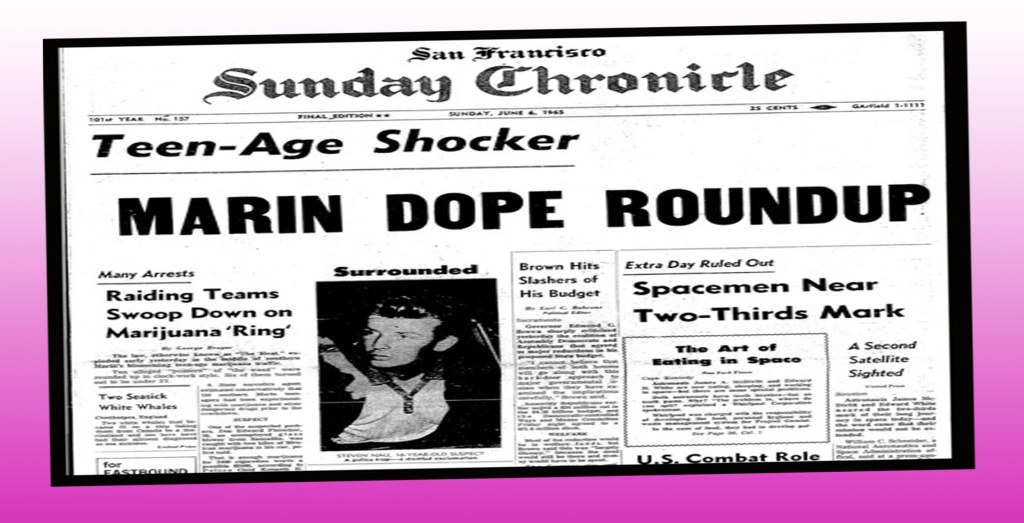
   One aspect of the cultural changes brought about by the dope smoking phenomenon was that it provided a sanctuary for oddball outcasts.  In earlier times young people who didn’t fit in would be shunned by various levels of In-Crowd but the sharing of a joint was a friendly experience which transcended such divisions.  Back in 1965 when I accidentally stumbled upon a highly secretive group of friends who were turning on, there was in play a certain amount of social cross-pollination.  Rich kids who lived in the leafier parts of Mill Valley would be going to Marin City and Sausalito to score their matchboxes from young people who they would never otherwise encounter.  Then the federal narcotics people held a massive raid in the summer of ’65 just before my graduation with a fanfare of publicity which succeeded in popularising marijuana throughout Marin County and in turn the bay area.

The front page of the Sunday Chronicle in June 1965 announcing the big raid in Mill Valley, Marin City and Sausalito.

   The fact was that young people were already ostracised from adult society by not being allowed to drink until they were 21 so the leap to smoking grass was not that big a deal.  And it was a very big social change.  When I first stumbled onto my friends’ clandestine pot smoking it had scared me to death.  But now I was a head like everybody else.

   On one occasion I was very smoke ridden and listening to Donovan singing Season Of The Witch when a friend asked if I had “heard about that Dreyfus guy?”  He then handed me the Independent Journal with a front page photo of Dave Dreyfus above the headline: ‘Helicopter Crash Kills Ex-Marinite.’  

   I was thunderstruck by this news which clearly meant nothing to my friend who couldn’t possibly comprehend its importance to me.  The Dreyfus boys; Dave, Tim and Jared, had been a part of our lives ever since my family arrived in Mill Valley in 1952.  Babbie and Barney Dreyfus were very close to my parents Blackie and Beth and I remember many a barbecue up at Bootjack Camp.    

   Dave had decided to join the army in the early 1960s which was a highly controversial thing considering the leftwing politics embraced by all my parents’ friends.  There was a political chasm between the boys of the Hallinan family and those of the Dreyfus family.  Both Dave and Tim Dreyfus seemed to sidestep their parents’ politics whereas all the Hallinan boys were uniformly militant in their support of a long list of causes which included civil rights, both in the deep south as well as the bay area, and opposition to the war in Vietnam.  Many a fist fight was waged by the Hallinan boys with those who disagreed with their politics.  And they were all tough fighters.  The use of the N word by any caucasian would ignite one of these battles which gained them a fearsome reputation throughout Marin County. 

   Back in 1952 their father, Vin Hallinan was a candidate for president on the Progressive Party’s ticket.  There wasn’t a hope of his being elected but his candidacy was a rallying point for the left which was under serious attack by the federal government at this time.  His opponents were Dwight D. Eisenhower for the Republicans and Adlai Stevenson for the Democrats.  In my sister Nell’s class at Old Mill School they held a mock presidential election and Nellie was surprised to learn that Tim Dreyfus voted for Eisenhower.  He even sported an I Like Ike badge with pride.

Some images from Vin Hallinan’s presidential bid in 1952. In the photo on the left Vin, Vivian and a very young Danny arrive at the polling station at Ross School to be to told by the precinct inspector that because they’d already sent a postal ballot from New York they couldn’t vote that day.

   So when Dave Dreyfus joined the army, all the Hallinan boys were disapproving but Babbie resolutely refused to criticise Dave for his decision.  He did his two years in the service then went to Texas where he learned to fly helicopters and became a flying instructor there.  He was a passenger on a demonstration ride while attending a helicopter convention near palm Springs when the crash that killed him occurred. 

   Dave was only 26 years old.  This was my first experience of death on a personal level and the fact that I got the news through a cloud of marijuana smoke made it all the more upsetting.  The last time I had seen Dave was at my sister Nell’s flat on Greenwich Street in San Francisco.  He was a very engaging and funny guy.  He was gently disagreeing with Nell’s commitment to socialist principles.  “But I like steak,” was his reply to her criticism of eating in fancy restaurants when so many were hungry. 

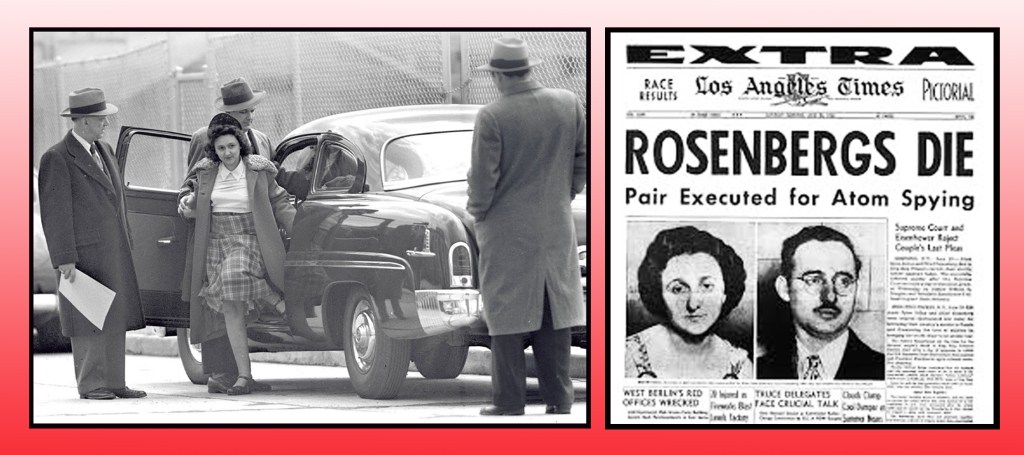
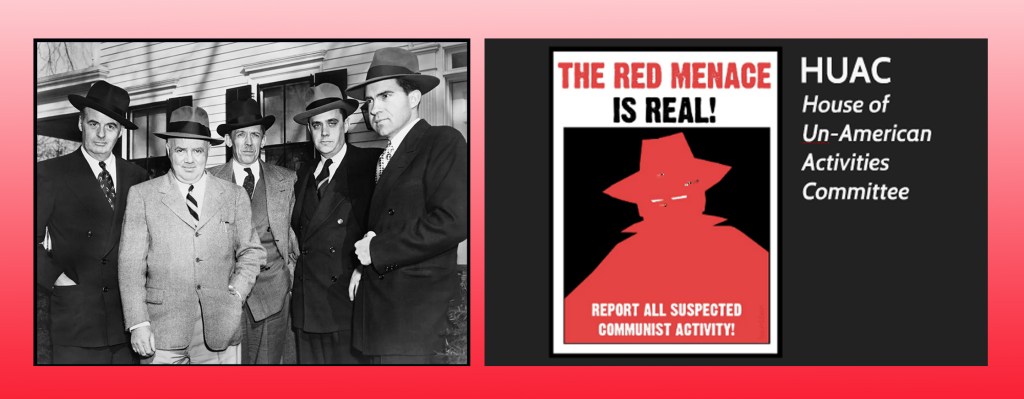
   Perhaps it was fear that turned both Dave and Tim away from their parents’ politics.  The cold war era was a frightening time to be left wing in your political outlook.  HUAC and Senator Joe McCarthy’s investigations ignited a blaze of terror across the nation, the reverberations of which are still felt today.  Guilt by association was a major concern.  My father Blackie told me that, after he was blacklisted, people he and my mother knew well in Greenwich Village suddenly didn’t know them at all on the streets of New York.  The fear of being subpoenaed and grilled about some petition you may have signed in the 1930s meant that debate on matters political became diminished.  The prosecution and conviction of Alger Hiss and the execution of the Rosenbergs sent a powerful shock wave through the families of the left during the early 1950s.  One of the scarier sights would be a visit by FBI agents to your doorstep and all of our families had many such visitations throughout the 1950s. 

Pictured on the left is Ethel Rosenberg being arrested by federal agents. On the right is the front page of the LA Times after they were executed.

   I remember Jared Dreyfus telling me about a kid in their neighbourhood saying to his brother Dave: “When it becomes legal to kill commies I’m going to kill your mother.”  Dave then proceeded to beat the daylights out of him.

On the left is a photo of the House Un-American Activities Committee under the chairmanship of J. Parnell Thomas with a young Dick Nixon standing on the right.

   My brother Jim also decided to join the army the previous year rather than be subject to the draft.  He waited until his 18th birthday in September, 1966 to enlist, thus avoiding the need for Blackie and Beth to give their permission.  Our parents, like all their close friends, were firm in their opposition to the war in Vietnam.  I had a temporary deferment because of shipping out as a sailor and the draft was a big problem which I, in my state of regular smoky intoxication, was simply not thinking about.  The choices seemed to be: getting drafted, going to jail or leaving the country.  One other choice as Ringo Hallinan points out, was fighting to end the war.

   Jim’s decision to deal with it by enlisting was complicated.  In part it was an act of rebellion against my parents and their politics, a fact he would admit to me later.  But it was also to confront those three choices.  Once inside he made a decision to sign up for the stenography corps and, luckily, he served his time in Korea and Germany.

   I too was against the Vietnam war but never fell in with a particularly political crowd so didn’t participate in any of the big demonstrations which were prevalent at that time.  The cycle of my life seemed to be getting a bit of poster work and doing my best to grind out something decent.  Then when I’d finished I would put out my thumb and head to Mill Valley where I would smoke myself into oblivion.

   Among my friends who I would turn on with was a very odd fellow named Matt.  Early in 1967 he somehow got this cabin at a place called Slide Ranch out in the wilds along the Pacific Coast Highway.  There were two routes to reach Stinson Beach: one across Mount Tam and the other along the coast road which you would pick up above Tam Valley.  So if I was hitching to Matt’s place I’d need two rides: one from the city to Tam Junction then another out the coast road.  It took a few trips to get used to where exactly it was as there was a steep dirt road which descended on the ocean side of the highway.  It came down past Matt’s cabin on the left then continued down around to the right stopping at a house at the bottom.  

   I had first met Matt the previous year when he was living on a houseboat in the marshes of Larkspur.  It became a regular hangout for me and was where I developed my passion for The Lovin’ Spoonful.  With a head full of ganja I listened to their first LP over and over.  It was not long after I had returned from my voyage on the Torvanger.  That trip had transformed me from the loud mouthed little guy I was in high school into a slightly introverted fellow who’d been out in the world.  So I returned a changed person and found a very different Mill Valley to the one I’d left behind only a few months earlier.  The pied piper of marijuana had come and taken a considerable number of the children away.  Tam High was practically unrecognisable to me.  A great majority of the boys had long hair and most of the girls sported serapes.  A large number of the students were smoking weed.  

   Someone who personified this dramatic change for me was Peter Perdue.  I had known Peter in my senior year as he was a friend of my brother Jim’s.  Peter was a slightly comical figure who was constantly seeking ways to be entertaining for his friends.  He had a vague resemblance to the comedy star Jerry Lewis and would physically flap around in a similar manner.  When I’d last seen him his hair was short as was every male student at Tam High but now his hair was long and expertly cut to make him look like Sonny Bono of Sonny and Cher.  In fact he dressed in bell bottom trousers and his girl friend of the time, Adrienne Inge, looked and dressed just like Cher even though her long hair was ginger instead of dark brown.  

   Peter was positively evangelical about the sociological changes which were happening.  He would read drug related interpretations into all of Bob Dylan’s lyrics, telling me that Mister Tambourine Man was, in fact, a drug dealer and he told me that the name The Lovin’ Spoonful was a reference to shooting up drugs.  He seemed to feel that the hippy phenomenon (it hadn’t yet been christened that) was something akin to a political movement.  I sifted a great deal of Peter’s opinions on this subject through a filter of skepticism.  But he was a very entertaining person to be around.

   His relationship with Adrienne was about to hit the rocks as she became smitten with an older guy named John Parker.  John was the elder brother of Gregg Parker who, like Peter, was now a senior at Tam.  John had been busted for marijuana possession and was on probation.  This didn’t stop him smoking weed, far from it.  Adrienne lived with her mother Eleanor in a small house on East Blithedale at the corner of Nelson.  Eleanor was an interesting old dame who did not like the business of pot smoking one little bit.  This was tough on her as Adrienne made no pretence about getting loaded on a regular basis.  Her mother made every attempt to become broad minded on this subject but then she would get a bit drunk and go crazy throwing all reserve out the window.  I would have long conversations with Eleanor across her kitchen table but one time I turned up while she was drunk and she pretty much threw me out of her house.

   Peter Perdue meanwhile was going through agonies over losing Adrienne to John Parker.  So it was through John Parker and Adrienne that I met Matt as they would go to his houseboat for their assignations.  

   But now, in 1967, Matt was no longer in Larkspur on a houseboat but all the way out at Slide Ranch which was a seriously remote location.  When I would visit it’d be for a few days.  Whoever had money would finance a visit to the grocery store in Stinson where we’d buy jars of peanut butter, loaves of white bread and bottles of milk, cheap food which went a long way.  I was charmed that a band making the rounds in the bay area was called The Peanut Butter Conspiracy.  However I never actually heard them play.

   Matt had worked as a carpenter but at this time didn’t look or behave like he had a job at all, also he seemed to keep himself stoned on weed around the clock.  He was highly intelligent, articulate and a disarmingly honest person which, at this time of my life, I was not.  So much of what was going on inside my head frightened and embarrassed me.  I think my biggest problem was that I didn’t have a girlfriend.  Bob Dylan expressed my state of mind succinctly in his 1965 song It’s Alright, Ma (I’m Only Bleeding): “And if my thought-dreams could be seen, they’d probably put my head in a guillotine.”

   I was now 20 years old and still living at my parents’ place in North Beach.  Hanging out with Matt and our circle of friends was an enjoyable way of not thinking seriously about my future.

  I soon had another assignment from Bill Graham which was a poster for a one-nighter on a Sunday at the Fillmore with an impressive lineup: B.B. King, Moby Grape and the Steve Miller Blues Band.  I decided to go for an Arabian Nights look and started with a tall chimney out of which came a swirling fog, within which I drew the lettering in a wavy pattern with the names of the bands along with the date and time.  Behind the chimney I drew an evil looking genie who was beckoning to a bald headed man in the foreground holding an equally bald headed child.  The significance of these images was lost on me as I was just letting whatever my hands drew make their way onto the poster board.  To the right I depicted a woman, presumably the child’s mother and behind her another genie with a slightly noble look on his face.  The bald headed child had a long extended arm which stretched around towards the mother.

A slightly skewed view of my artwork for the BB King poster.

   I remember how Bill used to examine Wes Wilson’s posters when he would deliver them on a Friday afternoon.  After perching a ladder against the wall above the staircase, he would staple about eight of the posters up in a row then stand back.  He would stare at them and extend his right arm towards them with his thumb straight up.  He would then rotate his thumb down to the 9 o’clock position and keep staring.  I think he was trying to formulate an opinion of the work Wes had done and as that work was something outside his control, I believe this bothered Bill.  Wes, in addition to Bill, was also in the process of becoming famous and was chalking up some very impressive commissions including the poster for the very last performance of The Beatles at Candlestick Park the previous year.  

   Wes would arrive with a friendly smile on his face.  Bonnie and Wes were highly conversational people but Bill was almost always busy and shooting the breeze wasn’t his style.   Though I had never heard Bill express an opinion on Wes’s posters, he clearly had them and his confidence in matters to do with graphic design was clearly growing.  

   I went in to see him in his little office to get paid for my latest poster for the B.B. King show and he suddenly became very cold and business-like.  

   “What have you got on this poster?” He asked.  “There’s a genie and another genie and a martian.  And a little martian.  I don’t like it.”  He wrote me a cheque for the artwork and said: “Come back when you can do something I like.”

   I was stunned.  His words wounded me tremendously and immediately.  Bill had always liked my work but now he was telling me to get lost.  I walked away from the Fillmore deeply traumatised.  I’d been fired.  If I had been at all professional I would have gone back to the drawing board and ground out some good spec art work and taken them into show Bill but I was not that person at all.  Instead I took refuge over in Mill Valley getting stoned with my friends.  I was too mortified and embarrassed to tell them what had happened with Bill so I just kept it to myself.

   I was, however, still able to walk into Bill’s concerts for free which I did, usually in the company of our friend Augie Belden.  Augie was always in search of a good time and he had a VW beetle which could take us into San Francisco to go see shows at the Fillmore and Winterland and on one occasion we saw a rather extraordinary performance at The Matrix featuring a band we’d never heard of called The Doors.

To be continued…

Amazon USA
https://www.amazon.com/dp/B085QN73VQ


Amazon UK
https://www.amazon.co.uk/dp/B085QN73VQ