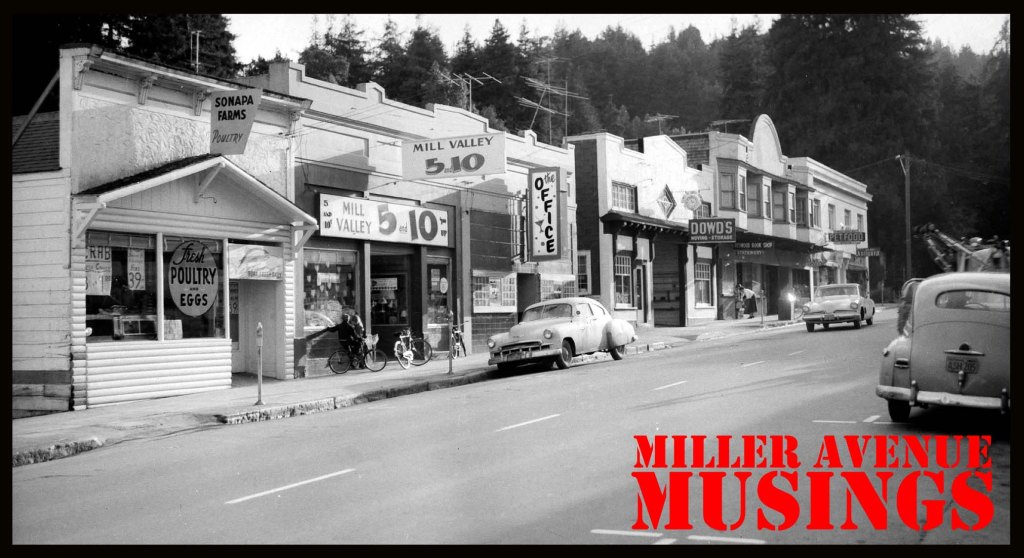
(Photo courtesy of the Lucretia Little History Room, Mill Valley Public Library)
A thread of comments begun by Alex Call on Facebook’s Mill Valley Kids started me thinking about that stretch of Throckmorton which runs from Miller Avenue up toward Old Mill Park.
One day, some years ago, I found myself standing at the corner of Miller and Throckmorton by the clock on that tall column outside the depot. I noticed how different this totally recognisable town was to the Mill Valley I grew up in during the 1950s and 60s. It struck me how the modern Mill Valley has a lack of practical, ordinary stores.
During the 1950s, the town had more than enough shops, cafes and bars to cater to every possible need. From where I was standing by the clock, my younger self would have looked up Throckmorton and seen Mayer’s department store on the corner opposite. This eventually became Women’s Mayer’s when the Men’s store opened sometime in the 1950s, but when I first encountered it, it was simply Mayer’s.
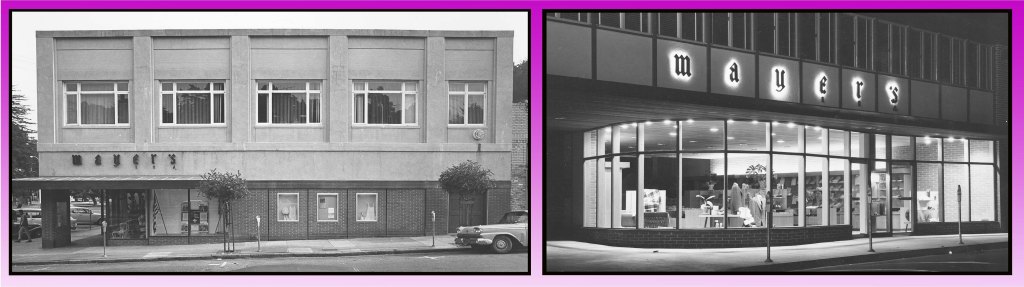
On the left is Women’s Mayer’s and on the right Men’s Mayer’s which was further down Miller Avenue. (Courtesy of the Lucretia Little History Room, Mill Valley Public Library)
As a kid I was intrigued by an x-ray machine they had in the shoe department at Mayer’s. It was a big box with a slot at the bottom to put your feet into. On the top was a screen which showed you an x-ray image of your feet which I found absolutely dazzling. I remember wiggling my toes and was thrilled to see my skeletal digits move on the screen.
Carrying on up the street you came to Esposti’s soda fountain where you could sit at the counter and be served by a person wearing an all white uniform. You could order anything from ice cream sodas to banana splits. Established in 1920 by brothers Ettore and Delelmo Esposti to sell ice cream in Mill Valley and by 1930 they began making their own.
Susan Hoots remembers that she “loved standing outside the big picture window and watching the ice cream dispense out of the ice cream maker. In those days my dad would run down town right before dinner and buy a hand packed quart to take home.”
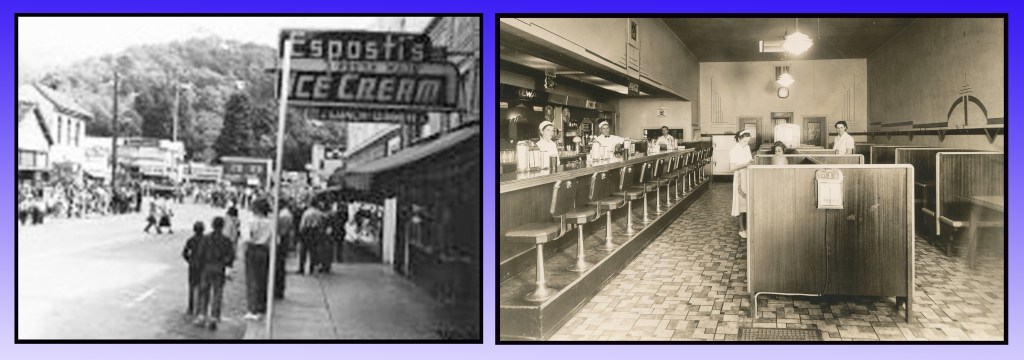
Esposti’s soda fountain outside and in. (Courtesy of the Lucretia Little History Room, Mill Valley Public Library)
My friend Sally Borgeson recalls: “Esposti’s was a place that sparkled, even on rainy days. My dad always ordered a root beer float and I would have a chocolate ice cream soda. I loved the sound of the soda dispenser, that whoosh and then the clank of spoons and dishes, the tall glass in front of me. We sat at the counter and I spun back and forth on the little stool. There was one of those noisy old style milkshake machines that could make two or three shakes at one time–chocolate, vanilla, strawberry, not the endless flavours we face today. It was a very typical post-war soda fountain.”
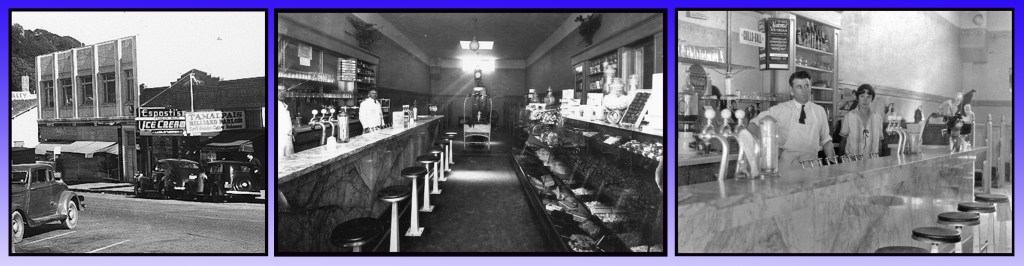
Views of Esposti’s from it’s early days probably in the 1930s. (Courtesy of the Lucretia Little History Room, Mill Valley Public Library)
When Esposti’s became La Ginestra I left my after school job at the Bus Depot and became a bus boy at the new Italian restaurant where I worked right up until I graduated from Tam High in 1965.
A few doors further you’d come to Ben Franklin five and dime store. We remember it as Ben Franklin but none of the photos from the library bear that name. A photo from the 1930s says Mill-Valley 5 10 15c-Store while in the late 1940s its says Mill Valley 5 and 10. The title five and ten cent store was coined at the turn of the century when that amount of money was worth a whole lot more than in the 1950s. Ben Franklin was where we’d buy penny candies, red and black liquorice sticks, bubble gum and trading cards. The adults in Ben Franklin didn’t seem to like kids at all and treated us coldly and with suspicion which was odd considering we were their customers.
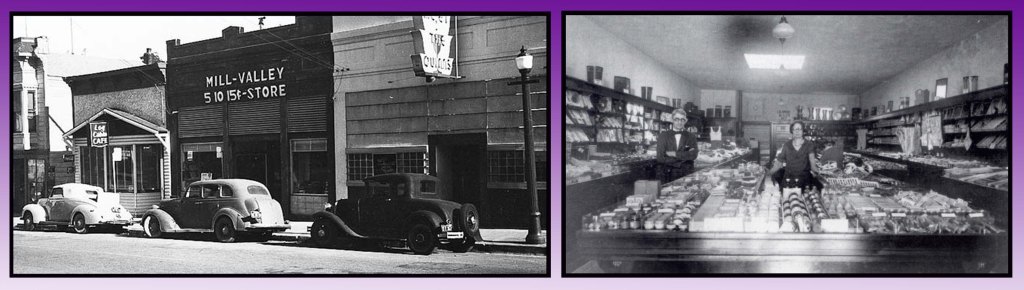
What we called the Ben Franklin Store before it was called that. (Courtesy of the Lucretia Little History Room, Mill Valley Public Library)
Next door was a bar, The Office. It’s title was a joke for drunken husbands to tell their wives they were still at the office. Tony Houston’s father was a regular drinker at the Old Mill Tavern and The Brothers down on Locust, though he stayed away from Quinn’s and the 2am Club. Tony remembers: “My dad never went into The Office but, as a misguided youth who looked much older than my actual age, I would boldly enter the establishment and have a few quick pops.” But in addition to liquor, The Office also served food. Mitch Howie remembers his mother taking him there for Spaghetti Nights on Tuesdays and Phyllis Frerichs Black recalls her mother, who worked in the Keystone Building on Lytton Square, spending many happy lunch hours at The Office with work colleagues. Before it was The Office it was the original location of Quinn’s Bar which, in my time, was next to the Mill Valley Market where Corte Madera meets Throckmorton. At some point in 1972, The Office became The Sweetwater as the era of the fern bar dawned.
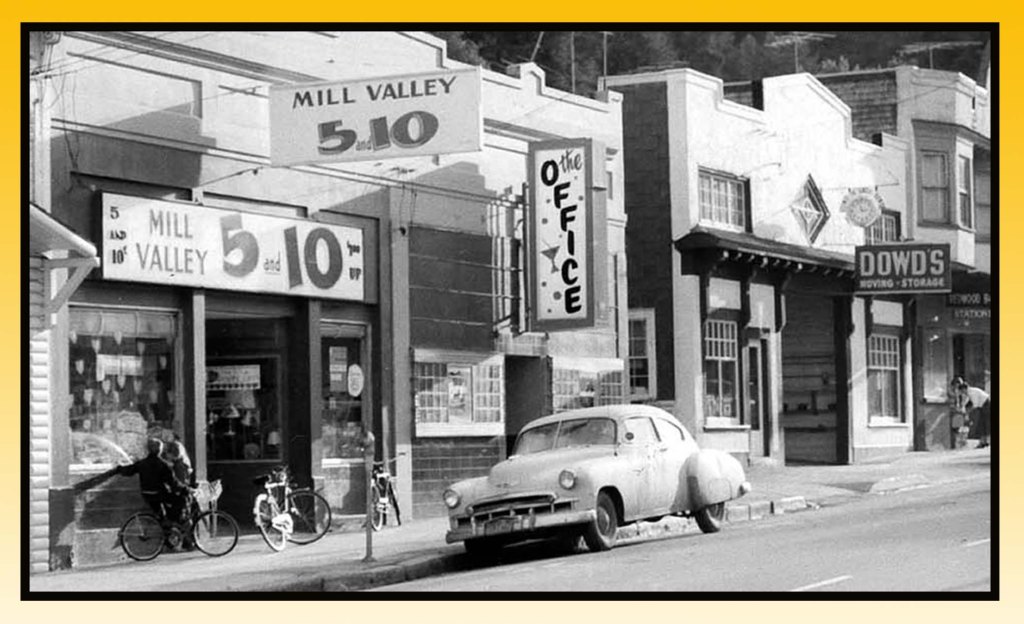
The Five & Dime store, The Office and Dowd’s Moving & Storage. (photo courtesy of the Lucretia Little History Room, Mill Valley Public Library)
The next building up from The Office belonged to Dowd’s Moving and Storage Company which began trading in 1896 using horse drawn vehicles. They started out doing everything from moving people into town, grading roads, assisting the fire department and burying the dead. When people rebuilt their burnt out homes they went to Dowd’s to buy their sand and cement. And in 1919 they abandoned horse drawn vehicles for motor trucks. Dowd’s was a highly successful company which eventually was sold in 1974.
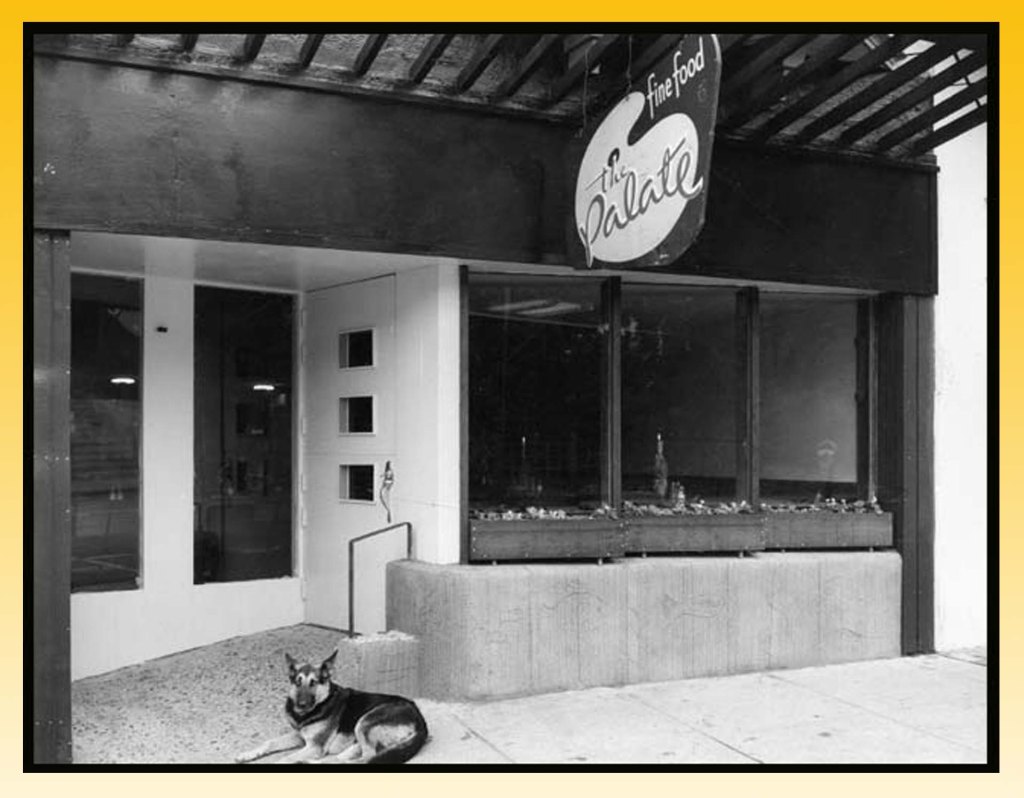
A dog relaxes in front of the Palate Restaurant. (courtesy of the Lucretia Little History Room, Mill Valley Public Library)
A bit further along you’d find The Palate restaurant. Several of the folks I grew up with went there with their parents but my folks never took us to restaurants in Mill Valley. My friends all talk about the burgers served at The Palate. Some loved them but many complained that they were difficult for children to eat. Also the proprietor, Farwell Taylor, seems to have been a person of notoriety. Alex Call remembers him playing the grand piano and Philip Richardson recalls that he knew lots of the famous jazz musicians of the day. Michael Zifcak, who worked there as a dishwasher, says: “I will never forget the crazy old guy and I will add: nasty. I believe his name was Farwell.”
The next stop on Throckmorton was Dimitroff’s frame shop followed by a pet food store which Marguerite Finney remembers had a piranha in a fishbowl. I also recall that aggressive looking fish whose sharp teeth were noticeable. I believe they fed it raw hamburger. We purchased four little turtles from that shop. They were all tragically devoured by visiting racoons within a week of bringing them home. The last place was an antique shop and then the street became residential. But that stretch of Throckmorton had such a lot of thriving businesses. And to think that it was only one side of the street.
Back at the clock I’d look to my right where, over on the corner of Throckmorton and Bernard, stood the Old Mill Tavern, the only bar I ever went in with my father Blackie. In the men’s toilet there was a lifesize full colour painting of a naked woman with a hinged fig leaf over her private part. If you lifted it, which I did, a loud sustained bell would go off out in the bar so the entire room would be laughing as I emerged, red faced. The Old Mill Tavern was operated by Fred Berick who must have been a political lefty because that was the only bar which Blackie ever took me into. Fred was best friends with Tony Houston’s father who was a blacklisted Hollywood writer.
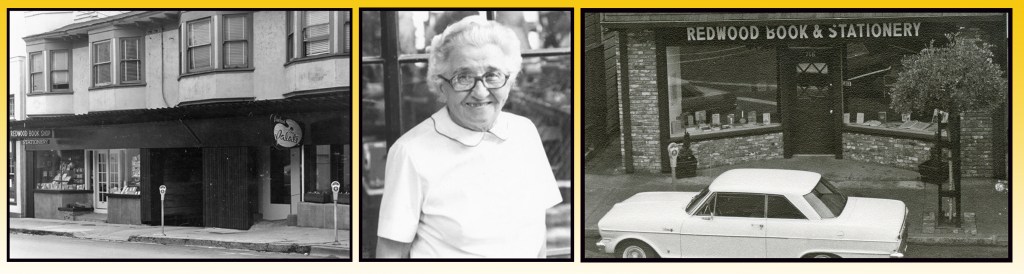
On the left is the Redwood Bookshop’s original location next to The Palate. Center is Mrs Roth and on the right is where I knew the shop next to Del’s Liquor. (Courtesy of the Lucretia Little History Room, Mill Valley Public Library)
Next door in the direction of Old Mill Park was the Redwood Book Shop. Owned by Mrs Jenna Roth, the bookshop was originally the other side of Throckmorton next door to The Palate but by the time we arrived in town it was next to Del’s Liquors just up from the Old Mill Tavern. I believe this was where my sister Nell, who always had her face in a book, purchased all her OZ, Mary Poppins and Nancy Drew books from.
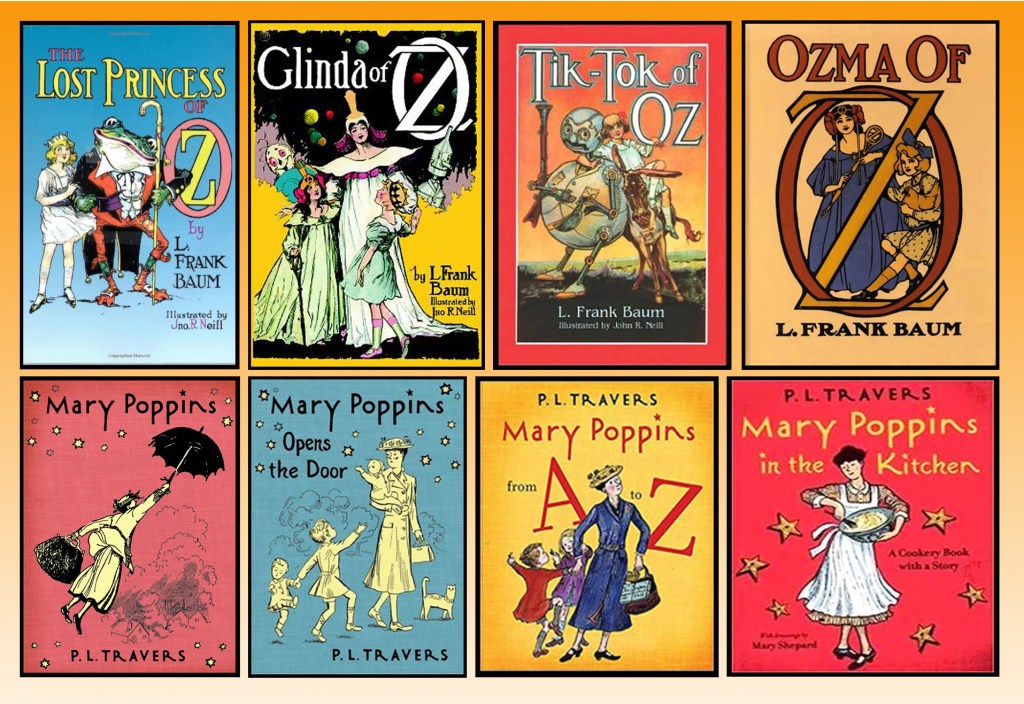
A selection of covers of the OZ books by L Frank Baum and Mary Poppins by P L Travers.
My schoolfriend Frank Truelove was introduced to The Hardy Boys books by his friend Finn Lamont and quickly began to seek them out. He found many up at the library on Lovell. “Finn owned a few,” remembers Frank. “ I had several. But they cost a dollar and my allowance was only 25 cents per week. So I had to find them where I could, which was the Redwood Bookstore. They were on a bottom shelf in the middle of the store about fifteen feet from the front door. They were on the side of the shelf hidden from the counter. If I was quiet, I was not noticed. I could read them for a half hour to an hour at a time. Nancy Drew, I remember, was popular with girls for the same reasons The Hardy Boys books were for boys.”
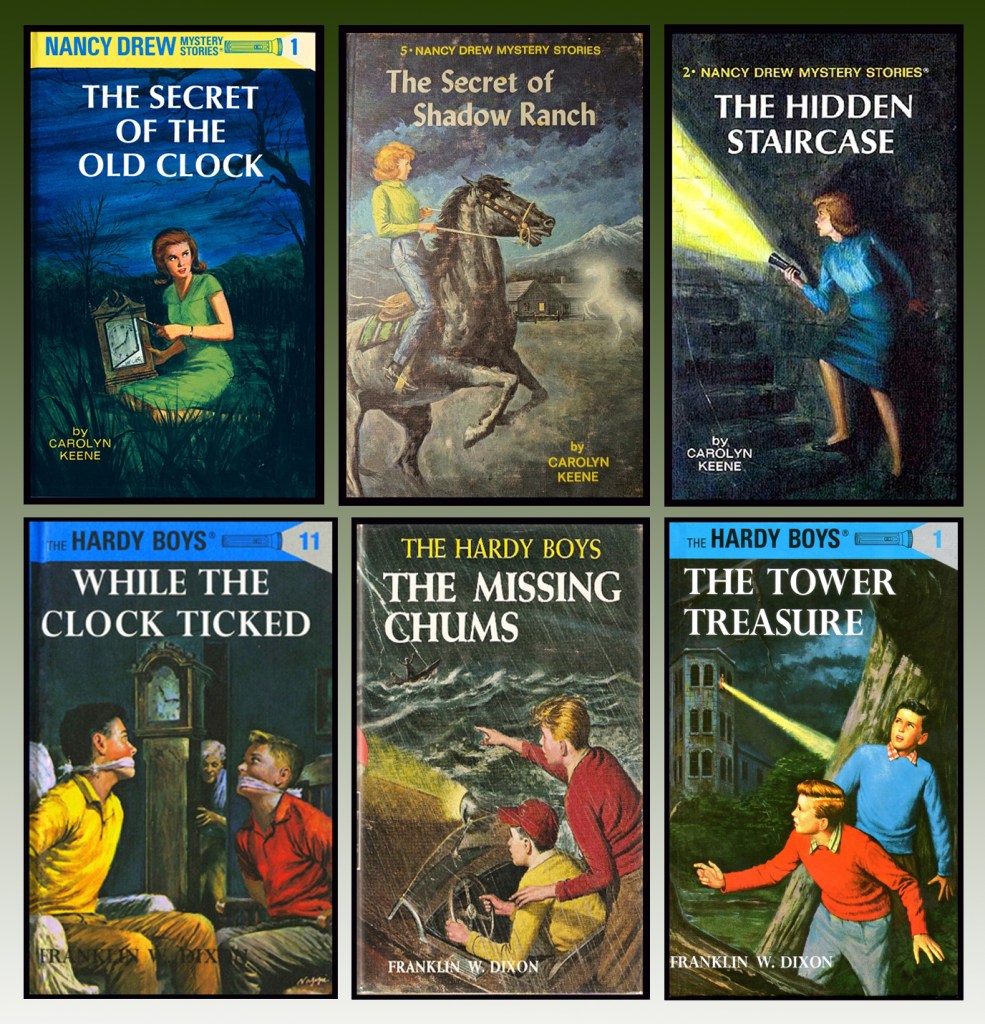
Both the Nancy Drew books and The Hardy Boys were published by the Stratemeyer Syndicate.
Both the Nancy Drew and Hardy Boys books along with a mountain of other titles were published by the Stratemeyer Syndicate. Founded in 1899 by Edward Stratemeyer with the publication of The Rover Boys followed by The Bobbsey Twins in 1904, Stratemeyer made a fortune hiring ghost writers to pen stories of adventure catering to young people. He died in 1930 leaving the syndicate to his two daughters, one of which bought out the other and updated the books eliminating words like roadster as well as racial slurs. So the books my sister Nell and my friend Frank read in the 1950s had originally been written in the 1920s, 30s and 40s.
If you left the bookshop and walked towards the corner by the Old Mill Tavern you came to Bernard Street, a fairly steep hill coming down from Lovell. Just above the Old Mill Tavern was a barber shop where my brother and I would have our monthly haircuts. As I write this I am totally bald on top but, as a kid, my hair used to grow very fast and after 30 days it would be looking pretty bushy, so Blackie would insist that Jimmy and I would get a haircut which was always pretty short. The barber was a very nice man whose shop was littered with magazines for the customers to read while waiting their turn in the chair. I’m pretty sure it was just him with one chair but I invite correction from others who know differently.
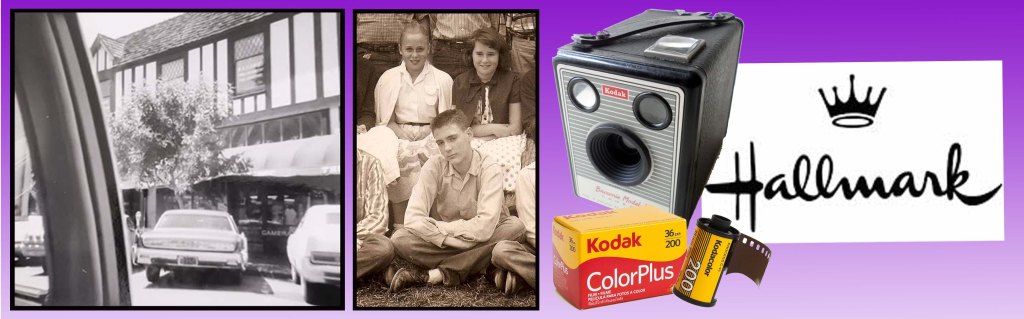
A view of Strawbridge’s from a car on the left. In the center Daphne Strawbridge, Katie Myers and John Cipolina from my sister’s 1957 school photo.
On the north side of Lytton Square were stores of every kind. Strawbridge’s specialised in cameras, photographic supplies, portable typewriters, artists’ supplies and stationery. They sold everything one would need for school work: binders, pads of lined paper, dividers. From an early age graphics fascinated me and I quickly developed an opinion of logos. One which I admired was the logo for Hallmark Cards which Strawbridge’s stocked lots of. My sister Katie was very good friends with Daphne Strawbridge who was in her class at Old Mill. Daphne and her brother Roger took part in the production of Julius Caesar my sister Nell organised with Shelly Bode at the Outdoor Art Club.
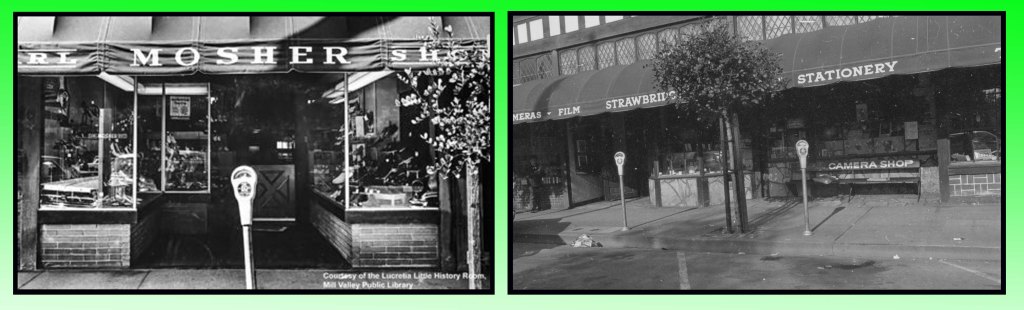
Carl Mosher’s shoe store on the left and Strawbridge’s on the right. (Courtesy of the Lucretia Little History Room, Mill Valley Public Library)
Mosher’s Shoes was where my mother took us at the beginning of each school year to purchase our regulation brown leather shoes which started out looking shiny and new but within a week looked like hell. The Moshers had a few sons, one of whom was Jack Mosher who I knew of but, as he was three years older, didn’t know during my time at Tam High. Years later in 1970, I was living in London and passed Jack Mosher on Kensington High Street. He looked at me and I at him, clearly recognising each other. We got chatting and he came back to the bedsit I was sharing with my then girlfriend for dinner where we spent the evening telling stories about Mill Valley. My British female companion was horrified by many of the tales we told and it gave me my first inkling that stories about my home town might be of interest. This was the very first time such a thought had ever occurred to me. While growing up in Mill Valley I was always enthralled by other places and could see nothing noteworthy about my home town.
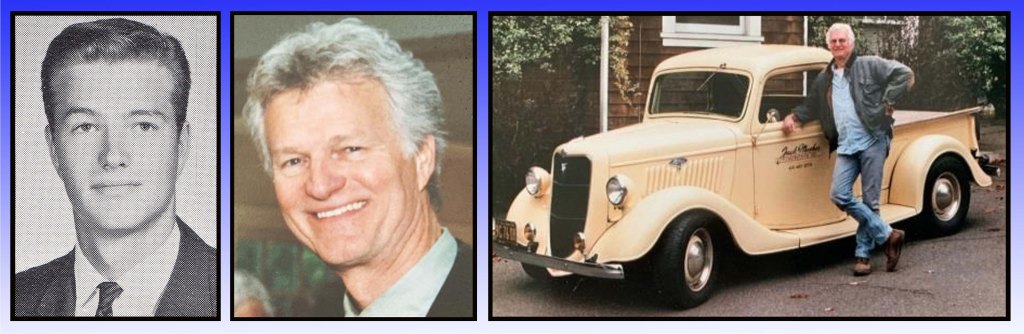
The late Jack Mosher on the left in his senior year at Tam High then later in life. Jack had a passion for vintage cars and is pictured with his 1935 Ford pickup. (Courtesy of the Lucretia Little History Room, Mill Valley Public Library)
Rutherford’s Pharmacy was also on Lytton Square. I have a memory that most pharmacies would have a revolving rack of comic books but maybe Rutherford’s didn’t because of the Bus Depot across the street which sold every comic book you could imagine. As you approached Corte Madera Street you couldn’t miss the sturdy and huge brick building which housed the Bank of America. Both the downtown banks were spacious inside but the B of A had all the atmosphere of a bustling train station. It was busy and lively and huge with little counters where you could use pens on chains.
On the other side of the square stood the Bus Depot, so called because that’s where the commuters caught the Greyhound buses into the city. But this written-word walkabout is going to take a few columns so in the next episode we’ll continue on up Throckmorton towards East Blithedale.
To be continued…
Amazon USA
https://www.amazon.com/dp/B085QN73VQ
Amazon UK
https://www.amazon.co.uk/dp/B085QN73VQ

 Miller Avenue Musings
Great stories that bring back a LOT of great memories. I’ve always had the impression that NO ONE remembered Esposti’s except for me . . . and the burgers at the Palate were AMAZING.
Your paragraph about Dowd’s didn’t have an explanation about why people had burnt out homes . . . and that barbershop on Bernard is where I used to go, too.
Men’s Mayers was for cub scout and boy scout uniforms, and the bus depot was my go-to place for my Superman comic books . . .
Just a few thoughts . . .
Ernie
LikeLike
Thanks for the picture of the Five and 10-cent store! I used to have dreams about that store… Wasn’t Dimitroff’s (on Throckmorton farther up from Dowd’s ) in that era? I think it was a picture framing and art-related biz. And the barber shop pretty much across the street? I sort of recall the guy who used to cut my hair was named Ray. And the Nimble Thimble in the same bldg but on the right side? I read both the Hardy Boys and Nancy Drew mysteries, but got the books out of the (old) library. I think there was another barber shop on Bernard about halfway up to Lovell w/ a good collection of comic books. Does that ring a bell?
LikeLike