“A Scramble For Guidance…”

Previously in Miller Avenue Musings:  My sister Nell had visited from London with her one year old son Poggy.  It was a very happy occasion and I made plans to go back to work on the San Francisco waterfront to save for a trip to London. 

All through my madness I’d been high as a kite, confident and sure of myself, but now the hubris began deserting me.  Doubt and darkness settled on my shoulders like ashes from above.  In coming down from the tremendous high of thinking I was the messiah, here to save the world, I kept on going down into what would prove to be a total nervous breakdown.  I had never contemplated such a fate and suddenly I was trapped within its walls.  There was no talking my way out of this one.  It wasn’t going to be better in the morning.  I gradually became separate from the world around me.

   There were still small slivers of light.  My old friend popular music continued to look after me.  The record player in my bedroom was constantly in use and I had a sizeable collection of LPs that I listened to.  Before I went crazy I had purchased the album Are You Experienced by the Jimi Hendrix Experience.  The Beatles record All You Need Is Love came into the Top 40 and I heard it on the radio but on my record player I listened to the Hendrix disc over and over.  

   The late Jimi Hendrix is mostly remembered for his electric guitar playing but as I listened over and over to that album I concentrated more on his words.  The subject matter in Hendrix’s lyrics dwelt on psychological problems, things I was beginning to experience.  One song was entitled Manic Depression and in it he described being unable to adapt to the world around him.  Manic depression was a concept I’d known nothing about.  I was, however, sliding into the grip of a severe manic depression.  So I immersed myself in the wailing music of the Jimi Hendrix Experience.   
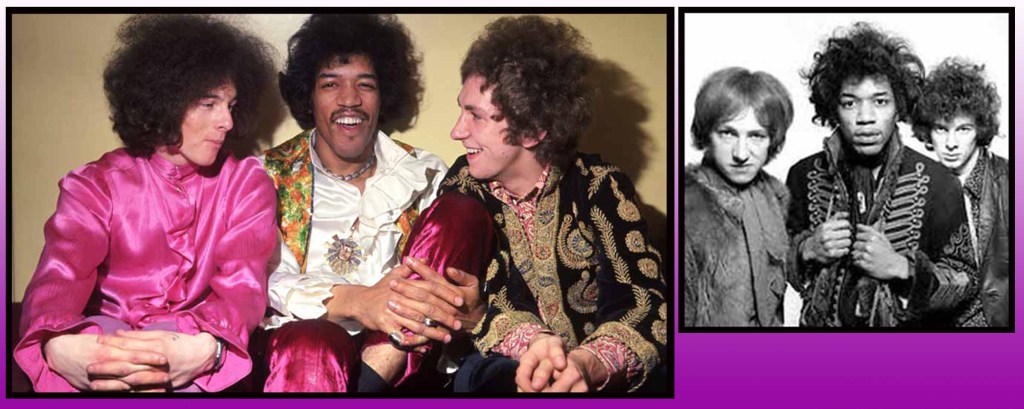
The Jimi Hendrix Experience featured bass player Noel Redding and drummer Mitch Mitchell.

   When I first saw Hendrix’s trio play at the Fillmore and on a flat bed truck in the panhandle, his hit on the radio was Purple Haze.  Now when I listened, I heard his lyrics in a very different way.  Whatever the Purple Haze was, he didn’t seem happy that it was physically surrounding him and he plaintively cried “Help Me,” a few times during the song.  I didn’t wonder at the time if he too, had had a nervous breakdown but his lyrical disposition on that album’s material lead me to conclude that he had.  The song I Don’t Live Today articulated perfectly my mental condition in the months to come as the emotional distance between myself and the real world grew and grew.  

The image of the Jimi Hendrix Experience was carefully created and nurtured by their manager, ex-Animal, Chas Chandler.

     The world outside my bubble of depression continued to turn in spite of the fact that I knew nothing about it.  The Vietnam war was dividing the nation in a big way and President Johnson’s policy of bombing North Vietnam was losing him support within the Democratic Party.  After Johnson’s re-election as president in 1964, Bobby Kennedy resigned as his attorney general and became a critic of the Vietnam war.  I remember a good friend predicting that Bobby would make ending the war his cause as a pathway to the presidency.  Maybe that is what he would have done had he lived until the next election.  

   But for now Johnson was committed to bombing North Vietnam though, in the oval office, he seemed to be trapped between hawks and doves.  In early September he denied there was any division within his cabinet about war tactics.  The press was reporting that Defence Secretary Robert McNamara was in conflict with military chiefs who wanted him to escalate the bombing but at a hastily convened press conference Johnson denied this.  A reporter asked Johnson if McNamara had threatened to resign if the bombing was stepped up and the president described that as “absolutely” untrue.  “That is the most ridiculous report I have seen since I became president.”
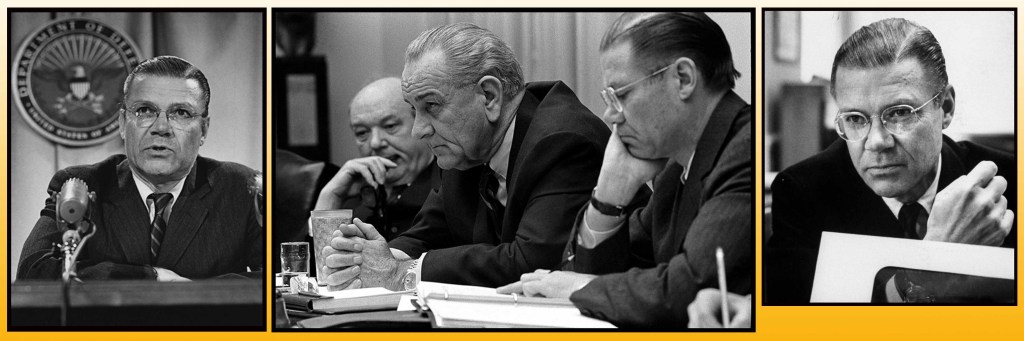
Three photos of President Johnson’s Secretary of Defense Robert McNamara. Pictured in the centre photo is Secretary of State Dean Rusk, Johnson and McNamara.

  But not all the criticism was coming from his own party.  George Romney, the Republican governor of Michigan became critical of the war.  Romney was positioning himself for the nomination to be the Republican presidential candidate in 1968 but he was not alone in that ambition.  Ronald Reagan, who had become governor of California also had his eye on this prize.  

George Romney was the governor of Michigan who, along with Ronald Reagan, sought the Republican presidential nomination for 1968.

   In pursuit of the presidential nomination, Reagan stated that the U.S. should be prepared to use nuclear weapons in Vietnam, echoing opinions expressed by Barry Goldwater in 1964.  Such talk was popular with gung-ho supporters of the war.  As governor, Reagan was a passionate slasher of budgets and his recent cuts to the Medi-Cal program for the poor were ruled illegal by a superior court judge.  Blackie had met Reagan back when he was a Roosevelt liberal and judged him, at that time, to be a “phony.”  Of course Reagan had shed his liberal credentials in 1947 when the House Un-American Activities committee came to Hollywood.  He jumped on the anti-Communist bandwagon, testified to the committee and sang like a bird to the FBI naming many names.

   But that was 1947.  Twenty years later in 1967 and Reagan was now governor of California.  His rival Romney was out on the trail drumming up support for his own nomination and probably should have chosen a different venue for his outdoor breakfast than Watts, the area of Los Angeles which had seen serious race riots in 1965.  Two articulate young black men, Tom Jacquette and Lou Smith, grilled him relentlessly on several issues, one being his support for Ronald Reagan’s cuts to the Medicare programme.  The two young men put Romney squarely on the defensive.
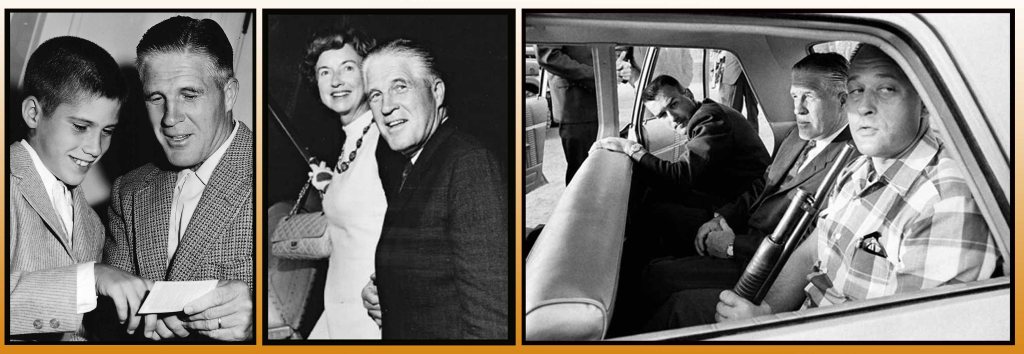
Governor Romney with his son Mitt, his wife Lenore and sandwiched between two armed police officers as he visited the site of the Detroit riots in 1967.

   In early August, nineteen Tam High students from Marin City headed for Los Angeles to attend the second Watts Summer Festival held to commemorate the riots which had occurred there.  “The whole purpose of this trip,” said Lanny Berry, leader of the six-day trip, “Is to show the Negro kids how many constructive self-help programs have developed in Watts.  The festival is one of them.”

   Helping Berry organise the self-help trip was Douglas Quiett, also from Marin City, and now a group counsellor at Marin Juvenile Hall.  Quiett, had organised the picketing of two Mill Valley realtors for CORE in 1963 as they were not obeying the recently passed Rumford Fair Housing Act.  

   The forces of racial separation were not going to let the Rumford Act go unchallenged.  A group called Americans to Outlaw Forced Housing  initiated a petition to repeal the Rumford Act and the Marin County Real Estate Board decided to make the petitions available through their office.  Though their spokesperson denied that the board was endorsing or condemning the repeal initiative, their supply of the petitions was seen as an endorsement.  Enough white voters in Marin and other counties in California went to their real estate board offices to collect and sign the petitions which put Proposition 14 to repeal the Rumford Act on the ballot that November.  The proposition was then passed with a majority of over 1.5 million votes.

   The passage of Proposition 14 highlighted a deeply engrained racial bias in the white majority of the state of California.  The Los Angeles Times endorsed  it, saying that housing discrimination was a “basic property right.”

The fight to defeat Proposition 14 was ultimately unsuccessful.

   However, Proposition 14’s passage into law hit two major obstacles.  First the California Supreme Court in May of 1966 overturned the measure and then the U.S. Supreme Court ruled in May of 1967 that California voters had violated the federal constitution in 1964 when they overturned the state’s open occupancy laws.
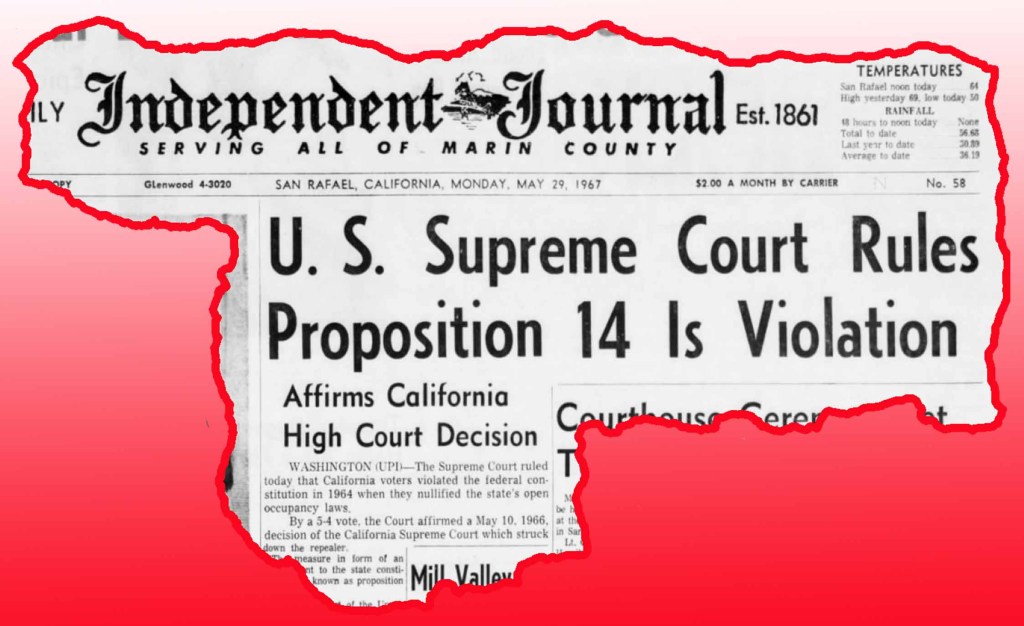
The Independent Journal’s headline announcing the U.S. Supreme Court’s decision that proposition 14 was a violation of the constitution.

   Ronald Reagan, as part of his campaign for election as governor in 1966, had supported outright repeal of the Rumford Act.  In the light of the Supreme Court’s decision in Washington, he modified his approach.  Speaking to the California Real Estate Association at their conference he promised to work for repeal of the act or to change it to the point “where it was no longer discriminatory and oppressive.”  Reagan denied any racism on his part, saying that his objections to the act should not be taken “as endorsement of bigotry and prejudice or the practice of discrimination.”  However his words, objecting to the Rumford act, sent a coded message to white people all over the state who wanted to keep black people out of their whites only towns.
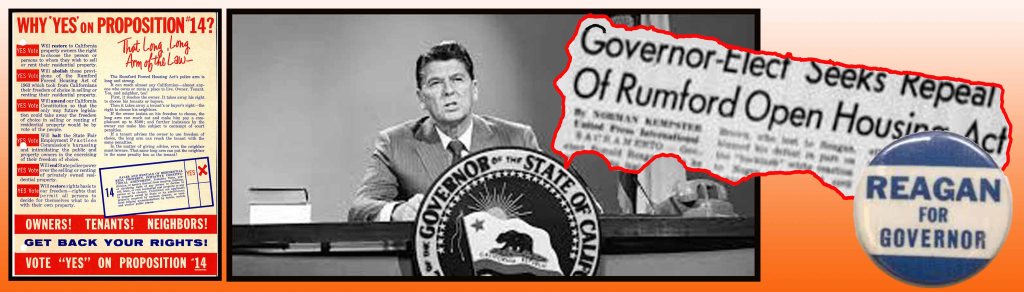
Ronald Reagan made his opposition to the Rumford Act a key part of his campaign to become Governor of California in 1966.

   Apart from the Collins family who lived high up on Summit Avenue, Mill Valley was just such a whites only town during my childhood there.  It wasn’t until I got to high school at Tam in 1961 that I encountered black students from Marin City.  The tough black guys congregated in the inner restaurant section of The Canteen, a building which stood across the street from the lower gate entrance to the back parking lot.  At recess, students who smoked all went through that lower gate to light their cigarettes off campus.  The white students stood around the front of the Canteen while the black students gathered inside the restaurant section.  This organic apartheid between tough white guys and their black counterparts meant they didn’t mix socially.    

   An appreciation of recent local history was not prevalent in Mill Valley at this time.  I had heard my parents say that Marin City came about as housing for ship builders during the war.  What I didn’t know was that prior to world war two there were no black people in Marin County at all and that many had come north from the deep south to work at Marinship during the war.  Once the war was over the employment vanished.  This migration probably explained why the kids from Marin City all spoke with southern accents.  

   On his first day as a freshman at Tam High, a good friend of mine from Mill Valley was attacked by a black male student in the boys’ locker room.  Thinking my friend had made rude remarks about him, the black fellow, who was bigger, punched him in the face repeatedly.

   During my sophomore year I shared a gym class with my good friend Jared Dreyfus.  At the end of class a black guy picked up Jared’s towel and walked to his locker.  Jared went over to him and said it was his towel.  The guy gave it to him and no more was thought of it.  When Jar and I left the locker room and came around the corner, there was this same black guy with two friends standing behind him.  “You called me a ni**er!” He shouted and threw a punch at Jar.  The punch landed on Jared’s arm as he raised the binder he was carrying to shield his face.  Jared shouted loudly: “I didn’t call you anything and I’m not going to hit you back!”  The guy made his accusation again and landed another punch followed by Jar repeating his shouted statement.  This went on for about four more punches.  Finally it stopped and the black student and his friends walked away.  

   The N word was highly emotive.  I recall one Sunday afternoon at the Sequoia when a group of about five black kids from Marin City attended for the movie that was on.  Sunday matinees at the Sequoia were never full and this group of black kids were pretty noisy so I could hear clearly what they were saying between bits of film.  They were using the N word a lot, calling each other by it.   But if a white person was to use that word there would be trouble.  Whenever there was racial tension at Tam High it usually started because someone had scrawled the N word on the inner wall of the Canteen.
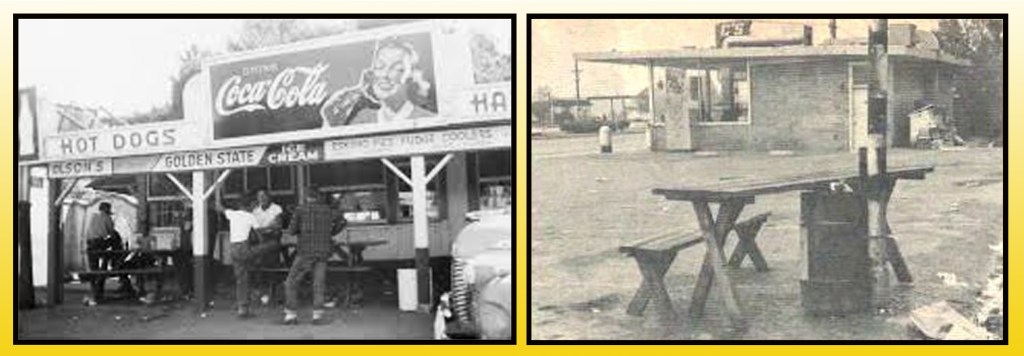
Two hangouts for tough students at Tam High. On the left is The Canteen and on the right is C’s Drive-In on Miller Avenue.

   C’s Drive-in, just up from Tam High on Miller Avenue, was where the tough white guys in Mill Valley hung out.  Most greasers drove their cars to C’s and when racial tension was in the air, the white tribe would gather at the drive-in.  If the fights occurred at school they were usually in the back parking lot near the Canteen.  And a fight would bring cop cars from all over the county with sirens wailing. 

   The N word was never uttered in the Myers household.  My mother Beth was a passionate anti-racist and would not tolerate such talk.  She had been to the deep south as a journalist and had actually witnessed lynchings of black people so she had no illusions about where the attitudes of racism could lead.  

   We always knew about the Collins family being the only black people in Mill Valley but, though Chuck Collins and I were the same age, I didn’t actually become friends with him until late in my time at Tam High.  Chuck didn’t speak with a southern accent like the kids from Marin City.  His dialect was the same as all the others in Mill Valley.  He had gone to Old Mill School at the same time that I went to Homestead.  When I finally did get to know Chuck, we had a conversation in which he told me just how painful it was to hear a white person use the N word.  I have never forgotten that conversation.  Also lodged in my memory is the Lenny Bruce routine he performed in a nightclub in which he used not only the N word but every offensive epithet to describe Jews, Italians, Puerto Ricans and any other minority group.  The point he was making was that if you took the poison out of the word you were left with just a word.  However what Chuck had said has kept me from ever using the N word.  

   But here I was listening over and over to the music of Jimi Hendrix.  I was looking for guidance in the words he sang: asking if I was experienced and somehow it seemed like a challenge.  I took his words about “coming across to him” as a dare to go to England.  I looked for guidance and somehow found it in the lyrics of Jimi Hendrix.

   But to get the money to travel to England I would have to go back to work on the waterfront and that meant getting myself into shape psychologically.  I had moved into a new phase of my craziness in which it became necessary to disguise my inner thoughts.  Blackie would have to be satisfied that I wasn’t crazy anymore and that wouldn’t be easy.

To be continued…

Amazon USA
https://www.amazon.com/dp/B085QN73VQ

Amazon UK
https://www.amazon.co.uk/dp/B085QN73VQ

Coming Down At Last

Previously in Miller Avenue Musings: while incarcerated in Napa, I saw my gay friend in the corridor with his arm in a sling and a bandaged wrist.  I asked what had happened and he began screaming at me, calling me a freak and telling me to stay away from him.

I wasn’t aware of my father Blackie’s presence at the hospital at all, but apparently he was there that day for, within the hour, I was discharged into his care.  I guess it was the fact that my friend attempted suicide, then turned on me in such a melodramatic fashion, which gave him concern for my safety.  

Black was instructed that I must be accompanied at all times and take my medication daily.  I was also not to smoke any weed or take any recreational drugs.  Things  moved quickly.  I gathered what few items I had with me and soon Blackie and I were checking out of Napa and cruising down the highway towards Marin and San Francisco.  

   Before long we were at 929 Union Street in San Francisco.  It had been about three weeks since my hospitalisation and the place was no different.  My bedroom was exactly as I’d left it.  Jar Dreyfus rang up and I took the phone in my room.  He wanted to know every detail of my adventure so I started at the beginning and told him about staying up all night talking with Wes Wilson, then being picked up by the Highway Patrol out on 101 the next morning.  I was delivering the facts in a straightforward manner, but Jared, from the beginning, began laughing heartily.  As I told him each new detail, his laughter became more raucous.  Why he should find my story so funny was a mystery to me, but being a natural performer, I found myself playing up to it: “Yeah but wait’ll you hear what happened next!”  I’m pretty sure that I gave him a full account of the past three weeks and he howled his way through all of it.  The phone call certainly lasted at least half an hour and Jared was still chortling as we wrapped things up.

   A few days later I was visited by Jan Kaufmann which was nice but I was still babbling about John Lennon and seeing her as somehow attached to me which hadn’t been the case since the summer of 1965.  She humoured me and it was a nice visit.

   I didn’t make many excursions out into San Francisco but those I can recall were with my sister Katie and her partner Lonnie.  I think my parents made a decision to fatten me up as I’d become awfully thin during my three weeks in Napa.  The fruit bowls in the kitchen were full of ripe bananas, nectarines and apples.  I was still convinced that I was the messiah but that delusion softened and became less urgent.  Also I simply kept it to myself.   

Three photos of me after my Napa incarceration. On the left, in front of SF City Hall, up on the roof at 929 Union Street and somewhere else in the city.

   I was still totally ignorant of what was happening in the wider world, knowing nothing of events in the news, domestic and from Vietnam.  In mid-August President Johnson made a statement about bombing raids near the Chinese border in Vietnam.  He said that the Peking government knows that the United States does not seek to widen the war in Vietnam.  “These air strikes are not intended as any threat to Communist China and they do not in fact pose any threat to that country.”  At the same time he stated that the Viet Cong now appears less anxious to engage American forces in ground combat.  Assessing the Vietnam situation at a White House news conference, Johnson said there had been a lull in both air and ground activity but added that this didn’t indicate any change in U.S. policy.  “So far as this government is concerned, our policy has not changed,” Johnson said.  “We are there to deter aggression.”

Two shots of LBJ leaving the White House and one of him towering over whoever he was telling a joke to.

   On the same day, as Johnson spoke in the White House, Dr. Martin Luther King addressed the Southern Christian Leadership Conference in Atlanta, Georgia, stating that he would not support President Johnson for re-election in 1968 unless he changed his Vietnam policy.  As a long time supporter of Johnson’s civil rights programmes, the statement marked a turning point for the veteran civil rights campaigner and Nobel Peace Prize winner.  He had never endorsed a political candidate before and gave no indication of which one he might back in 1968.

Martin Luther King and colleagues in conference with President Johnson at the White House.

   After a few weeks my parents found a day clinic through their Kaiser health plan.  I was with Blackie the day we visited the clinic where I would spend the next month or so as a day patient.  It was on an upper floor of a big building a few blocks from the Fillmore Auditorium, on the north side of Geary.  Dr. Weinberg was in charge of the clinic.  He was a short man like myself and very dynamic.  He had a crew cut and his eyes were engaging.  He had a physical resemblance to my school friend Tommy Harper.  He wore a long sleeved white shirt with a black tie and his sleeves were rolled up.  I liked him immediately.  He was straight talking and the first thing he told me was that he understood that I had been behaving in a crazy manner and had enough medication running through me to knock an ordinary person out cold.

   “The bad news, John,” he said, “Is that you won’t be able to smoke dope anymore.  But the good news is that this experience is going to make you 4F.”  4F was unfit for military service.  He also told me he was involved in the ‘Recall Reagan Committee,’ which meant that he was of the political left.  Dr. Weinberg showed me around the clinic which occupied an entire floor.  After the tour he said I should be there at 9am the following morning.

   By this time, the need for a chaperone seemed to dissolve as I don’t recall anyone accompanying me to the clinic.  I took the same buses there as I would to the Fillmore Auditorium.  I’d catch a 41 Union outside our apartment to Steiner Street, then transfer to the 22 Fillmore.

The Munis were my way of getting to and from the Day Clinic.

   When I first returned to the Union Street apartment, I was able to listen to KFRC again and catch up on the songs I’d missed while in Napa.  Light My Fire by The Doors was number one and the Beatles had a new single in the charts, All You Need is Love. Frankie Valli of the Four Seasons sang Can’t Take My Eyes Off You  and Diana Ross and The Supremes were in there with Reflections.  Ever since I was a little boy popular music had been a good friend to me and in this turbulent time of my life, it continued to be.  

   A record I particularly liked was The Letter by a group called The Box Tops who I never heard of again.  The song however was recorded later by Joe Cocker and others.  I liked the lyrics for its inventive use of air and train travel in an original way.

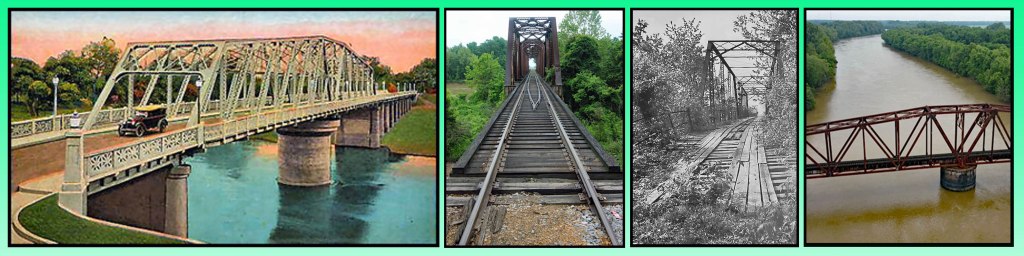
   But of all the records in the Top 40 as August became September, the one song which captured my soul and became the soundtrack to this phase of my long road to recovery was Ode to Billie Joe by Bobbie Gentry.  This record had a haunting quality with its simple musical landscape and enigmatic lyrics.  It evoked a world and way of life which was entirely alien to me.  The song spoke of a dusty Delta day with names like Choctaw Ridge and the Tallahatchie Bridge, providing a vision of caucasian farming life in the cotton fields of Mississippi.  The story mixed everyday chit-chat across a dinner table with news of a profound tragedy when Billie Joe McAllister jumped off the Tallahatchie Bridge.  I connected with this record on so many levels, as it seemed to embody the precarious psychological territory I was now entering.  I was not yet depressed but still exhilarated by my psychedelic experience.  Depression would come later and it would be powerful indeed.  Somehow this record predicted that reality.  I never owned a copy of Ode to Billie Joe, I only ever heard it on the radio but it would run through my head every day as I made my way to the clinic.

Bobbie Gentry performing and the central shot is her standing on the Tallahatchie Bridge in Mississippi.

The Tallahatchie Bridge which crosses the Yazoo River at different stages of its existence.

   On my first day I met the other patients, about twenty of them, both young men and women.  There were several doctors on hand and often small groups would convene in one of the many rooms.  One fellow I became friendly with was very preoccupied with guns.  At least talking about guns and acting out the use of them.  He would constantly describe how he would set up a particular brand of machine gun to mow down imaginary people.  He acted this scenario out many times and was quite specific when describing his weaponry, knowing brand names and other details.  I got the impression he was being funny, as he said all this with a wry smile.  But it was always the same joke.  Only the brand of machine gun occasionally changed.

   There was a very thin delicate young woman who was super sensitive and could cry at the drop of a pin.  Another patient was a tallish heavy set man who dressed in smart tweed sports jackets.   He also had extremely long coal black hair and was in the process of transitioning to become a woman.  One problem with this was that he had a very dark beard under his skin which he shaved close every day but his lower face was almost blue from the whiskers under the surface.  This did make the prospect of being convincing as a woman somewhat questionable.  He was having electrolysis sessions to remove his beard.

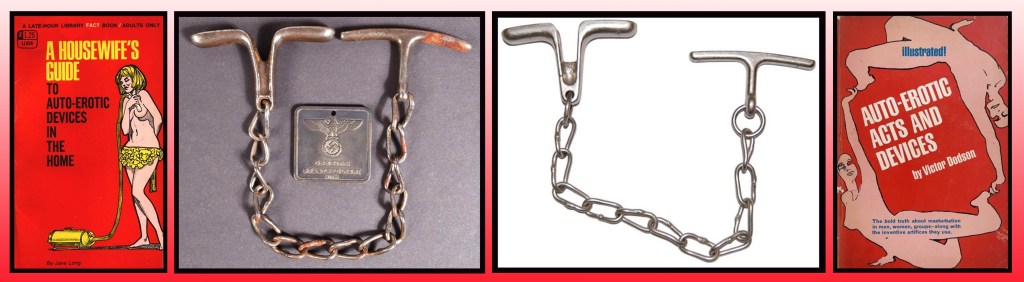
   There was a tall man who seemed a bit older than most of the patients, possibly in his thirties.  He had a copy of a paperback book about auto-erotics.  Auto-erotic was not  a phrase I had ever encountered before.  It was, I soon learned, a fancy way of saying masturbation.  I asked this guy about it and he immediately became aggressive.  He asked if I would like to participate in one of his sexual sessions.  When I declined his invitation he snarled at me to mind my own business.  He had more than a whiff of the Tenderloin district about him and after this encounter, I regarded him with caution.  

   Once a week Dr. Weinberg would chair a meeting of all the patients in which any topics could be discussed.  On the day of the meeting the auto-erotic guy brought a set of German handcuffs with him.  He was showing them around to people and the super sensitive young woman asked about them.  “Would you like to try them on?” he asked.  She said yes.  The cuffs were two interlocking metal pieces connected by a chain.  You would put the chain around the wrists, fit one metal piece into the other then twist the chain.  All eyes were on him as he put the cuffs around the girl’s very thin wrists.  All  went well until he twisted the chain and she screamed in agony, bursting into tears.  Dr. Weinberg was immediately on his feet.  He demanded that the guy leave the clinic at once and never come back or he’d call the police.  Mr. Tenderloin scurried away taking his German handcuffs with him.  He was never to be seen again.

Left and right two paperback books about auto-eroticism. The central pictures show German handcuffs. The ones on the left are from the Nazi era.

   Political correctness was a concept which had not yet been conceived in 1967, but Dr. Weinberg was definitely not politically correct.  He would always use the word ‘crazy’ rather than lofty psychiatric descriptions of psychological problems.  At another one of our meetings, the man transitioning to be a woman asked if he could wear a dress to the next meeting.  Dr. Weinberg said no.  The trans man asked why and he answered: “Because you make one hell of an ugly woman.”

   My days at the clinic continued to be interesting.  Because depression hadn’t yet gripped my soul, I was a fairly upbeat patient.  My friend with the gun fetish continued to act out his massacres which I confess I actually found very funny.  He would mime the assembling of the weaponry in great detail and once the imaginary machine gun was loaded, he would then give a totally committed performance of blasting whoever the recipient was to smithereens with visual flourishes and audibly interesting sound effects.   The trans man continued to complain about not being able to wear a dress to meetings and on journeys home from the clinic, Ode To Billie Joe was invariably running through my head.  

   Gradually I was coming down from my long drawn out high.  I was still convinced of my messianic mission but not so stridently.  At my parents’ flat, things were a little constrained as both Blackie and Beth were worried that I’d get involved in pot smoking again.  Blackie told me that after my incarceration, he’d been visited by two narcotics agents who had been tracking the drug that I took.  At the time I didn’t believe him as I thought he was just trying to scare me, but after reading Matthew Baggott’s article on STP, I am now more inclined to think Blackie was telling me the truth.  The STP piece informed me about narcotics agents tracing the drug’s route through the Haight Ashbury district.  

   As I started my descent from the giddy heights of early in the summer, depression slowly began to creep up on me.  My confidence, which had been so strong throughout the entire adventure, also began deserting me.  

   During this time, my father took to referring to young people who engaged in drug taking of any kind (so most of my friends) as “sick.”  If ever I said anything weird to him he’d quickly retort: “Johnny stop that.  You’re talking like those sick guys.”

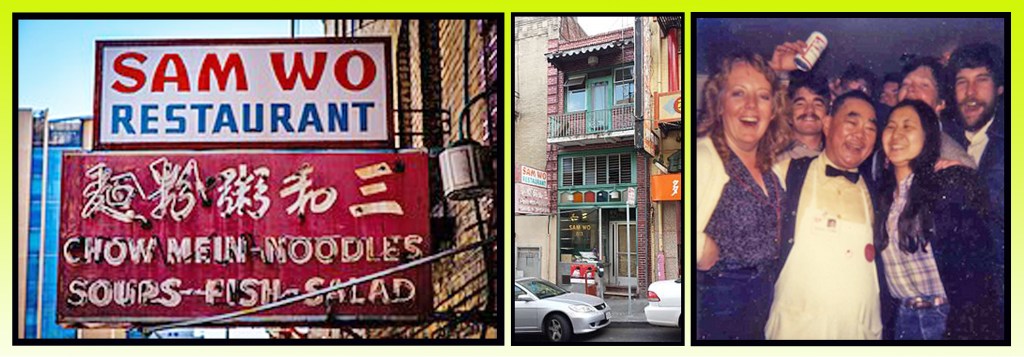
   At some point my parents’ friend Coco Cutler invited me to have dinner in Chinatown with her.  She took me to a restaurant on Washington Street called Sam Wo.  We walked through the slightly grubby kitchen on the ground floor and climbed the steps to the second floor.  Coco clearly knew this place well and it later became a favourite with all my family, but this was my first visit.  The waiter, recognising Coco, pointed to a table and shouted, rather rudely, “You sit there!”  He was Edsel Ford Fung and his rudeness was a bit of showmanship which clearly was as popular as the delicious noodle dishes they served.  They had a dumb waiter to send the dishes upstairs.  I had beef chow mein and we drank lots of tea.  Edsel Ford Fung gave us chopsticks with our meal, which I had never used before.  Coco taught me how to eat with them which was life-changing in itself.   

Sam Wo, the famous Chinese restaurant on Washington Street. On the right is Edsel Ford Fung at his retirement party.

   Coco was well aware of what I was going through.  Poor Blackie and Beth didn’t have a clue how to deal with me but Coco did and I found her easy to talk to.  She lived in a beautiful apartment at the top of Telegraph Hill with a stunning view of the Bay Bridge.  Unlike my parents she was interested in and knew a lot about psychoanalysis and, as I was moving into a phase of losing my ability to converse, she was a good person to be talking to.

To be continued…

Amazon USA
https://www.amazon.com/dp/B085QN73VQ

Amazon UK
https://www.amazon.co.uk/dp/B085QN73VQ