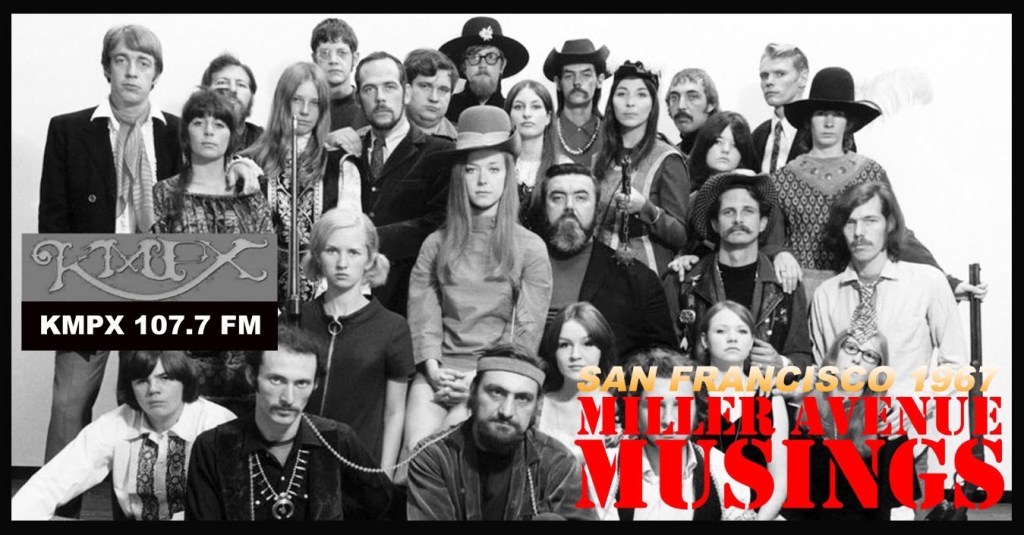
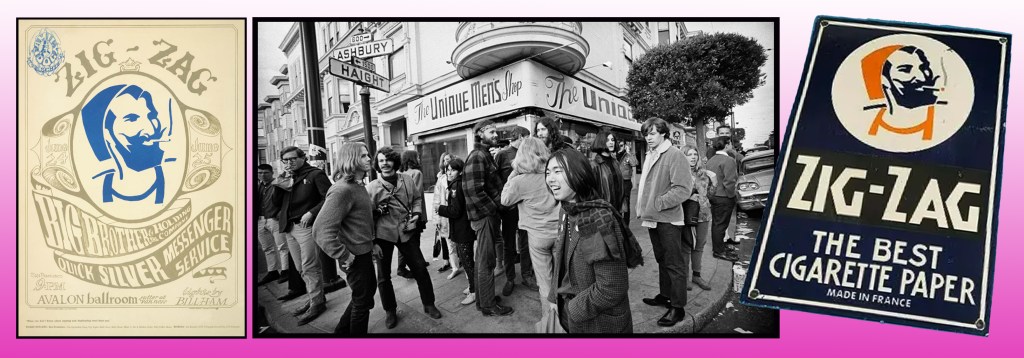
It was July, 1967 in San Francisco and I was now in my second day of madness, having taken what I believe was a dose of the dangerous drug STP. I was possessed by a conviction that there was someone coming to see me who I was meant to meet. Having gone to the Haight Ashbury district with my father Blackie in the hope of meeting this person, I gave up after half an hour of wading through an ocean of hippies. Back at our apartment in North Beach, I decided to go out for a walk.
I wandered down Union Street to Washington Square and turned right on Columbus, passing many Italian restaurants, crossing Broadway with its topless nightclubs and City Lights, the best bookshop in North Beach. I made my way to the mini flat-iron Columbus Tower building on the corner of Kearny. There was a Zim’s Burger bar on the ground floor which I always enjoyed eating at. But a Zim’s burger was not of interest to me on this occasion. I made my way up to the second floor and paid a visit to Bob McClay at the Tempo office. I had met Bob through my friend Jo Bergman who was working with him and Sue Cox at Tempo earlier in the year.
Tempo was a tip sheet for top 40 radio stations and it was owned by legendary disc jockey ‘Big Daddy’ Tom Donahue. Sue and Bob had produced the weekly tip sheet and Jo answered the phones and ran the office.

Three photos of Bob McClay and a visual of the TEMPO Top 40 tip sheet
Sue (now Susan Kirk) remembers: “McClay wrote the articles choosing whatever topic he deemed current and important about the music scene. I chose the new records and reviewed the latest hits and artists. We mailed 45’s from the week’s pick to over one hundred radio stations across the US and around the world. DJ’s didn’t have access fast enough like we did so we really did radio a great service. The artists benefited from what we did, getting their latest recordings on the air.”
Tom Donahue had hired Sue, she remembers, because she had “a great ear for hits and Tom knew it. As a boss Tom was exacting in what he wanted but was pretty hands off. My dear friend Carl Scott who knew Tom well moved into the office above Tempo in Columbus Tower.”

San Francisco DJ “Big Daddy” Tom Donahue pictured in centre with record producer Phil Spector and Righteous Brothers vocalist Bill Medley.
Bob McClay was also now presenting a regular program on FM Radio KMPX. I had visited him at the studio on Green Street about a month earlier while he did one of his shows. I’d never been in a radio studio before and enjoyed chatting with him while the records played. Clearly Bob had some experience in this line of work. He was much more of a disc jockey than Larry Miller who I had first listened to on the station.
In fact KMPX, which started its hippie output with Miller early in 1967, had now been transformed by Tom Donahue. KMPX, had previously specialised in foreign language programming and had sold Larry Miller the graveyard slot of midnight to 6am. His radio voice was friendly and unpretentious and the records he played were an interesting mix of folk, rock and blues which soon attracted a sizeable hippie audience for the FM station. There was at this time a big distinction between AM and FM radio. AM had a larger wavelength whereas FM stations were less mainstream.
So Tom Donahue went to the management of KMPX and proposed that he would present the eight to midnight slot and that they should switch to 24 hours of the kind of music that Miller was playing. They agreed and Bob McClay was one of the people Donahue recruited to the station.

From left: Bob McClay, Larry Miller, Tom Donahue at KMPX and at KYA with John Lennon.
Though I was a regular listener to Miller’s show on KMPX I still listened to Top 40 which at this time was KFRC. I had listened to pop music stations ever since I first discovered Radio KOBY in 1956 when I was nine years old. Early Elvis, Pat Boone and Harry Belafonte hits kept me listening. 1950s pop was a very broad church incorporating Perry Como, Rosemary Clooney and the big band sound of Elmer Bernstein. That station carried me through grade school into junior high when it was superseded by KEWB. They played hits like Bobby Darin’s Mack The Knife, Poison Ivy by the Coasters and Misty by Johnny Mathis. After The Beatles came along in 1964 and dominated the charts for a long time, KEWB suddenly found it had a rival in KYA. Soul came into the mix with two stations: KDIA and KSOL. From 1966 on it was KFRC that I listened to and by this time most soul artists were making the charts: Aretha Franklin, Marvin Gaye, The Four Tops, James Brown, Stevie Wonder and many more all crossed over to become Top 40 stars. And up until his departure in 1965, Tom Donahue was one of the most popular DJs on KYA.
Of course Donahue was an old fashioned Disc Jockey who had “Top 40” running through his veins. Back when he was on KYA he would rattle off patter like: “It’s 2.20 KYA Home of the Hits time here at twelve sixty on your radio dial and here’s Sam Cooke with…” But now on the hip FM station, he slowed things right down with his mellifluous deep voice: “You’re listening to KMPX where we’re changing the world. That’s right man, we’re changing the world.”

From left: Tom Donahue when he first arrived at KYA in 1961, with Bill Graham in the late 1960s and a ticket for the final Beatles concert which he produced.
An extremely big man in every sense, Donahue established himself as a DJ during the 1950s on station WIBG in Philadelphia. In 1961, in the wake of the payola investigations which damaged many of the reputations of East Coast DJs, Donahue arrived at KYA in San Francisco where he was an instant hit. In partnership with fellow DJ Bobby Mitchell, he formed Tempo Productions, putting on record hops and concerts. They branched out into other businesses, forming a record company, opening a North Beach night club and investing in thoroughbred horse racing. Donahue departed KYA in 1965 but stayed on in San Francisco to oversee his many business interests which included producing The Beatles final ever concert at Candlestick Park on August 29th, 1966.

From left: Ralph Gleason with the Beatles, Paul McCartney and Joan Baez, Lennon, Harrison & McCartney going on stage at Candlestick Park.
Sue Cox remembers that she, McClay and Bobby Mitchell were all involved in the production of that final Beatles performance. “Carl Scott and I stood 50 feet from the stage on the ground and wept together when they ended the concert.”

From left: The Fab Four crossing the baseball field, a poster for the event, Sue Cox pictured with Ringo and Wes Wilson’s poster for the concert.
I never got to know Tom Donahue but met him in McClay’s office a few times. Extremely tall and physically very weighty, I would see him around town, sometimes visiting Bill Graham at the Fillmore. He made the transition from fast talking top 40 DJ to mellow presenter of folk and rock album tracks on FM radio. Having grown a beard sometime during his tenure at KYA, Big Daddy now had very long hair as well but he didn’t convince my hippie friends in Marin that he was one of them.
All my friends and I were in our early twenties and considered the age of thirty to be very old indeed. One friend sarcastically listed the three most important people in the hippie scene: “Bill Graham, Tom Donahue and Ralph Gleason.” Bill was 36, Tom Donahue was 39 and Ralph Gleason, the jazz critic on the Chronicle was 50.
Bob McClay, however, was a different kind of person altogether. He was much more of a genuine enthusiast than a businessman. Both McClay and Donahue were older than me and had been part of the beat generation. Of course smoking weed had been going on forever but it always occurred in the mysterious world of beatniks and jazz musicians. It wasn’t until the hippie era that it came out into the open. I remember a pre-hippie article in MAD Magazine in 1960 in which Wally Wood drew fabulous pictures for a hip version of The Night Before Christmas. It featured a Santa Claus with dark glasses and a very thin cigarette between his lips. It opened with: ’Twas the night before Christmas, and all thru the pad, Not a hipster was stirring, not even old Dad. The chimney was draped in that stocking routine, in hopes that the fat man would soon make the scene.

A few of the fabulous illustrations by Wallace Wood for MAD Magazine’s hip version of The Night Before Christmas from 1960.
In fact when my friend Jo Bergman first introduced me to Bob McClay we quickly discovered that we shared a passion for the cartoons of Wallace Wood in MAD Magazine. Hanging out in Bob’s office was a fun way to spend time as he seemed able to do his work while chatting. All the record companies would send them free discs which were scattered all over the place.
Among the discs which Bob gave me was John Sebastian’s first solo album called Tarzana Kid and, being a devoted Sebastian fan, I loved it. He also gave me an LP of The Mugwumps, a band which preceded both the Lovin’ Spoonful and the Mamas and Papas. It featured Denny Doherty, Cass Elliot, Zal Yanofsky, Jim Hendricks and John Sebastian and my favourite track was their vocal harmony performance of the old Coasters song Searchin’. Another gift from McClay was an LP of British Cat Stevens which I loved. I was particularly taken by I Love My Dog. An album by The Who entitled A Quick One had the terrific song Boris The Spider. McClay also introduced me to the Bee Gees with their single New York Mining Disaster 1941. I had never heard of them and they sang just like The Beatles.
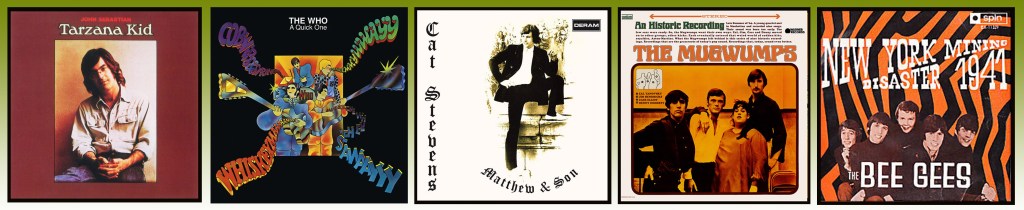
From left: John Sebastian’s Tarzana Kid, The Who’s A Quick One, Cat Stevens, The Mugwumps and the Bee Gees.
Another person I encountered, both in Bill Graham’s little office at the Fillmore and at Bob McClay’s place was the photographer Jim Marshall. Although I was in the same room with Marshall many times, he never spoke to me and never acknowledged my presence. He was rather loud and opinionated. There didn’t seem to be any subject on which this guy did not have an opinion. While sitting in Graham’s office talking at him he constantly took photos of Bill. He did the same thing with Bob McClay.
While clicking snaps of McClay one afternoon, he mentioned John Philips of The Mamas and Papas. Marshall had witnessed Philips refusing to sign autographs for some fans and describing such activity as “chicken shit.” Marshall then railed against such attitudes: “That’s the price you pay,” he thundered in his overly audible manner. “It comes with the territory.” Whether or not he shared this opinion with Philips is not known. He then derided Marty Balin for describing the thrill of performing as like having sex. He was basically a show business photographer who was in San Francisco at this time because it was the place to be. I don’t recall Bill Graham or Bob McClay saying much in Marshall’s presence. I think they would just quietly nod in agreement with whatever stridently stated opinions he would offer and get on with what they were doing as he snapped pictures of them.

Three shots of photographer Jim Marshall, in the centre with Ralph Gleason and the Beatles at Candlestick Park.
So I paid a visit to Bob McClay in my now crazy state of mind. Sue had left Tempo to be Music Director at Radio KRLA and had taken Jo with her. Jo was filling time until Mick Jagger was ready for her to return to London to run the Rolling Stones’ office. I’m now grateful that Jo and Sue weren’t there as it must have become immediately clear to Bob that I was not in my right mind. I have no recollection of what nonsense I talked on this occasion but he skilfully managed to get rid of me without any unpleasantness.
Back out on the street I walked up Columbus avenue, crossing Broadway where the Condor Club featured topless star Carol Doda, famous for having silicone implants to enlarge her breasts. I knew this part of town pretty well. Whenever I was working all night on a poster, I would take a break in the early hours and walk down to Broadway, observing the hustlers outside each club. I was under 21 and looked much younger so they never tried to hustle me.
I did once visit one of these clubs to discuss doing a poster for them. It was lunchtime and these two hefty expensively dressed men sat at a table with me while they ate their delicious looking steaks. I had brought a layout pad with some sketches on it which they looked at as they chewed their medium rare beef. I was reminded of a Dean Martin and Jerry Lewis movie called 3 Ring Circus in which Jerry, who was starving hungry, is being talked at by a circus boss who is eating his delicious breakfast of bacon and eggs. As the boss talked he waved his bacon laden fork around in the air. Lewis’s eyes and face moved with the bacon as the boss waved the fork. Of course I wasn’t starving but it was a drag watching these two gangsters eat their succulent steaks in front of me without offering so much as a cup of coffee. My father Blackie drummed into me that you should never eat in front of people without offering to share what you had. This attitude was almost certainly a product of his experience of the depression, but these two goombahs suffered no such inhibition. I never did do a poster for them.
So I continued walking up Columbus towards Union Street. By now I was in my second day of acting strangely and Blackie and Beth must have been very concerned about my mental health. They had many close friends to turn to and I suspect that they contacted Alvah Bessie, a writer who they’d known for years. Alvah had fought in the Abraham Lincoln Brigade in the Spanish Civil War and been one of the Hollywood Ten who went to prison in the early 1950s for defying the House UnAmerican Activities Committee. Blacklisted like my parents, Alvah had carved out a job for himself at the Hungry i nightclub as stage manager and host introducing such acts as Mort Sahl and Lenny Bruce.
Alvah’s daughter Eva was married to Fillmore poster artist Wes Wilson. I don’t remember if I called Wes or if my parents did. All I recall is Wes arriving at the apartment on Union Street and driving me back to their house in Mill Valley.
To be continued. . .

Amazon USA
https://www.amazon.com/dp/B085QN73VQ
Amazon UK
https://www.amazon.co.uk/dp/B085QN73VQ






 Miller Avenue Musings