
Jim Morrison singing with The Doors at the Magic Mountain Festival, Mount Tam in the summer of 1967.
The Matrix was a small club which started in San Francisco in the mid-1960s. It was located on Fillmore at the Marina end of that street. I only ever went to The Matrix a few times and never knew that it was part-owned by Marty Balin who sang with Jefferson Airplane. The first time I went there was because Marty had invited me to observe a gathering of the Jefferson Airplane Fan Club one afternoon. It was in 1966 before Grace Slick had replaced Signe Andersen and Marty was the only band member in attendance. The club was packed full of young women who were asking him questions adoringly. As the Airplane was recording with RCA at this time he told the young audience that he and the band had recently had lunch with Elvis Presley. A groan of abhorrence rippled through the room which caused Marty to say: “Well, anyway, I was impressed.”At this time Elvis would have been known to these young people only as the star of movies like Spinout and Paradise, Hawaiian Style.
So one evening early in 1967, Augie Belden and I decided to go to the Matrix. Why we chose that night I don’t remember for the act playing was a band we’d never heard of called The Doors. We sat at a table very close to the stage and there weren’t more than eight people in the audience ourselves included. We found The Doors compelling to listen to and look at. Their manner was very confident and the songs were original and catchy. Jim Morrison, the band’s singer was good looking and charismatic. His vocal style was impressive and he had a rock and roll voice though my brother-in-law insists that he always sang flat.
I was particularly impressed by the lyrics to Twentieth Century Fox and was beguiled by their rendering of Kurt Weill’s Whiskey Song. Equally impressive was the keyboard style of Ray Manzarek. Morrison didn’t speak to the audience between numbers but he held our attention by leaning on the keyboard and talking quietly with Manzarek. This enigmatic performance art kept the small audience engaged even though we couldn’t hear what they were talking about.
All the material they performed that night was on their debut album which I purchased soon after. They had a unique sound. The centrepiece was Manzarek’s keyboards and Morrison’s vocals but drummer John Densmore and guitarist Robby Krieger filled their spaces with original and engaging instrumentation.

Marty Balin’s club The Matrix.
Augie and I saw The Doors in March and sometime between then and the summer their single, Light My Fire, went to number one nationwide and they became an enormous draw overnight. The next time Augie and I saw them was at Bill Graham’s Winterland but by now they were huge and I found them less exciting than I had at the Matrix. Though Jim Morrison had a passing resemblance to Mick Jagger he exhibited none of the physical fluidity of the Stones vocalist. He would just stand at the microphone like a statue holding onto it without any movement. Also his vocal improvisations, which occurred often, were mainly dull and uninteresting.
The next time I saw The Doors was up on Mount Tam at the Mountain Theatre. Radio KFRC put on a big show called The Magic Mountain Festival and, in addition to The Doors, Dionne Warwick appeared. Her set was brilliant but again I found The Doors a bit dull. All their numbers sounded very similar and dragged at a slow tempo. By now they were touring the nation and possibly beginning to burn out.
Augie and I were very lucky to have seen The Doors at The Matrix before they were famous. It was such an intimate setting and there wasn’t a trace of self indulgence in their performance whereas the times I saw them after Light My Fire was a hit, Jim Morrison would leave enormously long pauses between sung passages. A friend told me of one gig where Ray Manzarek became so exasperated with Morrison’s pauses that he said loudly over the microphone: “Will you please sing?”
I spent the afternoon wandering around and I came across my old classmate Bill Champlin and had a chat with him. His band, The Sons of Champlin, were playing the following day and knowing I’d done poster work for the Fillmore, he told me that Bill Graham had decided not to book his band anymore because he thought they were “too ugly.” If he was upset by this he gave no indication but then Bill Champlin was a showbiz pro from early on. All through high school he had bands like The Opposite Six working the dances in Marin County. Bill had a good growling rock and roll voice and played the piano with panache. He had been a music student of Mr Greenwood’s at Tam High. This meant he was in the high school marching band along with Mark Symmes and Billy Bowen. These guys spoke highly of Mister Greenwood who brought out a high calibre of musicianship in his students.
I had been to the Mountain Theatre many times throughout my childhood for the annual plays and it was a novelty to see a rock concert happening there. The Monterey Pop Festival was a week away and the news from there travelled fast. Monterey provided a showcase for the bay area bands as well as hosting Otis Redding, The Who and The Jimi Hendrix Experience. Word spread that The Who and Hendrix finished their sets by wrecking their equipment and Jimi actually set fire to his electric guitar on stage. This did seem a bit extreme for the largely peaceful scene in San Francisco so, the following week, when Hendrix played the Fillmore, I went along to see him. I watched his set from upstairs and in addition to playing the guitar with his tongue he also played it upside down behind his back as well as creating feedback on his amplifier and simulating a sexual act with it. I can only guess that someone had had a word with him not to go too far at the peaceful Fillmore for the only violent thing he did was to throw his guitar on the floor at the end of the set.
As Hendrix was also doing a free concert in the Panhandle at Golden Gate Park on that Sunday afternoon I decided to make my way there and have another look and listen. The Jimi Hendrix Experience was a trio with Mitch Mitchell on drums and Noel Redding on bass. All three had crowns of fizzy long hair and were dressed in what looked like old fashioned marching band jackets. They performed on a flatbed truck which was parked at the Baker Street end of the Panhandle and they attracted a sizeable crowd.
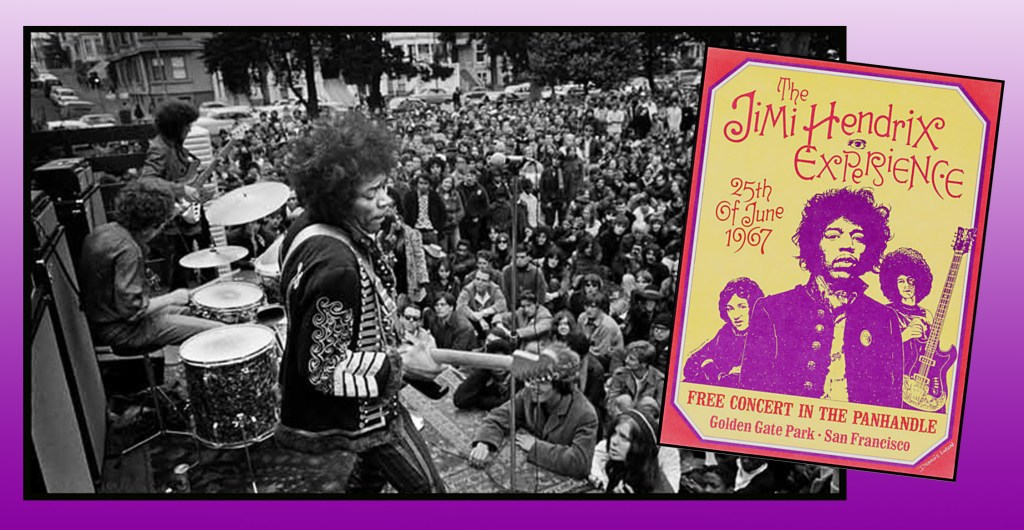
Hendrix plays in the Panhandle. The eagle eyed among you can spot John Goddard of Village Music in the front row wearing dark glasses just above Jimi’s right thumb.
The only songs they played which I knew were Wild Thing and Hey Joe which had been a radio hit the previous year for The Leaves but the rest of his material was original. As with The Doors I bought their LP entitled Are You Experienced? The song I particularly liked was Purple Haze. The instrumentation conjured images of a factory with massive machine-like hammers going up and down. Because his diction was not too clear I and a few friends mistook the line: Excuse me while I kiss the sky for Excuse me while I kiss this guy and assumed that Jimi Hendrix was gay.
I continued doing poster work for individual bands and, of course, socialising smokily with my friends in Mill Valley. I picked up a bit of poster work from Bill Graham’s rivals over at the Avalon Ballroom. I did a few bumper stickers to promote their two quietest nights, Thursdays and Sundays.
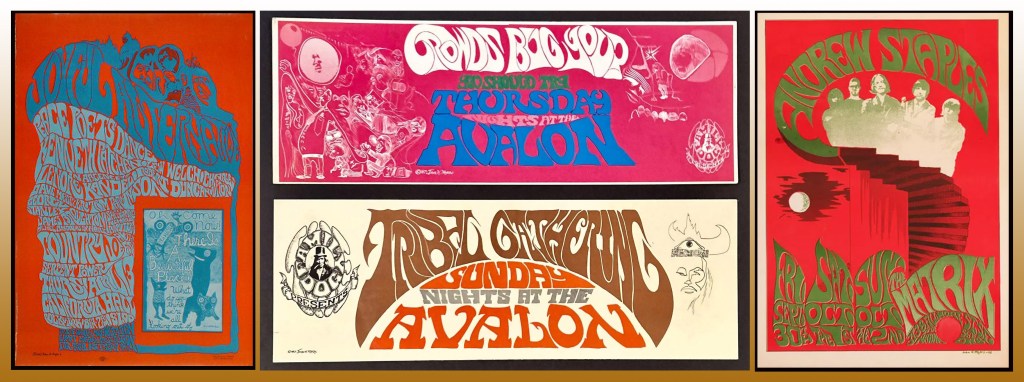
A few bits of poster art I did after leaving the Fillmore.
I was not an early riser during 1967. I stayed up late and slept late. If I was at my parents’ in North Beach, I would draw pictures into the night and early in the year I found an FM radio station which played good music all night long. It was KMPX and the disc jockey was named Larry Miller who had a very nice personal style with none of the usual DJ malarkey. Since I first discovered pop radio as a kid in the early 1950s I had found disc jockeys incredibly annoying. Were it not for the music they played I would never have listened to their asinine babbling but Larry Miller was nothing like that and I regularly listened to him all night. He didn’t play hit records but rather music which clearly appealed to him. He also played records with drug related subject matter. Cocaine Blues by Dave Van Ronk was one and The Pusher by Steppenwolf was another. The Pusher was actually written by country artist Hoyt Axton but Steppenwolf made it their own and I became rather hooked on that song. John Kay’s voice was raw, soulful and a bit scary as he sang with a righteous fury about getting his bible, razor and gun in pursuit of the pusher-man.

A handbill which DJ Larry Miller designed himself for his show on Radio KMPX.
I had never heard anything by the Velvet Underground until Larry Miller played it. I was a bit shocked by the words to Heroin with Lou Reed describing sticking a spike into his vein. KMPX exposed me to music that I never would have heard otherwise.
Around this time I was invited up to Coco Cutler’s apartment on Telegraph Hill. Coco was an old friend of my parents from their political past, meaning she was left wing. She was in her sixties, physically tiny and had a beautiful face. The view from her flat was stunning as it looked out across the Embarcadero and the Bay Bridge. I had seen an old film, Dark Passage, starring Humphrey Bogart and Lauren Bacall which had a scene of him climbing the steps from the Embarcadero up to just below Coco’s window and was surprised to hear that she had watched them film that scene in 1946. She said it was impressive just how many times Bogie had to climb that hill.
The reason that Coco had invited me up to her place was to meet a young friend of a friend who had come from London. She was Jo Bergman who I liked immediately. Jo was short with a smiley face surrounded by a cloud of frizzy black hair and her laughter was infectious. Jo spoke in an American accent but clearly had a European and British sensibility. Coco’s good friends Elliott and Norma Sullivan lived in London and had made the introduction. Jo was over here working for a friend who ran a record plugging business. She was biding her time until she would return to London to set up and run the Rolling Stones office for Mick Jagger. She regaled us with tales about the London music scene and how the Stones were harassed by the police about drugs but they wouldn’t touch the Beatles because they’d been made MBEs by the queen.

My friend Jo Bergman in three photos with and without the Stones.
The record plugging office where she worked was located in Columbus Tower which I knew as there was a Zims on the ground floor which I regularly ate at. I absolutely loved a Zims Burger.
As Jo had invited me to visit the office I soon did. She sat at a typewriter in the reception area on the first floor and her boss, a guy named Bob McClay, operated from the next room. I guess that his business was recommending discs to radio stations. We hit it off straight away as Bob was the only person I had ever met who shared my passion for the cartoons of Wallace Wood. Wood was one of my favourite cartoonists from MAD Magazine.
McClay’s office was littered with LPs and singles. He invited me to take whatever I wanted, so I did and was soon listening to the Bee Gees (New York Mining Disaster 1941), Cat Stevens (I love My Dog As Much As I Love You) and The Who (Boris The Spider).
Columbus Tower was located at the tip of Columbus Avenue and Kearney Street and it had the look of a much smaller Flatiron Building which stands on Fifth Avenue in New York City. It was owned at this time by Frank Werber who managed the Kingston Trio and also ran The Trident restaurant in Sausalito. As I was always on the hustle for graphic design work, Bob McClay made an intro and I spent some time talking with Werber in his spacious office up on the top floor of Columbus Tower. He was a very engaging guy and interestingly had a back story similar to Bill Graham’s. Born in Germany he and his parents escaped the Nazis in dramatic circumstances and he grew up in New York. Though I had a nice time talking with Frank I didn’t come away with any graphic design work.
Though the city was where I did any business that was going, my emotional home was still Mill Valley where I’d get high with my friends. A preoccupation for me at this time was to have a good trip on LSD as the few times I’d tried it hadn’t been great. I guess I was bowing to peer pressure as so many of my friends were dropping acid and having a wonderful time. They would tell me that I had to let myself go and not let my ego get in the way. It truly became an aspiration to have a good experience with the drug which seemed to be all over the place.
When we got high we would always play records. Listening to records and singing along with them was a thing I had been doing since I was a little kid. At nine years old I would jig around my parents’ bedroom to Elvis records doing pretty accurate imitations of him. I had a passion for the rock and roll of the 1950s which subsided after Elvis went in the army and wasn’t re-ignited until the Beatles came along. I was totally ignorant of the mechanics of music but this didn’t stop me emulating the vocal styles of John Sebastian, John Lennon and Bob Dylan.
As the summer progressed an acetate of a recording by the Beatles started making the rounds. An acetate was a pre-release disc which wasn’t for broadcast or sale. It was A Day in the Life which would feature on the soon to be released Sgt. Pepper’s Lonely Hearts Club Band. I heard it a few times. First in Bob McClay’s office and then at a packed Fillmore gig. I was standing near the band room door talking to Dicken Scully when this track came over the sound system. It began with John Lennon singing wistful lyrics in a mellifluous manner. Then a full orchestra began a musical climb like a rocket ship, going higher and higher until it crashed into a piano riff with Paul McCartney singing of getting out of bed, catching a bus, then going into a dream. At this juncture a combination of Lennon’s voice and the full orchestra took us off into a musical dreamscape before returning to Lennon singing his song. Then the orchestral rocket began again and climbed higher and higher and higher until it finally reached its climax. Then sounded a beautiful musical chord. It was like nothing I had ever heard before and the huge crowd at the Fillmore burst into applause. From where I was standing I could see Bill Graham on the other side of the auditorium laughing maniacally as he looked up at the ceiling. Having stage managed the playing of the acetate he was clearly pleased with himself. It was a special moment.
To be continued…

Amazon USA
https://www.amazon.com/dp/B085QN73VQ
Amazon UK
https://www.amazon.co.uk/dp/B085QN73VQ
 Miller Avenue Musings