1967-The Summer of Love part 4

The Beatles launching their LP Sgt. Pepper’s Lonely Hearts Club Band.

Some person said: “If you can remember the 1960s, you weren’t there.”  I have no idea who made this statement but from my point of view it’s wrong.  I was there and I do have very clear memories of a lot of it and in 1967 I was a 20 year old hippy poster artist who went crazy on LSD and wound up in a mental hospital during the Summer of Love.  So if I can remember it, anyone can. 

   That summer in the bay area, was very eventful.  Large outdoor rock festivals began happening, a manifestation of the fact that lots of young Americans were adopting the hippy way of life, albeit for a short time.

   Haight Street in San Francisco was throbbing with hippies and head shops.  What my father Blackie would describe as guerrilla capitalism was everywhere with long haired drug dealers on every street corner whispering coded pitches to passing strangers.  A good friend of mine went there to score a lid of grass and had to follow the dealer up to his apartment.  Once inside the guy pulled a gun on him and demanded all his money. My friend extracted a meagre ten dollar bill from his wallet insisting it was all he had.  He lived.

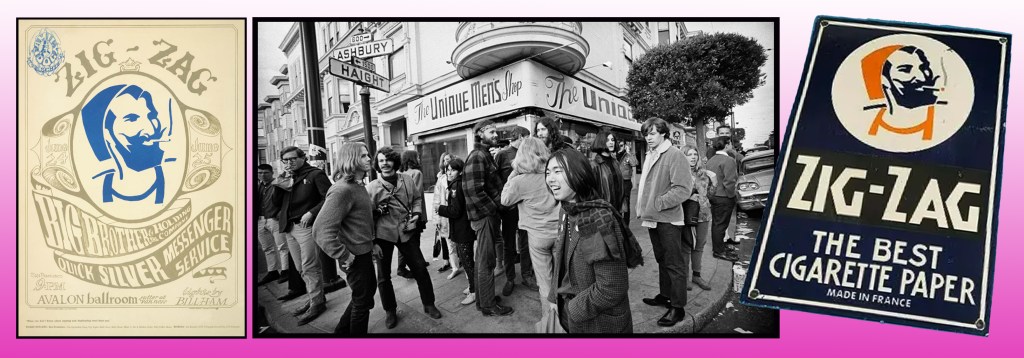
   On Haight Street the sidewalk was packed with long haired young men and even longer haired young women.  A constant refrain of ‘Spare change?’ could be heard up and down the street from weary looking young people.  Psychedelic posters for dance concerts at the Fillmore and Avalon decorated many windows and the Zig-Zag Cigarette Papers logo adorned posters, T-shirts and coffee mugs. 

   But the most defining event of that summer was the release of the Beatles’ LP, Sgt. Peppers Lonely Hearts Club Band.  This album instantly became a hit with everybody I knew.  Each house I entered, for the longest time, had this record playing.  On the front cover was a colour photo of the four Beatles wearing brightly coloured old fashioned marching band uniforms, standing in front of a big collage which featured pictures of a wide variety of characters including Karl Marx, Marilyn Monroe and Edgar Allan Poe.  

   The music seized your attention right from the start: the rock band opening of the title track with George Harrison’s bee-sting guitar notes and Paul McCartney’s athletic vocal.  It proceeded to take you on a journey of many different musical styles with full orchestral backing and new surprises each time you listened.  And the lyrics were so very good.  The words to She’s Leaving Home, Fixing a Hole and With a Little Help From My Friends were intelligent, sensitive and they made you think.  McCartney’s lyrical optimism was countered artfully by Lennon’s cynicism.  Also for the first time these guys seemed to be reflecting on what it was like to be a Beatle.  Lyrical references to newspaper taxis and silly people who don’t get past their doors, gave shape to the Beatles’ recent history of an entirely unprecedented celebrity which they’d been living through for the past few years.  And here they were in the midst of the hippy era seeming to be more relevant than ever.

   This was the very same foursome who provided most of the soundtrack to my teenage years.  Their music and lyrics spoke directly to me and my generation about the agonies and joys of young love, lust and all the satellite subjects which concerned their audience of acne-ridden adolescents.  From their arrival in the USA in early 1964, I, along with millions of young people all over the world, followed their musical output devotedly, learning each of their songs by heart and singing them out loud with my friends at surreptitious drinking sessions.  

   But unlike other showbiz fads, they simply didn’t fade away.  They got better.  Rubber Soul was their first LP which illustrated the point that they were definitely not a flash in the pan.  Their talent was something special which stood the test of time.  Then in 1966 they produced Revolver which continued to break new ground with songs like Eleanor Rigby, Taxman and Got to Get You into My Life.  During that year they also found themselves mired in controversy.  John Lennon gave an interview to the London Evening Standard in which he predicted that Christianity would die out and said that “we’re more popular than Jesus now.”  This caused no controversy in the UK and the interview was not published in the USA until late in the summer.  In June Capitol released a compilation LP entitled The Beatles Yesterday and Today with a cover photo featuring all four wearing white coats and covered with decapitated baby dolls and pieces of raw meat.  They were all laughing and looked like crazed butchers.  The band said it was a protest against the Vietnam war.   As soon as it was released it was immediately withdrawn by Capitol and replaced with a new photo.
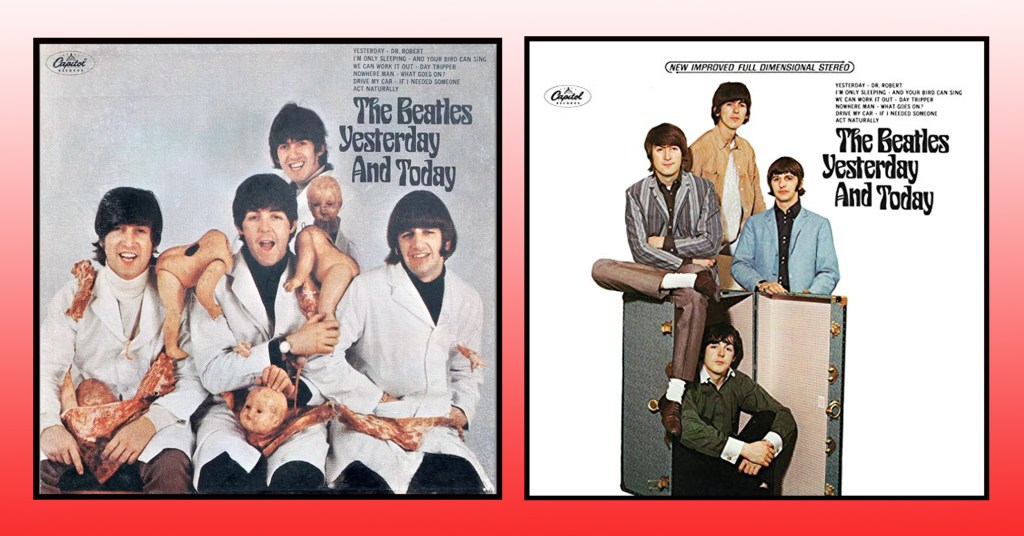
On the left is the photo the Beatles’ wanted and on the right the one Capitol Records chose.

   When the Lennon interview was reprinted in the USA that summer, it ignited a huge furore in the southern bible belt which rippled across the country.  A disc jockey in Alabama organised a public burning of Beatles material and all this occurred just as they were about to embark on an American tour.  The press conference which kicked it off was an uncharacteristically sombre business.  Previous Beatles press conferences had all the colourful anarchy of a Marx Brothers movie but this one was weighed down with seriousness.  John Lennon, looking pained, reluctantly apologised for causing offence.
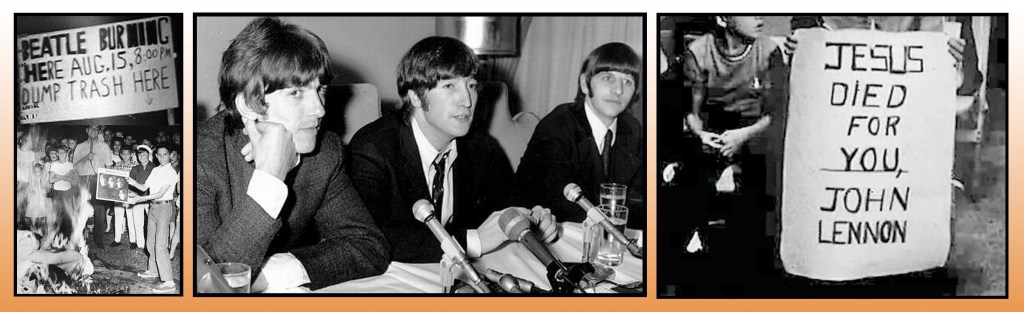
Beatles burning in the Bible Belt, a very sombre press conference and a message for John Lennon.

   On top of this, they had to flee the Philippines in a hurry after they’d snubbed the first lady, Imelda Marcos, who had invited them to tea.  They were clearly unprepared for the angry public reaction.  So after their final concert in Candlestick Park in San Francisco, they decided to stop touring and just work in the recording studio.

   The Beatles were worshipped in a way which was not entirely healthy and I was as starstruck as everybody else.  The hysteria generated by their initial American success in 1964 seemed to have morphed into a slightly different form of hero worship but it was still idolatry plain and simple.  I remember sitting around a house in Strawberry which I visited regularly and discussing the Beatles as if they were gods.  The house was owned by a woman who was older than me and had two young children.  She was separated from her husband and several of my friends and I would gather there regularly to smoke weed and listen to music.  She was a guitar playing folk singer who was managed by Frank Werber.

   It was at this time that I realised that Mill Valley was becoming a place where people from the rock and roll scene were moving in.  Wes Wilson and his wife Eva had a house with a long garden on Sycamore. Bill Graham and guitarist Mike Bloomfield moved into Mill Valley.   Mike had left the Butterfield Blues Band and started his own group called The Electric Flag.  I once saw his bass player, Harvey Brooks with a big smile on his face, wandering, along Sunnyside near the Post Office one morning.  I also heard a remark which chilled my soul.  The woman in Strawberry was talking about somebody who was “shooting smack with the Electric Flag.”  Nobody in my immediate circle was doing anything like that. It scared me.

   I guess that I made a distinction between smoking grass and what I considered to be hard drugs.  Somehow I didn’t consider acid to be in that category but through my limited experience with it I knew how powerful it could be.  As the summer arrived I became more and more determined that I should have a good experience with LSD.  I had become convinced that the reason I wasn’t able to have a good trip was to do with my egotism and that I needed to work on myself.  This was not an easy prospect as I had always been a little guy with a big mouth and an even bigger head.  The particularly bad trip I’d had the previous year while at the Fillmore was all about loss of control.  I felt I had to hold onto my control and was absolutely terrified by the fact that it was oozing away from me in dramatic fashion.

   While all this internal drama was going on with me, out in the real world the Vietnam war was, by this time, raging.  The daily news had a stream of stories about military action in Vietnam as well as many about students burning their draft cards and huge demonstrations against the war.  The police tactics against anti-war protestors became increasingly violent and just as blood was definitely flowing over in Vietnam so too did it flow on the streets of America.  David Harris who was married to Joan Baez went to prison for refusing to be drafted into the army.  I know a movie producer in Hollywood who pretended he was gay, which he wasn’t, and avoided the draft that way.

   My sister Nell was no longer in San Francisco but living in London with her husband and their newborn son Poggy.  Nellie and the Hallinan boys had been very active in demonstrations in the city but now had taken her left wing activism to England.  The Hallinan boys all remained very active in civil rights and anti-Vietnam war demonstrations

   Back in 1965 both Kayo and Ringo Hallinan recruited a small army of tough fighters to form the front line of an anti-war march from Berkeley to Oakland which the Hell’s Angels had announced they were going to break up.  Not realising who was in the front of the march, Sonny Barger, Northern California president of the Angels, waded into the crowd thinking they were dealing with pacifists.  Barger, shouting abuse, as he pushed his way through the crowd, reached up to pull down a banner.  “As he pulled the banner down,” said Ringo, “Kayo hit him with a right fist on one side of his jaw and I delivered a left hook on his other.  He went down like a stone.  The Angels kept coming, thinking we were a bunch of pacifist wimps.  They suddenly found themselves surrounded by a lot of tough guys bent on pounding them.  I remember the looks on their faces as they suddenly realised they were in trouble.  And they were.  We kicked their asses until the Oakland police attacked us and drove us back.  Barger lied about that day on many occasions.  How they kicked the commies’ asses.  It was a fine moment.”

Conn (Ringo) Hallinan on the left before the fight and his brother Terence (Kayo) Hallinan seen punching a Hell’s Angel.

   But I stayed away from the big demonstrations as so many turned violent.  One day I was hitch hiking out of Mill Valley to the city and got a lift with a young man who was on his way to an anti-war demonstration in Berkeley.  He was quite candid in telling me that his motivation was nothing to do with the war but rather it was to meet beautiful young women.

   I went to a party in Berkeley and met a guy about my age who was joining the marines the next day.  I asked him why and his answer was chilling: “Because I want to kill somebody,” he said.   I was so startled by this that I asked him, if it was completely legal, would he kill me?  His answer was yes.  Now it just happened that I met this guy rather than one of the thousands of young recruits who had no such agenda and were simply doing what the government was ordering them to do.

   The whole situation was something I was just not thinking about.  My way of dealing with the possibility of being drafted was to smoke another joint.   And yet my brother Jim was now in the military and having done his basic training he would be having a stopover in Seattle for a few days en route to Korea.  I thought about flying up to see him.

   Several guys from my Tam High class of 1965 went into the service and found themselves in Vietnam.  Corky Corcoran, Ed Smith and Les Taylor all served over there.  Another who was a year younger than me was Ernie Bergman.  

   Corky, who I had known since 7th grade at Edna Maguire, joined the army in the summer of 1966 and became a paratrooper.  Never having been on an airplane before, he was flown to Fort Lewis in Washington where he did his basic training then it was off to Fort Benning in Georgia where he attended jump school.  By 1967 he was in Vietnam with the 173rd Airborne Brigade.  “We went through the Brigade Jungle School in Bien Hoa,” said Corky, “To prepare us for the upcoming months in the Dak To area of the central highlands.”  His job was as a radio teletype operator, part of a 3-man team working from a jeep filled with communications equipment.  “We were constantly on the move,” remembers Corky.  “ There were some scary times indeed but I made it home in July, 1968.”

Corky Corcoran on the left as a soldier in Vietnam and on the right with his wife in more recent times.

   Les Taylor had grown up in a military family, having lived in France, Germany, Turkey and several locations in the USA before arriving at Tam High in his sophomore year.  By the time he got to Vietnam he was a qualified helicopter pilot and his initial training began while he was still a student at Tam.  On one of his early missions as co-pilot in Vietnam, ferrying men to a combat zone, his commander froze at the controls and he had to take over and fly the copter into the landing area.

Les Taylor in two different military uniforms and on the right a more recent view if him.

   Eddie Smith and I had been friends since 6th Grade at Alto.  He didn’t go into the service until late in 1967 and went to Vietnam the following year.  He said that more American GI’s died between ’68 and ’69 than at any other time in the war.  Ed: “I was on a mortar platoon out in the field most of the time. But when we were in base camp, it was just as dangerous.  The Vietcong and the regular North Vietnamese Army were shooting mortar rounds and rockets at us all the time.  I had plenty of close calls but luckily never got wounded.  It was scary as hell and I had nightmares for quite awhile once I got back to the states.”
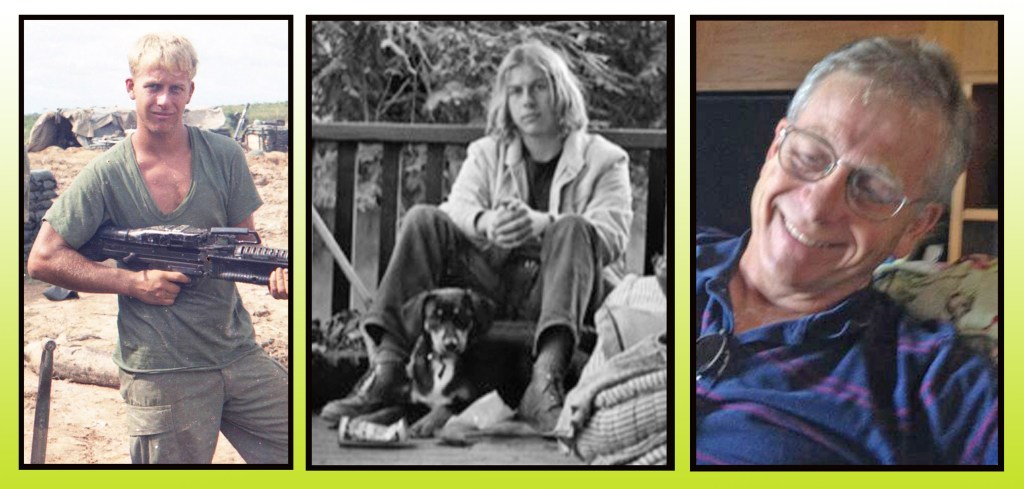
Ed Smith on the left in Vietnam, middle back in Marin after his service and a more recent photo on the right.


   Ernie Bergman who was in my brother Jim’s year, joined the Navy in his graduation year of 1966 but didn’t get to Vietnam until April 1967.  His first day in Danang was traumatic as he was assigned to be a stretcher bearer for the hospital triage centre where the wounded were brought to see if they could be saved.  “What a shock to my whole being!” Says Ernie.  “I saw soldiers and marines with all kinds of injuries, lost limbs, large wounds, lots of blood, lots of horror.  One guy I was carrying looked like he was on the wrong side of a claymore mine and had 1000 little pockmarks all over his body, face and uniform.  Just before I put him down he started shaking so I called the nurse over.  I was looking directly into his face and he died right there.  Holy Shit!  This is REAL!  If anything, that first day in Vietnam at the triage center probably had more emotional and mental effect on me than anything else I experienced in my 30 months overseas and in Vietnam.”

On the left a picture of Ernie Bergman in the Navy and on the right more recently at the US Congress in Washington DC.

   So while I was smoking weed, dreaming of tangerine trees with marmalade skies, staying up all night to the sound of Larry Miller on KMPX, these guys were experiencing hell on earth in Vietnam.  The ride I was on didn’t have much further to go.

To be continued…

Amazon USA
https://www.amazon.com/dp/B085QN73VQ


Amazon UK
https://www.amazon.co.uk/dp/B085QN73VQ

1967 – The Summer of Love, ch. 3

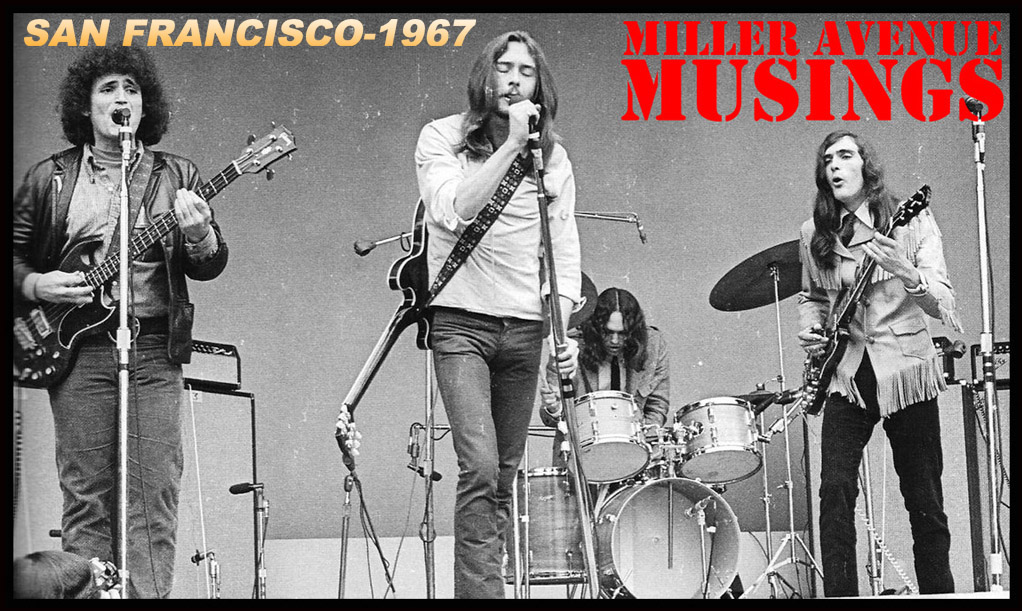
Jim Morrison singing with The Doors at the Magic Mountain Festival, Mount Tam in the summer of 1967.

The Matrix was a small club which started in San Francisco in the mid-1960s.  It was located on Fillmore at the Marina end of that street.  I only ever went to The Matrix a few times and never knew that it was part-owned by Marty Balin who sang with Jefferson Airplane.  The first time I went there was because Marty had invited me to observe a gathering of the Jefferson Airplane Fan Club one afternoon.  It was in 1966 before Grace Slick had replaced Signe Andersen and Marty was the only band member in attendance.  The club was packed full of young women who were asking him questions adoringly.  As the Airplane was recording with RCA at this time he told the young audience that he and the band had recently had lunch with Elvis Presley.  A groan of abhorrence rippled through the room which caused Marty to say: “Well, anyway, I was impressed.”At this time Elvis would have been known to these young people only as the star of movies like Spinout and Paradise, Hawaiian Style.

   So one evening early in 1967, Augie Belden and I decided to go to the Matrix.  Why we chose that night I don’t remember for the act playing was a band we’d never heard of called The Doors.  We sat at a table very close to the stage and there weren’t more than eight people in the audience ourselves included.  We found The Doors compelling to listen to and look at.  Their manner was very confident and the songs were original and catchy.  Jim Morrison, the band’s singer was good looking and charismatic.  His vocal style was impressive and he had a rock and roll voice though my brother-in-law insists that he always sang flat.  

   I was particularly impressed by the lyrics to Twentieth Century Fox and was beguiled by their rendering of Kurt Weill’s Whiskey Song.  Equally impressive was the keyboard style of Ray Manzarek.  Morrison didn’t speak to the audience between numbers but he held our attention by leaning on the keyboard and talking quietly with Manzarek.  This enigmatic performance art kept the small audience engaged even though we couldn’t hear what they were talking about.  

   All the material they performed that night was on their debut album which I purchased soon after.  They had a unique sound.  The centrepiece was Manzarek’s keyboards and Morrison’s vocals but drummer John Densmore and guitarist Robby Krieger filled their spaces with original and engaging instrumentation.

Marty Balin’s club The Matrix.

   Augie and I saw The Doors in March and sometime between then and the summer their single, Light My Fire, went to number one nationwide and they became an enormous draw overnight.  The next time Augie and I saw them was at Bill Graham’s Winterland but by now they were huge and I found them less exciting than I had at the Matrix.  Though Jim Morrison had a passing resemblance to Mick Jagger he exhibited none of the physical fluidity of the Stones vocalist.  He would just stand at the microphone like a statue holding onto it without any movement.  Also his vocal improvisations, which occurred often, were mainly dull and uninteresting. 

   The next time I saw The Doors was up on Mount Tam at the Mountain Theatre. Radio KFRC put on a big show called The Magic Mountain Festival and, in addition to The Doors, Dionne Warwick appeared.  Her set was brilliant but again I found The Doors a bit dull.  All their numbers sounded very similar and dragged at a slow tempo.  By now they were touring the nation and possibly beginning to burn out.

   Augie and I were very lucky to have seen The Doors at The Matrix before they were famous.  It was such an intimate setting and there wasn’t a trace of self indulgence in their performance whereas the times I saw them after Light My Fire was a hit, Jim Morrison would leave enormously long pauses between sung passages.  A friend told me of one gig where Ray Manzarek became so exasperated with Morrison’s pauses that he said loudly over the microphone: “Will you please sing?”

   I spent the afternoon wandering around and I came across my old classmate Bill Champlin and had a chat with him.  His band, The Sons of Champlin, were playing the following day and knowing I’d done poster work for the Fillmore, he told me that Bill Graham had decided not to book his band anymore because he thought they were “too ugly.”  If he was upset by this he gave no indication but then Bill Champlin was a showbiz pro from early on.  All through high school he had bands like The Opposite Six working the dances in Marin County.  Bill had a good growling rock and roll voice and played the piano with panache.  He had been a music student of Mr Greenwood’s at Tam High.  This meant he was in the high school marching band along with Mark Symmes and Billy Bowen.  These guys spoke highly of Mister Greenwood who brought out a high calibre of musicianship in his students.

   I had been to the Mountain Theatre many times throughout my childhood for the annual plays and it was a novelty to see a rock concert happening there.  The Monterey Pop Festival was a week away and the news from there travelled fast.  Monterey provided a showcase for the bay area bands as well as hosting Otis Redding, The Who and The Jimi Hendrix Experience.  Word spread that The Who and Hendrix finished their sets by wrecking their equipment and Jimi actually set fire to his electric guitar on stage.  This did seem a bit extreme for the largely peaceful scene in San Francisco so, the following week, when Hendrix played the Fillmore, I went along to see him.  I watched his set from upstairs and in addition to playing the guitar with his tongue he also played it upside down behind his back as well as creating feedback on his amplifier and simulating a sexual act with it.  I can only guess that someone had had a word with him not to go too far at the peaceful Fillmore for the only violent thing he did was to throw his guitar on the floor at the end of the set.

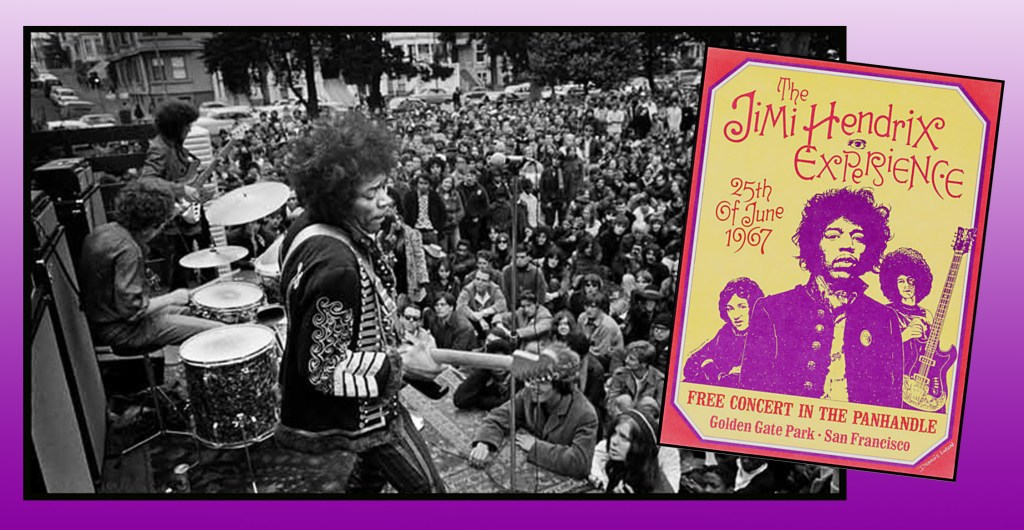
   As Hendrix was also doing a free concert in the Panhandle at Golden Gate Park on that Sunday afternoon I decided to make my way there and have another look and listen.  The Jimi Hendrix Experience was a trio with Mitch Mitchell on drums and Noel Redding on bass.  All three had crowns of fizzy long hair and were dressed in what looked like old fashioned marching band jackets.  They performed on a flatbed truck which was parked at the Baker Street end of the Panhandle and they attracted a sizeable crowd. 

Hendrix plays in the Panhandle. The eagle eyed among you can spot John Goddard of Village Music in the front row wearing dark glasses just above Jimi’s right thumb.

   The only songs they played which I knew were Wild Thing and Hey Joe which had been a radio hit the previous year for The Leaves but the rest of his material was original.  As with The Doors I bought their LP entitled Are You Experienced?  The song I particularly liked was Purple Haze.  The instrumentation conjured images of a factory with massive machine-like hammers going up and down.  Because his diction was not too clear I and a few friends mistook the line: Excuse me while I kiss the sky for Excuse me while I kiss this guy and assumed that Jimi Hendrix was gay.

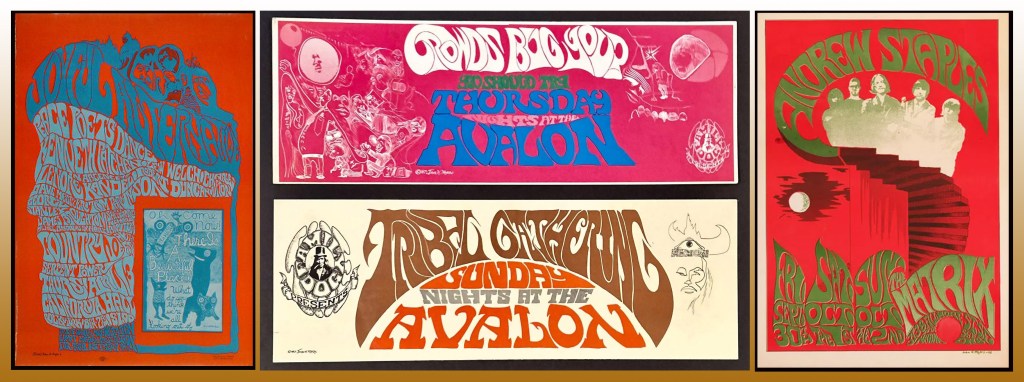
   I continued doing poster work for individual bands and, of course, socialising smokily with my friends in Mill Valley.  I picked up a bit of poster work from Bill Graham’s rivals over at the Avalon Ballroom.  I did a few bumper stickers to promote their two quietest nights, Thursdays and Sundays.  

A few bits of poster art I did after leaving the Fillmore.

   I was not an early riser during 1967.  I stayed up late and slept late.  If I was at my parents’ in North Beach, I would draw pictures into the night and early in the year I found an FM radio station which played good music all night long.  It was KMPX and the disc jockey was named Larry Miller who had a very nice personal style with none of the usual DJ malarkey.  Since I first discovered pop radio as a kid in the early 1950s I had found disc jockeys incredibly annoying.  Were it not for the music they played I would never have listened to their asinine babbling but Larry Miller was nothing like that and I regularly listened to him all night.  He didn’t play hit records but rather music which clearly appealed to him.  He also played records with drug related subject matter.  Cocaine Blues by Dave Van Ronk was one and The Pusher by Steppenwolf was another.  The Pusher was actually written by country artist Hoyt Axton but Steppenwolf made it their own and I became rather hooked on that song.  John Kay’s voice was raw, soulful and a bit scary as he sang with a righteous fury about getting his bible, razor and gun in pursuit of the pusher-man. 

A handbill which DJ Larry Miller designed himself for his show on Radio KMPX.

   I had never heard anything by the Velvet Underground until Larry Miller played it.  I was a bit shocked by the words to Heroin with Lou Reed describing sticking a spike into his vein.  KMPX exposed me to music that I never would have heard otherwise.

   Around this time I was invited up to Coco Cutler’s apartment on Telegraph Hill.  Coco was an old friend of my parents from their political past, meaning she was left wing.  She was in her sixties, physically tiny and had a beautiful face.  The view from her flat was stunning as it looked out across the Embarcadero and the Bay Bridge.  I had seen an old film, Dark Passage, starring Humphrey Bogart and Lauren Bacall which had a scene of him climbing the steps from the Embarcadero up to just below Coco’s window and was surprised to hear that she had watched them film that scene in 1946.  She said it was impressive just how many times Bogie had to climb that hill.

   The reason that Coco had invited me up to her place was to meet a young friend of a friend who had come from London.  She was Jo Bergman who I liked immediately.  Jo was short with a smiley face surrounded by a cloud of frizzy black hair and her laughter was infectious.  Jo spoke in an American accent but clearly had a European and British sensibility.  Coco’s good friends Elliott and Norma Sullivan lived in London and had made the introduction.  Jo was over here working for a friend who ran a record plugging business.  She was biding her time until she would return to London to set up and run the Rolling Stones office for Mick Jagger.  She regaled us with tales about the London music scene and how the Stones were harassed by the police about drugs but they wouldn’t touch the Beatles because they’d been made MBEs by the queen.  

My friend Jo Bergman in three photos with and without the Stones.

   The record plugging office where she worked was located in Columbus Tower which I knew as there was a Zims on the ground floor which I regularly ate at.  I absolutely loved a Zims Burger.  

   As Jo had invited me to visit the office I soon did.  She sat at a typewriter in the reception area on the first floor and her boss, a guy named Bob McClay, operated from the next room.  I guess that his business was recommending discs to radio stations.  We hit it off straight away as Bob was the only person I had ever met who shared my passion for the cartoons of Wallace Wood.  Wood was one of my favourite cartoonists from MAD Magazine.    

   McClay’s office was littered with LPs and singles.  He invited me to take whatever I wanted, so I did and was soon listening to the Bee Gees (New York Mining Disaster 1941), Cat Stevens (I love My Dog As Much As I Love You) and The Who (Boris The Spider).  

   Columbus Tower was located at the tip of Columbus Avenue and Kearney Street and it had the look of a much smaller Flatiron Building which stands on Fifth Avenue in New York City.  It was owned at this time by Frank Werber who managed the Kingston Trio and also ran The Trident restaurant in Sausalito.  As I was always on the hustle for graphic design work, Bob McClay made an intro and I spent some time talking with Werber in his spacious office up on the top floor of Columbus Tower.  He was a very engaging guy and interestingly had a back story similar to Bill Graham’s.  Born in Germany he and his parents escaped the Nazis in dramatic circumstances and he grew up in New York. Though I had a nice time talking with Frank I didn’t come away with any graphic design work.

   Though the city was where I did any business that was going, my emotional home was still Mill Valley where I’d get high with my friends.  A preoccupation for me at this time was to have a good trip on LSD as the few times I’d tried it hadn’t been great.  I guess I was bowing to peer pressure as so many of my friends were dropping acid and having a wonderful time.  They would tell me that I had to let myself go and not let my ego get in the way.  It truly became an aspiration to have a good experience with the drug which seemed to be all over the place.   

   When we got high we would always play records.  Listening to records and singing along with them was a thing I had been doing since I was a little kid.  At nine years old I would jig around my parents’ bedroom to Elvis records doing pretty accurate imitations of him.  I had a passion for the rock and roll of the 1950s which subsided after Elvis went in the army and wasn’t re-ignited until the Beatles came along.  I was totally ignorant of the mechanics of music but this didn’t stop me emulating the vocal styles of John Sebastian, John Lennon and Bob Dylan.  

   As the summer progressed an acetate of a recording by the Beatles started making the rounds.  An acetate was a pre-release disc which wasn’t for broadcast or sale.  It was A Day in the Life which would feature on the soon to be released Sgt. Pepper’s Lonely Hearts Club Band.  I heard it a few times.  First in Bob McClay’s office and then at a packed Fillmore gig.  I was standing near the band room door talking to Dicken Scully when this track came over the sound system.  It began with John Lennon singing wistful lyrics in a mellifluous manner.  Then a full orchestra began a musical climb like a rocket ship, going higher and higher until it crashed into a piano riff with Paul McCartney singing of getting out of bed, catching a bus, then going into a dream.  At this juncture a combination of Lennon’s voice and the full orchestra took us off into a musical dreamscape before returning to Lennon singing his song.  Then the orchestral rocket began again and climbed higher and higher and higher until it finally reached its climax.  Then sounded a beautiful musical chord.  It was like nothing I had ever heard before and the huge crowd at the Fillmore burst into applause.  From where I was standing I could see Bill Graham on the other side of the auditorium laughing maniacally as he looked up at the ceiling.  Having stage managed the playing of the acetate he was clearly pleased with himself.  It was a special moment.

To be continued…

Amazon USA
https://www.amazon.com/dp/B085QN73VQ


Amazon UK
https://www.amazon.co.uk/dp/B085QN73VQ

The Summer of Love – part 1

Pictured above are The Quicksilver Messenger Service

There was a song which was released as a single in May of 1967 by Scott MacKenzie.  It was entitled San Francisco (Be sure to wear some flowers in your hair).  It went into the charts nationally and also became an international hit.  All of my friends were avid listeners to the popular music of the day and yet I never heard a single one of them enthuse about Scott MacKenzie or his song.  I heard it on the radio and regarded it as a purely commercial pop record cashing in on the hippy scene in the Bay Area.  And yet whenever there’s a television or radio documentary about the Haight Ashbury in that year this is the song that’s always trotted out to accompany it.

   It was written and produced by John Philips of the Mamas and Papas.  The tune was catchy enough but the lyrics were a bit worthy with references to all the “gentle people” to be found in the city by the bay.  True there were many Be-ins and Love-ins that year which is what the song was on about.  But there was a dark side to the hippy phenomenon as well with regular reports in the Chronicle about overdosed dead bodies collapsed in doorways along Haight Street.  The name Charles Manson was unknown then but he too resided in the Haight Ashbury district at that time with his ‘family’ which, along with him, would become infamous in just a few years time.

   The summer of 1967 in San Francisco became known as the summer of love.  The hippy happening was at its height with young people from all over the United States and the world arriving on Haight Street every day, possibly encouraged by Scott MacKenzie and his wretched song.  

   For me, however, as the summer of love reached its peak, I went off the rails on a psychedelic substance and wound up incarcerated in a psychiatric hospital.  I was twenty years old and, as a result, my memories of that year are skewed by this experience.  With hindsight, I was headed for psychological trouble with or without LSD but that doesn’t alter the fact that I flipped out on acid.  And I do know from others that it was a particularly bad batch.

   Working for Bill Graham at the Fillmore Auditorium provided an exciting window on the emerging San Francisco rock scene which had, by 1967, become world famous.  I returned from a trip abroad in January and rang up Bill at the Fillmore to let him know I was back in town and available for any poster work he needed.  I had only been away a few months but things had changed dramatically.  The scene had become nationally and internationally renowned with reporters from all over the world turning up to write about Haight-Ashbury and the music it had spawned.  The two biggest bands, Jefferson Airplane and The Grateful Dead were becoming very famous indeed and there was a gaggle of new poster artists in town.  Before it was Wes Wilson, Mouse and a few others but now psychedelic artwork was everywhere and the advertising industry had begun imitating the lettering style that Wes had made popular with his poster art.  Also Bill Graham was different.  He too was in the process of becoming a celebrity. 

   I went in to see Bill and Bonnie at the Fillmore and he seemed more polished somehow.  He was certainly better dressed, sporting a snappy green suede jacket.  He was now mixing with famous people in the music business and the glow was rubbing off on him a bit.  Enjoying his suede jacket he asked Bonnie if she thought it made him look like a ‘rock mogul.’  

   He’d been back east and seen a special preview of the soon to be released Don’t Look Back, a documentary on Bob Dylan, by D.A. Pennebaker.  He gave his verdict loudly: “Bob Dylan is an asshole!  Albert Grossman steals the show.”  Dylan’s manager, Grossman, is seen in the film prodding London impresario Tito Burns to get more money for Bob.  Bill had become friendly with Grossman after negotiating with him for an exclusive deal on the Butterfield Blues Band.  

   I overheard Bill giving an interview in his tiny office at the Fillmore to a reporter from Time Magazine.  When the article came out, he was furious with the way the guy had written about him.   He felt misrepresented.

   The job Bill gave me was a poster design for a weekend show featuring The Blues Project, Jimmy Reed, John Lee Hooker and the Stu Gardner Trio.  I was very excited about doing this poster and, following my old pattern, I walked up Russian Hill to the corner store where I bought a pack of cigarettes and a Cadbury’s chocolate bar.  I started work about 8pm in the kitchen at my parents’ apartment on Union Street and worked through the night.  I drew a picture of a black male blues musician playing a harmonica which stretched off into the distance and swerved around in a liquid shape to frame the lettering.  On the top of the harmonica I drew a keyboard being played by musicians.  I had a drummer and depicted the vibrations his drumsticks created.  I also did cartoons of Paul Butterfield, Bob Dylan, Pig Pen and Jerry Garcia.  Down below was a black street scene with people dancing and in the right hand corner stood a white police officer with a billy club observing them.  The police officer was not sympathetically drawn.  He looked mean and intolerant.  I was trying to put the blues into a political context.

   All of this appeared on a light green background with the letters coming out white.  I delivered the artwork to the printer and thought no more about it until I wandered into the Fillmore that Friday night.  Being apologetic was not a quality I was used to seeing in Bill Graham but that is exactly how he approached me as I walked up the stairs.  “After all the trouble I’ve had with the police,” he said, “I simply couldn’t allow that picture of the cop to be on the poster.  It would be a red rag to a bull.  I’m sorry but the printer and I had to change your artwork.”

   What he and the printer had done was to black out the entire street scene as well as all the musicians playing.  The only bit of my work remaining was the blues player, the harmonica and the lettering.  To be honest it looked very good.  It was dark blue with a lighter blue for the harp player who was reversed out of the background with the lettering in white.

On the left is the original poster and on the right is what Bill Graham and the printer cooked up.

   The trouble with the police that Bill was referring to had occurred at the Fillmore before I came along.  I remember reading about raids on the hall by the police in the Chronicle before I knew him so I was aware of the reality he was dealing with.  The police definitely harassed him in the early days and the memory of those encounters clearly lingered.  For me the abiding recollection of my poster being changed was the diplomatic way in which Bill had explained it to me.  He was a very persuasive person. 

   Being part of the furniture at the Fillmore meant I got very used to seeing the bands up close and becoming familiar with them and their repertoire.  Quicksilver Messenger Service was a five piece unit which featured John Cipollina on lead guitar.  Cipollina had been in my sister Katie’s class at Old Mill School.   I remember being impressed by their image.  Both lead singer/guitarist Gary Duncan and Cipollina had long straight hair and wore dark cowboy hats making the band look like a gang of wild west outlaws.  For some numbers Duncan would slide his guitar strap around so that his instrument was on his back and he’d beat a cowbell with a drumstick.  As with all the bands at the Fillmore these guys were constantly stoned on weed.

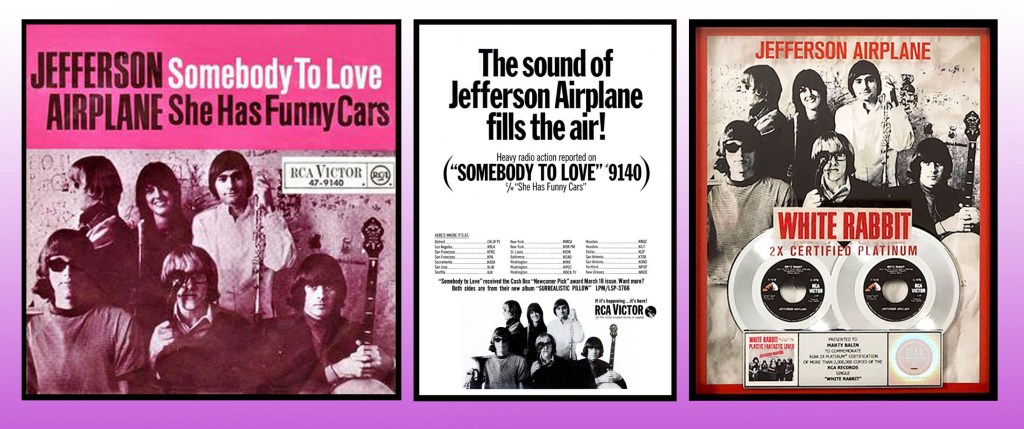
   I didn’t get to know members of Jefferson Airplane until they changed female vocalist.  Originally Signe Andersen was in the band but at some point during my time at the Fillmore she left and was replaced by Grace Slick who I had seen performing with her band The Great Society.  Grace was a very beautiful woman, good musician and terrific singer.  She was also a very nice person, at least to me.  They used to rehearse at the Fillmore in the afternoons and I was always impressed that they would lug their own gear up the stairs.  Early on Bonnie MacLean had introduced me to Marty Balin and I would have regular chats with him in the foyer of the Fillmore while painting my boards.  Another local band, Sopwith Camel, had a hit record on the radio entitled Hello Hello, which Marty described as “a piece of shit.”  The fact that it was being played on KFRC irritated him.  “We’ve got to get a single out,” he said.

RCA ad art for singles by Jefferson Airplane.

   In addition to Marty Balin I became friendly with their drummer Spencer Dryden.  I remember one day taking a ride down into the Tenderloin district with Spencer in his VW Beetle.  His ashtray was heaving with roaches and cigarette butts.  He lit up an enormous joint as we sped down Geary.  By the time we hit the Tenderloin I was seriously stoned.  Spencer went into some building while I loitered on the street and was soon approached by this smiling black guy in a leather jacket.  “Hey little brother,” he said.  “You want something good?”  He opened a shiny pouch  with three or four enormous fat joints wrapped in bright yellow cigarette paper.  When he realised he wasn’t going to make a sale he moved on quickly.  Then Spencer came out and we drove back to the Fillmore.  I don’t remember why I was along for the ride but I was.  

   My favourite musician in the Airplane was Jorma Kaukonen whose guitar playing was so exotic.  His riffs had something of the Arabian Nights about them.  I never spoke to Jorma but he and Bill had a conversational rapport which was interesting.  He was regularly sitting in Graham’s tiny office just talking.  Bill didn’t shoot the breeze with many people but Jorma was an exception.

   The other band I became very familiar with was The Grateful Dead.  Bass player Phil Lesh and I regularly had a chat as he was a fan of the EC horror comics of the early 1950s and had seen my cartoon of the Old Witch in a comic strip I had done for one of the psychedelic newspapers.  On an evening at the Fillmore I would often go up to the band room and just hang around.  I did an awful lot of hanging around at the Fillmore.  One afternoon up there I saw Pig Pen and Bob Weir leafing through binders with plastic window pages containing black and white 8×10 photographs of good looking women.  

   Like Jorma in the Airplane, I truly enjoyed watching and listening to Jerry Garcia play the guitar.  He seemed to physically propel himself forward with each note he played which was hypnotic to observe.  Garcia was probably the most friendly person on that scene.  He seemed so approachable.  I never engaged Jerry in conversation but he’d always say hello to me.  

   The look of the Grateful Dead was something to send shivers down the spines of most middle class parents.  Very long hair on guys who didn’t really have the right kind of hair to be that long with the exception of Bob Weir.  The Dead had the Haight Ashbury lifestyle written all over them.  One of the funniest numbers in every one of their sets was when Pig Pen (aka Ron Mckernan) would come out from behind his electric keyboard and sing Good Mornin’ Little School Girl.  He had a terrific blues voice and the sight of him with his long hair and beard singing: “Tell your mama and papa, that I’m a little school boy too,” was such a contradiction that it made me laugh every time.

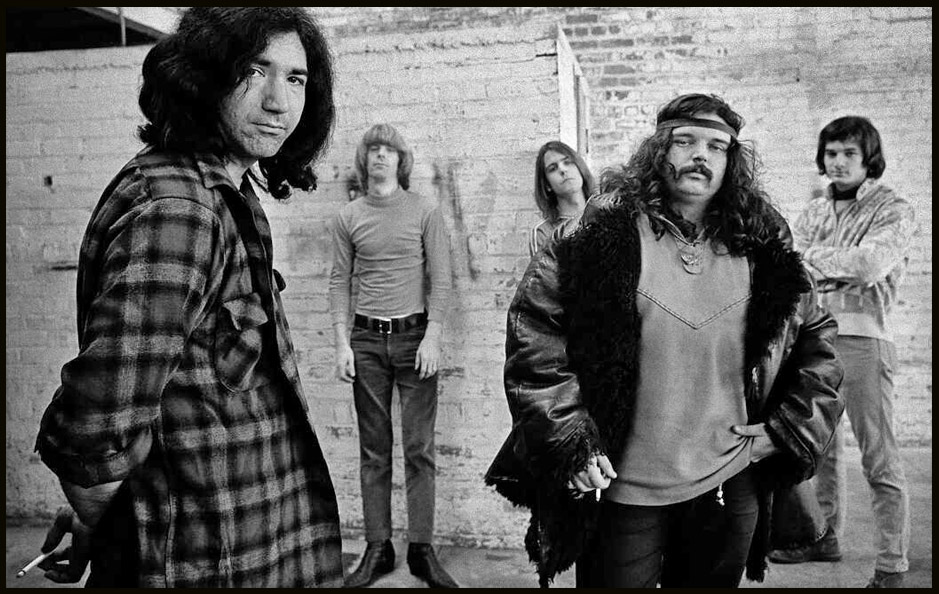
Members of The Grateful Dead, from left: Jerry Garcia, Phil Lesh, Bob Weir, Ron (Pig-Pen) McKernan, Bill Kreutzmann

   Bill Graham kept a cowbell and drumstick in his office and when the Dead were doing their second set of the evening he’d bring them out and go to the side of the stage behind the amplifier and accompany them rhythmically.  I never saw him do this with any other bands.

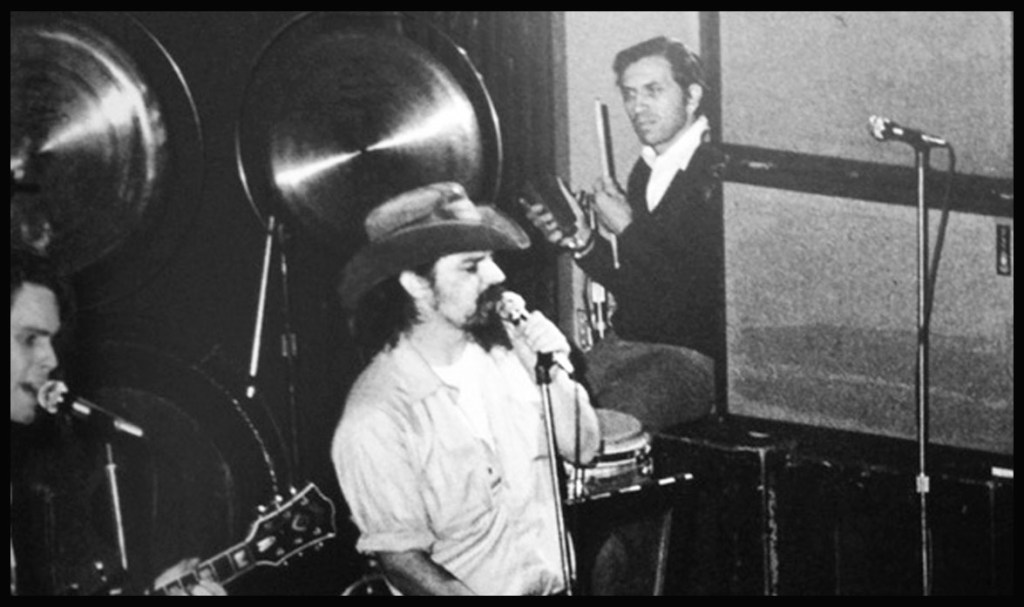
Bill Graham at the side of the Fillmore stage accompanying The Dead with cowbell. From left: Bob Weir, Pig Pen and Bill Graham.

   The band room was guarded during gigs by Dicken Scully whose brother Rock was one of the Dead’s two managers (the other was Danny Rifkin).  Dicken was tall, thin, wore glasses and had long blond hair.  He was a very nice guy to me but was very strict about who got beyond that door.  Lots of people tried to get past Dicken but unless he knew you had a genuine connection to one of the bands playing he was resolutely firm in denying access.

   One thing that hanging around the Fillmore did for me was to feed the fantasy of becoming a performer myself.  I was much too shy to get up on a stage and sing but it was an aspiration which grew as I clearly had the talent and a good singing voice.  On long walks home from the Fillmore I would compose my own songs.  My route home took me down Geary to Van Ness.  I’d then turn left on Polk Street and walk however many blocks to Union.  Then I’d turn right, going up and over Russian Hill until I reached my parents’ apartment.  The walk took me about forty minutes which was just long enough to write a song and once inside I’d scribble the words down on a piece of art work.  I had a big professional drawing board in my bedroom and was constantly doodling.

   Hanging around the Fillmore was not like having a social life for all my real friends were across the Golden Gate Bridge in Mill Valley.  Every opportunity I had to go there was seized upon with enthusiasm.  My mode of transport was hitch hiking.  I’d put my thumb out on Lombard street and within half an hour I would be walking down Miller Avenue.  I’d make my way to one of many houses where, invariably,  I’d get loaded on weed with my friends who were all indulging in this activity.  As I’d walk in, I’d be handed a lit joint and away we’d go.  The music on the record player could be Dylan’s Blonde On Blonde or Revolver by The Beatles.  A lid of grass sat in a plastic bag on a table surrounded by packets of Rizla cigarette papers.  We’d roll skinny little joints, light them and suck the smoke deep into our lungs.  We would then hold our breath as long as we could and finally release the smoke in a mighty dizzy exhalation.  Much of the conversation which followed was whispered by people holding their breath.

   This was the way of life I had embraced.  Being loaded meant that everything was either interesting or funny.  The smallest detail in a work of art became something enormous and recorded music seemed that much more exciting.  One negative side of being stoned so often was my tendency to talk about creative things I might do rather than actually doing them.  

To be continued...

Amazon USA

Amazon UK