Back to the Waterfront

Somewhere in the midst of my comedown and the start of my depression, my childhood friend Robbie Bridges, appeared and invited me to go on a road trip to southern California.  Robbie was the son of Harry Bridges and he and I used to play together when we were very young.  After his parents’ divorce, he’d been living back east with his mother Nancy.  He was now based in San Francisco and doing some kind of a white collar job which was nothing to do with Harry or the longshore union.

   Robbie must have known what I’d been through the past few months but my memory of our drive down the coast was that we talked as if nothing had happened to me and I responded well to this.  Everybody around me at this time was treating me with tremendous delicacy and somehow Robbie not thinking there was anything wrong with me was liberating.  At one point he asked me to drive and I did.  It was an exciting moment of self discovery to learn that I actually knew how to drive a car.  

   He told me all about the pop music he was keen on.  He was particularly taken by The Who and told me about gigs he’d been to.  I cannot remember where we stayed on this trip but I think we were away from San Francisco for a few days.

   A little bit of logical thinking was seeping into my fevered brain.  The idea of a trip to England, became something I felt I had to do.  I knew that in order to get the money for such a journey, I would need to go back to work on the waterfront.  But to do that I would have to pull myself together and make accommodations with the world around me.  For someone who, a mere six weeks earlier, had been stomping around the psychiatric wards at Napa State Hospital insisting that John Lennon was in the next room, this was something of a tall order.  But at every point on my journey of madness, I had responded to the signals around me and the fact I had two contacts in London: my sister Nell and my friend Jo Bergman, I took as just such a signal.  It did, however, require some organisation on my part.

   That I had the opportunity to work on the waterfront as a ship’s clerk was a privilege indeed.  This privilege came to me as a result of being Blackie Myers’ son.  I was aware just how sought after the clerking jobs on the front were.  For starters they paid very well indeed and it could be more than a bit interesting, particularly when you worked down inside the hold of a cargo ship.  

   Had I never worked on the front before, the prospect of clerking would have terrified me, but the waterfront was a world I was familiar with having done it a fair bit.  However this time was different.  The recent experiences I’d been through had taken me into dimensions outside the social boundaries of normal society and I realised I’d have to conform to my father’s ways.  The first thing would be to cut my hair and dress in a sober manner.  There was a huge prejudice against long hairs on the front and, after several months of being a hippie mental patient, my hair was long indeed.  My father was a very respected guy up and down the Embarcadero and I knew that it would be disrespectful of me to behave in any way which upset or embarrassed him.

Blackie with his brothers Billie and Harvey in Brooklyn(left), Blackie at his desk in the NMU, and Blackie on Market Street with a seafaring friend.

   Also it was very important to be conscientious in the work, which wasn’t really that difficult but accuracy was essential.  Blackie always stressed the importance of doing your job to the best of your ability.  The reason he always gave for this was to protect the union.  After all that was his history.  He was a sailor by trade and had helped build the National Maritime Union which was no cake walk.  Whenever they tied up a ship and went on strike they were up against all the forces that the ship owners had at their disposal: the police, the national guard, and gangs of strike breakers known as Goon Squads.  The fight to build their union had been long and bloody.  A few of Blackie’s comrades had been killed in the struggle and while he and his sailors were building the NMU on the east coast, Harry Bridges was leading the longshore union on the west coast.   

From left: Blackie Myers, Harry Bridges, Vincent Hallinan.

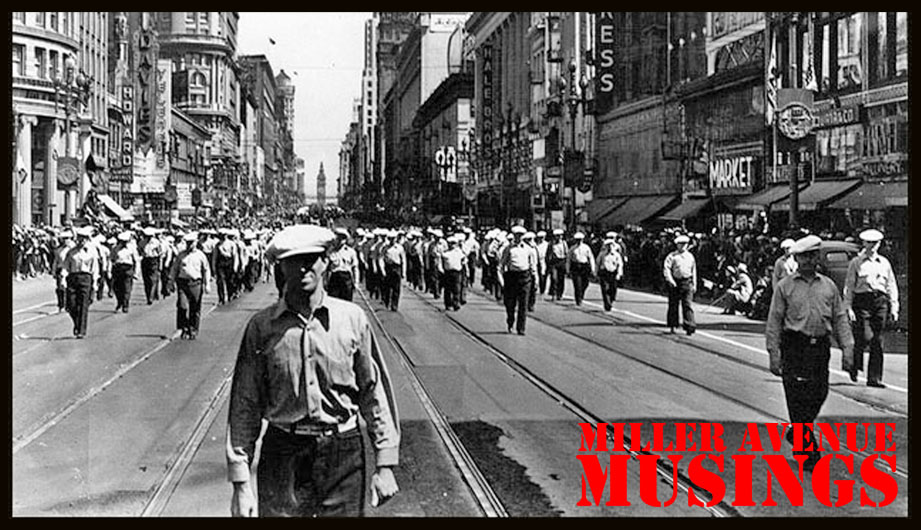
   The west coast longshore strike of 1934 was a crucial turning point for the American trade union movement.  The police, firing live rounds at the striking stevedores, injured many and killed two.  The union held a funeral march for the two dead men which processed up Market Street.  Thousands of people lined the street to watch.  This was a major factor which led to a general strike.

How the Hearst press Examiner reported the first days of the 1934 longshore strike.

   The 1934 strike was the beginning and the original union, the ILA, became the ILWU (International Longshore & Warehouse Union).  Their militancy improved working conditions and wages for ordinary labourers.  But it also made Harry a target.  Those that felt the working class should know their place conspired against him.  He was, after all, an Australian by birth, and the federal government would do their damndest to deport him.  But that was in the 1930s.
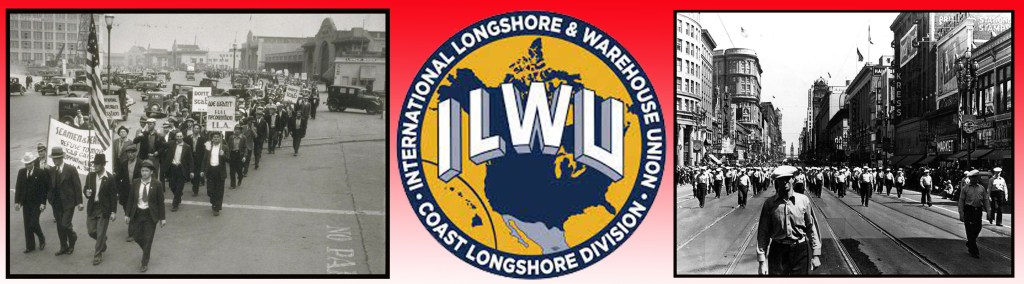
From left: the 1934 longshore strike, the ILWU logo, the longshoremen march up Market Street in 1939.
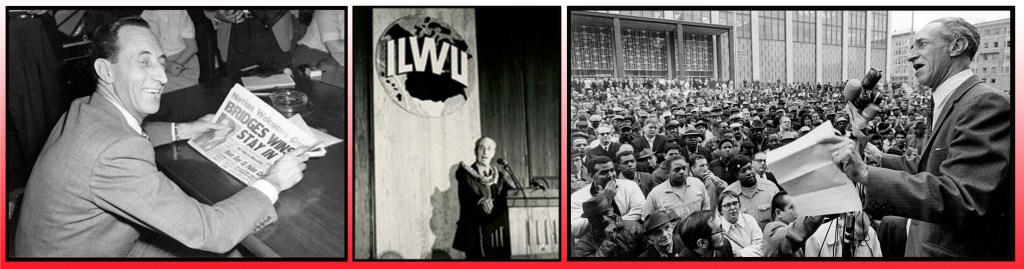
From left: Harry getting good news, speaking at a conference, and speaking to a large crowd in San Francisco.


   In 1952, the Myers family had travelled all the way from Connecticut to California because every job Blackie managed to get on the east coast would last only as long as it took the FBI to turn up and tell his employer what a dangerous radical he was.

   The last leg of our journey west was from Taos, New Mexico to Mill Valley.  All of us, Blackie, Beth, Nellie, Katie, Jimmy and I were bleary-eyed from the endless stretches of highway but when we crossed the Golden Gate Bridge and climbed Waldo Grade, the end was in sight.  Turning left off Miller Avenue at the 2am Club, we drove into Homestead Valley where a welcome party for us was in progress at Bob Robertson’s house.  Bob was an executive of the longshore union, the ILWU.  Every family friend we would know in the town we were destined to grow up in was there.  The Dreyfus family, the Hallinan family and the Bridges family along with the Goldblatts and the Cox’s.  It was such a friendly gathering of people and I instantly thought of all these folks as family.

   The reason we had come west was the possibility of work for Blackie on the San Francisco waterfront.  Harry Bridges and Blackie Myers were trade union comrades of old.  However it took some time before Black was allowed to work on the front.  With hindsight, I think the delay was possibly because Harry, with all the political persecution he was continuing to suffer, felt nervous about provoking the federal government.  After all Blackie had been a prominent trade unionist in New York and was an early target of the witch hunters.
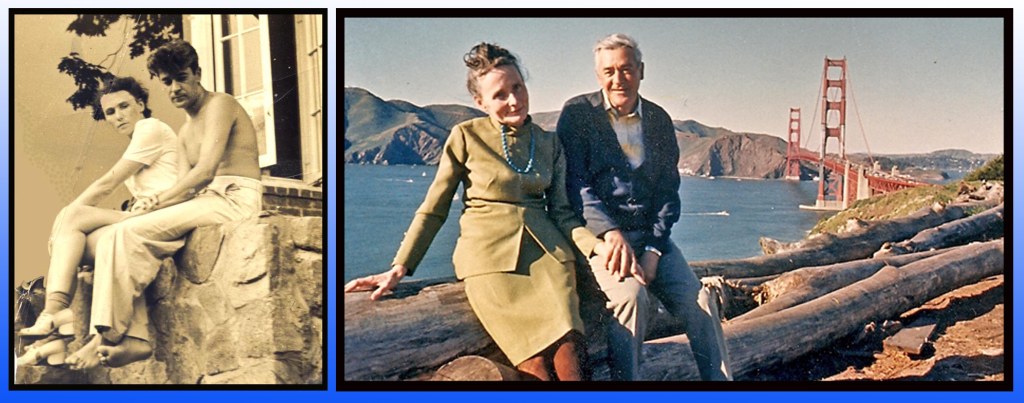
Beth and Blackie pictured on the left in Connecticut in 1950 and on the right in San Francisco in the 1960s.

From left: Johnny Myers with Blackie in Manhattan, centre: Jimmy. Blackie & John, on the right Johnny, Blackie, Jim and Totem our cat.

   Harry was born in Melbourne, and had gone to sea at a young age, winding up working on the docks in San Francisco.  The federal government had tried repeatedly to prosecute and deport Harry, claiming he’d lied about not being a member of the Communist Party. 

   The propaganda of the post war anti-Communist era was very powerful indeed.  Hollywood fell in line with the government by creating a blacklist for writers, directors and actors who wouldn’t cooperate with the House Un-American Activities Committee.  The cooperation the committee required was to name names of those who either were Communists or fellow travellers.  The Hollywood Ten all went to prison, Alger Hiss too went to jail and in 1953 the Rosenbergs were executed for treason so by that time the terror in the country was pretty substantial.
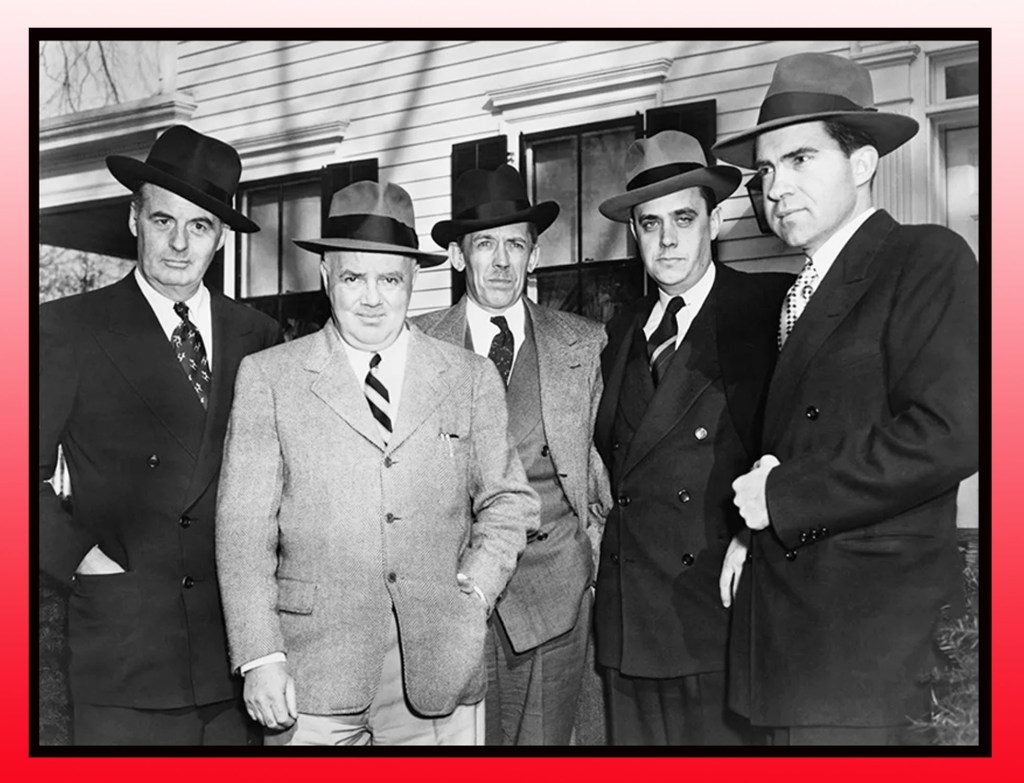
The House Un-American Activities Committee featuring a young Richard Nixon on the right and J. Parnell Thomas in the centre.

Pressbook advertising for the 1951 Warner Brothers film ‘I Was A Communist For The F.B.I’

   For Americans who have grown up believing the propaganda of the McCarthy era, the image of a Communist was a ruthless person with shifty mannerisms and dishonest tendencies.  Many of my parents’ friends were actually party members but none of them behaved remotely like that.  Humour played a big role in most of those friendships.  

   Blackie had a mischievous sense of humour and was what he called a pork chop socialist.  Whatever put food on the table was what motivated him and he was always fair with others.  During the depression he found himself in a town where they had a fist fight contest with a prize of ten dollars for whoever won.  Handy with his fists, Blackie fought the guy and beat him, but then split the money with his opponent.  When I asked him if he was tougher than the other guy, his answer was: “No.  I was hungrier.”

   As kids, we always enjoyed Blackie’s performances.  He was a very good mimic and did a pitch perfect impersonation of Harry, who he always called The Nose. 

  There were party members who did behave in a stereotypical secretive way but none of my parents’ friends were like that at all.  One such person was our neighbour, Dennis Brogan’s grandmother Jean.  She used to bring us her copies of The People’s World newspaper and my memory of her was that she was completely humourless.  

   The American Communist Party became a political force in the early days of the Great Depression.  President Franklin Delano Roosevelt had no qualms about dealing with Communists.  His administration had many advisors from all avenues of left wing politics including the NMU, and Blackie was one of them.  A family friend, Albert Kahn, wrote in his book, High Treason, quoting FDR just after his electoral victory in 1932: “Coming back from the west last week, I talked to an old friend who runs a great western railroad.  ‘Fred,’ I asked him, ‘what are the people talking about out here?’  I can hear him answer even now.  ‘Frank,’ he replied, ‘I’m sorry to say that men out here are talking revolution.’”

   Blackie had gone to sea at age fourteen and became an able bodied seaman.  Following the Wall Street Crash of 1929 and the great depression it had caused, he was often out of work and would “grab a handful of boxcars” to get from one port to another in search of a ship to sign on.  The hiring halls in every port were referred to as Fink Halls as sailors would have to bribe the man handing out the jobs.  The pay was low and working conditions on the ships were often dangerous.  Blackie was a tough guy who during those years was both hungry and angry.  It wasn’t until he became involved with those working to organise as a union that he was able to channel his anger in a constructive way.  

   But the fights ahead were deadly dangerous as the shipowners perceived the formation of the union as a direct attack on their interests and deployed all their weapons.  The NMU organised strikes on the east coast and ports in the Gulf of Mexico and not one of them was won easily.  In addition to the brute force of the military, police and goon squads, the shipowners also had the help of press barons like William Randolph Hearst whose newspapers utilised highly effective anti-labour propaganda.  One of Hearst’s papers was the San Francisco Examiner, whose readers were told on a regular basis of what an enemy of the state, Harry Bridges was.  During the 1934 strike the Examiner described the strikers as rioters, and celebrated the National Guard and police as heroes defending decent citizens.  The fact that they were firing live rounds at unarmed workers was celebrated as protecting the interests of decent society.

   People who aren’t too clear on their history often mix up the House Un-American Activities Committee with the senate committee of Joe McCarthy but the two are separate.  The House Committee began stirring things up in 1947 while Joe McCarthy didn’t discover Anti-Communism as a cause until 1950.  Once he did, he went at it with a vengeance, grilling ordinary citizens on television about petitions they might have signed years before or meetings they may have attended.

   Blackie and Beth had been popular folks about town before he was blacklisted but after that, people they’d known pretty well would pass them on the streets of Manhattan without a glimmer of recognition.

  He told me later that he truly hadn’t seen the red scare coming.  But the signs were there.  As an advisor to the U.S. Government on labour relations during World War 2, he was sent into Germany with the occupying troops in 1945.  He told me he’d had a meeting with General Patton not long before the accident which killed him.  After they’d dealt with their business, Patton poured them each a snifter of the finest brandy and held his glass up in a toast, saying: “Now that this is over, we’re going to get you bastards.”  Black told me that he just laughed.  But soon after his return to the U.S. his passport was taken away from him.  A sailor without a passport cannot work as a seaman.

   The choreography of the cold war was designed with military precision and one of the most important weapons was propaganda.  Convincing the American public to forget about the Germans, Italians and Japanese being their enemy and to concentrate their fear on the Russians, was essential to this endeavour.  

   They were helped in no small part by the hearings held by HUAC and Senator McCarthy but also by Hollywood and those who controlled the media.  People with left wing or liberal tendencies during the 1930s and 40s suddenly found themselves perceived as highly suspicious individuals and began running for cover.  Many of them became stool pigeons and turned on their friends.  The fifth amendment, which protects citizens from incriminating themselves, was seen by the newspapers as an admission of guilt and people who took it often lost their jobs.

   But the machinations of the federal government didn’t work on my parents and their close friends and I grew up hearing fantastic trade union tales from the 1930s and 40s.

   So here I was, fresh out of Napa Hospital, preparing myself for going back to work on the waterfront and yet there were still a few hoops which I had to jump through.  True, I wasn’t over my crazyiness but was capable of putting on a reasonable appearance of “not so crazy.”  I continued taking Thorazine, but in smaller doses.  I went to the barber shop and got my hair cut short.  I started shaving regularly and dressing in a conservative way.  When Black was convinced I was okay he told me he’d had a word with Johnny Aitken who was the dispatcher in the hiring hall and when I felt up to it I could turn up for work.  

To be continued…
Amazon USA
https://www.amazon.com/dp/B085QN73VQ
Amazon UK
https://www.amazon.co.uk/dp/B085QN73VQ

The Summer of Love – part 1

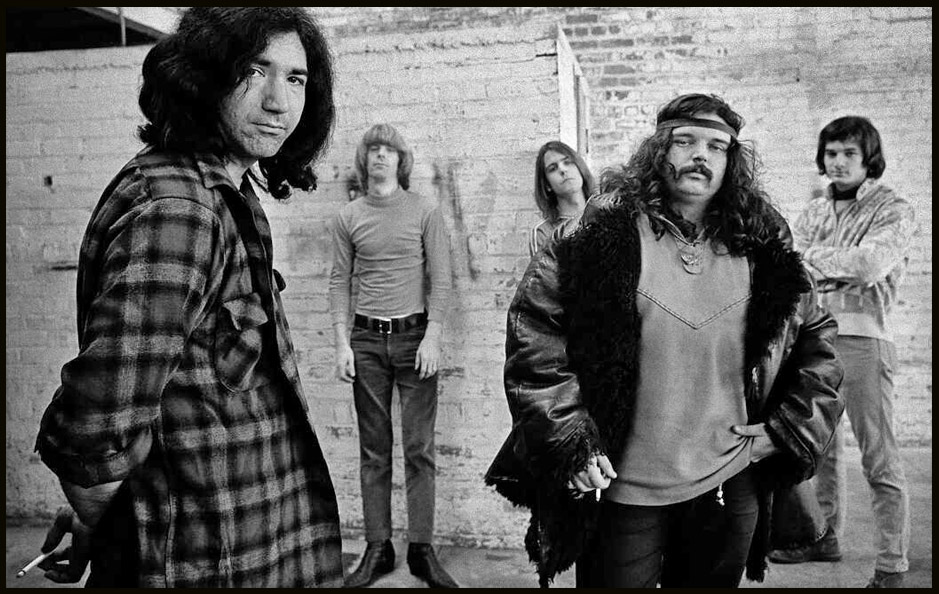
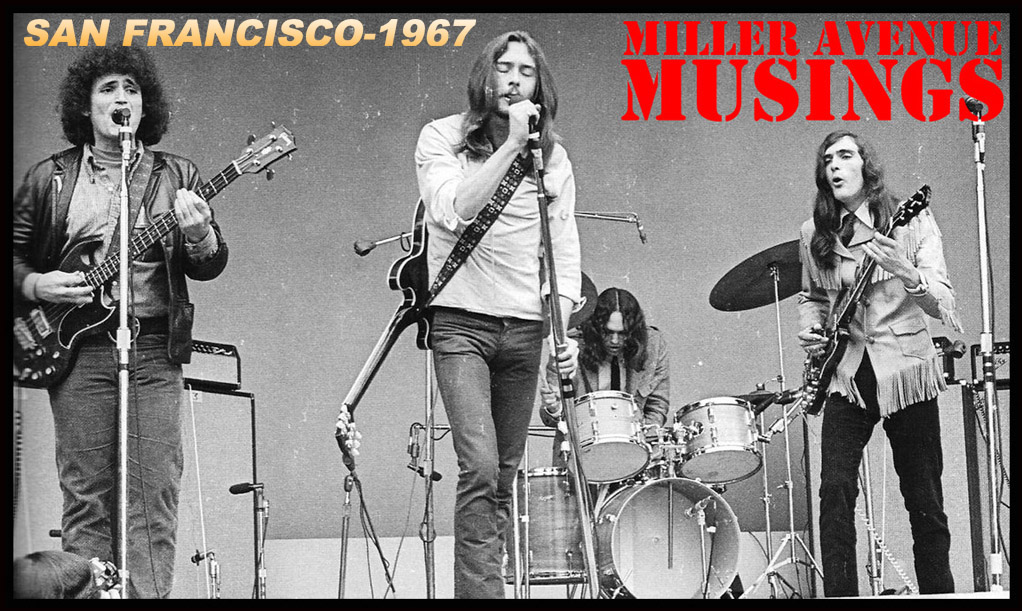
Pictured above are The Quicksilver Messenger Service

There was a song which was released as a single in May of 1967 by Scott MacKenzie.  It was entitled San Francisco (Be sure to wear some flowers in your hair).  It went into the charts nationally and also became an international hit.  All of my friends were avid listeners to the popular music of the day and yet I never heard a single one of them enthuse about Scott MacKenzie or his song.  I heard it on the radio and regarded it as a purely commercial pop record cashing in on the hippy scene in the Bay Area.  And yet whenever there’s a television or radio documentary about the Haight Ashbury in that year this is the song that’s always trotted out to accompany it.

   It was written and produced by John Philips of the Mamas and Papas.  The tune was catchy enough but the lyrics were a bit worthy with references to all the “gentle people” to be found in the city by the bay.  True there were many Be-ins and Love-ins that year which is what the song was on about.  But there was a dark side to the hippy phenomenon as well with regular reports in the Chronicle about overdosed dead bodies collapsed in doorways along Haight Street.  The name Charles Manson was unknown then but he too resided in the Haight Ashbury district at that time with his ‘family’ which, along with him, would become infamous in just a few years time.

   The summer of 1967 in San Francisco became known as the summer of love.  The hippy happening was at its height with young people from all over the United States and the world arriving on Haight Street every day, possibly encouraged by Scott MacKenzie and his wretched song.  

   For me, however, as the summer of love reached its peak, I went off the rails on a psychedelic substance and wound up incarcerated in a psychiatric hospital.  I was twenty years old and, as a result, my memories of that year are skewed by this experience.  With hindsight, I was headed for psychological trouble with or without LSD but that doesn’t alter the fact that I flipped out on acid.  And I do know from others that it was a particularly bad batch.

   Working for Bill Graham at the Fillmore Auditorium provided an exciting window on the emerging San Francisco rock scene which had, by 1967, become world famous.  I returned from a trip abroad in January and rang up Bill at the Fillmore to let him know I was back in town and available for any poster work he needed.  I had only been away a few months but things had changed dramatically.  The scene had become nationally and internationally renowned with reporters from all over the world turning up to write about Haight-Ashbury and the music it had spawned.  The two biggest bands, Jefferson Airplane and The Grateful Dead were becoming very famous indeed and there was a gaggle of new poster artists in town.  Before it was Wes Wilson, Mouse and a few others but now psychedelic artwork was everywhere and the advertising industry had begun imitating the lettering style that Wes had made popular with his poster art.  Also Bill Graham was different.  He too was in the process of becoming a celebrity. 

   I went in to see Bill and Bonnie at the Fillmore and he seemed more polished somehow.  He was certainly better dressed, sporting a snappy green suede jacket.  He was now mixing with famous people in the music business and the glow was rubbing off on him a bit.  Enjoying his suede jacket he asked Bonnie if she thought it made him look like a ‘rock mogul.’  

   He’d been back east and seen a special preview of the soon to be released Don’t Look Back, a documentary on Bob Dylan, by D.A. Pennebaker.  He gave his verdict loudly: “Bob Dylan is an asshole!  Albert Grossman steals the show.”  Dylan’s manager, Grossman, is seen in the film prodding London impresario Tito Burns to get more money for Bob.  Bill had become friendly with Grossman after negotiating with him for an exclusive deal on the Butterfield Blues Band.  

   I overheard Bill giving an interview in his tiny office at the Fillmore to a reporter from Time Magazine.  When the article came out, he was furious with the way the guy had written about him.   He felt misrepresented.

   The job Bill gave me was a poster design for a weekend show featuring The Blues Project, Jimmy Reed, John Lee Hooker and the Stu Gardner Trio.  I was very excited about doing this poster and, following my old pattern, I walked up Russian Hill to the corner store where I bought a pack of cigarettes and a Cadbury’s chocolate bar.  I started work about 8pm in the kitchen at my parents’ apartment on Union Street and worked through the night.  I drew a picture of a black male blues musician playing a harmonica which stretched off into the distance and swerved around in a liquid shape to frame the lettering.  On the top of the harmonica I drew a keyboard being played by musicians.  I had a drummer and depicted the vibrations his drumsticks created.  I also did cartoons of Paul Butterfield, Bob Dylan, Pig Pen and Jerry Garcia.  Down below was a black street scene with people dancing and in the right hand corner stood a white police officer with a billy club observing them.  The police officer was not sympathetically drawn.  He looked mean and intolerant.  I was trying to put the blues into a political context.

   All of this appeared on a light green background with the letters coming out white.  I delivered the artwork to the printer and thought no more about it until I wandered into the Fillmore that Friday night.  Being apologetic was not a quality I was used to seeing in Bill Graham but that is exactly how he approached me as I walked up the stairs.  “After all the trouble I’ve had with the police,” he said, “I simply couldn’t allow that picture of the cop to be on the poster.  It would be a red rag to a bull.  I’m sorry but the printer and I had to change your artwork.”

   What he and the printer had done was to black out the entire street scene as well as all the musicians playing.  The only bit of my work remaining was the blues player, the harmonica and the lettering.  To be honest it looked very good.  It was dark blue with a lighter blue for the harp player who was reversed out of the background with the lettering in white.

On the left is the original poster and on the right is what Bill Graham and the printer cooked up.

   The trouble with the police that Bill was referring to had occurred at the Fillmore before I came along.  I remember reading about raids on the hall by the police in the Chronicle before I knew him so I was aware of the reality he was dealing with.  The police definitely harassed him in the early days and the memory of those encounters clearly lingered.  For me the abiding recollection of my poster being changed was the diplomatic way in which Bill had explained it to me.  He was a very persuasive person. 

   Being part of the furniture at the Fillmore meant I got very used to seeing the bands up close and becoming familiar with them and their repertoire.  Quicksilver Messenger Service was a five piece unit which featured John Cipollina on lead guitar.  Cipollina had been in my sister Katie’s class at Old Mill School.   I remember being impressed by their image.  Both lead singer/guitarist Gary Duncan and Cipollina had long straight hair and wore dark cowboy hats making the band look like a gang of wild west outlaws.  For some numbers Duncan would slide his guitar strap around so that his instrument was on his back and he’d beat a cowbell with a drumstick.  As with all the bands at the Fillmore these guys were constantly stoned on weed.

   I didn’t get to know members of Jefferson Airplane until they changed female vocalist.  Originally Signe Andersen was in the band but at some point during my time at the Fillmore she left and was replaced by Grace Slick who I had seen performing with her band The Great Society.  Grace was a very beautiful woman, good musician and terrific singer.  She was also a very nice person, at least to me.  They used to rehearse at the Fillmore in the afternoons and I was always impressed that they would lug their own gear up the stairs.  Early on Bonnie MacLean had introduced me to Marty Balin and I would have regular chats with him in the foyer of the Fillmore while painting my boards.  Another local band, Sopwith Camel, had a hit record on the radio entitled Hello Hello, which Marty described as “a piece of shit.”  The fact that it was being played on KFRC irritated him.  “We’ve got to get a single out,” he said.

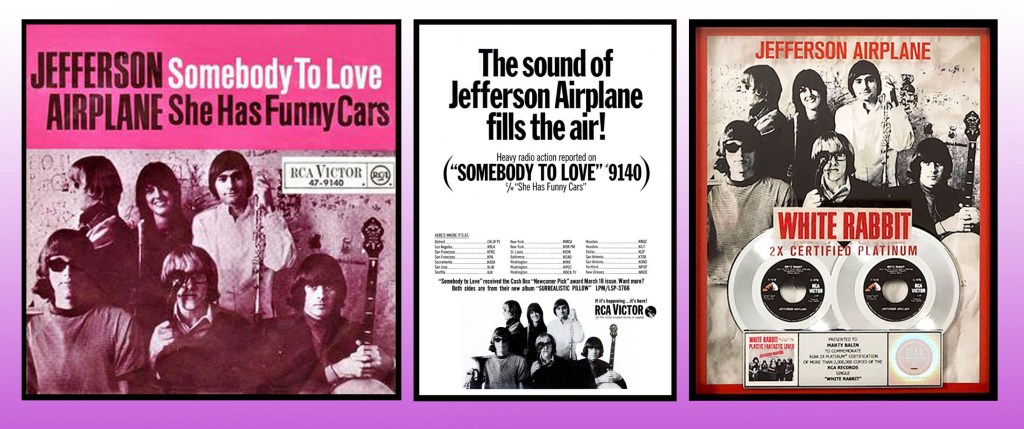
RCA ad art for singles by Jefferson Airplane.

   In addition to Marty Balin I became friendly with their drummer Spencer Dryden.  I remember one day taking a ride down into the Tenderloin district with Spencer in his VW Beetle.  His ashtray was heaving with roaches and cigarette butts.  He lit up an enormous joint as we sped down Geary.  By the time we hit the Tenderloin I was seriously stoned.  Spencer went into some building while I loitered on the street and was soon approached by this smiling black guy in a leather jacket.  “Hey little brother,” he said.  “You want something good?”  He opened a shiny pouch  with three or four enormous fat joints wrapped in bright yellow cigarette paper.  When he realised he wasn’t going to make a sale he moved on quickly.  Then Spencer came out and we drove back to the Fillmore.  I don’t remember why I was along for the ride but I was.  

   My favourite musician in the Airplane was Jorma Kaukonen whose guitar playing was so exotic.  His riffs had something of the Arabian Nights about them.  I never spoke to Jorma but he and Bill had a conversational rapport which was interesting.  He was regularly sitting in Graham’s tiny office just talking.  Bill didn’t shoot the breeze with many people but Jorma was an exception.

   The other band I became very familiar with was The Grateful Dead.  Bass player Phil Lesh and I regularly had a chat as he was a fan of the EC horror comics of the early 1950s and had seen my cartoon of the Old Witch in a comic strip I had done for one of the psychedelic newspapers.  On an evening at the Fillmore I would often go up to the band room and just hang around.  I did an awful lot of hanging around at the Fillmore.  One afternoon up there I saw Pig Pen and Bob Weir leafing through binders with plastic window pages containing black and white 8×10 photographs of good looking women.  

   Like Jorma in the Airplane, I truly enjoyed watching and listening to Jerry Garcia play the guitar.  He seemed to physically propel himself forward with each note he played which was hypnotic to observe.  Garcia was probably the most friendly person on that scene.  He seemed so approachable.  I never engaged Jerry in conversation but he’d always say hello to me.  

   The look of the Grateful Dead was something to send shivers down the spines of most middle class parents.  Very long hair on guys who didn’t really have the right kind of hair to be that long with the exception of Bob Weir.  The Dead had the Haight Ashbury lifestyle written all over them.  One of the funniest numbers in every one of their sets was when Pig Pen (aka Ron Mckernan) would come out from behind his electric keyboard and sing Good Mornin’ Little School Girl.  He had a terrific blues voice and the sight of him with his long hair and beard singing: “Tell your mama and papa, that I’m a little school boy too,” was such a contradiction that it made me laugh every time.

Members of The Grateful Dead, from left: Jerry Garcia, Phil Lesh, Bob Weir, Ron (Pig-Pen) McKernan, Bill Kreutzmann

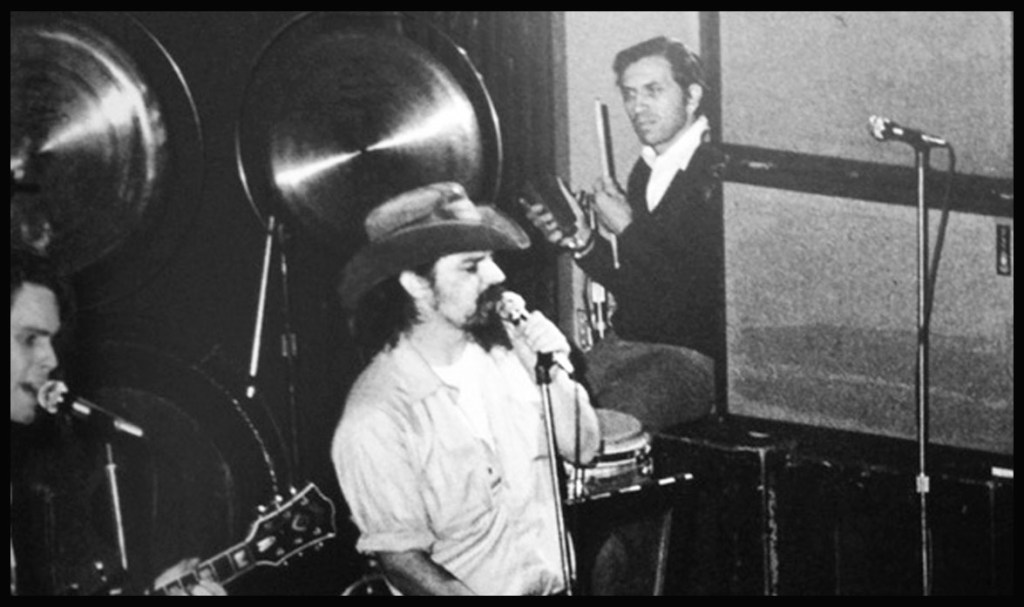
   Bill Graham kept a cowbell and drumstick in his office and when the Dead were doing their second set of the evening he’d bring them out and go to the side of the stage behind the amplifier and accompany them rhythmically.  I never saw him do this with any other bands.

Bill Graham at the side of the Fillmore stage accompanying The Dead with cowbell. From left: Bob Weir, Pig Pen and Bill Graham.

   The band room was guarded during gigs by Dicken Scully whose brother Rock was one of the Dead’s two managers (the other was Danny Rifkin).  Dicken was tall, thin, wore glasses and had long blond hair.  He was a very nice guy to me but was very strict about who got beyond that door.  Lots of people tried to get past Dicken but unless he knew you had a genuine connection to one of the bands playing he was resolutely firm in denying access.

   One thing that hanging around the Fillmore did for me was to feed the fantasy of becoming a performer myself.  I was much too shy to get up on a stage and sing but it was an aspiration which grew as I clearly had the talent and a good singing voice.  On long walks home from the Fillmore I would compose my own songs.  My route home took me down Geary to Van Ness.  I’d then turn left on Polk Street and walk however many blocks to Union.  Then I’d turn right, going up and over Russian Hill until I reached my parents’ apartment.  The walk took me about forty minutes which was just long enough to write a song and once inside I’d scribble the words down on a piece of art work.  I had a big professional drawing board in my bedroom and was constantly doodling.

   Hanging around the Fillmore was not like having a social life for all my real friends were across the Golden Gate Bridge in Mill Valley.  Every opportunity I had to go there was seized upon with enthusiasm.  My mode of transport was hitch hiking.  I’d put my thumb out on Lombard street and within half an hour I would be walking down Miller Avenue.  I’d make my way to one of many houses where, invariably,  I’d get loaded on weed with my friends who were all indulging in this activity.  As I’d walk in, I’d be handed a lit joint and away we’d go.  The music on the record player could be Dylan’s Blonde On Blonde or Revolver by The Beatles.  A lid of grass sat in a plastic bag on a table surrounded by packets of Rizla cigarette papers.  We’d roll skinny little joints, light them and suck the smoke deep into our lungs.  We would then hold our breath as long as we could and finally release the smoke in a mighty dizzy exhalation.  Much of the conversation which followed was whispered by people holding their breath.

   This was the way of life I had embraced.  Being loaded meant that everything was either interesting or funny.  The smallest detail in a work of art became something enormous and recorded music seemed that much more exciting.  One negative side of being stoned so often was my tendency to talk about creative things I might do rather than actually doing them.  

To be continued...

Amazon USA

Amazon UK