
Previously in Miller Avenue Musings: While incarcerated in Napa State Hospital in the summer of 1967, I tried a door which wasn’t locked and wandered away, getting on a bus which took me through the countryside.
In the summer months, Northern California is peppered with golden hills covered in long grass, bleached white by the sun. We passed many such hills as I sat in the back of the bus watching the scenery go by. Eventually we came to a small town, the name of which I cannot remember. The bus driver pulled up in front of a depot and announced that it was the end of the line so I got off and had a wander around. It was a beautiful summer’s day and the town was very pretty indeed. Finding a bench, I sat down and watched the world go by. I wasn’t aware of days of the week at this time but I’d guess it was a weekday as people were going about their business, shopping, delivering and all the various activities you would see in a small town. There was a grocery store, a book shop, a cafe as well as a bank, sturdily enclosed in a solid brick building.
Before long I became aware of a man in a suit and tie standing near the bench I was sitting on. He seemed to be checking a piece of paper then looking up towards me. He then spoke. He asked if my name was John Myers, and I answered yes. He was a police officer and it was his assignment to find me and return me to the hospital. He sat down and explained that a car would be coming for us pretty soon. He was a really nice guy and we talked about his job as a cop. Though I had some very delusional ideas, my natural ability to communicate in a conversational manner had not deserted me. This fellow told me about his caseload which he simply couldn’t get under control because as soon as he started to make headway with one thing, another demand on his time would interfere. As a result he had a constant treadmill of unfinished business.
We sat on the bench talking for about twenty minutes until the car arrived to take me back. Our conversation continued on the ride back to the hospital where he delivered me to my ward, said his goodbyes and was gone. The man in charge of the ward was normally a very friendly fellow but on this occasion he was extremely angry with me for wandering off. To be honest it wasn’t even something I had meant to do. He grabbed my upper arm and dug his thumbnail into my flesh as he demanded that I promise not to do it again. Though his grip was painful I ignored the pain and didn’t react to it. I simply smiled at him until he let go. I then promised not to wander off again, which, in turn, made him smile.
In my ward there were only men. The hospital clearly had a separate accommodation for women. I don’t recall any of the patients who I didn’t get on with. There was the older fellow who slept in the next bed to me as well as a slightly camp gay guy who was a bit of a hippie. We talked about dope a lot and he had a good sense of humour as I recall. It’s a bit ironic that I should have accidentally escaped because I really didn’t mind being there at all.
One day my sister Katie visited with her boyfriend (soon to be husband) Lonnie. My father Blackie was with them and we had a good visit though Katie remembers me as heavily sedated. She also said that my medication caused me to have moments of losing muscular and verbal control. We’d be walking about the place, talking, and my words would suddenly become garbled. At the same time my arm and leg would go slack and I’d drag myself along for a bit. Then I’d regain control until it happened again. Apparently it happened several times during their visit.
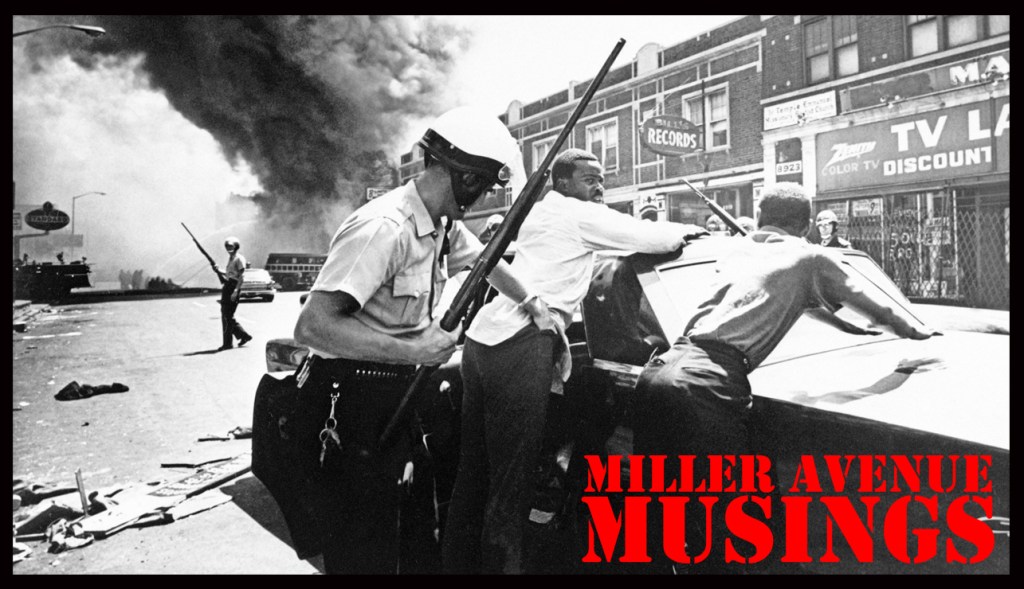
While I was leading a confined existence inside Napa State Hospital, the news, national and international, was very traumatic. The rioting which had exploded in New Jersey sparked further conflict in other places like Minneapolis, Harlem, and Youngstown, Ohio. The next city to explode on the scale of Newark was Detroit, Michigan. Rioting broke out after the police raided an after-hours drinking club and the word spread that officers had handcuffed a black teenager then kicked him down some stairs. This was the spark that lit the fuse and set the black community rioting, but as it spread, white people joined in. While fires raged and looting escalated, Governor George Romney asked President Johnson to send federal troops into the area which he did. By the time things cooled down, the death toll had soared to 36 over three days. Even Dr. Martin Luther King supported the use of federal troops in quelling the violence in Detroit. “There’s no question,” he said, “that when a riot erupts, it has to be halted.” King sent a telegram to President Johnson stating that unless Congress acted to create jobs for black people, the rioting would spread. “A riot is the language of the unheard – that last desperate act – when the Negro says, ‘I’m tired of living like a dog’.”
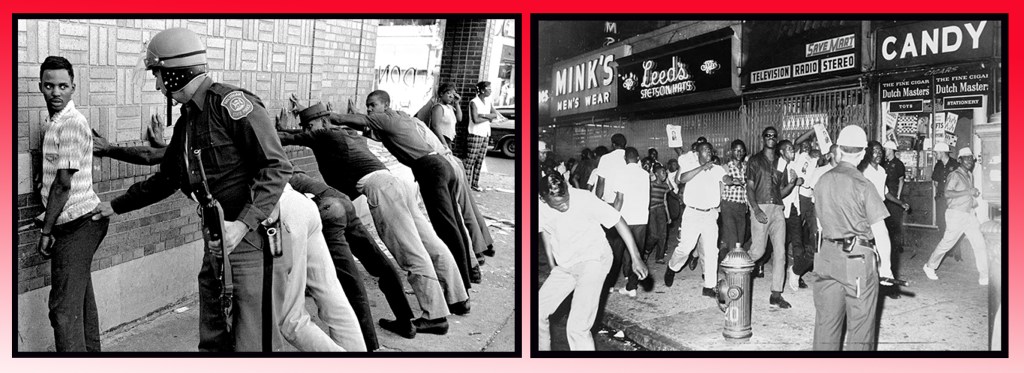
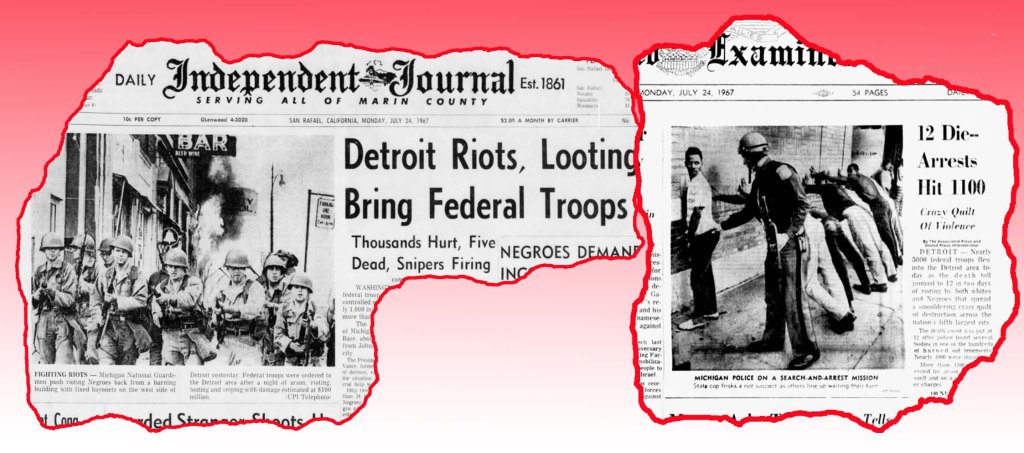
Two reports of the Detroit riots in the Independent Journal and San Francisco Examiner.

The violent anger of black Americans which had exploded so dramatically in Newark and Detroit rippled across the country in smaller skirmishes at many locations. It even manifested itself in Marin City. In the early hours of a week night in late July, a car drove slowly past the Marin City fire station and someone in the car aimed a pistol at the station and fired a shot. Two Highway Patrolmen cruising nearby heard the radio report and gave chase to the sniper vehicle down Drake Avenue. Halting the car near Cole Drive, the patrolmen stepped from their vehicle. Suddenly gun shot came from the darkness behind them. As they turned to see where the shots came from, the sniper’s car sped off. The two officers radioed for help and moved their patrol car 200 feet from the scene. Then a heavier caliber rifle opened up on them from the high rise housing and the two officers exchanged gunfire with the snipers. Sheriff’s deputies and Highway Patrol officers then arrived at speed with red lights flashing and sirens blaring. Sheriff’s deputies reported scattered gun fire from the housing development but no one was injured.

News of the Marin City incident along with the latest from Detroit.
The following night a black male teenager who lived on Cole Drive, was wandering about, brandishing a hand gun. He shot first at a building and then at a passing sheriff’s patrol car. The first bullet he fired passed through a wooden wall and hit two people asleep in their beds. One was a 6 year old girl and the other was the girl’s 62 year old grandfather. The bullet first hit the grandfather, passing through his right calf, then through the girl’s right forearm, lodging in her left shoulder, shaking her awake screaming. The teenage shooter then fired four or five shots at the patrol car but was felled by one of several deputies on foot patrol who shot him in the left hip. The teenage shooter and the 6 year old girl were both taken to Marin General Hospital while the grandfather was driven to a medical facility in San Francisco.
Marin City was where the black community lived in our county. It sat at the bottom of Waldo Grade between Sausalito and Tam Valley. Although it was only a mile and a bit from Mill Valley, it was a world away from that almost entirely white town. In the north of the United States at this time, there was no segregation like they had in the deep south but there was an economic apartheid which kept black people out of white neighbourhoods.
The housing at Marin City was constructed during World War 2 to accommodate the workers at the massive MarinShip yards which the federal government contracted the Bechtel Company to build in Sausalito. They turned out Liberty Ships and tankers for the war effort and needed labourers around the clock. African Americans came north in search of well paid employment. They came primarily from Louisiana, Arkansas and Mississippi. But when the war ended, MarinShip closed and the employment came to an end. Marin had always been a white county but now it had a black community within it.
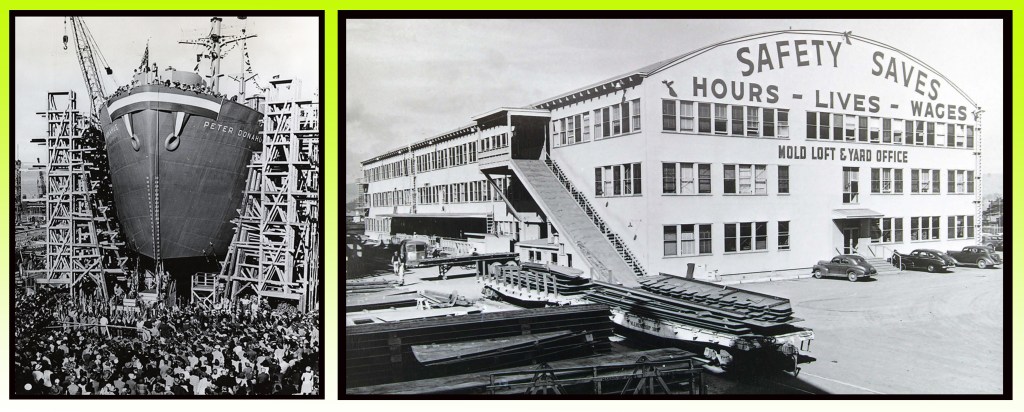


Some images of Marinship, the federal government’s ship building facility in Sausalito during World War 2. It produced many Liberty ships and tankers for the war effort.
The Collins family were the only black people to live in Mill Valley when I was growing up. Dr Daniel Collins, a prominent dentist, actually bought his house direct from the previous owners rather than going through one of the realtors in town. He side stepped the main gate keepers who kept Mill Valley white.
In June,1963, the Rumford Fair Housing Act was passed by the California Legislature. It banned racial, religious and ethnic discrimination in the sale and rental of housing. This new law was soon to be tested by the Congress of Racial Equality (CORE) in Mill Valley. On Saturday, 16th November, 1963, a total of 75 persons picketed Walburn Realty at 90 East Blithedale. Douglas Quiett, chairman of the Marin branch of CORE charged that Mrs Walburn had told a black woman she didn’t have an apartment for rent, but later showed it to two white women. The Independent Journal reported that “Among the picketers was Dr Daniel A Collins, newly appointed to the state board of education and a Mill Valley resident.”
A group called Americans to Outlaw Forced Housing initiated a petition to repeal the Rumford Act and the Marin County Real Estate Board took the decision to make the petitions available through their office. Though their spokesperson denied that the board was endorsing or condemning the repeal initiative, their supply of the petitions was seen as an endorsement.
“Yesterday’s stand taken by the real estate board on the Rumford Act,” said Douglas Quiett of CORE, “should make clear to everybody in Marin that we have a legitimate protest. The board won’t announce its ‘official’ position on the initiative, and yet it will make petitions available at its office. This simply means that many real estate brokers in this county don’t want a fair housing law.” As Marin CORE entered its third weekend of picketing the realtor’s office, the dispute intensified. But four weeks later they ended their picket after reaching an agreement with Walburn Realty. “We have reached agreement on four of our five proposals to Mrs Walburn,” said Douglas Quiett.

The picketing of Walburn Realty in Mill Valley was regularly reported in the Independent Journal.
However CORE now began picketing Ted Gibson Realtor at 328 Miller Avenue. In November 1963, a black family went to Gibson asking to see a home advertised in a newspaper. They were told the house was sold and none other was available in the price class. A white couple, an hour later, was shown the first house plus several others in the price range, claimed Quiett.
After three sessions of negotiations with Gibson and his attorney, Albert Bianchi, CORE decided to picket. Gibson, said Bianchi, had agreed not to practice discrimination but refused CORE’s demand that he display a sign that he is a ‘fair opportunity broker.’ Bianchi likened the demand to a merchant being required to place in his store window a sign saying ‘I am not a Communist.’
Meanwhile enough white people in Marin and other California counties went to their local real estate board offices to collect and sign those petitions which put Proposition 14 on the ballot in November. That proposition was for the repeal of the Rumford Act. In the eleventh month of 1964 it was passed with a majority of over 1.5 million votes.
The Independent Journal reported: “Californians have made known their opposition to state laws banning discrimination in housing, but the final word on the boiling controversy probably will come in the courts.”
When Dr Collins bought his house in Mill Valley in 1952 for $20,000, he dealt direct with Mrs Faltin, the woman who sold it. “By this time,” said Dr Collins, “She had begun to get calls from some of the local real estate dealers, giving her a bad time. They were harsh with her for selling her property to a n——r. She said, ‘Why don’t you come up and have lunch with Dr and Mrs Collins before you pass judgment on them?’ They were too much cowards to do that. They would not confront either of us, but just began to badger Mrs Faltin. She said it made no difference to her. She liked us, she thought we were first-class citizens, and she was delighted to sell us her house. And so she did.”

Two photos of Dr Daniel A Collins on the left and his son Chuck Collins on the right. Chuck was in my year at Tam High.
About a week before the family moved in, Dr Collins received a call from a representative of the realtors, passing on the message that they would buy the house at a good profit for him. He told them that the only offer he would consider would be for them to double the price he paid. He received no further calls.
“I saw myself at that time getting $20,000 net profit, free of tax,” said Dr Collins. “And I could go somewhere else and buy a house. But they weren’t that brave. They were just a bunch of bullshitters, a bunch of cowards looking for a sucker. They weren’t willing to pay the price of their prejudice.”
But I was thinking of none of this. Not the racist practices of Mill Valley realtors. I wasn’t even aware of the riots in Newark or Detroit. Or the snipers in Marin City or the daily death toll from the war in Vietnam. I was just taking my doses of thorazine and thinking that John Lennon must be in the next room. Each day passed with a similarity to the day before and the day after.
One morning I saw my gay friend in the corridor with his arm in a sling. The wrist on that arm was heavily bandaged. I asked him what had happened. He glared at me malevolently then he began shrieking: “Get away from me you freak! Don’t you come anywhere near me! Get away from me!”
I shrank back from him, stunned by his outburst. The bandage on his wrist looked like he had slit his wrist.
To be continued…

Amazon USA
https://www.amazon.com/dp/B085QN73VQ
Amazon UK
https://www.amazon.co.uk/dp/B085QN73VQ
 Miller Avenue Musings