1967 – The Summer of Love, chapter two

Pictured on the left, Bill Graham

By 1967 I had become a head.  A great deal of my time was devoted to getting high with my chums in Mill Valley.  When one joint had been passed around the room and reached the end of its existence someone would pull another Rizla out of the packet, sprinkle a sizeable batch of grass into it and roll another one.  We would spend hours talking and laughing about ‘straight’ people and how unaware they were about their rituals and behaviours.  We took great delight in considering ourselves different to the rest of society.

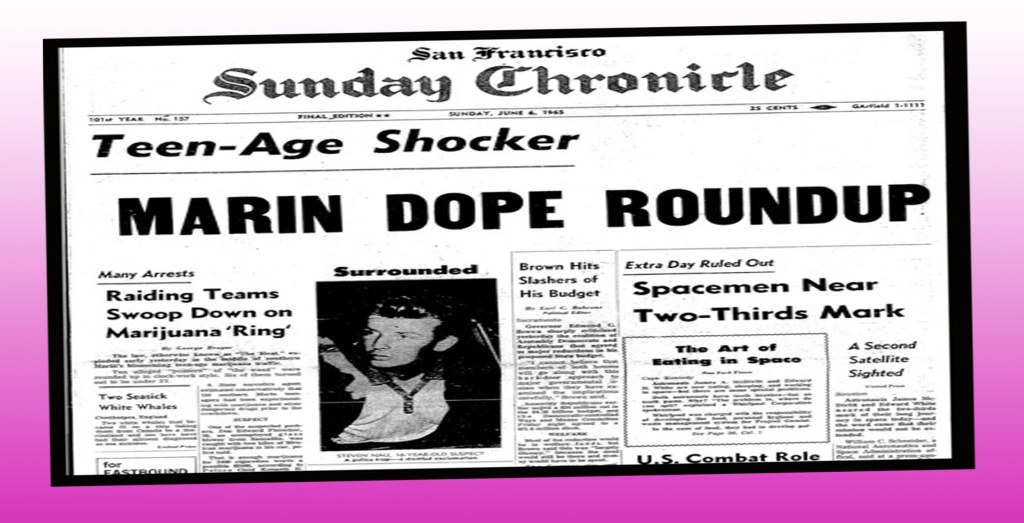
   One aspect of the cultural changes brought about by the dope smoking phenomenon was that it provided a sanctuary for oddball outcasts.  In earlier times young people who didn’t fit in would be shunned by various levels of In-Crowd but the sharing of a joint was a friendly experience which transcended such divisions.  Back in 1965 when I accidentally stumbled upon a highly secretive group of friends who were turning on, there was in play a certain amount of social cross-pollination.  Rich kids who lived in the leafier parts of Mill Valley would be going to Marin City and Sausalito to score their matchboxes from young people who they would never otherwise encounter.  Then the federal narcotics people held a massive raid in the summer of ’65 just before my graduation with a fanfare of publicity which succeeded in popularising marijuana throughout Marin County and in turn the bay area.

The front page of the Sunday Chronicle in June 1965 announcing the big raid in Mill Valley, Marin City and Sausalito.

   The fact was that young people were already ostracised from adult society by not being allowed to drink until they were 21 so the leap to smoking grass was not that big a deal.  And it was a very big social change.  When I first stumbled onto my friends’ clandestine pot smoking it had scared me to death.  But now I was a head like everybody else.

   On one occasion I was very smoke ridden and listening to Donovan singing Season Of The Witch when a friend asked if I had “heard about that Dreyfus guy?”  He then handed me the Independent Journal with a front page photo of Dave Dreyfus above the headline: ‘Helicopter Crash Kills Ex-Marinite.’  

   I was thunderstruck by this news which clearly meant nothing to my friend who couldn’t possibly comprehend its importance to me.  The Dreyfus boys; Dave, Tim and Jared, had been a part of our lives ever since my family arrived in Mill Valley in 1952.  Babbie and Barney Dreyfus were very close to my parents Blackie and Beth and I remember many a barbecue up at Bootjack Camp.    

   Dave had decided to join the army in the early 1960s which was a highly controversial thing considering the leftwing politics embraced by all my parents’ friends.  There was a political chasm between the boys of the Hallinan family and those of the Dreyfus family.  Both Dave and Tim Dreyfus seemed to sidestep their parents’ politics whereas all the Hallinan boys were uniformly militant in their support of a long list of causes which included civil rights, both in the deep south as well as the bay area, and opposition to the war in Vietnam.  Many a fist fight was waged by the Hallinan boys with those who disagreed with their politics.  And they were all tough fighters.  The use of the N word by any caucasian would ignite one of these battles which gained them a fearsome reputation throughout Marin County. 

   Back in 1952 their father, Vin Hallinan was a candidate for president on the Progressive Party’s ticket.  There wasn’t a hope of his being elected but his candidacy was a rallying point for the left which was under serious attack by the federal government at this time.  His opponents were Dwight D. Eisenhower for the Republicans and Adlai Stevenson for the Democrats.  In my sister Nell’s class at Old Mill School they held a mock presidential election and Nellie was surprised to learn that Tim Dreyfus voted for Eisenhower.  He even sported an I Like Ike badge with pride.

Some images from Vin Hallinan’s presidential bid in 1952. In the photo on the left Vin, Vivian and a very young Danny arrive at the polling station at Ross School to be to told by the precinct inspector that because they’d already sent a postal ballot from New York they couldn’t vote that day.

   So when Dave Dreyfus joined the army, all the Hallinan boys were disapproving but Babbie resolutely refused to criticise Dave for his decision.  He did his two years in the service then went to Texas where he learned to fly helicopters and became a flying instructor there.  He was a passenger on a demonstration ride while attending a helicopter convention near palm Springs when the crash that killed him occurred. 

   Dave was only 26 years old.  This was my first experience of death on a personal level and the fact that I got the news through a cloud of marijuana smoke made it all the more upsetting.  The last time I had seen Dave was at my sister Nell’s flat on Greenwich Street in San Francisco.  He was a very engaging and funny guy.  He was gently disagreeing with Nell’s commitment to socialist principles.  “But I like steak,” was his reply to her criticism of eating in fancy restaurants when so many were hungry. 

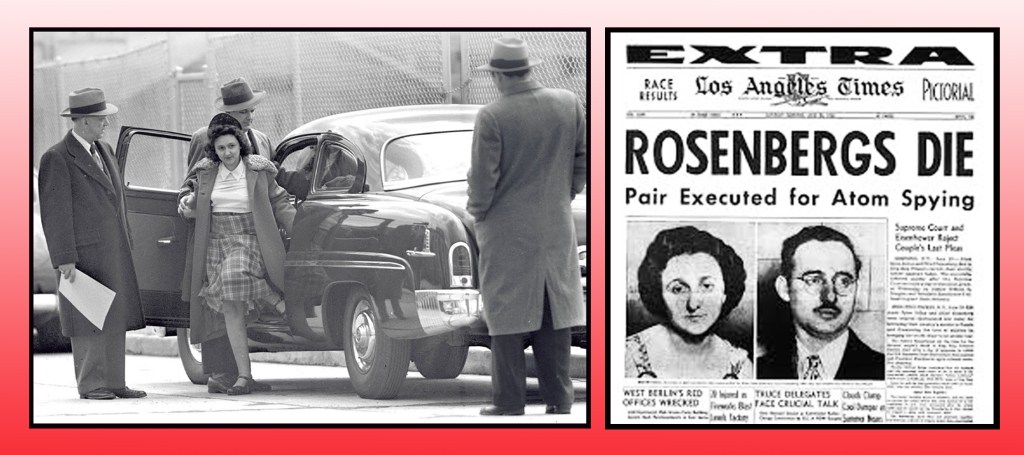
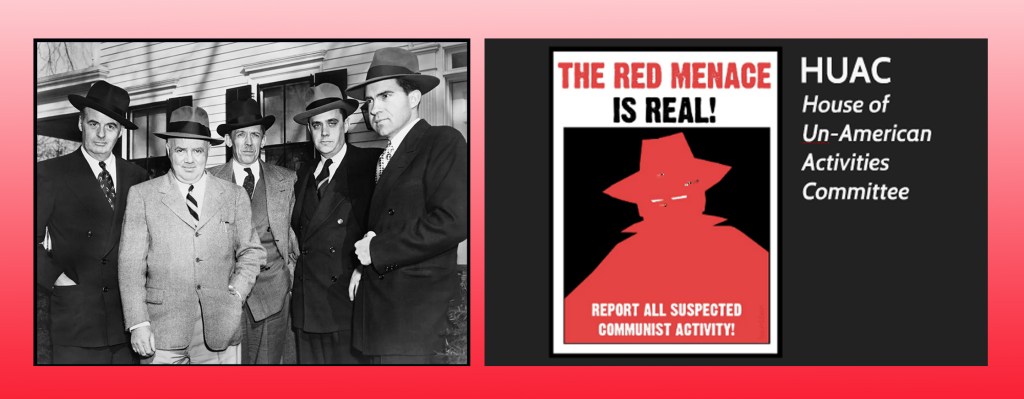
   Perhaps it was fear that turned both Dave and Tim away from their parents’ politics.  The cold war era was a frightening time to be left wing in your political outlook.  HUAC and Senator Joe McCarthy’s investigations ignited a blaze of terror across the nation, the reverberations of which are still felt today.  Guilt by association was a major concern.  My father Blackie told me that, after he was blacklisted, people he and my mother knew well in Greenwich Village suddenly didn’t know them at all on the streets of New York.  The fear of being subpoenaed and grilled about some petition you may have signed in the 1930s meant that debate on matters political became diminished.  The prosecution and conviction of Alger Hiss and the execution of the Rosenbergs sent a powerful shock wave through the families of the left during the early 1950s.  One of the scarier sights would be a visit by FBI agents to your doorstep and all of our families had many such visitations throughout the 1950s. 

Pictured on the left is Ethel Rosenberg being arrested by federal agents. On the right is the front page of the LA Times after they were executed.

   I remember Jared Dreyfus telling me about a kid in their neighbourhood saying to his brother Dave: “When it becomes legal to kill commies I’m going to kill your mother.”  Dave then proceeded to beat the daylights out of him.

On the left is a photo of the House Un-American Activities Committee under the chairmanship of J. Parnell Thomas with a young Dick Nixon standing on the right.

   My brother Jim also decided to join the army the previous year rather than be subject to the draft.  He waited until his 18th birthday in September, 1966 to enlist, thus avoiding the need for Blackie and Beth to give their permission.  Our parents, like all their close friends, were firm in their opposition to the war in Vietnam.  I had a temporary deferment because of shipping out as a sailor and the draft was a big problem which I, in my state of regular smoky intoxication, was simply not thinking about.  The choices seemed to be: getting drafted, going to jail or leaving the country.  One other choice as Ringo Hallinan points out, was fighting to end the war.

   Jim’s decision to deal with it by enlisting was complicated.  In part it was an act of rebellion against my parents and their politics, a fact he would admit to me later.  But it was also to confront those three choices.  Once inside he made a decision to sign up for the stenography corps and, luckily, he served his time in Korea and Germany.

   I too was against the Vietnam war but never fell in with a particularly political crowd so didn’t participate in any of the big demonstrations which were prevalent at that time.  The cycle of my life seemed to be getting a bit of poster work and doing my best to grind out something decent.  Then when I’d finished I would put out my thumb and head to Mill Valley where I would smoke myself into oblivion.

   Among my friends who I would turn on with was a very odd fellow named Matt.  Early in 1967 he somehow got this cabin at a place called Slide Ranch out in the wilds along the Pacific Coast Highway.  There were two routes to reach Stinson Beach: one across Mount Tam and the other along the coast road which you would pick up above Tam Valley.  So if I was hitching to Matt’s place I’d need two rides: one from the city to Tam Junction then another out the coast road.  It took a few trips to get used to where exactly it was as there was a steep dirt road which descended on the ocean side of the highway.  It came down past Matt’s cabin on the left then continued down around to the right stopping at a house at the bottom.  

   I had first met Matt the previous year when he was living on a houseboat in the marshes of Larkspur.  It became a regular hangout for me and was where I developed my passion for The Lovin’ Spoonful.  With a head full of ganja I listened to their first LP over and over.  It was not long after I had returned from my voyage on the Torvanger.  That trip had transformed me from the loud mouthed little guy I was in high school into a slightly introverted fellow who’d been out in the world.  So I returned a changed person and found a very different Mill Valley to the one I’d left behind only a few months earlier.  The pied piper of marijuana had come and taken a considerable number of the children away.  Tam High was practically unrecognisable to me.  A great majority of the boys had long hair and most of the girls sported serapes.  A large number of the students were smoking weed.  

   Someone who personified this dramatic change for me was Peter Perdue.  I had known Peter in my senior year as he was a friend of my brother Jim’s.  Peter was a slightly comical figure who was constantly seeking ways to be entertaining for his friends.  He had a vague resemblance to the comedy star Jerry Lewis and would physically flap around in a similar manner.  When I’d last seen him his hair was short as was every male student at Tam High but now his hair was long and expertly cut to make him look like Sonny Bono of Sonny and Cher.  In fact he dressed in bell bottom trousers and his girl friend of the time, Adrienne Inge, looked and dressed just like Cher even though her long hair was ginger instead of dark brown.  

   Peter was positively evangelical about the sociological changes which were happening.  He would read drug related interpretations into all of Bob Dylan’s lyrics, telling me that Mister Tambourine Man was, in fact, a drug dealer and he told me that the name The Lovin’ Spoonful was a reference to shooting up drugs.  He seemed to feel that the hippy phenomenon (it hadn’t yet been christened that) was something akin to a political movement.  I sifted a great deal of Peter’s opinions on this subject through a filter of skepticism.  But he was a very entertaining person to be around.

   His relationship with Adrienne was about to hit the rocks as she became smitten with an older guy named John Parker.  John was the elder brother of Gregg Parker who, like Peter, was now a senior at Tam.  John had been busted for marijuana possession and was on probation.  This didn’t stop him smoking weed, far from it.  Adrienne lived with her mother Eleanor in a small house on East Blithedale at the corner of Nelson.  Eleanor was an interesting old dame who did not like the business of pot smoking one little bit.  This was tough on her as Adrienne made no pretence about getting loaded on a regular basis.  Her mother made every attempt to become broad minded on this subject but then she would get a bit drunk and go crazy throwing all reserve out the window.  I would have long conversations with Eleanor across her kitchen table but one time I turned up while she was drunk and she pretty much threw me out of her house.

   Peter Perdue meanwhile was going through agonies over losing Adrienne to John Parker.  So it was through John Parker and Adrienne that I met Matt as they would go to his houseboat for their assignations.  

   But now, in 1967, Matt was no longer in Larkspur on a houseboat but all the way out at Slide Ranch which was a seriously remote location.  When I would visit it’d be for a few days.  Whoever had money would finance a visit to the grocery store in Stinson where we’d buy jars of peanut butter, loaves of white bread and bottles of milk, cheap food which went a long way.  I was charmed that a band making the rounds in the bay area was called The Peanut Butter Conspiracy.  However I never actually heard them play.

   Matt had worked as a carpenter but at this time didn’t look or behave like he had a job at all, also he seemed to keep himself stoned on weed around the clock.  He was highly intelligent, articulate and a disarmingly honest person which, at this time of my life, I was not.  So much of what was going on inside my head frightened and embarrassed me.  I think my biggest problem was that I didn’t have a girlfriend.  Bob Dylan expressed my state of mind succinctly in his 1965 song It’s Alright, Ma (I’m Only Bleeding): “And if my thought-dreams could be seen, they’d probably put my head in a guillotine.”

   I was now 20 years old and still living at my parents’ place in North Beach.  Hanging out with Matt and our circle of friends was an enjoyable way of not thinking seriously about my future.

  I soon had another assignment from Bill Graham which was a poster for a one-nighter on a Sunday at the Fillmore with an impressive lineup: B.B. King, Moby Grape and the Steve Miller Blues Band.  I decided to go for an Arabian Nights look and started with a tall chimney out of which came a swirling fog, within which I drew the lettering in a wavy pattern with the names of the bands along with the date and time.  Behind the chimney I drew an evil looking genie who was beckoning to a bald headed man in the foreground holding an equally bald headed child.  The significance of these images was lost on me as I was just letting whatever my hands drew make their way onto the poster board.  To the right I depicted a woman, presumably the child’s mother and behind her another genie with a slightly noble look on his face.  The bald headed child had a long extended arm which stretched around towards the mother.

A slightly skewed view of my artwork for the BB King poster.

   I remember how Bill used to examine Wes Wilson’s posters when he would deliver them on a Friday afternoon.  After perching a ladder against the wall above the staircase, he would staple about eight of the posters up in a row then stand back.  He would stare at them and extend his right arm towards them with his thumb straight up.  He would then rotate his thumb down to the 9 o’clock position and keep staring.  I think he was trying to formulate an opinion of the work Wes had done and as that work was something outside his control, I believe this bothered Bill.  Wes, in addition to Bill, was also in the process of becoming famous and was chalking up some very impressive commissions including the poster for the very last performance of The Beatles at Candlestick Park the previous year.  

   Wes would arrive with a friendly smile on his face.  Bonnie and Wes were highly conversational people but Bill was almost always busy and shooting the breeze wasn’t his style.   Though I had never heard Bill express an opinion on Wes’s posters, he clearly had them and his confidence in matters to do with graphic design was clearly growing.  

   I went in to see him in his little office to get paid for my latest poster for the B.B. King show and he suddenly became very cold and business-like.  

   “What have you got on this poster?” He asked.  “There’s a genie and another genie and a martian.  And a little martian.  I don’t like it.”  He wrote me a cheque for the artwork and said: “Come back when you can do something I like.”

   I was stunned.  His words wounded me tremendously and immediately.  Bill had always liked my work but now he was telling me to get lost.  I walked away from the Fillmore deeply traumatised.  I’d been fired.  If I had been at all professional I would have gone back to the drawing board and ground out some good spec art work and taken them into show Bill but I was not that person at all.  Instead I took refuge over in Mill Valley getting stoned with my friends.  I was too mortified and embarrassed to tell them what had happened with Bill so I just kept it to myself.

   I was, however, still able to walk into Bill’s concerts for free which I did, usually in the company of our friend Augie Belden.  Augie was always in search of a good time and he had a VW beetle which could take us into San Francisco to go see shows at the Fillmore and Winterland and on one occasion we saw a rather extraordinary performance at The Matrix featuring a band we’d never heard of called The Doors.

To be continued…

Amazon USA
https://www.amazon.com/dp/B085QN73VQ


Amazon UK
https://www.amazon.co.uk/dp/B085QN73VQ
The Summer of Love – part 1

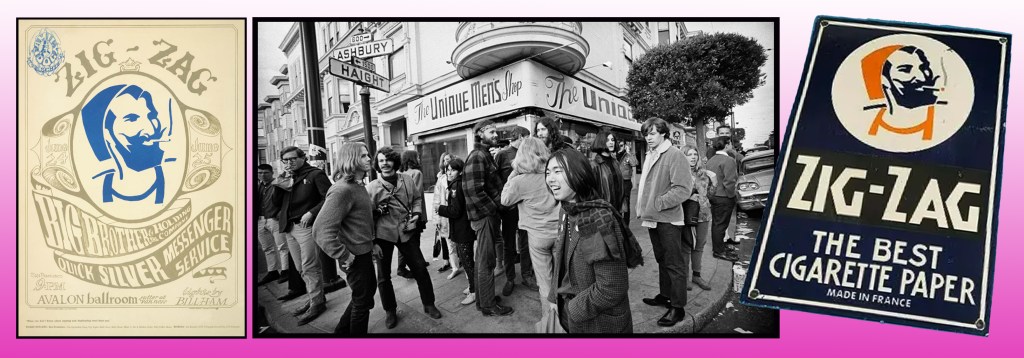
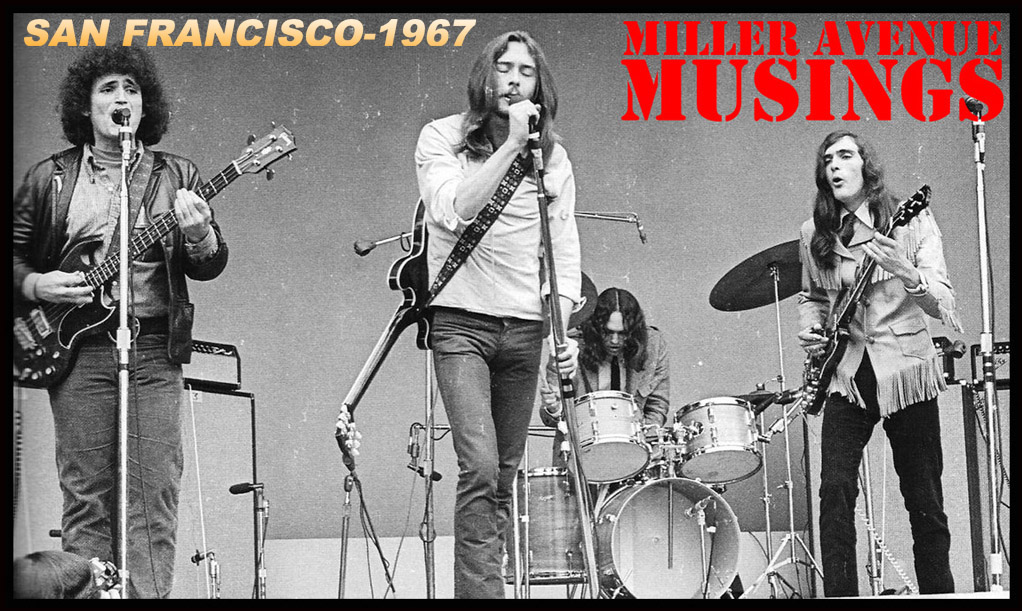
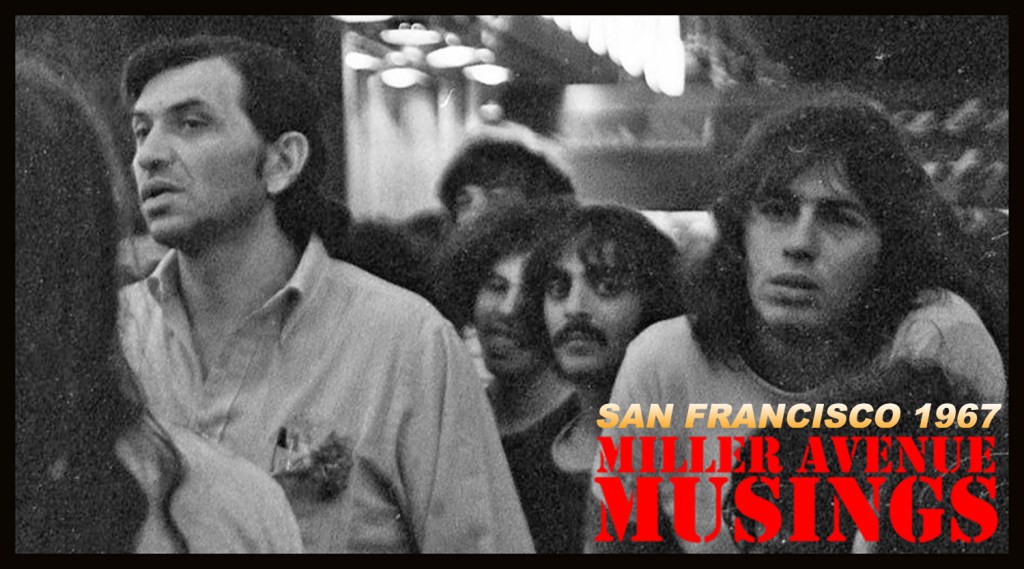
Pictured above are The Quicksilver Messenger Service

There was a song which was released as a single in May of 1967 by Scott MacKenzie.  It was entitled San Francisco (Be sure to wear some flowers in your hair).  It went into the charts nationally and also became an international hit.  All of my friends were avid listeners to the popular music of the day and yet I never heard a single one of them enthuse about Scott MacKenzie or his song.  I heard it on the radio and regarded it as a purely commercial pop record cashing in on the hippy scene in the Bay Area.  And yet whenever there’s a television or radio documentary about the Haight Ashbury in that year this is the song that’s always trotted out to accompany it.

   It was written and produced by John Philips of the Mamas and Papas.  The tune was catchy enough but the lyrics were a bit worthy with references to all the “gentle people” to be found in the city by the bay.  True there were many Be-ins and Love-ins that year which is what the song was on about.  But there was a dark side to the hippy phenomenon as well with regular reports in the Chronicle about overdosed dead bodies collapsed in doorways along Haight Street.  The name Charles Manson was unknown then but he too resided in the Haight Ashbury district at that time with his ‘family’ which, along with him, would become infamous in just a few years time.

   The summer of 1967 in San Francisco became known as the summer of love.  The hippy happening was at its height with young people from all over the United States and the world arriving on Haight Street every day, possibly encouraged by Scott MacKenzie and his wretched song.  

   For me, however, as the summer of love reached its peak, I went off the rails on a psychedelic substance and wound up incarcerated in a psychiatric hospital.  I was twenty years old and, as a result, my memories of that year are skewed by this experience.  With hindsight, I was headed for psychological trouble with or without LSD but that doesn’t alter the fact that I flipped out on acid.  And I do know from others that it was a particularly bad batch.

   Working for Bill Graham at the Fillmore Auditorium provided an exciting window on the emerging San Francisco rock scene which had, by 1967, become world famous.  I returned from a trip abroad in January and rang up Bill at the Fillmore to let him know I was back in town and available for any poster work he needed.  I had only been away a few months but things had changed dramatically.  The scene had become nationally and internationally renowned with reporters from all over the world turning up to write about Haight-Ashbury and the music it had spawned.  The two biggest bands, Jefferson Airplane and The Grateful Dead were becoming very famous indeed and there was a gaggle of new poster artists in town.  Before it was Wes Wilson, Mouse and a few others but now psychedelic artwork was everywhere and the advertising industry had begun imitating the lettering style that Wes had made popular with his poster art.  Also Bill Graham was different.  He too was in the process of becoming a celebrity. 

   I went in to see Bill and Bonnie at the Fillmore and he seemed more polished somehow.  He was certainly better dressed, sporting a snappy green suede jacket.  He was now mixing with famous people in the music business and the glow was rubbing off on him a bit.  Enjoying his suede jacket he asked Bonnie if she thought it made him look like a ‘rock mogul.’  

   He’d been back east and seen a special preview of the soon to be released Don’t Look Back, a documentary on Bob Dylan, by D.A. Pennebaker.  He gave his verdict loudly: “Bob Dylan is an asshole!  Albert Grossman steals the show.”  Dylan’s manager, Grossman, is seen in the film prodding London impresario Tito Burns to get more money for Bob.  Bill had become friendly with Grossman after negotiating with him for an exclusive deal on the Butterfield Blues Band.  

   I overheard Bill giving an interview in his tiny office at the Fillmore to a reporter from Time Magazine.  When the article came out, he was furious with the way the guy had written about him.   He felt misrepresented.

   The job Bill gave me was a poster design for a weekend show featuring The Blues Project, Jimmy Reed, John Lee Hooker and the Stu Gardner Trio.  I was very excited about doing this poster and, following my old pattern, I walked up Russian Hill to the corner store where I bought a pack of cigarettes and a Cadbury’s chocolate bar.  I started work about 8pm in the kitchen at my parents’ apartment on Union Street and worked through the night.  I drew a picture of a black male blues musician playing a harmonica which stretched off into the distance and swerved around in a liquid shape to frame the lettering.  On the top of the harmonica I drew a keyboard being played by musicians.  I had a drummer and depicted the vibrations his drumsticks created.  I also did cartoons of Paul Butterfield, Bob Dylan, Pig Pen and Jerry Garcia.  Down below was a black street scene with people dancing and in the right hand corner stood a white police officer with a billy club observing them.  The police officer was not sympathetically drawn.  He looked mean and intolerant.  I was trying to put the blues into a political context.

   All of this appeared on a light green background with the letters coming out white.  I delivered the artwork to the printer and thought no more about it until I wandered into the Fillmore that Friday night.  Being apologetic was not a quality I was used to seeing in Bill Graham but that is exactly how he approached me as I walked up the stairs.  “After all the trouble I’ve had with the police,” he said, “I simply couldn’t allow that picture of the cop to be on the poster.  It would be a red rag to a bull.  I’m sorry but the printer and I had to change your artwork.”

   What he and the printer had done was to black out the entire street scene as well as all the musicians playing.  The only bit of my work remaining was the blues player, the harmonica and the lettering.  To be honest it looked very good.  It was dark blue with a lighter blue for the harp player who was reversed out of the background with the lettering in white.

On the left is the original poster and on the right is what Bill Graham and the printer cooked up.

   The trouble with the police that Bill was referring to had occurred at the Fillmore before I came along.  I remember reading about raids on the hall by the police in the Chronicle before I knew him so I was aware of the reality he was dealing with.  The police definitely harassed him in the early days and the memory of those encounters clearly lingered.  For me the abiding recollection of my poster being changed was the diplomatic way in which Bill had explained it to me.  He was a very persuasive person. 

   Being part of the furniture at the Fillmore meant I got very used to seeing the bands up close and becoming familiar with them and their repertoire.  Quicksilver Messenger Service was a five piece unit which featured John Cipollina on lead guitar.  Cipollina had been in my sister Katie’s class at Old Mill School.   I remember being impressed by their image.  Both lead singer/guitarist Gary Duncan and Cipollina had long straight hair and wore dark cowboy hats making the band look like a gang of wild west outlaws.  For some numbers Duncan would slide his guitar strap around so that his instrument was on his back and he’d beat a cowbell with a drumstick.  As with all the bands at the Fillmore these guys were constantly stoned on weed.

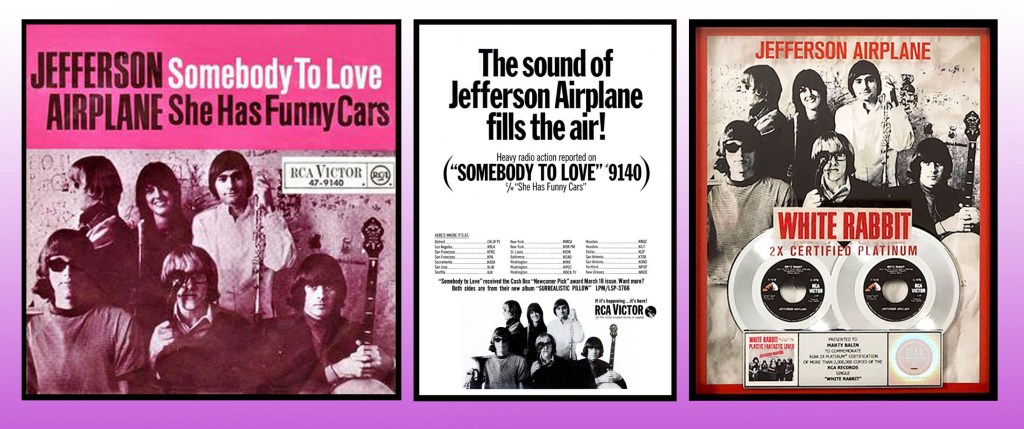
   I didn’t get to know members of Jefferson Airplane until they changed female vocalist.  Originally Signe Andersen was in the band but at some point during my time at the Fillmore she left and was replaced by Grace Slick who I had seen performing with her band The Great Society.  Grace was a very beautiful woman, good musician and terrific singer.  She was also a very nice person, at least to me.  They used to rehearse at the Fillmore in the afternoons and I was always impressed that they would lug their own gear up the stairs.  Early on Bonnie MacLean had introduced me to Marty Balin and I would have regular chats with him in the foyer of the Fillmore while painting my boards.  Another local band, Sopwith Camel, had a hit record on the radio entitled Hello Hello, which Marty described as “a piece of shit.”  The fact that it was being played on KFRC irritated him.  “We’ve got to get a single out,” he said.

RCA ad art for singles by Jefferson Airplane.

   In addition to Marty Balin I became friendly with their drummer Spencer Dryden.  I remember one day taking a ride down into the Tenderloin district with Spencer in his VW Beetle.  His ashtray was heaving with roaches and cigarette butts.  He lit up an enormous joint as we sped down Geary.  By the time we hit the Tenderloin I was seriously stoned.  Spencer went into some building while I loitered on the street and was soon approached by this smiling black guy in a leather jacket.  “Hey little brother,” he said.  “You want something good?”  He opened a shiny pouch  with three or four enormous fat joints wrapped in bright yellow cigarette paper.  When he realised he wasn’t going to make a sale he moved on quickly.  Then Spencer came out and we drove back to the Fillmore.  I don’t remember why I was along for the ride but I was.  

   My favourite musician in the Airplane was Jorma Kaukonen whose guitar playing was so exotic.  His riffs had something of the Arabian Nights about them.  I never spoke to Jorma but he and Bill had a conversational rapport which was interesting.  He was regularly sitting in Graham’s tiny office just talking.  Bill didn’t shoot the breeze with many people but Jorma was an exception.

   The other band I became very familiar with was The Grateful Dead.  Bass player Phil Lesh and I regularly had a chat as he was a fan of the EC horror comics of the early 1950s and had seen my cartoon of the Old Witch in a comic strip I had done for one of the psychedelic newspapers.  On an evening at the Fillmore I would often go up to the band room and just hang around.  I did an awful lot of hanging around at the Fillmore.  One afternoon up there I saw Pig Pen and Bob Weir leafing through binders with plastic window pages containing black and white 8×10 photographs of good looking women.  

   Like Jorma in the Airplane, I truly enjoyed watching and listening to Jerry Garcia play the guitar.  He seemed to physically propel himself forward with each note he played which was hypnotic to observe.  Garcia was probably the most friendly person on that scene.  He seemed so approachable.  I never engaged Jerry in conversation but he’d always say hello to me.  

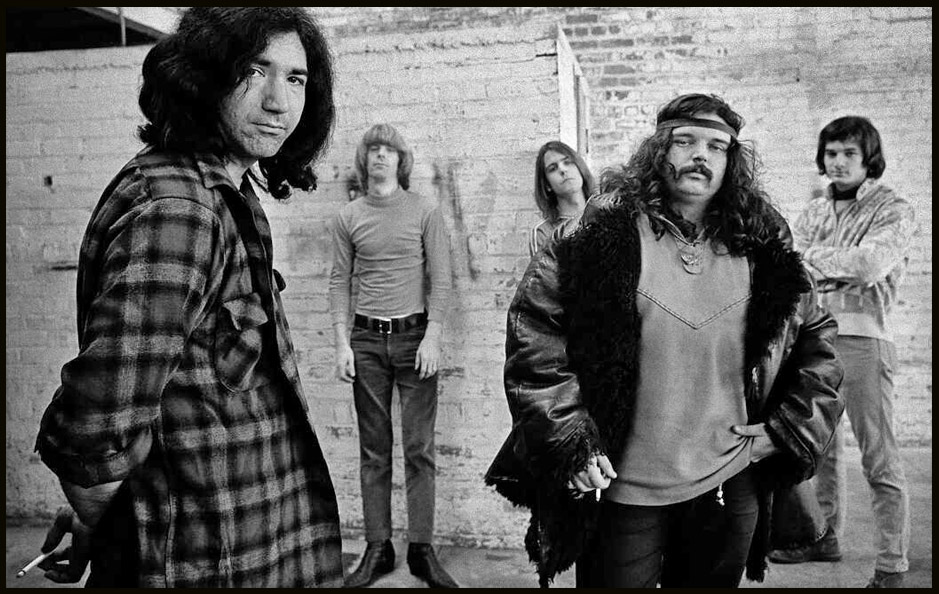
   The look of the Grateful Dead was something to send shivers down the spines of most middle class parents.  Very long hair on guys who didn’t really have the right kind of hair to be that long with the exception of Bob Weir.  The Dead had the Haight Ashbury lifestyle written all over them.  One of the funniest numbers in every one of their sets was when Pig Pen (aka Ron Mckernan) would come out from behind his electric keyboard and sing Good Mornin’ Little School Girl.  He had a terrific blues voice and the sight of him with his long hair and beard singing: “Tell your mama and papa, that I’m a little school boy too,” was such a contradiction that it made me laugh every time.

Members of The Grateful Dead, from left: Jerry Garcia, Phil Lesh, Bob Weir, Ron (Pig-Pen) McKernan, Bill Kreutzmann

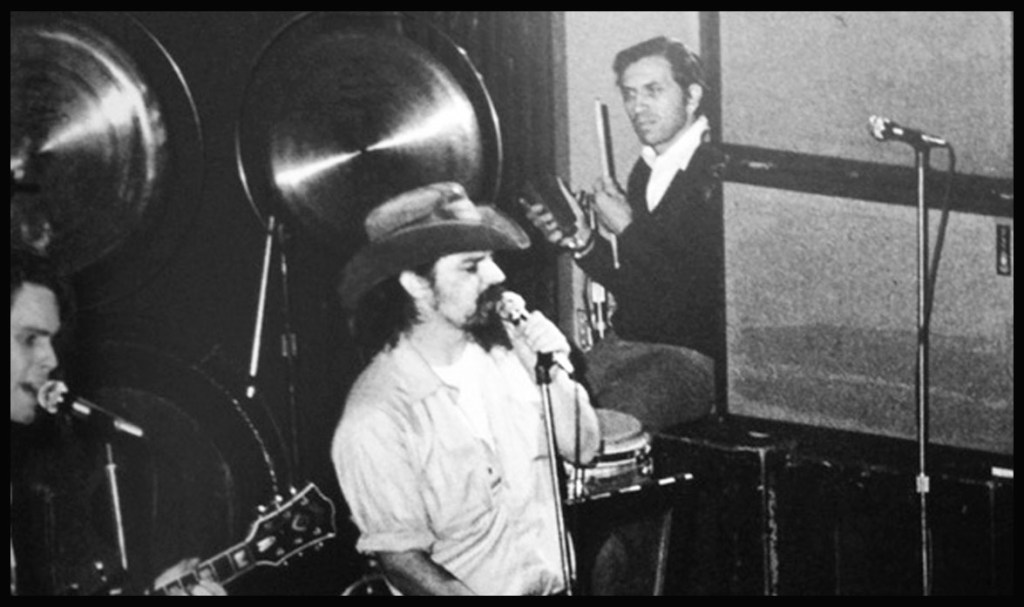
   Bill Graham kept a cowbell and drumstick in his office and when the Dead were doing their second set of the evening he’d bring them out and go to the side of the stage behind the amplifier and accompany them rhythmically.  I never saw him do this with any other bands.

Bill Graham at the side of the Fillmore stage accompanying The Dead with cowbell. From left: Bob Weir, Pig Pen and Bill Graham.

   The band room was guarded during gigs by Dicken Scully whose brother Rock was one of the Dead’s two managers (the other was Danny Rifkin).  Dicken was tall, thin, wore glasses and had long blond hair.  He was a very nice guy to me but was very strict about who got beyond that door.  Lots of people tried to get past Dicken but unless he knew you had a genuine connection to one of the bands playing he was resolutely firm in denying access.

   One thing that hanging around the Fillmore did for me was to feed the fantasy of becoming a performer myself.  I was much too shy to get up on a stage and sing but it was an aspiration which grew as I clearly had the talent and a good singing voice.  On long walks home from the Fillmore I would compose my own songs.  My route home took me down Geary to Van Ness.  I’d then turn left on Polk Street and walk however many blocks to Union.  Then I’d turn right, going up and over Russian Hill until I reached my parents’ apartment.  The walk took me about forty minutes which was just long enough to write a song and once inside I’d scribble the words down on a piece of art work.  I had a big professional drawing board in my bedroom and was constantly doodling.

   Hanging around the Fillmore was not like having a social life for all my real friends were across the Golden Gate Bridge in Mill Valley.  Every opportunity I had to go there was seized upon with enthusiasm.  My mode of transport was hitch hiking.  I’d put my thumb out on Lombard street and within half an hour I would be walking down Miller Avenue.  I’d make my way to one of many houses where, invariably,  I’d get loaded on weed with my friends who were all indulging in this activity.  As I’d walk in, I’d be handed a lit joint and away we’d go.  The music on the record player could be Dylan’s Blonde On Blonde or Revolver by The Beatles.  A lid of grass sat in a plastic bag on a table surrounded by packets of Rizla cigarette papers.  We’d roll skinny little joints, light them and suck the smoke deep into our lungs.  We would then hold our breath as long as we could and finally release the smoke in a mighty dizzy exhalation.  Much of the conversation which followed was whispered by people holding their breath.

   This was the way of life I had embraced.  Being loaded meant that everything was either interesting or funny.  The smallest detail in a work of art became something enormous and recorded music seemed that much more exciting.  One negative side of being stoned so often was my tendency to talk about creative things I might do rather than actually doing them.  

To be continued...

Amazon USA

Amazon UK