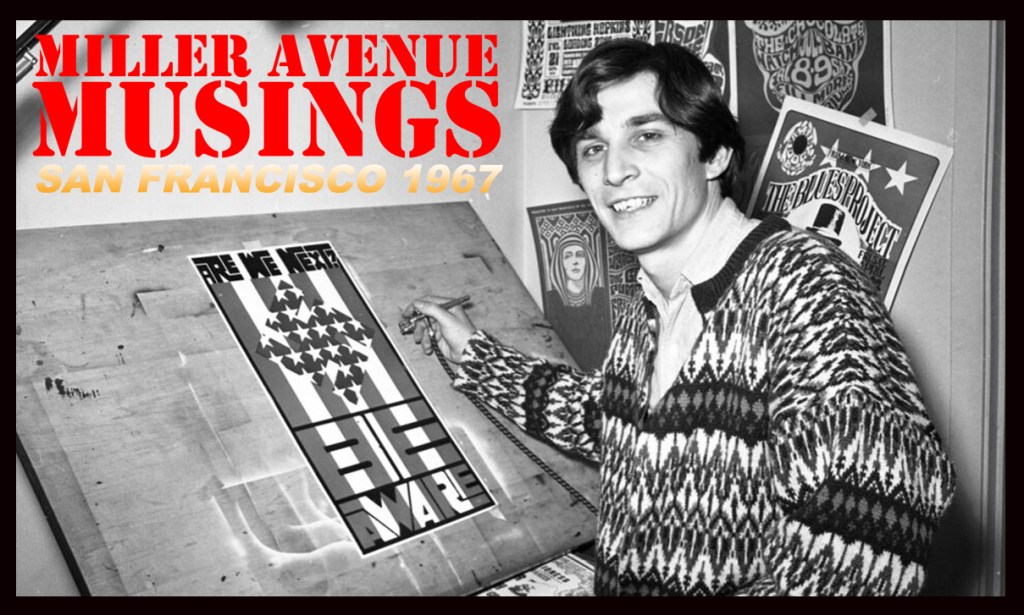
Previously in Miller Avenue Musings: It is the summer of 1967 in San Francisco and I, having taken the drug STP, have flipped out and gone crazy.
In the second day of my madness I returned to my parents’ apartment on Union Street after a visit to Bob McClay’s office. I don’t remember if it was my parents or myself that contacted Wes Wilson but I do remember that he arrived in the late afternoon and drove me back to his house in Mill Valley.
He and his wife Eva, who’d recently given birth to their son Colin, lived in a nice house on Locust Avenue just below East Blithedale. The house was set back from the road and as you entered from the street through a gate you followed the path through a pretty lawn.

Three photos of Wes with his wife Eva (and baby Colin) at different stages of their life together.
Eva was in bed breast feeding her baby. After saying hello, Wes and I went upstairs to his studio. He lit a joint and we started talking. He engaged in every topic I raised and questioned me in depth. He clearly was interested in what I had to say whereas most of my friends had, by this time, started making excuses to avoid talking to me. It was as though all the doors in my mind had flown open at once and I stammered from subject to subject with great haste, but Wes took each subject I touched on and examined it forensically.
By the summer of 1967 Wes Wilson was the most prominent of the psychedelic poster artists working on the San Francisco scene. Before I knew him, his posters had inspired me to send off samples of my own work to Bill Graham which got me my first job for him, painting the boards at the top of the stairs at the Fillmore which advertised the coming attractions. Bill could only confirm his bookings two weeks in advance so I was always doing my boards that far ahead.
The first time I met Wes was on one of his Friday afternoon deliveries of that week’s Fillmore posters. He’d come up the stairs carrying a sizeable brown package full of posters, fresh from the printer. Bill would get his ladder out and staple about seven of them along the wall above the staircase. Wes was a very friendly fellow in contrast to Bill who was all business and brusque in his presence. Bonnie and Jim Haynie seemed to like Wes a lot but Bill, who never interfered with Wes’s way of working, would stare at the new poster and say nothing.
On that first occasion I was all over Wes with questions about how he did his work. I was quite surprised to learn that he worked small and enlarged: meaning that his art work was smaller than the printed poster. He was very encouraging to me and talked about his desire to purchase an airbrush when he could afford it. I had never heard of such a thing and even after I examined one down at Flax’s, I still had no idea what you did with it.
The first Wes Wilson poster I ever saw was while I was a student at College of Marin, doing my comic strip Captain Campus in the Tower Times. The headline was Batman with a cartoon of Batman and Robin advertising three nights of gigs at the Fillmore which Bill Graham was producing with Quicksilver Messenger Service and The Great Society. Also advertised were “Batman movies chapters 1 – 2 – 3.” The great success of the ABC Television series Batman starring Adam West had spawned a craze for everything to do with the caped crusader and the three chapters in question were from the 1940s serials which I had seen at the Sequoia’s Saturday matinees as a kid. I’d recently sat through a showing of all of them at a North Beach cinema thinking they would be as good as I’d recalled but sadly, seeing them all in one sitting, they were numbingly dull. One advantage of the very funny new TV series was how good the costumes were. In the cheapo 1940s serials they were dreadful.
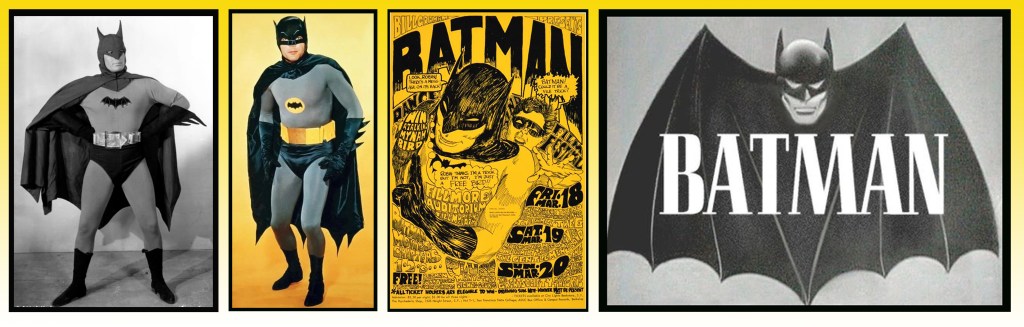
From left: Lewis Wilson as Batman in the 1940s serial; Adam West as Batman in the 1966 TV show; Wes Wilson’s poster; Title card for the 1940s serial.
The next poster by Wes to catch my attention was a brightly coloured orange and red design in which the letters fit stylishly into the shape of a human head. Headlined a “Blues-Rock Bash” it featured The Paul Butterfield Blues Band and the Jefferson Airplane. Again this was a Bill Graham production happening one night in a gymnasium and two nights at the Fillmore. I think it was this poster which convinced me that I could do this and inspired me to write to Bill.

Three early Wes Wilson posters. The middle one inspired me to think I could do this kind of art work.
By the time I finally started working at the Fillmore, Wes had done so many posters that it could already be considered a body of work. Of course he was also still doing artwork for Bill’s rivals over at the Avalon Ballroom, the Family Dog. Bill paid him on time and didn’t interfere with his concepts, unlike Chet Helms over at the Avalon, and this eventually made him work exclusively for the Fillmore while an artist named Stanley Mouse took over the Avalon work.
Wes had designed the original logo for the Family Dog. Ever since I was a young boy I’ve been a fan of good logos. Be it for Warner Brothers, Chevrolet Motors or Coca Cola, it was a subject on which I had very strong opinions and the Family Dog logo was, in my opinion, an excellent piece of work. A good logo must travel, meaning that it looks good big or small and is always familiar whenever you see it. The Family Dog logo adorned all the Avalon posters done by Wes, Mouse and all the others who followed them.
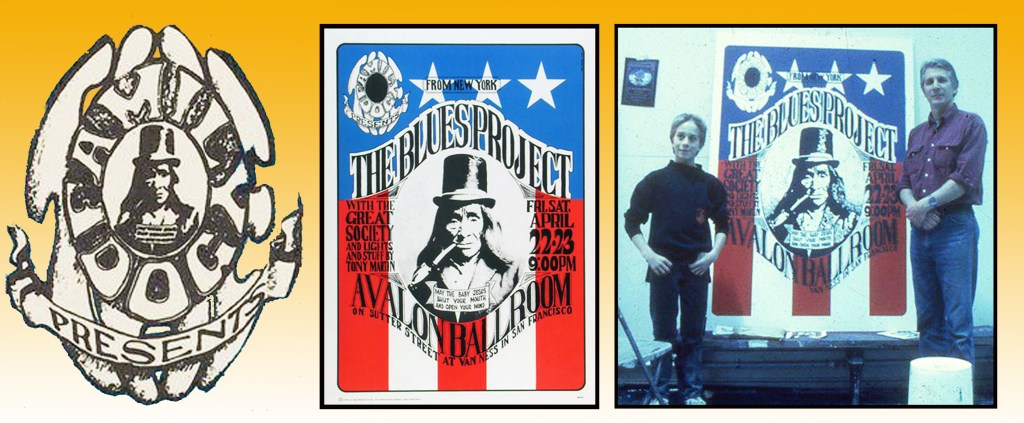
From left: The Family Dog logo that Wes designed; A poster he designed for a gig at the Avalon; Wes with his son Jason in 1987 – the two painted this enlarged version of the poster to be displayed in the Hard Rock Cafe in San Francisco.
Wes got his start in the design business when he was living at the very bohemian Wentley Hotel on the fringes of the Tenderloin district in San Francisco. A friend introduced him to someone who was running a print shop for an insurance firm and was on the hunt for an artist with design skills. This guy was impressed by his drawings and they went into business together as Contact Printing. Wes was doing the layouts and handling the printing as well. A personal project he produced at this time was the “Are We Next?” posters. He had them printed and took several over to Berkeley for a big anti-Vietnam War rally at which he saw Allen Ginsberg. The famous beat poet told him he thought the imagery of a swastika lodged within the stars and stripes was “too paranoid.”

From left: Wes pictured with his poster “Are We Next?”; the poster itself; Wes signing copies at a poster convention years later.
Wes was later visited by a delegation from the Anti-Defimation League who were concerned that the poster might be anti semitic. Wes assured them it wasn’t, introducing them to his wife Eva. “She’s Jewish,” he said. “I love her dearly. We’re having a baby soon. Her father was a screenwriter. One of the blacklisted Hollywood Ten.” By the time they left they were satisfied that Wes was not a Nazi sympathiser.
Somewhere along the line at Contact Printing, Wes did the posters for the Trips Festival at the Longshoreman’s Hall which brought him to the attention of Chet Helms. Chet ran The Family Dog, which was producing weekend concerts at Bill Graham’s Fillmore Auditorium. He and Graham would produce alternate weekends. Wes did the poster for what turned out to be a sold out sensation featuring the Butterfield Blues Band.
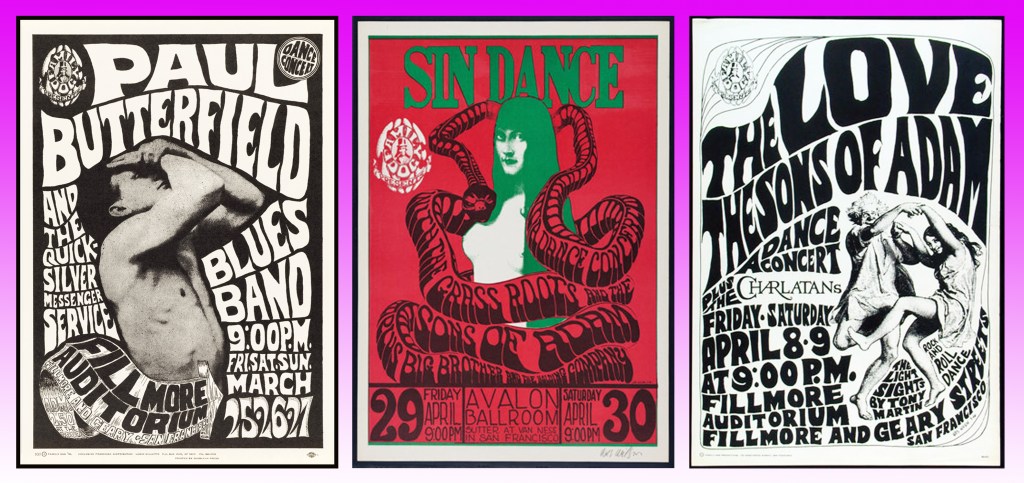
Three early Family Dog posters by Wes Wilson.
The business arrangement between Chet Helms and Bill Graham came to a shuddering halt after Graham got up early the Monday morning after the sold out weekend and phoned Albert Grossman in New York to negotiate an exclusive deal for himself to promote all future Butterfield shows. When Helms realised what Bill had done he dissolved their partnership and started doing shows at the Avalon. While painting my boards at the Fillmore I heard all Bill’s phone calls as he wasn’t remotely shy and retiring and one thing he’d say many times was: “What Chet doesn’t realise is that you’ve got to get up in the morning.”
My first day working at the Fillmore was just after the Andy Warhol weekend. Bonnie MacLean told me all about it and Wes’s poster for that event is one of my favourites. If you look on the Wes Wilson website he tells an amusing tale about Andy Warhol paying him a visit at the house on Locust. They were both interviewed on a radio station in San Francisco and afterwards Warhol asked Wes where he could find some “fun” activity. The only suggestion he could come up with was paying him a visit in Mill Valley to talk about art. “Andy looked so utterly bored at that prospect,” said Wes, “that my impression was that he would not be taking me up on my offer – but I passed him my address and phone number just in case.” Exhausted from several late night poster jobs, Wes drove home and went straight to bed. About 8pm he was woken by strangers at his front door asking if this was Wes Wilson’s place. Wes was in his pyjamas as a stream of creatures, including Andy Warhol spilled out of a limousine parked in the street and proceeded to party.

Three Wes Wilson posters for Bill Graham at the Fillmore Auditorium.
One artist that Wes introduced me to was the German illustrator Heinrich Kley. He used Kley’s pen and ink drawings of turtles playing musical instruments on his poster for the band The Turtles who appeared at the Fillmore in July, 1966. This inspired me to purchase a book of his drawings which were wonderfully surreal. Kley drew beautiful pen and ink drawings of various animals doing improbable things. Elephants ice skating, alligators dancing with bears, and the turtles which Wes had used, playing stringed instruments and a tambourine.

Another three Fillmore posters for Bill Graham including the one on the right featuring illustrations by Heinrich Kley.
Wes introduced a style of lettering that I thought he’d simply invented, but subsequently learned that it was based on a typeface crafted by Austrian painter and graphic designer Alfred Roller at the beginning of the 20th century. The first time I saw this style of lettering was on one my favourite posters by Wes: a double bill of Jefferson Airplane and the Grateful Dead at the Fillmore. This poster also taught me what Wes was up to with his airbrush. It featured two photos of the bands which were outlined in a cloud like halftone shape which had clearly been achieved with the airbrush. I also believe that this was the first time Wes had used bleed for its borders. Whereas all his previous posters had white borders, the navy blue background of this one bled off beyond the trim marks. With a few exceptions, Wes continued to bleed his borders for the rest of the posters he did for Bill Graham.
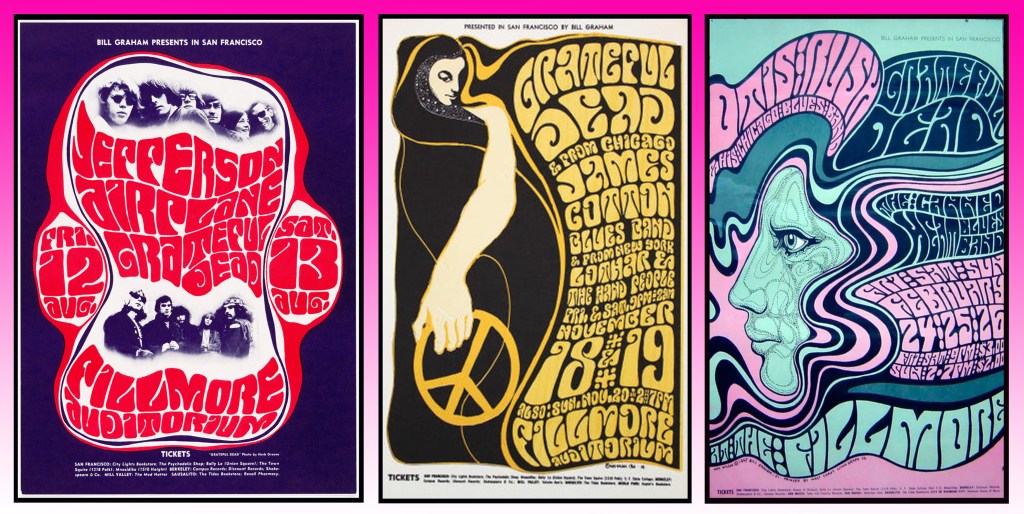
Three Fillmore posters featuring the lettering style of Alfred Roller.
Wes continued to use the Alfred Roller style of lettering and it is associated with his work. His illustrations were also very striking. Many artful nude females adorned several of the posters and to my mind they all resembled Eva. Wes had a command of colour which was impressive. For the Fillmore and Avalon posters he rarely used more than two colours and how he used them was interesting. For the “Sin Dance” poster for the Family Dog he only had red and green but by printing most of the red over the green it gave a black and by having the logo reversed out of the red it made it white. So the effect was four colours rather than the two actually used.
Of course Wes understood the printing process thoroughly and was able to innovate, often pushing his printers to try things they normally wouldn’t do. When he designed the poster for The Association with the flaming letters, the printer rang him up to say that they were getting a little white line around the letters. Wes had a look and decided it was an attractive effect.
The relationship with Bill Graham eventually turned sour. Usually Bill was very honourable about paying people on time and in full but he did suffer occasional spasms of greed. The late Jim Haynie remembers him regularly violating the fire regulation limit to sneak more paying customers into the Fillmore often via the fire escape. It soon became clear that the sales of his posters were a going concern. When I asked my friend John Goddard, who ran Village Music in Mill Valley, how many Fillmore posters and handbills he sold, his reply was: “More than you would think.” People were now collecting them.
Wes had been copyrighting each poster as it came out but Bill wanted to formalise the arrangement with a contract. So Bill and Wes sat down and worked out a deal. They drew up a contract which Wes signed, granting him 6% per poster. “But then he broke the agreement right away,” said Wes. “An article came out in TIME Magazine reporting that he’d sold 100,000 posters.” So Wes went to see him with a few friends demanding his royalties. He said he was due $6,000 on one particular poster. “He got all upset,” remembers Wes, “And we went from being friends in the morning to being enemies that afternoon.”
Although Wes was a political pacifist, he, like Graham, had been in the military and could fight. When things got heated with Bill he suggested that they step outside and settle things with fisticuffs. “Bill Graham said okay to that,” said Wes. “And as we walked out the door onto the sidewalk, Bill quickly turned around, locked the door behind him and disappeared up the stairs. From that day on, he continued to cheat me out of lots of money by not honouring our honestly agreed-to and mutually signed agreement.”
Wes sought advice from a few lawyers and they all said that because he’d left his signed contract in Bill’s trust without a copy of his own, he might as well forget it. “Bill had shown himself to be a lying crook rather than an honest person,” said Wes. “That’s how I lost all of my respect for Bill Graham.”

Three photos of Wes Wilson throughout the years.
This incident must have occurred after I had visited Bill at the Fillmore in mid 1968 on my return from a European trip. I wanted to get royalties on my four Fillmore posters. He went upstairs to look at the books and returned to write me a cheque for a few hundred dollars.
But back in the summer of 1967, as Wes and I talked through the night up in his studio, such concerns were not on the table. We talked about everything from societal politics to human sexuality. Finally as the sun started rising Wes excused himself and went to bed. I walked out on their front porch as the first light of morning settled gently over the beautiful lowlands of Mill Valley. The fever in my brain convinced me that something important was happening. People were coming from all over the world to meet me. I walked down the path to the wooden gate and, opening it, stepped onto the sidewalk of Locust then up to East Blithedale. The sun was now coming up as I headed towards Highway 101 with a great sense of purpose.
To be continued…

Amazon USA
https://www.amazon.com/dp/B085QN73VQ
Amazon UK
https://www.amazon.co.uk/dp/B085QN73VQ
 Miller Avenue Musings