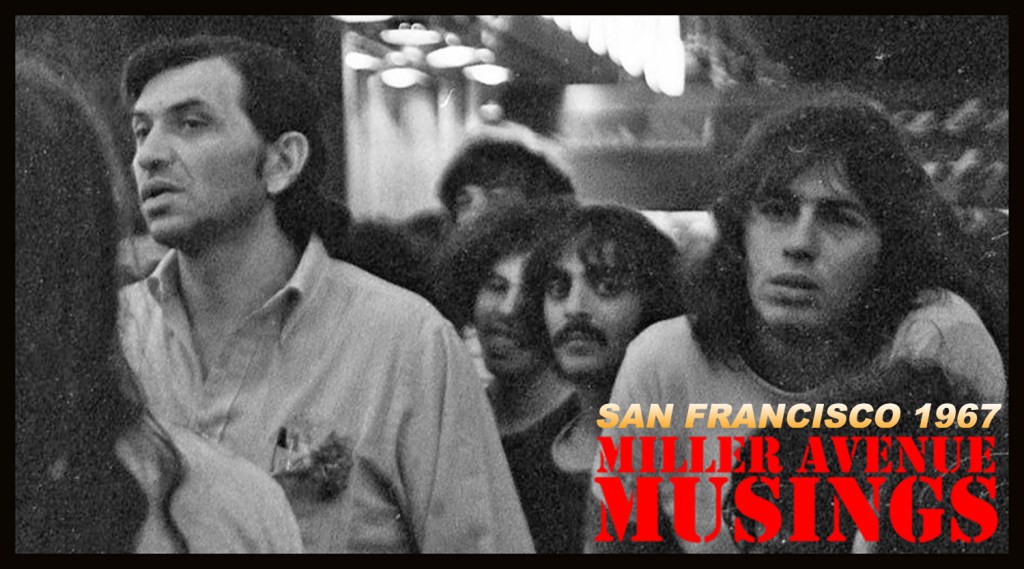
1967-The Summer of Love-part 5

As the summer of 1967 arrived, I became more and more determined that I should have a good experience with LSD.  I had become convinced that the reason I wasn’t able to have a good trip was to do with my ego and that I needed to work on myself.  So that was my inner dilemma.  The particularly bad trip I’d had the previous year at the Fillmore was all about loss of control.  I felt I had to hold onto my ability to control and was terrified that it was oozing away from me in dramatically large globules.

   Although I was living at my parents’ apartment on Russian Hill in San Francisco’s North Beach, I was definitely becoming more and more remote from them.  When I occasionally brought young women home with me, I never introduced them to Blackie and Beth.  On one occasion my extreme hippy friend Matt came over to the city and crashed on the floor of my bedroom.  I don’t recall the details of his encounter with my mother Beth, but she became very upset by his lack of hygiene in our kitchen.  Back in my bedroom Matt said: “I’m sorry I freaked your mother out.”  He said this in a way which implied that he had no control over his behaviour.  Matt was unable to interact with straight society.  His way of life involved smoking marijuana in industrial quantities and only associating with those who did the same.

   Although I was steeped in the drug culture, I was still able to socialise with straight people, something Matt was incapable of doing.  He was a highly intelligent and articulate individual but made no compromise with society.  Jared Dreyfus and I were both very diplomatic people and the fact that we smoked grass didn’t alter that reality.  I remember Jar being acerbic about one of my hippy friends whose syntax was littered with phrases like “Oh, man” and “Far out.”  He raised a critical eyebrow at such talk and wasn’t timid about sharing his opinions with me.  “Myers,” he said. “Are you really spending time with people who speak like that?”  Though I was no longer in high school, Jar’s opinion was still important to me and any opportunity to visit the Dreyfus house was always welcome.

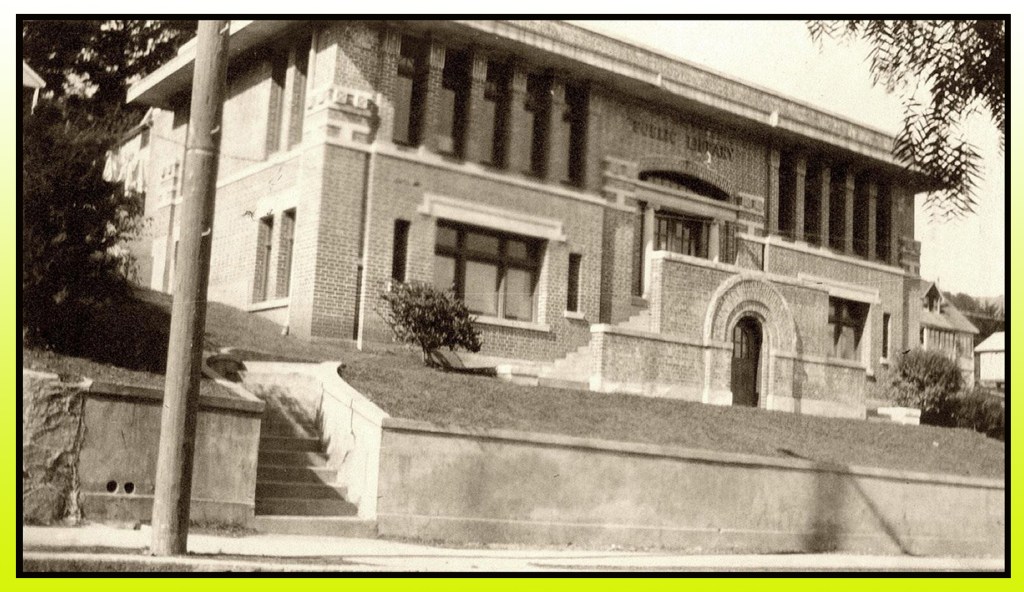
   While growing up in Mill Valley there were certain buildings that I had loved.  The old Carnegie library up on Lovell was a place I enjoyed spending time.  A building of solid brick which first opened in 1911, it was a magical place where my siblings and I would spend hours reading or just searching for books of interest.  I was not a big reader but I did love books nonetheless, particularly those with illustrations.  Up on the top floor was where most adults spent time but down on the lower level was where the children’s books were.  There was also a separate entrance to the lower level, with a round-top door and a brick surround which matched it.  It was a glorious place to hang around.  

 The Carnegie Library on Lovell. (Courtesy of the Lucretia Little History Room, Mill Valley Public Library)

  Another venue I spent a lot of time at was the Bus Depot.  It was a train station when it opened in 1889, but by the time my family arrived in Mill Valley in 1952, it was the place the Greyhound buses to and from the city arrived and departed from.  More importantly for me as a small child was the huge selection of comic books they displayed on their racks.  I spent so much time at the Bus Depot that the ladies who worked there, Brun and Margo, got to know me and allowed me to read the comics when other kids were told to put them back.    

Several views of the Depot as it was before it was the Book Depot. (Courtesy of the Lucretia Little History Room, Mill Valley Public Library)

   A building I also loved was the Dreyfus house up in West Blithedale canyon.  It was a large wooden house which probably dated back to the turn of the century.  I never saw anything above the middle floor which contained the kitchen, dining room, living room, TV room and a wonderful glass enclosed porch which overlooked the hill down to the street.  The street snaked around the house from the bottom to the top.

   After a visit to the Dreyfus house one day, I got a lift downtown in Jar’s silver Austin Healey.  He pulled into a parking place on Corte Madera in the shade of the Bank of America building.  I was telling him about some person I didn’t care for and suddenly he turned to me and said: “So that bastard is walking around living his life with no problems and Dave is dead.”  Dave was his older brother who had been killed in a helicopter accident at the beginning of the year.  “That’s god’s justice, John.  He’s alive and Dave is dead.  Which leads me to conclude that god’s justice is a crock of shit.”

   What neither of us could have known at the time was that in the last years of his life, Jar became a born again Christian.  It was something which puzzled all of his family.  I remember both Barney and Babbie being baffled by Jared’s religious conversion as were his kids Adam, Christian and Kate.  Jon Diederich who was a good friend from grade school at Old Mill credited Jar with making him question his Catholic faith at a very young age so for his friend to embrace a branch of the very faith he had earlier mocked, was puzzling.  After his conversion, Jar never tried to convert me and the few times we discussed his religious beliefs he respected my lack of belief.  I even recall raising the conversation we’d had about Dave in his car and he remembered it clearly.

   After leaving Jar I took a Greyhound bus back to the city.  If I had a graphics job to complete I would do it at my parents place where I had a big drawing board in my bedroom.  So the city was where I worked and Mill Valley was where I would go to hang out with my friends and get high.   On my next Mill Valley excursion, having crashed at a friend’s house high up on Edgewood, I awoke to a sunny day and, splashing water on my face, walked down the road to Molino and took a left on Mirabelle.  I continued onto Ethel past a few barking dogs until I came to the steps behind Brown’s Department Store where I descended to Miller Avenue.  Suddenly I found myself downtown on a beautiful summer’s day.  I wandered up  past Mens’ Mayer’s and Meyer’s Bakery then crossed the street.

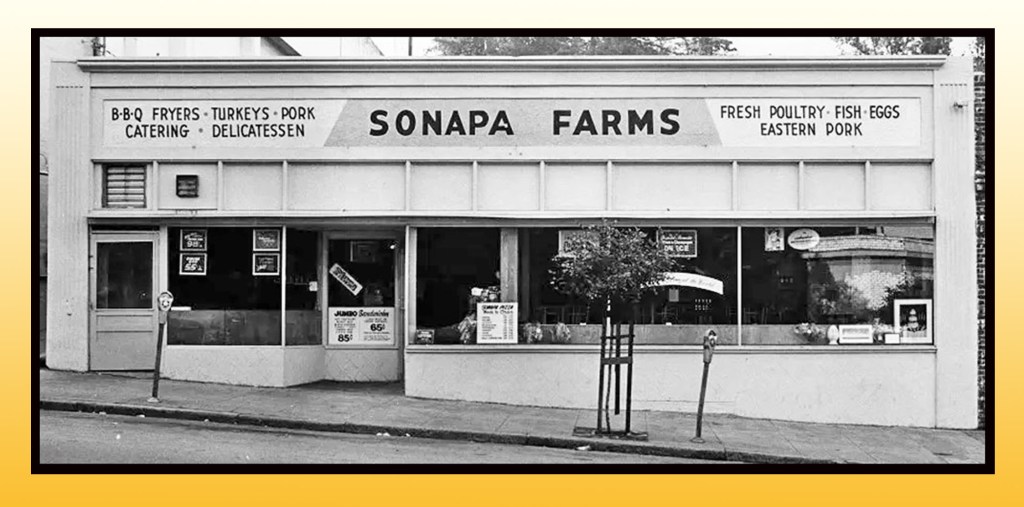
   The depot was still the Bus Depot with Greyhounds coming in and out of town on the hour.  I sat on the bench by the taxi rank and watched the world go by then glanced up at the old clock to see it was almost 1pm.  Hunger beckoned.  I walked up past Pat & Joe’s and Redhill Liquor to Sonapa Farms just below the Sequoia building to have one of their delicious sandwiches.  

Sonata Farms, a deli just below the Sequoia Theatre on Throckmorton. (Courtesy of the Lucretia Little History Room, Mill Valley Public Library)

   I sat in the window facing Throckmorton while eating my roast beef on rye in a basket with a big dill pickle.  The thing about sitting in the window at Sonapa Farms was that you got a panoramic view.  The hill which exists at that end of Throckmorton could be properly appreciated from the top to the bottom.  A steady parade of Chevies, Mustangs and VW’s ran up and down to and from East Blithedale.  The pedestrian traffic was interesting too.  Most were faces I didn’t know but one person stopped and turned to look at me.  A broad and engaging smile told me it was someone I knew.  It was Tom Connell.  Tom was a person I had known for years through the Dreyfus family but I hadn’t seen him in a long while.

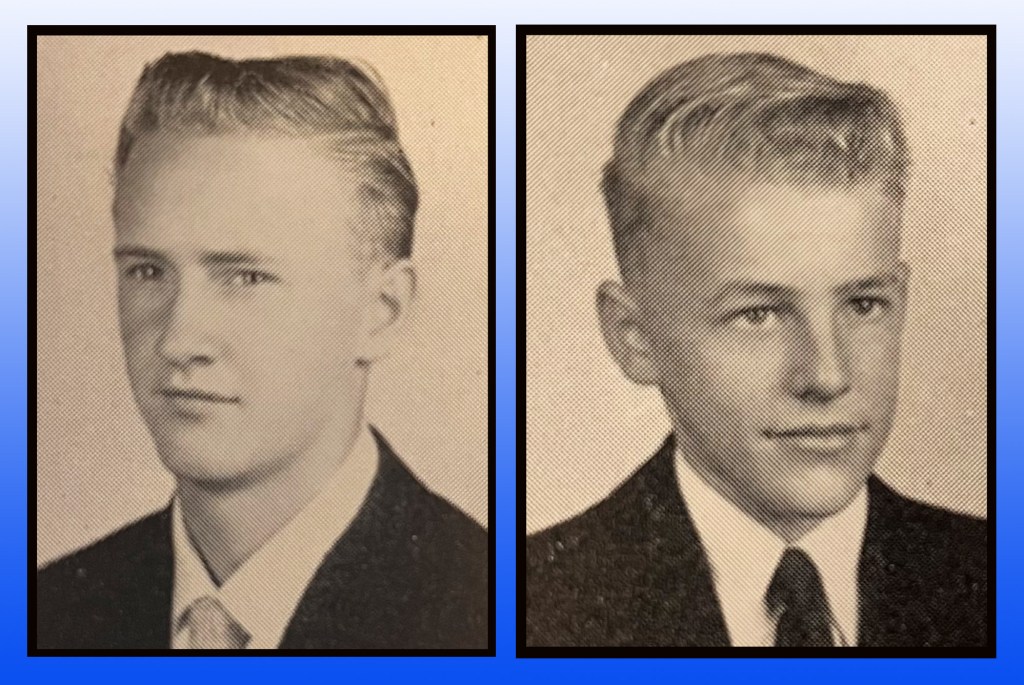
Tam High photos of Dave Dreyfus and Tom Connell who, along with Abby Wassermann were in the class of 1958. (Courtesy of the Lucretia Little History Room, Mill Valley Public Library)

   He was older than me and had a passing resemblance to the film actor Robert Vaughan although unlike the Man From U.N.C.L.E., Tom had blond hair.  He’d been in Dave Dreyfus’s class at Tam High and was what I guess you would call an entrepreneur.  Tom always had a money making scheme in progress.  Every winter he would run a Christmas tree lot and as kids, my brother Jim and I worked for him, finding ourselves in freezing caravan trailers at various locations around the county.  The Dreyfus’s had a beach cabin out at Stinson which Tom used to make use of for what Jared referred to as scenes, or in other words amorous encounters with young women.  It seems that every person I knew through the Dreyfus family was smart and articulate and Tom was no exception.  So he came in and sat down.  He’d heard about my poster work at the Fillmore, probably from Jar, and was interested to hear more.

   I told him that since I’d stopped working for Bill Graham that poster commissions were thin on the ground.  He listened to me with an impressive intensity.  He wanted to know about what the work of producing a poster entailed.  He offered to drive me back to San Francisco if I’d buy him some gas for his sports car.  I was rather charmed by his candour, coughed up for a visit to the gas station and off we went across the Golden Gate Bridge.

   As we drove into the city, Tom was thinking out loud of how a business could be built around my ability to produce posters.  It was a seductive idea.  He found a parking place on Union Street near my parents’ apartment.  Unlike my hippy friend Matt, Tom was charming to my mother Beth and had a nice chat with her before coming into the workplace in my bedroom.  I showed him samples of original artwork and the finished printed product.  He suggested that I produce a logo of my signature in much the same way that Walt Disney’s supposed signature was the trademark of the Disney Corporation.   

   Tom’s idea, which was evolving conversationally, was to produce posters on a variety of themes and sell them.  He encouraged me to get on with the signature logo and said that he needed to speak to someone about finance before we could go ahead.  It was an interesting idea and I felt excited by it.

   I got word that brother Jim was being posted to Korea which sounded better than Da Nang.  He would be stopping over for a few days in Seattle and wondered if I’d like to fly up for a visit.  It seemed like a good idea so I booked a flight.  At this time I had pretty long hair and bushy sideburns.  I was, at age 20, unable to grow a full beard.  I could manage a moustache, sideburns and the area around my neck but there were no whiskers between my chin and lower lip so I had to wait a few years to be fully bearded.  

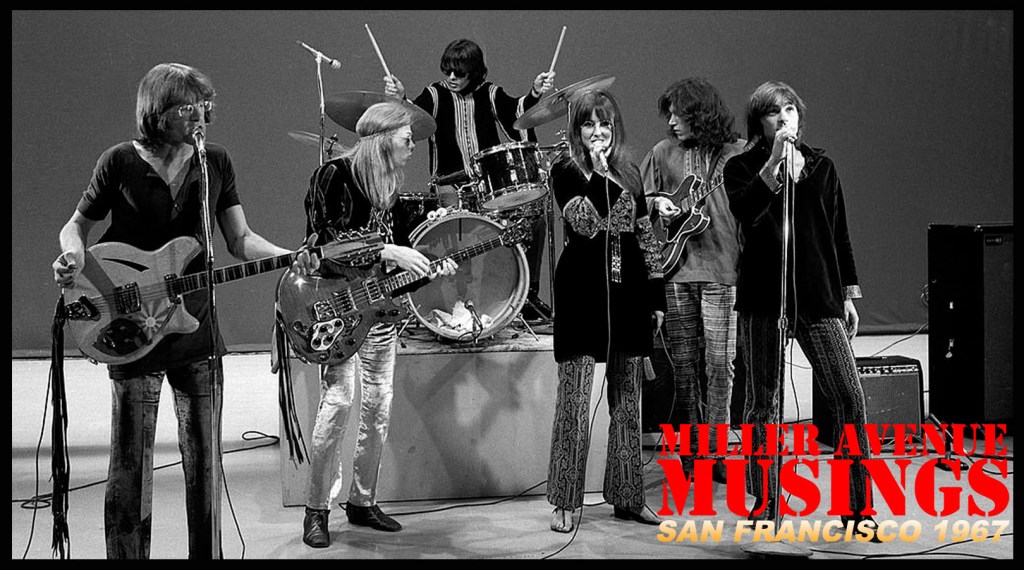
   My flight to Seattle was without incident and when I disembarked I came across members of the Jefferson Airplane being mobbed by autograph hunters.  It was very odd to see them in a totally different context to the Fillmore where such a thing would never happen.  It was also interesting to see how famous they were becoming.  Marty Balin was dutifully signing his name and nodded hello as I walked past.

   Jimmy met me at the gate in his army uniform.  We went off for lunch where he was surprisingly talkative.  He told me about basic training which he didn’t enjoy at all and found himself regretting his enlistment.  He also told me about some of his colleagues, one of whom bragged of a gay relationship he’d had with a famous Hollywood movie star complete with photos of him with the actor.  Hardly the stuff of discretion.  He told me too of another soldier who, while stationed near Death Valley, would stamp on and kill tarantula spiders whenever he encountered them, which was often.

   Jim and I didn’t share many interests while growing up in the Myers family.  I was a year and a half older than him but he outgrew me at age five which erased any possibility of physical bullying on my part.  His height and angular handsome face was in contrast to my diminutive stature.  I was a remarkably tiny child and though good looks seemed to run in our family, Jim was always the handsome one while I was the little cute one.  By the time I was ten I’d developed a passion for MAD Magazine, comic books and horror movies.  Jim studiously avoided expressing interest in anything I felt passionate about and therefore began collecting baseball cards.  Oh he read my comic books and MADs but quietly without fanfare.

   One thing we did share was a sense of humour.  Many times we’d find ourselves in hysterical stitches at the Sequoia Theatre while a Road Runner cartoon unspooled or at certain scenes in a Jerry Lewis movie.  Yet neither of us could tell a joke properly.  We’d start giggling about the punchline before we got to it.  Our teddy bear collection as young kids, known to us as Bearville, was a unifying experience as was our cat Totem when the family moved from Seymour Avenue down to Catalpa Street.  Just as we had invented voices for all thirty of the teddy bears, we would talk for Totem in a funny voice which amused us no end.  However, if there were no teddy bears, cat, or road runner cartoons involved, Jim and I went separate ways.

   So it was surprising to me to find him so animated as we talked over our lunch.  He had gone from living at home to being in the army which must have been a hell of a shock.  I remember, at age eighteen, getting very emotional on the bow of the ship Torvanger as it sailed under the Golden Gate Bridge on its way to Japan.  I was leaving home in a life changing way and, alone on the bow of the ship, I burst into tears and sobbed for some time.  I don’t know that Jim had a similar experience but it must have been a tough moment for him, leaving the nest.

   So Jimmy and I had a good visit.  I stayed the night in his hotel room.  He took photos of me wearing his uniform which was odd as my hair was long and I had bushy sideburns.  The next morning after breakfast we saw a bit of Seattle, said our goodbyes and then I was off to the airport. 

   My flight back to San Francisco was early afternoon.  As I have mentioned previously I had long hair and sideburns.  I was dressed in blue jeans, cowboy boots, a white shirt and a black leather vest (or waistcoat).  I looked like a hippy.  There was a huge stigma in American society about long hair on men.  In 1967 it was fine for male pop stars and Hollywood actors but in general society such an appearance attracted unwanted attention. “Are you a boy or a girl?” was a phrase regularly shouted by men at other men with long hair.  Whenever I worked as a ship’s clerk on the waterfront, my father Blackie insisted that I cut my hair as this intolerance was so prevalent on the front.  

   I boarded my flight to San Francisco and as I turned right to enter the cabin I saw that practically all the seats were occupied by uniformed soldiers.  I immediately felt panicked.  The prospect of wading through this potentially hostile crowd in such cramped conditions filled me with dread. 

To be continued…

Amazon USA
https://www.amazon.com/dp/B085QN73VQ


Amazon UK
https://www.amazon.co.uk/dp/B085QN73VQ
1967-The Summer of Love part 4

The Beatles launching their LP Sgt. Pepper’s Lonely Hearts Club Band.

Some person said: “If you can remember the 1960s, you weren’t there.”  I have no idea who made this statement but from my point of view it’s wrong.  I was there and I do have very clear memories of a lot of it and in 1967 I was a 20 year old hippy poster artist who went crazy on LSD and wound up in a mental hospital during the Summer of Love.  So if I can remember it, anyone can. 

   That summer in the bay area, was very eventful.  Large outdoor rock festivals began happening, a manifestation of the fact that lots of young Americans were adopting the hippy way of life, albeit for a short time.

   Haight Street in San Francisco was throbbing with hippies and head shops.  What my father Blackie would describe as guerrilla capitalism was everywhere with long haired drug dealers on every street corner whispering coded pitches to passing strangers.  A good friend of mine went there to score a lid of grass and had to follow the dealer up to his apartment.  Once inside the guy pulled a gun on him and demanded all his money. My friend extracted a meagre ten dollar bill from his wallet insisting it was all he had.  He lived.

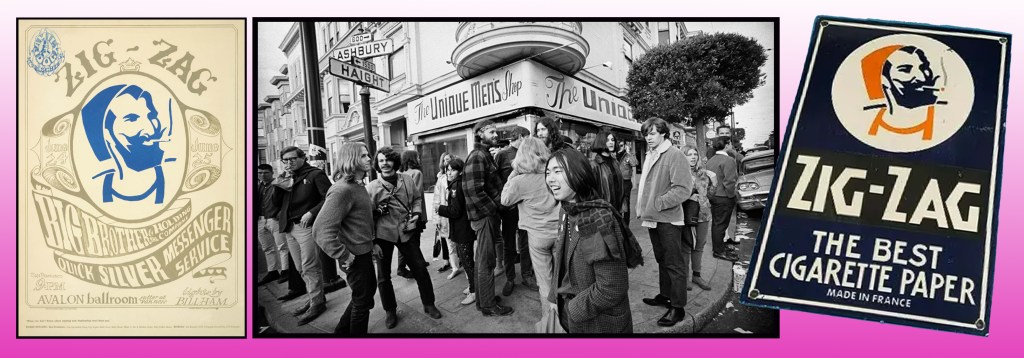
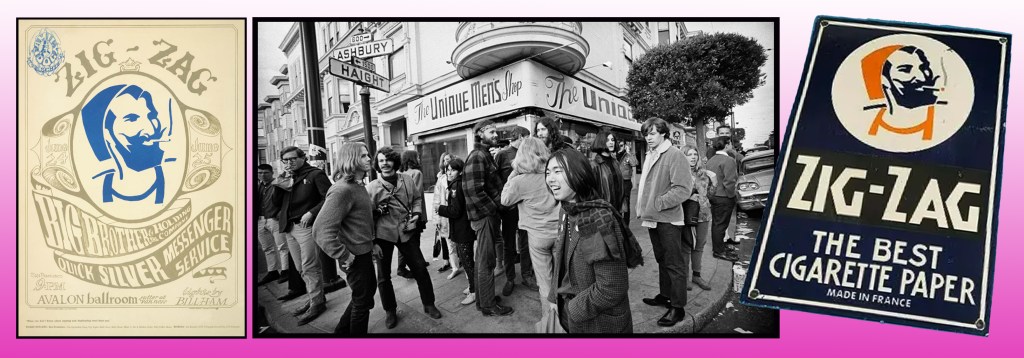
   On Haight Street the sidewalk was packed with long haired young men and even longer haired young women.  A constant refrain of ‘Spare change?’ could be heard up and down the street from weary looking young people.  Psychedelic posters for dance concerts at the Fillmore and Avalon decorated many windows and the Zig-Zag Cigarette Papers logo adorned posters, T-shirts and coffee mugs. 


   But the most defining event of that summer was the release of the Beatles’ LP, Sgt. Peppers Lonely Hearts Club Band.  This album instantly became a hit with everybody I knew.  Each house I entered, for the longest time, had this record playing.  On the front cover was a colour photo of the four Beatles wearing brightly coloured old fashioned marching band uniforms, standing in front of a big collage which featured pictures of a wide variety of characters including Karl Marx, Marilyn Monroe and Edgar Allan Poe.  

   The music seized your attention right from the start: the rock band opening of the title track with George Harrison’s bee-sting guitar notes and Paul McCartney’s athletic vocal.  It proceeded to take you on a journey of many different musical styles with full orchestral backing and new surprises each time you listened.  And the lyrics were so very good.  The words to She’s Leaving Home, Fixing a Hole and With a Little Help From My Friends were intelligent, sensitive and they made you think.  McCartney’s lyrical optimism was countered artfully by Lennon’s cynicism.  Also for the first time these guys seemed to be reflecting on what it was like to be a Beatle.  Lyrical references to newspaper taxis and silly people who don’t get past their doors, gave shape to the Beatles’ recent history of an entirely unprecedented celebrity which they’d been living through for the past few years.  And here they were in the midst of the hippy era seeming to be more relevant than ever.

   This was the very same foursome who provided most of the soundtrack to my teenage years.  Their music and lyrics spoke directly to me and my generation about the agonies and joys of young love, lust and all the satellite subjects which concerned their audience of acne-ridden adolescents.  From their arrival in the USA in early 1964, I, along with millions of young people all over the world, followed their musical output devotedly, learning each of their songs by heart and singing them out loud with my friends at surreptitious drinking sessions.  

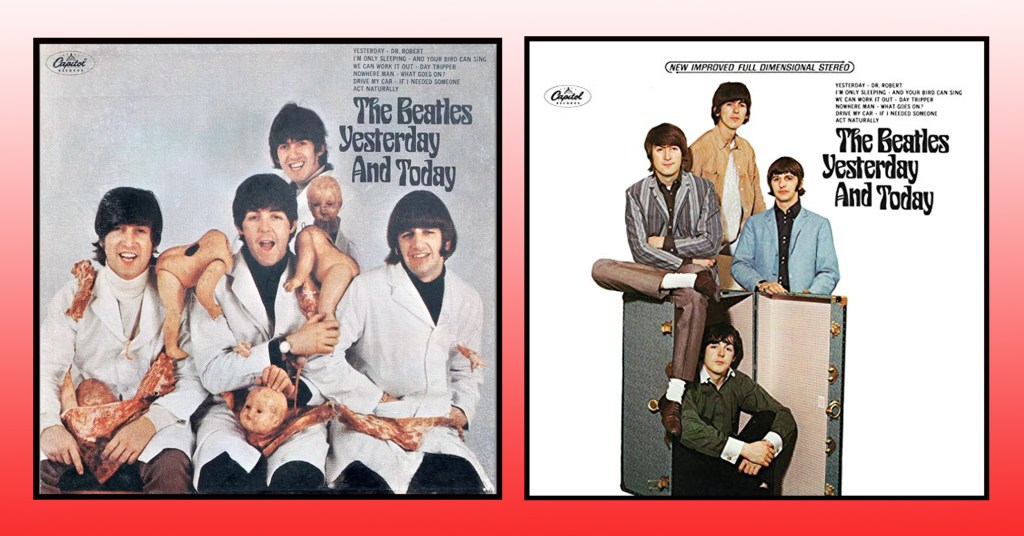
   But unlike other showbiz fads, they simply didn’t fade away.  They got better.  Rubber Soul was their first LP which illustrated the point that they were definitely not a flash in the pan.  Their talent was something special which stood the test of time.  Then in 1966 they produced Revolver which continued to break new ground with songs like Eleanor Rigby, Taxman and Got to Get You into My Life.  During that year they also found themselves mired in controversy.  John Lennon gave an interview to the London Evening Standard in which he predicted that Christianity would die out and said that “we’re more popular than Jesus now.”  This caused no controversy in the UK and the interview was not published in the USA until late in the summer.  In June Capitol released a compilation LP entitled The Beatles Yesterday and Today with a cover photo featuring all four wearing white coats and covered with decapitated baby dolls and pieces of raw meat.  They were all laughing and looked like crazed butchers.  The band said it was a protest against the Vietnam war.   As soon as it was released it was immediately withdrawn by Capitol and replaced with a new photo.

On the left is the photo the Beatles’ wanted and on the right the one Capitol Records chose.

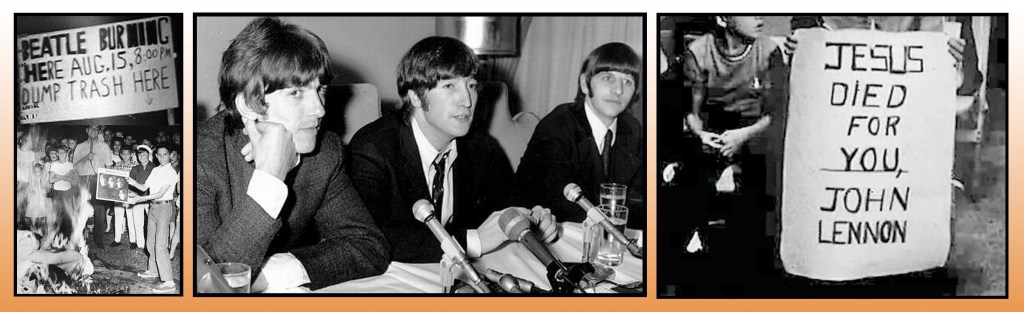
   When the Lennon interview was reprinted in the USA that summer, it ignited a huge furore in the southern bible belt which rippled across the country.  A disc jockey in Alabama organised a public burning of Beatles material and all this occurred just as they were about to embark on an American tour.  The press conference which kicked it off was an uncharacteristically sombre business.  Previous Beatles press conferences had all the colourful anarchy of a Marx Brothers movie but this one was weighed down with seriousness.  John Lennon, looking pained, reluctantly apologised for causing offence.

Beatles burning in the Bible Belt, a very sombre press conference and a message for John Lennon.

   On top of this, they had to flee the Philippines in a hurry after they’d snubbed the first lady, Imelda Marcos, who had invited them to tea.  They were clearly unprepared for the angry public reaction.  So after their final concert in Candlestick Park in San Francisco, they decided to stop touring and just work in the recording studio.

   The Beatles were worshipped in a way which was not entirely healthy and I was as starstruck as everybody else.  The hysteria generated by their initial American success in 1964 seemed to have morphed into a slightly different form of hero worship but it was still idolatry plain and simple.  I remember sitting around a house in Strawberry which I visited regularly and discussing the Beatles as if they were gods.  The house was owned by a woman who was older than me and had two young children.  She was separated from her husband and several of my friends and I would gather there regularly to smoke weed and listen to music.  She was a guitar playing folk singer who was managed by Frank Werber.

   It was at this time that I realised that Mill Valley was becoming a place where people from the rock and roll scene were moving in.  Wes Wilson and his wife Eva had a house with a long garden on Sycamore. Bill Graham and guitarist Mike Bloomfield moved into Mill Valley.   Mike had left the Butterfield Blues Band and started his own group called The Electric Flag.  I once saw his bass player, Harvey Brooks with a big smile on his face, wandering, along Sunnyside near the Post Office one morning.  I also heard a remark which chilled my soul.  The woman in Strawberry was talking about somebody who was “shooting smack with the Electric Flag.”  Nobody in my immediate circle was doing anything like that. It scared me.

   I guess that I made a distinction between smoking grass and what I considered to be hard drugs.  Somehow I didn’t consider acid to be in that category but through my limited experience with it I knew how powerful it could be.  As the summer arrived I became more and more determined that I should have a good experience with LSD.  I had become convinced that the reason I wasn’t able to have a good trip was to do with my egotism and that I needed to work on myself.  This was not an easy prospect as I had always been a little guy with a big mouth and an even bigger head.  The particularly bad trip I’d had the previous year while at the Fillmore was all about loss of control.  I felt I had to hold onto my control and was absolutely terrified by the fact that it was oozing away from me in dramatic fashion.

   While all this internal drama was going on with me, out in the real world the Vietnam war was, by this time, raging.  The daily news had a stream of stories about military action in Vietnam as well as many about students burning their draft cards and huge demonstrations against the war.  The police tactics against anti-war protestors became increasingly violent and just as blood was definitely flowing over in Vietnam so too did it flow on the streets of America.  David Harris who was married to Joan Baez went to prison for refusing to be drafted into the army.  I know a movie producer in Hollywood who pretended he was gay, which he wasn’t, and avoided the draft that way.

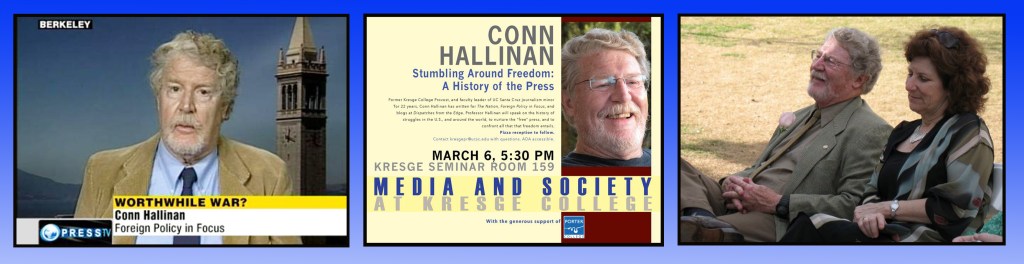
   My sister Nell was no longer in San Francisco but living in London with her husband and their newborn son Poggy.  Nellie and the Hallinan boys had been very active in demonstrations in the city but now had taken her left wing activism to England.  The Hallinan boys all remained very active in civil rights and anti-Vietnam war demonstrations

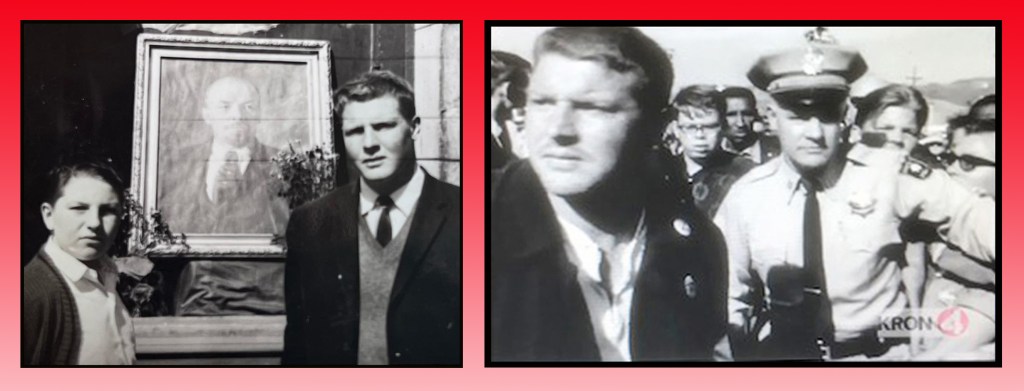
   Back in 1965 both Kayo and Ringo Hallinan recruited a small army of tough fighters to form the front line of an anti-war march from Berkeley to Oakland which the Hell’s Angels had announced they were going to break up.  Not realising who was in the front of the march, Sonny Barger, Northern California president of the Angels, waded into the crowd thinking they were dealing with pacifists.  Barger, shouting abuse, as he pushed his way through the crowd, reached up to pull down a banner.  “As he pulled the banner down,” said Ringo, “Kayo hit him with a right fist on one side of his jaw and I delivered a left hook on his other.  He went down like a stone.  The Angels kept coming, thinking we were a bunch of pacifist wimps.  They suddenly found themselves surrounded by a lot of tough guys bent on pounding them.  I remember the looks on their faces as they suddenly realised they were in trouble.  And they were.  We kicked their asses until the Oakland police attacked us and drove us back.  Barger lied about that day on many occasions.  How they kicked the commies’ asses.  It was a fine moment.”

Conn (Ringo) Hallinan on the left before the fight and his brother Terence (Kayo) Hallinan seen punching a Hell’s Angel.

   But I stayed away from the big demonstrations as so many turned violent.  One day I was hitch hiking out of Mill Valley to the city and got a lift with a young man who was on his way to an anti-war demonstration in Berkeley.  He was quite candid in telling me that his motivation was nothing to do with the war but rather it was to meet beautiful young women.

   I went to a party in Berkeley and met a guy about my age who was joining the marines the next day.  I asked him why and his answer was chilling: “Because I want to kill somebody,” he said.   I was so startled by this that I asked him, if it was completely legal, would he kill me?  His answer was yes.  Now it just happened that I met this guy rather than one of the thousands of young recruits who had no such agenda and were simply doing what the government was ordering them to do.

   The whole situation was something I was just not thinking about.  My way of dealing with the possibility of being drafted was to smoke another joint.   And yet my brother Jim was now in the military and having done his basic training he would be having a stopover in Seattle for a few days en route to Korea.  I thought about flying up to see him.

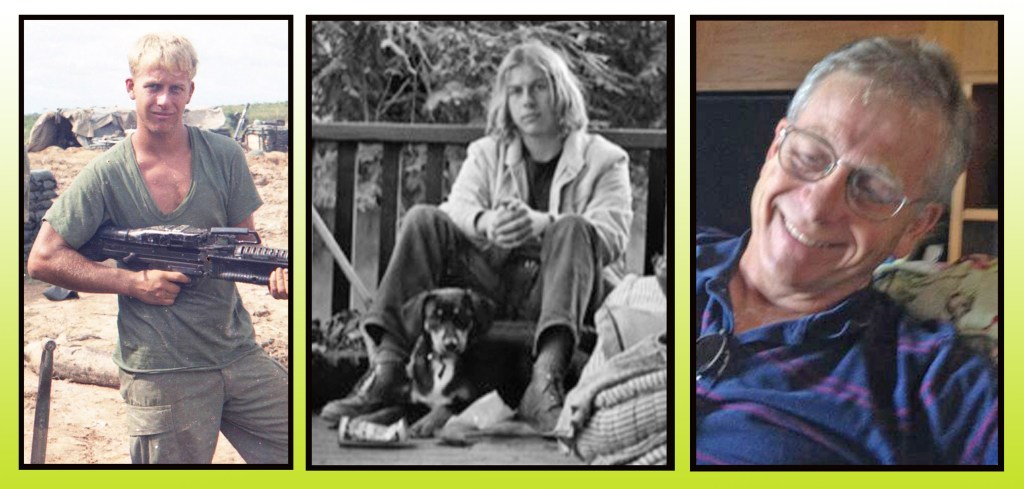
   Several guys from my Tam High class of 1965 went into the service and found themselves in Vietnam.  Corky Corcoran, Ed Smith and Les Taylor all served over there.  Another who was a year younger than me was Ernie Bergman.  

   Corky, who I had known since 7th grade at Edna Maguire, joined the army in the summer of 1966 and became a paratrooper.  Never having been on an airplane before, he was flown to Fort Lewis in Washington where he did his basic training then it was off to Fort Benning in Georgia where he attended jump school.  By 1967 he was in Vietnam with the 173rd Airborne Brigade.  “We went through the Brigade Jungle School in Bien Hoa,” said Corky, “To prepare us for the upcoming months in the Dak To area of the central highlands.”  His job was as a radio teletype operator, part of a 3-man team working from a jeep filled with communications equipment.  “We were constantly on the move,” remembers Corky.  “ There were some scary times indeed but I made it home in July, 1968.”

Corky Corcoran on the left as a soldier in Vietnam and on the right with his wife in more recent times.

   Les Taylor had grown up in a military family, having lived in France, Germany, Turkey and several locations in the USA before arriving at Tam High in his sophomore year.  By the time he got to Vietnam he was a qualified helicopter pilot and his initial training began while he was still a student at Tam.  On one of his early missions as co-pilot in Vietnam, ferrying men to a combat zone, his commander froze at the controls and he had to take over and fly the copter into the landing area.

Les Taylor in two different military uniforms and on the right a more recent view if him.

   Eddie Smith and I had been friends since 6th Grade at Alto.  He didn’t go into the service until late in 1967 and went to Vietnam the following year.  He said that more American GI’s died between ’68 and ’69 than at any other time in the war.  Ed: “I was on a mortar platoon out in the field most of the time. But when we were in base camp, it was just as dangerous.  The Vietcong and the regular North Vietnamese Army were shooting mortar rounds and rockets at us all the time.  I had plenty of close calls but luckily never got wounded.  It was scary as hell and I had nightmares for quite awhile once I got back to the states.”

Ed Smith on the left in Vietnam, middle back in Marin after his service and a more recent photo on the right.


   Ernie Bergman who was in my brother Jim’s year, joined the Navy in his graduation year of 1966 but didn’t get to Vietnam until April 1967.  His first day in Danang was traumatic as he was assigned to be a stretcher bearer for the hospital triage centre where the wounded were brought to see if they could be saved.  “What a shock to my whole being!” Says Ernie.  “I saw soldiers and marines with all kinds of injuries, lost limbs, large wounds, lots of blood, lots of horror.  One guy I was carrying looked like he was on the wrong side of a claymore mine and had 1000 little pockmarks all over his body, face and uniform.  Just before I put him down he started shaking so I called the nurse over.  I was looking directly into his face and he died right there.  Holy Shit!  This is REAL!  If anything, that first day in Vietnam at the triage center probably had more emotional and mental effect on me than anything else I experienced in my 30 months overseas and in Vietnam.”

On the left a picture of Ernie Bergman in the Navy and on the right more recently at the US Congress in Washington DC.

   So while I was smoking weed, dreaming of tangerine trees with marmalade skies, staying up all night to the sound of Larry Miller on KMPX, these guys were experiencing hell on earth in Vietnam.  The ride I was on didn’t have much further to go.

To be continued…

Amazon USA
https://www.amazon.com/dp/B085QN73VQ


Amazon UK
https://www.amazon.co.uk/dp/B085QN73VQ

1967 – The Summer of Love, ch. 3

Jim Morrison singing with The Doors at the Magic Mountain Festival, Mount Tam in the summer of 1967.

The Matrix was a small club which started in San Francisco in the mid-1960s.  It was located on Fillmore at the Marina end of that street.  I only ever went to The Matrix a few times and never knew that it was part-owned by Marty Balin who sang with Jefferson Airplane.  The first time I went there was because Marty had invited me to observe a gathering of the Jefferson Airplane Fan Club one afternoon.  It was in 1966 before Grace Slick had replaced Signe Andersen and Marty was the only band member in attendance.  The club was packed full of young women who were asking him questions adoringly.  As the Airplane was recording with RCA at this time he told the young audience that he and the band had recently had lunch with Elvis Presley.  A groan of abhorrence rippled through the room which caused Marty to say: “Well, anyway, I was impressed.”At this time Elvis would have been known to these young people only as the star of movies like Spinout and Paradise, Hawaiian Style.

   So one evening early in 1967, Augie Belden and I decided to go to the Matrix.  Why we chose that night I don’t remember for the act playing was a band we’d never heard of called The Doors.  We sat at a table very close to the stage and there weren’t more than eight people in the audience ourselves included.  We found The Doors compelling to listen to and look at.  Their manner was very confident and the songs were original and catchy.  Jim Morrison, the band’s singer was good looking and charismatic.  His vocal style was impressive and he had a rock and roll voice though my brother-in-law insists that he always sang flat.  

   I was particularly impressed by the lyrics to Twentieth Century Fox and was beguiled by their rendering of Kurt Weill’s Whiskey Song.  Equally impressive was the keyboard style of Ray Manzarek.  Morrison didn’t speak to the audience between numbers but he held our attention by leaning on the keyboard and talking quietly with Manzarek.  This enigmatic performance art kept the small audience engaged even though we couldn’t hear what they were talking about.  

   All the material they performed that night was on their debut album which I purchased soon after.  They had a unique sound.  The centrepiece was Manzarek’s keyboards and Morrison’s vocals but drummer John Densmore and guitarist Robby Krieger filled their spaces with original and engaging instrumentation.

Marty Balin’s club The Matrix.

   Augie and I saw The Doors in March and sometime between then and the summer their single, Light My Fire, went to number one nationwide and they became an enormous draw overnight.  The next time Augie and I saw them was at Bill Graham’s Winterland but by now they were huge and I found them less exciting than I had at the Matrix.  Though Jim Morrison had a passing resemblance to Mick Jagger he exhibited none of the physical fluidity of the Stones vocalist.  He would just stand at the microphone like a statue holding onto it without any movement.  Also his vocal improvisations, which occurred often, were mainly dull and uninteresting. 

   The next time I saw The Doors was up on Mount Tam at the Mountain Theatre. Radio KFRC put on a big show called The Magic Mountain Festival and, in addition to The Doors, Dionne Warwick appeared.  Her set was brilliant but again I found The Doors a bit dull.  All their numbers sounded very similar and dragged at a slow tempo.  By now they were touring the nation and possibly beginning to burn out.

   Augie and I were very lucky to have seen The Doors at The Matrix before they were famous.  It was such an intimate setting and there wasn’t a trace of self indulgence in their performance whereas the times I saw them after Light My Fire was a hit, Jim Morrison would leave enormously long pauses between sung passages.  A friend told me of one gig where Ray Manzarek became so exasperated with Morrison’s pauses that he said loudly over the microphone: “Will you please sing?”

   I spent the afternoon wandering around and I came across my old classmate Bill Champlin and had a chat with him.  His band, The Sons of Champlin, were playing the following day and knowing I’d done poster work for the Fillmore, he told me that Bill Graham had decided not to book his band anymore because he thought they were “too ugly.”  If he was upset by this he gave no indication but then Bill Champlin was a showbiz pro from early on.  All through high school he had bands like The Opposite Six working the dances in Marin County.  Bill had a good growling rock and roll voice and played the piano with panache.  He had been a music student of Mr Greenwood’s at Tam High.  This meant he was in the high school marching band along with Mark Symmes and Billy Bowen.  These guys spoke highly of Mister Greenwood who brought out a high calibre of musicianship in his students.

   I had been to the Mountain Theatre many times throughout my childhood for the annual plays and it was a novelty to see a rock concert happening there.  The Monterey Pop Festival was a week away and the news from there travelled fast.  Monterey provided a showcase for the bay area bands as well as hosting Otis Redding, The Who and The Jimi Hendrix Experience.  Word spread that The Who and Hendrix finished their sets by wrecking their equipment and Jimi actually set fire to his electric guitar on stage.  This did seem a bit extreme for the largely peaceful scene in San Francisco so, the following week, when Hendrix played the Fillmore, I went along to see him.  I watched his set from upstairs and in addition to playing the guitar with his tongue he also played it upside down behind his back as well as creating feedback on his amplifier and simulating a sexual act with it.  I can only guess that someone had had a word with him not to go too far at the peaceful Fillmore for the only violent thing he did was to throw his guitar on the floor at the end of the set.

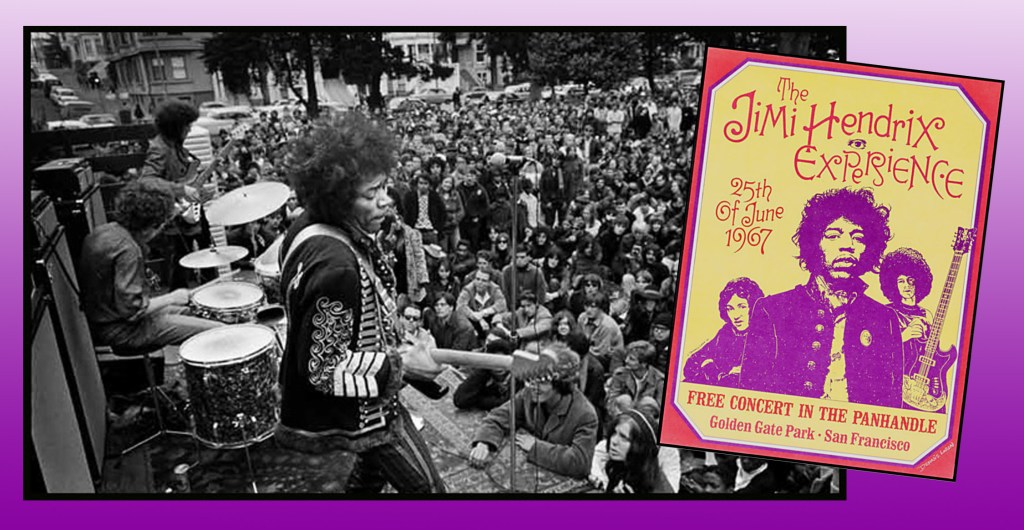
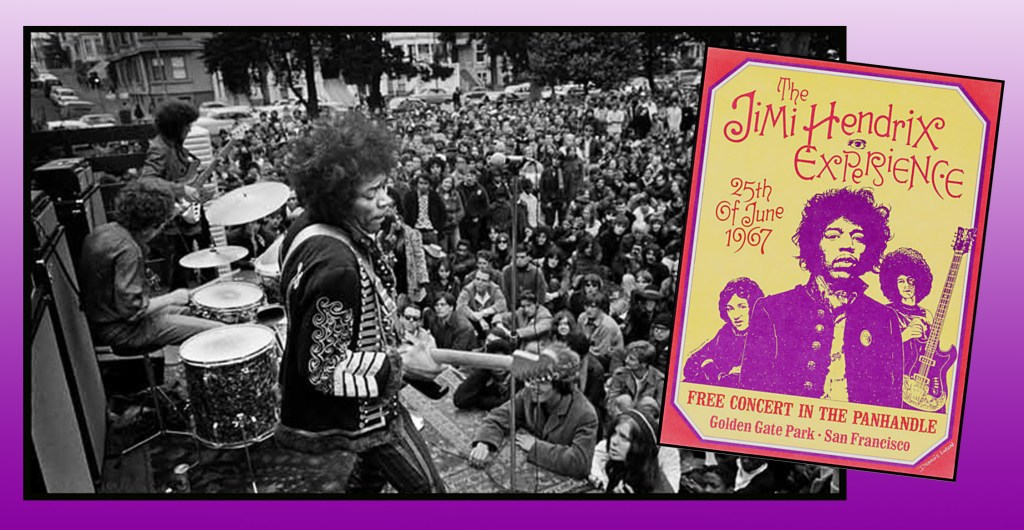
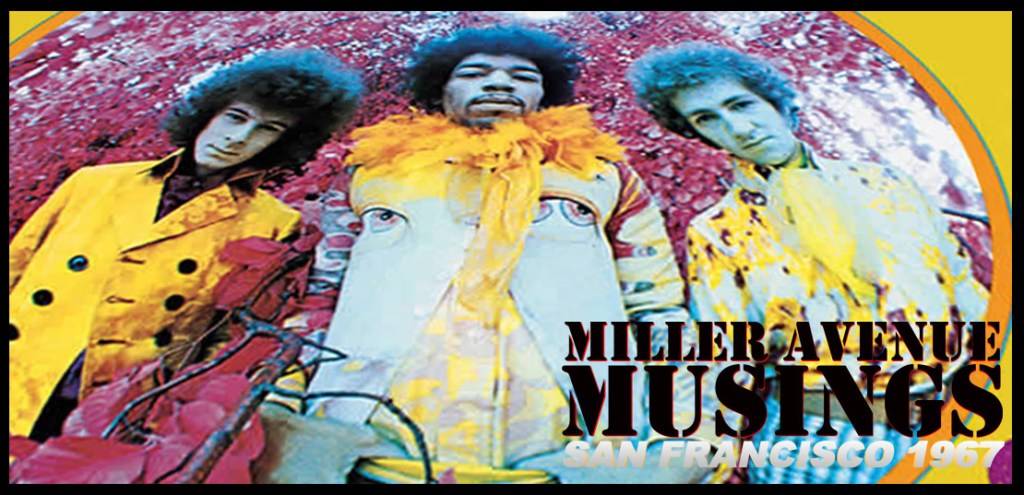
   As Hendrix was also doing a free concert in the Panhandle at Golden Gate Park on that Sunday afternoon I decided to make my way there and have another look and listen.  The Jimi Hendrix Experience was a trio with Mitch Mitchell on drums and Noel Redding on bass.  All three had crowns of fizzy long hair and were dressed in what looked like old fashioned marching band jackets.  They performed on a flatbed truck which was parked at the Baker Street end of the Panhandle and they attracted a sizeable crowd. 

Hendrix plays in the Panhandle. The eagle eyed among you can spot John Goddard of Village Music in the front row wearing dark glasses just above Jimi’s right thumb.

   The only songs they played which I knew were Wild Thing and Hey Joe which had been a radio hit the previous year for The Leaves but the rest of his material was original.  As with The Doors I bought their LP entitled Are You Experienced?  The song I particularly liked was Purple Haze.  The instrumentation conjured images of a factory with massive machine-like hammers going up and down.  Because his diction was not too clear I and a few friends mistook the line: Excuse me while I kiss the sky for Excuse me while I kiss this guy and assumed that Jimi Hendrix was gay.

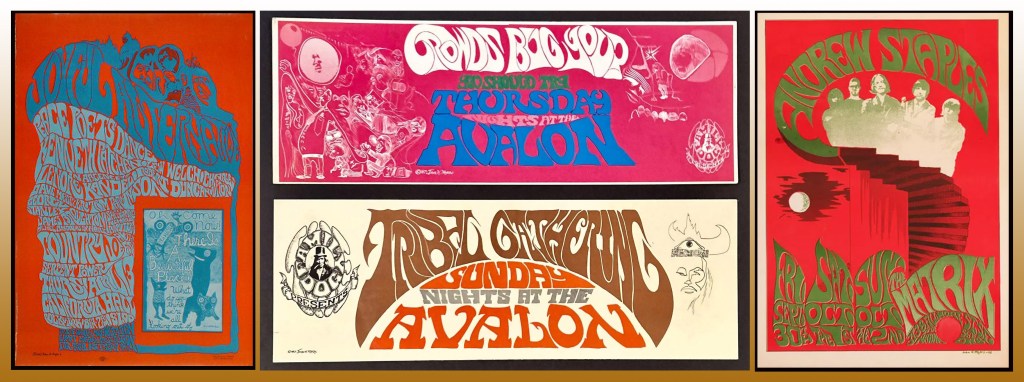
   I continued doing poster work for individual bands and, of course, socialising smokily with my friends in Mill Valley.  I picked up a bit of poster work from Bill Graham’s rivals over at the Avalon Ballroom.  I did a few bumper stickers to promote their two quietest nights, Thursdays and Sundays.  

A few bits of poster art I did after leaving the Fillmore.

   I was not an early riser during 1967.  I stayed up late and slept late.  If I was at my parents’ in North Beach, I would draw pictures into the night and early in the year I found an FM radio station which played good music all night long.  It was KMPX and the disc jockey was named Larry Miller who had a very nice personal style with none of the usual DJ malarkey.  Since I first discovered pop radio as a kid in the early 1950s I had found disc jockeys incredibly annoying.  Were it not for the music they played I would never have listened to their asinine babbling but Larry Miller was nothing like that and I regularly listened to him all night.  He didn’t play hit records but rather music which clearly appealed to him.  He also played records with drug related subject matter.  Cocaine Blues by Dave Van Ronk was one and The Pusher by Steppenwolf was another.  The Pusher was actually written by country artist Hoyt Axton but Steppenwolf made it their own and I became rather hooked on that song.  John Kay’s voice was raw, soulful and a bit scary as he sang with a righteous fury about getting his bible, razor and gun in pursuit of the pusher-man. 

A handbill which DJ Larry Miller designed himself for his show on Radio KMPX.

   I had never heard anything by the Velvet Underground until Larry Miller played it.  I was a bit shocked by the words to Heroin with Lou Reed describing sticking a spike into his vein.  KMPX exposed me to music that I never would have heard otherwise.

   Around this time I was invited up to Coco Cutler’s apartment on Telegraph Hill.  Coco was an old friend of my parents from their political past, meaning she was left wing.  She was in her sixties, physically tiny and had a beautiful face.  The view from her flat was stunning as it looked out across the Embarcadero and the Bay Bridge.  I had seen an old film, Dark Passage, starring Humphrey Bogart and Lauren Bacall which had a scene of him climbing the steps from the Embarcadero up to just below Coco’s window and was surprised to hear that she had watched them film that scene in 1946.  She said it was impressive just how many times Bogie had to climb that hill.

   The reason that Coco had invited me up to her place was to meet a young friend of a friend who had come from London.  She was Jo Bergman who I liked immediately.  Jo was short with a smiley face surrounded by a cloud of frizzy black hair and her laughter was infectious.  Jo spoke in an American accent but clearly had a European and British sensibility.  Coco’s good friends Elliott and Norma Sullivan lived in London and had made the introduction.  Jo was over here working for a friend who ran a record plugging business.  She was biding her time until she would return to London to set up and run the Rolling Stones office for Mick Jagger.  She regaled us with tales about the London music scene and how the Stones were harassed by the police about drugs but they wouldn’t touch the Beatles because they’d been made MBEs by the queen.  

My friend Jo Bergman in three photos with and without the Stones.

   The record plugging office where she worked was located in Columbus Tower which I knew as there was a Zims on the ground floor which I regularly ate at.  I absolutely loved a Zims Burger.  

   As Jo had invited me to visit the office I soon did.  She sat at a typewriter in the reception area on the first floor and her boss, a guy named Bob McClay, operated from the next room.  I guess that his business was recommending discs to radio stations.  We hit it off straight away as Bob was the only person I had ever met who shared my passion for the cartoons of Wallace Wood.  Wood was one of my favourite cartoonists from MAD Magazine.    

   McClay’s office was littered with LPs and singles.  He invited me to take whatever I wanted, so I did and was soon listening to the Bee Gees (New York Mining Disaster 1941), Cat Stevens (I love My Dog As Much As I Love You) and The Who (Boris The Spider).  

   Columbus Tower was located at the tip of Columbus Avenue and Kearney Street and it had the look of a much smaller Flatiron Building which stands on Fifth Avenue in New York City.  It was owned at this time by Frank Werber who managed the Kingston Trio and also ran The Trident restaurant in Sausalito.  As I was always on the hustle for graphic design work, Bob McClay made an intro and I spent some time talking with Werber in his spacious office up on the top floor of Columbus Tower.  He was a very engaging guy and interestingly had a back story similar to Bill Graham’s.  Born in Germany he and his parents escaped the Nazis in dramatic circumstances and he grew up in New York. Though I had a nice time talking with Frank I didn’t come away with any graphic design work.

   Though the city was where I did any business that was going, my emotional home was still Mill Valley where I’d get high with my friends.  A preoccupation for me at this time was to have a good trip on LSD as the few times I’d tried it hadn’t been great.  I guess I was bowing to peer pressure as so many of my friends were dropping acid and having a wonderful time.  They would tell me that I had to let myself go and not let my ego get in the way.  It truly became an aspiration to have a good experience with the drug which seemed to be all over the place.   

   When we got high we would always play records.  Listening to records and singing along with them was a thing I had been doing since I was a little kid.  At nine years old I would jig around my parents’ bedroom to Elvis records doing pretty accurate imitations of him.  I had a passion for the rock and roll of the 1950s which subsided after Elvis went in the army and wasn’t re-ignited until the Beatles came along.  I was totally ignorant of the mechanics of music but this didn’t stop me emulating the vocal styles of John Sebastian, John Lennon and Bob Dylan.  

   As the summer progressed an acetate of a recording by the Beatles started making the rounds.  An acetate was a pre-release disc which wasn’t for broadcast or sale.  It was A Day in the Life which would feature on the soon to be released Sgt. Pepper’s Lonely Hearts Club Band.  I heard it a few times.  First in Bob McClay’s office and then at a packed Fillmore gig.  I was standing near the band room door talking to Dicken Scully when this track came over the sound system.  It began with John Lennon singing wistful lyrics in a mellifluous manner.  Then a full orchestra began a musical climb like a rocket ship, going higher and higher until it crashed into a piano riff with Paul McCartney singing of getting out of bed, catching a bus, then going into a dream.  At this juncture a combination of Lennon’s voice and the full orchestra took us off into a musical dreamscape before returning to Lennon singing his song.  Then the orchestral rocket began again and climbed higher and higher and higher until it finally reached its climax.  Then sounded a beautiful musical chord.  It was like nothing I had ever heard before and the huge crowd at the Fillmore burst into applause.  From where I was standing I could see Bill Graham on the other side of the auditorium laughing maniacally as he looked up at the ceiling.  Having stage managed the playing of the acetate he was clearly pleased with himself.  It was a special moment.

To be continued…

Amazon USA
https://www.amazon.com/dp/B085QN73VQ


Amazon UK
https://www.amazon.co.uk/dp/B085QN73VQ

1967 – The Summer of Love, chapter two

Pictured on the left, Bill Graham

By 1967 I had become a head.  A great deal of my time was devoted to getting high with my chums in Mill Valley.  When one joint had been passed around the room and reached the end of its existence someone would pull another Rizla out of the packet, sprinkle a sizeable batch of grass into it and roll another one.  We would spend hours talking and laughing about ‘straight’ people and how unaware they were about their rituals and behaviours.  We took great delight in considering ourselves different to the rest of society.

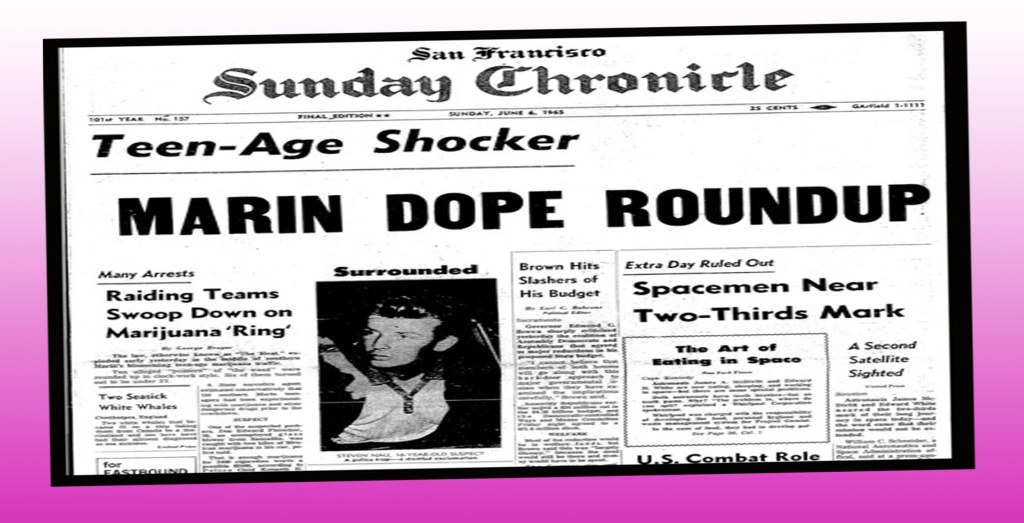
   One aspect of the cultural changes brought about by the dope smoking phenomenon was that it provided a sanctuary for oddball outcasts.  In earlier times young people who didn’t fit in would be shunned by various levels of In-Crowd but the sharing of a joint was a friendly experience which transcended such divisions.  Back in 1965 when I accidentally stumbled upon a highly secretive group of friends who were turning on, there was in play a certain amount of social cross-pollination.  Rich kids who lived in the leafier parts of Mill Valley would be going to Marin City and Sausalito to score their matchboxes from young people who they would never otherwise encounter.  Then the federal narcotics people held a massive raid in the summer of ’65 just before my graduation with a fanfare of publicity which succeeded in popularising marijuana throughout Marin County and in turn the bay area.

The front page of the Sunday Chronicle in June 1965 announcing the big raid in Mill Valley, Marin City and Sausalito.

   The fact was that young people were already ostracised from adult society by not being allowed to drink until they were 21 so the leap to smoking grass was not that big a deal.  And it was a very big social change.  When I first stumbled onto my friends’ clandestine pot smoking it had scared me to death.  But now I was a head like everybody else.

   On one occasion I was very smoke ridden and listening to Donovan singing Season Of The Witch when a friend asked if I had “heard about that Dreyfus guy?”  He then handed me the Independent Journal with a front page photo of Dave Dreyfus above the headline: ‘Helicopter Crash Kills Ex-Marinite.’  

   I was thunderstruck by this news which clearly meant nothing to my friend who couldn’t possibly comprehend its importance to me.  The Dreyfus boys; Dave, Tim and Jared, had been a part of our lives ever since my family arrived in Mill Valley in 1952.  Babbie and Barney Dreyfus were very close to my parents Blackie and Beth and I remember many a barbecue up at Bootjack Camp.    

   Dave had decided to join the army in the early 1960s which was a highly controversial thing considering the leftwing politics embraced by all my parents’ friends.  There was a political chasm between the boys of the Hallinan family and those of the Dreyfus family.  Both Dave and Tim Dreyfus seemed to sidestep their parents’ politics whereas all the Hallinan boys were uniformly militant in their support of a long list of causes which included civil rights, both in the deep south as well as the bay area, and opposition to the war in Vietnam.  Many a fist fight was waged by the Hallinan boys with those who disagreed with their politics.  And they were all tough fighters.  The use of the N word by any caucasian would ignite one of these battles which gained them a fearsome reputation throughout Marin County. 

   Back in 1952 their father, Vin Hallinan was a candidate for president on the Progressive Party’s ticket.  There wasn’t a hope of his being elected but his candidacy was a rallying point for the left which was under serious attack by the federal government at this time.  His opponents were Dwight D. Eisenhower for the Republicans and Adlai Stevenson for the Democrats.  In my sister Nell’s class at Old Mill School they held a mock presidential election and Nellie was surprised to learn that Tim Dreyfus voted for Eisenhower.  He even sported an I Like Ike badge with pride.

Some images from Vin Hallinan’s presidential bid in 1952. In the photo on the left Vin, Vivian and a very young Danny arrive at the polling station at Ross School to be to told by the precinct inspector that because they’d already sent a postal ballot from New York they couldn’t vote that day.

   So when Dave Dreyfus joined the army, all the Hallinan boys were disapproving but Babbie resolutely refused to criticise Dave for his decision.  He did his two years in the service then went to Texas where he learned to fly helicopters and became a flying instructor there.  He was a passenger on a demonstration ride while attending a helicopter convention near palm Springs when the crash that killed him occurred. 

   Dave was only 26 years old.  This was my first experience of death on a personal level and the fact that I got the news through a cloud of marijuana smoke made it all the more upsetting.  The last time I had seen Dave was at my sister Nell’s flat on Greenwich Street in San Francisco.  He was a very engaging and funny guy.  He was gently disagreeing with Nell’s commitment to socialist principles.  “But I like steak,” was his reply to her criticism of eating in fancy restaurants when so many were hungry. 

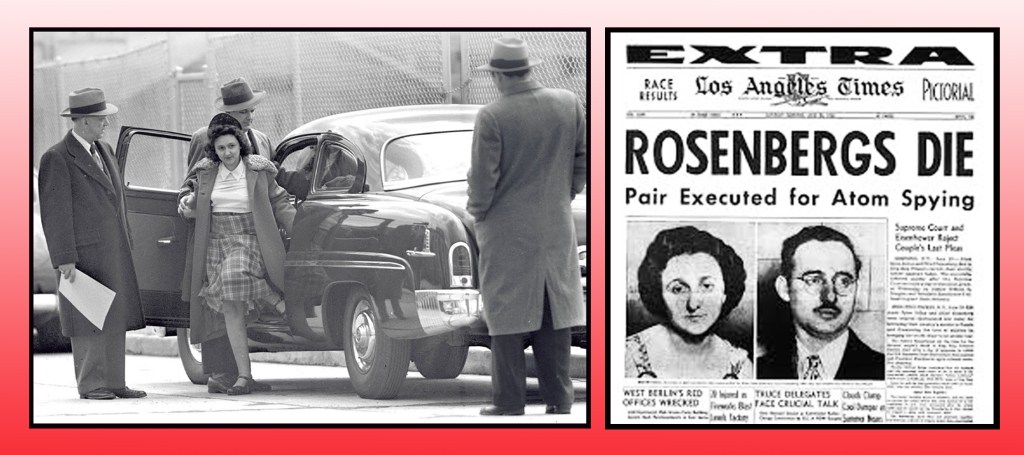
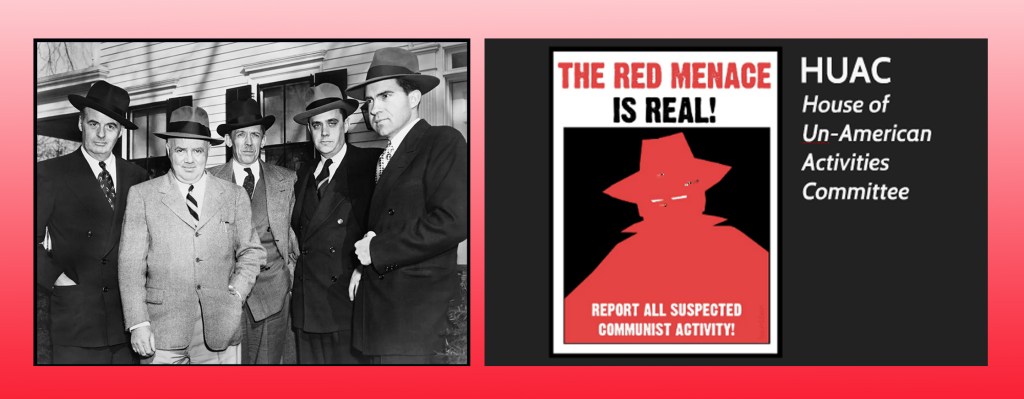
   Perhaps it was fear that turned both Dave and Tim away from their parents’ politics.  The cold war era was a frightening time to be left wing in your political outlook.  HUAC and Senator Joe McCarthy’s investigations ignited a blaze of terror across the nation, the reverberations of which are still felt today.  Guilt by association was a major concern.  My father Blackie told me that, after he was blacklisted, people he and my mother knew well in Greenwich Village suddenly didn’t know them at all on the streets of New York.  The fear of being subpoenaed and grilled about some petition you may have signed in the 1930s meant that debate on matters political became diminished.  The prosecution and conviction of Alger Hiss and the execution of the Rosenbergs sent a powerful shock wave through the families of the left during the early 1950s.  One of the scarier sights would be a visit by FBI agents to your doorstep and all of our families had many such visitations throughout the 1950s. 

Pictured on the left is Ethel Rosenberg being arrested by federal agents. On the right is the front page of the LA Times after they were executed.

   I remember Jared Dreyfus telling me about a kid in their neighbourhood saying to his brother Dave: “When it becomes legal to kill commies I’m going to kill your mother.”  Dave then proceeded to beat the daylights out of him.

On the left is a photo of the House Un-American Activities Committee under the chairmanship of J. Parnell Thomas with a young Dick Nixon standing on the right.

   My brother Jim also decided to join the army the previous year rather than be subject to the draft.  He waited until his 18th birthday in September, 1966 to enlist, thus avoiding the need for Blackie and Beth to give their permission.  Our parents, like all their close friends, were firm in their opposition to the war in Vietnam.  I had a temporary deferment because of shipping out as a sailor and the draft was a big problem which I, in my state of regular smoky intoxication, was simply not thinking about.  The choices seemed to be: getting drafted, going to jail or leaving the country.  One other choice as Ringo Hallinan points out, was fighting to end the war.

   Jim’s decision to deal with it by enlisting was complicated.  In part it was an act of rebellion against my parents and their politics, a fact he would admit to me later.  But it was also to confront those three choices.  Once inside he made a decision to sign up for the stenography corps and, luckily, he served his time in Korea and Germany.

   I too was against the Vietnam war but never fell in with a particularly political crowd so didn’t participate in any of the big demonstrations which were prevalent at that time.  The cycle of my life seemed to be getting a bit of poster work and doing my best to grind out something decent.  Then when I’d finished I would put out my thumb and head to Mill Valley where I would smoke myself into oblivion.

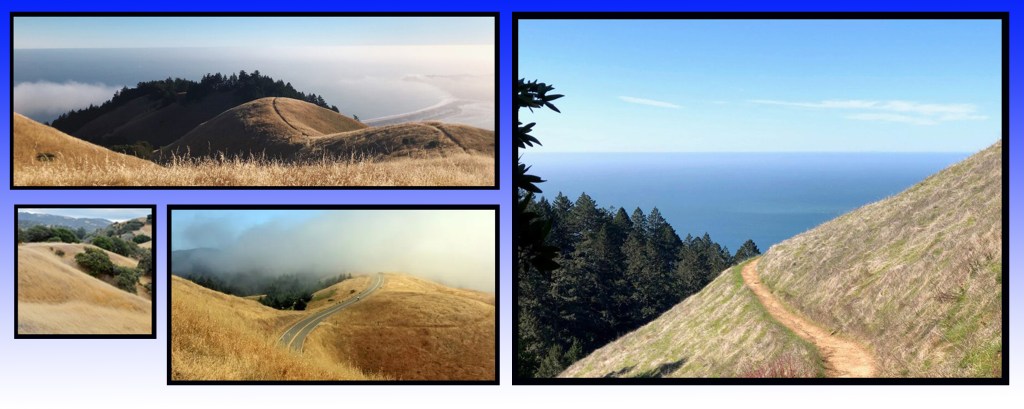
   Among my friends who I would turn on with was a very odd fellow named Matt.  Early in 1967 he somehow got this cabin at a place called Slide Ranch out in the wilds along the Pacific Coast Highway.  There were two routes to reach Stinson Beach: one across Mount Tam and the other along the coast road which you would pick up above Tam Valley.  So if I was hitching to Matt’s place I’d need two rides: one from the city to Tam Junction then another out the coast road.  It took a few trips to get used to where exactly it was as there was a steep dirt road which descended on the ocean side of the highway.  It came down past Matt’s cabin on the left then continued down around to the right stopping at a house at the bottom.  

   I had first met Matt the previous year when he was living on a houseboat in the marshes of Larkspur.  It became a regular hangout for me and was where I developed my passion for The Lovin’ Spoonful.  With a head full of ganja I listened to their first LP over and over.  It was not long after I had returned from my voyage on the Torvanger.  That trip had transformed me from the loud mouthed little guy I was in high school into a slightly introverted fellow who’d been out in the world.  So I returned a changed person and found a very different Mill Valley to the one I’d left behind only a few months earlier.  The pied piper of marijuana had come and taken a considerable number of the children away.  Tam High was practically unrecognisable to me.  A great majority of the boys had long hair and most of the girls sported serapes.  A large number of the students were smoking weed.  

   Someone who personified this dramatic change for me was Peter Perdue.  I had known Peter in my senior year as he was a friend of my brother Jim’s.  Peter was a slightly comical figure who was constantly seeking ways to be entertaining for his friends.  He had a vague resemblance to the comedy star Jerry Lewis and would physically flap around in a similar manner.  When I’d last seen him his hair was short as was every male student at Tam High but now his hair was long and expertly cut to make him look like Sonny Bono of Sonny and Cher.  In fact he dressed in bell bottom trousers and his girl friend of the time, Adrienne Inge, looked and dressed just like Cher even though her long hair was ginger instead of dark brown.  

   Peter was positively evangelical about the sociological changes which were happening.  He would read drug related interpretations into all of Bob Dylan’s lyrics, telling me that Mister Tambourine Man was, in fact, a drug dealer and he told me that the name The Lovin’ Spoonful was a reference to shooting up drugs.  He seemed to feel that the hippy phenomenon (it hadn’t yet been christened that) was something akin to a political movement.  I sifted a great deal of Peter’s opinions on this subject through a filter of skepticism.  But he was a very entertaining person to be around.

   His relationship with Adrienne was about to hit the rocks as she became smitten with an older guy named John Parker.  John was the elder brother of Gregg Parker who, like Peter, was now a senior at Tam.  John had been busted for marijuana possession and was on probation.  This didn’t stop him smoking weed, far from it.  Adrienne lived with her mother Eleanor in a small house on East Blithedale at the corner of Nelson.  Eleanor was an interesting old dame who did not like the business of pot smoking one little bit.  This was tough on her as Adrienne made no pretence about getting loaded on a regular basis.  Her mother made every attempt to become broad minded on this subject but then she would get a bit drunk and go crazy throwing all reserve out the window.  I would have long conversations with Eleanor across her kitchen table but one time I turned up while she was drunk and she pretty much threw me out of her house.

   Peter Perdue meanwhile was going through agonies over losing Adrienne to John Parker.  So it was through John Parker and Adrienne that I met Matt as they would go to his houseboat for their assignations.  

   But now, in 1967, Matt was no longer in Larkspur on a houseboat but all the way out at Slide Ranch which was a seriously remote location.  When I would visit it’d be for a few days.  Whoever had money would finance a visit to the grocery store in Stinson where we’d buy jars of peanut butter, loaves of white bread and bottles of milk, cheap food which went a long way.  I was charmed that a band making the rounds in the bay area was called The Peanut Butter Conspiracy.  However I never actually heard them play.

   Matt had worked as a carpenter but at this time didn’t look or behave like he had a job at all, also he seemed to keep himself stoned on weed around the clock.  He was highly intelligent, articulate and a disarmingly honest person which, at this time of my life, I was not.  So much of what was going on inside my head frightened and embarrassed me.  I think my biggest problem was that I didn’t have a girlfriend.  Bob Dylan expressed my state of mind succinctly in his 1965 song It’s Alright, Ma (I’m Only Bleeding): “And if my thought-dreams could be seen, they’d probably put my head in a guillotine.”

   I was now 20 years old and still living at my parents’ place in North Beach.  Hanging out with Matt and our circle of friends was an enjoyable way of not thinking seriously about my future.

  I soon had another assignment from Bill Graham which was a poster for a one-nighter on a Sunday at the Fillmore with an impressive lineup: B.B. King, Moby Grape and the Steve Miller Blues Band.  I decided to go for an Arabian Nights look and started with a tall chimney out of which came a swirling fog, within which I drew the lettering in a wavy pattern with the names of the bands along with the date and time.  Behind the chimney I drew an evil looking genie who was beckoning to a bald headed man in the foreground holding an equally bald headed child.  The significance of these images was lost on me as I was just letting whatever my hands drew make their way onto the poster board.  To the right I depicted a woman, presumably the child’s mother and behind her another genie with a slightly noble look on his face.  The bald headed child had a long extended arm which stretched around towards the mother.

A slightly skewed view of my artwork for the BB King poster.

   I remember how Bill used to examine Wes Wilson’s posters when he would deliver them on a Friday afternoon.  After perching a ladder against the wall above the staircase, he would staple about eight of the posters up in a row then stand back.  He would stare at them and extend his right arm towards them with his thumb straight up.  He would then rotate his thumb down to the 9 o’clock position and keep staring.  I think he was trying to formulate an opinion of the work Wes had done and as that work was something outside his control, I believe this bothered Bill.  Wes, in addition to Bill, was also in the process of becoming famous and was chalking up some very impressive commissions including the poster for the very last performance of The Beatles at Candlestick Park the previous year.  

   Wes would arrive with a friendly smile on his face.  Bonnie and Wes were highly conversational people but Bill was almost always busy and shooting the breeze wasn’t his style.   Though I had never heard Bill express an opinion on Wes’s posters, he clearly had them and his confidence in matters to do with graphic design was clearly growing.  

   I went in to see him in his little office to get paid for my latest poster for the B.B. King show and he suddenly became very cold and business-like.  

   “What have you got on this poster?” He asked.  “There’s a genie and another genie and a martian.  And a little martian.  I don’t like it.”  He wrote me a cheque for the artwork and said: “Come back when you can do something I like.”

   I was stunned.  His words wounded me tremendously and immediately.  Bill had always liked my work but now he was telling me to get lost.  I walked away from the Fillmore deeply traumatised.  I’d been fired.  If I had been at all professional I would have gone back to the drawing board and ground out some good spec art work and taken them into show Bill but I was not that person at all.  Instead I took refuge over in Mill Valley getting stoned with my friends.  I was too mortified and embarrassed to tell them what had happened with Bill so I just kept it to myself.

   I was, however, still able to walk into Bill’s concerts for free which I did, usually in the company of our friend Augie Belden.  Augie was always in search of a good time and he had a VW beetle which could take us into San Francisco to go see shows at the Fillmore and Winterland and on one occasion we saw a rather extraordinary performance at The Matrix featuring a band we’d never heard of called The Doors.

To be continued…

Amazon USA
https://www.amazon.com/dp/B085QN73VQ


Amazon UK
https://www.amazon.co.uk/dp/B085QN73VQ

The Summer of Love – part 1

Pictured above are The Quicksilver Messenger Service

There was a song which was released as a single in May of 1967 by Scott MacKenzie.  It was entitled San Francisco (Be sure to wear some flowers in your hair).  It went into the charts nationally and also became an international hit.  All of my friends were avid listeners to the popular music of the day and yet I never heard a single one of them enthuse about Scott MacKenzie or his song.  I heard it on the radio and regarded it as a purely commercial pop record cashing in on the hippy scene in the Bay Area.  And yet whenever there’s a television or radio documentary about the Haight Ashbury in that year this is the song that’s always trotted out to accompany it.

   It was written and produced by John Philips of the Mamas and Papas.  The tune was catchy enough but the lyrics were a bit worthy with references to all the “gentle people” to be found in the city by the bay.  True there were many Be-ins and Love-ins that year which is what the song was on about.  But there was a dark side to the hippy phenomenon as well with regular reports in the Chronicle about overdosed dead bodies collapsed in doorways along Haight Street.  The name Charles Manson was unknown then but he too resided in the Haight Ashbury district at that time with his ‘family’ which, along with him, would become infamous in just a few years time.

   The summer of 1967 in San Francisco became known as the summer of love.  The hippy happening was at its height with young people from all over the United States and the world arriving on Haight Street every day, possibly encouraged by Scott MacKenzie and his wretched song.  

   For me, however, as the summer of love reached its peak, I went off the rails on a psychedelic substance and wound up incarcerated in a psychiatric hospital.  I was twenty years old and, as a result, my memories of that year are skewed by this experience.  With hindsight, I was headed for psychological trouble with or without LSD but that doesn’t alter the fact that I flipped out on acid.  And I do know from others that it was a particularly bad batch.

   Working for Bill Graham at the Fillmore Auditorium provided an exciting window on the emerging San Francisco rock scene which had, by 1967, become world famous.  I returned from a trip abroad in January and rang up Bill at the Fillmore to let him know I was back in town and available for any poster work he needed.  I had only been away a few months but things had changed dramatically.  The scene had become nationally and internationally renowned with reporters from all over the world turning up to write about Haight-Ashbury and the music it had spawned.  The two biggest bands, Jefferson Airplane and The Grateful Dead were becoming very famous indeed and there was a gaggle of new poster artists in town.  Before it was Wes Wilson, Mouse and a few others but now psychedelic artwork was everywhere and the advertising industry had begun imitating the lettering style that Wes had made popular with his poster art.  Also Bill Graham was different.  He too was in the process of becoming a celebrity. 

   I went in to see Bill and Bonnie at the Fillmore and he seemed more polished somehow.  He was certainly better dressed, sporting a snappy green suede jacket.  He was now mixing with famous people in the music business and the glow was rubbing off on him a bit.  Enjoying his suede jacket he asked Bonnie if she thought it made him look like a ‘rock mogul.’  

   He’d been back east and seen a special preview of the soon to be released Don’t Look Back, a documentary on Bob Dylan, by D.A. Pennebaker.  He gave his verdict loudly: “Bob Dylan is an asshole!  Albert Grossman steals the show.”  Dylan’s manager, Grossman, is seen in the film prodding London impresario Tito Burns to get more money for Bob.  Bill had become friendly with Grossman after negotiating with him for an exclusive deal on the Butterfield Blues Band.  

   I overheard Bill giving an interview in his tiny office at the Fillmore to a reporter from Time Magazine.  When the article came out, he was furious with the way the guy had written about him.   He felt misrepresented.

   The job Bill gave me was a poster design for a weekend show featuring The Blues Project, Jimmy Reed, John Lee Hooker and the Stu Gardner Trio.  I was very excited about doing this poster and, following my old pattern, I walked up Russian Hill to the corner store where I bought a pack of cigarettes and a Cadbury’s chocolate bar.  I started work about 8pm in the kitchen at my parents’ apartment on Union Street and worked through the night.  I drew a picture of a black male blues musician playing a harmonica which stretched off into the distance and swerved around in a liquid shape to frame the lettering.  On the top of the harmonica I drew a keyboard being played by musicians.  I had a drummer and depicted the vibrations his drumsticks created.  I also did cartoons of Paul Butterfield, Bob Dylan, Pig Pen and Jerry Garcia.  Down below was a black street scene with people dancing and in the right hand corner stood a white police officer with a billy club observing them.  The police officer was not sympathetically drawn.  He looked mean and intolerant.  I was trying to put the blues into a political context.

   All of this appeared on a light green background with the letters coming out white.  I delivered the artwork to the printer and thought no more about it until I wandered into the Fillmore that Friday night.  Being apologetic was not a quality I was used to seeing in Bill Graham but that is exactly how he approached me as I walked up the stairs.  “After all the trouble I’ve had with the police,” he said, “I simply couldn’t allow that picture of the cop to be on the poster.  It would be a red rag to a bull.  I’m sorry but the printer and I had to change your artwork.”

   What he and the printer had done was to black out the entire street scene as well as all the musicians playing.  The only bit of my work remaining was the blues player, the harmonica and the lettering.  To be honest it looked very good.  It was dark blue with a lighter blue for the harp player who was reversed out of the background with the lettering in white.

On the left is the original poster and on the right is what Bill Graham and the printer cooked up.

   The trouble with the police that Bill was referring to had occurred at the Fillmore before I came along.  I remember reading about raids on the hall by the police in the Chronicle before I knew him so I was aware of the reality he was dealing with.  The police definitely harassed him in the early days and the memory of those encounters clearly lingered.  For me the abiding recollection of my poster being changed was the diplomatic way in which Bill had explained it to me.  He was a very persuasive person. 

   Being part of the furniture at the Fillmore meant I got very used to seeing the bands up close and becoming familiar with them and their repertoire.  Quicksilver Messenger Service was a five piece unit which featured John Cipollina on lead guitar.  Cipollina had been in my sister Katie’s class at Old Mill School.   I remember being impressed by their image.  Both lead singer/guitarist Gary Duncan and Cipollina had long straight hair and wore dark cowboy hats making the band look like a gang of wild west outlaws.  For some numbers Duncan would slide his guitar strap around so that his instrument was on his back and he’d beat a cowbell with a drumstick.  As with all the bands at the Fillmore these guys were constantly stoned on weed.

   I didn’t get to know members of Jefferson Airplane until they changed female vocalist.  Originally Signe Andersen was in the band but at some point during my time at the Fillmore she left and was replaced by Grace Slick who I had seen performing with her band The Great Society.  Grace was a very beautiful woman, good musician and terrific singer.  She was also a very nice person, at least to me.  They used to rehearse at the Fillmore in the afternoons and I was always impressed that they would lug their own gear up the stairs.  Early on Bonnie MacLean had introduced me to Marty Balin and I would have regular chats with him in the foyer of the Fillmore while painting my boards.  Another local band, Sopwith Camel, had a hit record on the radio entitled Hello Hello, which Marty described as “a piece of shit.”  The fact that it was being played on KFRC irritated him.  “We’ve got to get a single out,” he said.

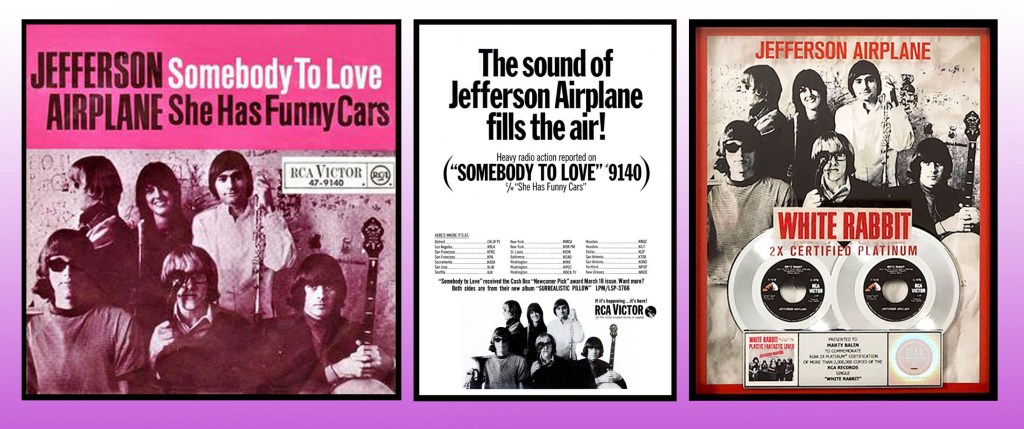
RCA ad art for singles by Jefferson Airplane.

   In addition to Marty Balin I became friendly with their drummer Spencer Dryden.  I remember one day taking a ride down into the Tenderloin district with Spencer in his VW Beetle.  His ashtray was heaving with roaches and cigarette butts.  He lit up an enormous joint as we sped down Geary.  By the time we hit the Tenderloin I was seriously stoned.  Spencer went into some building while I loitered on the street and was soon approached by this smiling black guy in a leather jacket.  “Hey little brother,” he said.  “You want something good?”  He opened a shiny pouch  with three or four enormous fat joints wrapped in bright yellow cigarette paper.  When he realised he wasn’t going to make a sale he moved on quickly.  Then Spencer came out and we drove back to the Fillmore.  I don’t remember why I was along for the ride but I was.  

   My favourite musician in the Airplane was Jorma Kaukonen whose guitar playing was so exotic.  His riffs had something of the Arabian Nights about them.  I never spoke to Jorma but he and Bill had a conversational rapport which was interesting.  He was regularly sitting in Graham’s tiny office just talking.  Bill didn’t shoot the breeze with many people but Jorma was an exception.

   The other band I became very familiar with was The Grateful Dead.  Bass player Phil Lesh and I regularly had a chat as he was a fan of the EC horror comics of the early 1950s and had seen my cartoon of the Old Witch in a comic strip I had done for one of the psychedelic newspapers.  On an evening at the Fillmore I would often go up to the band room and just hang around.  I did an awful lot of hanging around at the Fillmore.  One afternoon up there I saw Pig Pen and Bob Weir leafing through binders with plastic window pages containing black and white 8×10 photographs of good looking women.  

   Like Jorma in the Airplane, I truly enjoyed watching and listening to Jerry Garcia play the guitar.  He seemed to physically propel himself forward with each note he played which was hypnotic to observe.  Garcia was probably the most friendly person on that scene.  He seemed so approachable.  I never engaged Jerry in conversation but he’d always say hello to me.  

   The look of the Grateful Dead was something to send shivers down the spines of most middle class parents.  Very long hair on guys who didn’t really have the right kind of hair to be that long with the exception of Bob Weir.  The Dead had the Haight Ashbury lifestyle written all over them.  One of the funniest numbers in every one of their sets was when Pig Pen (aka Ron Mckernan) would come out from behind his electric keyboard and sing Good Mornin’ Little School Girl.  He had a terrific blues voice and the sight of him with his long hair and beard singing: “Tell your mama and papa, that I’m a little school boy too,” was such a contradiction that it made me laugh every time.

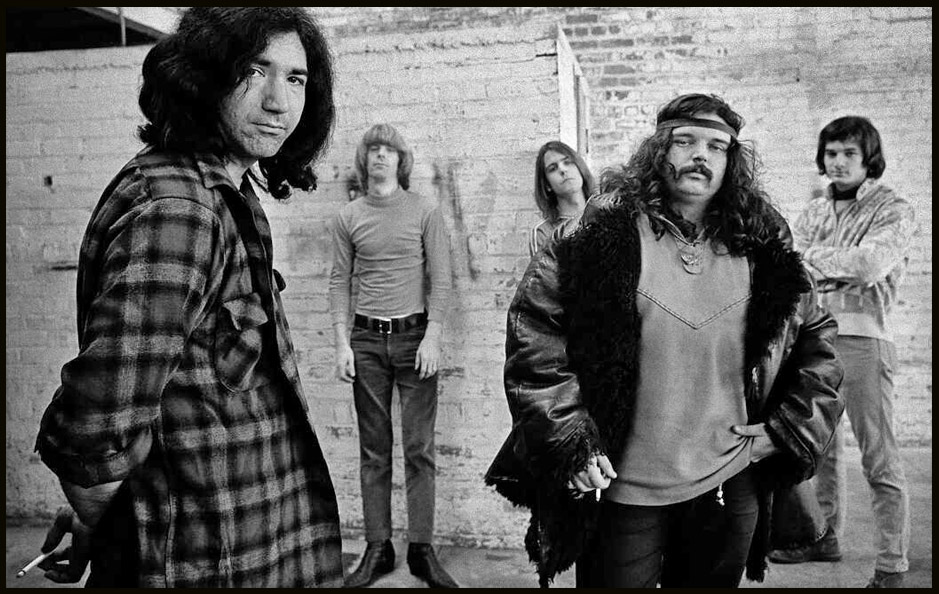
Members of The Grateful Dead, from left: Jerry Garcia, Phil Lesh, Bob Weir, Ron (Pig-Pen) McKernan, Bill Kreutzmann

   Bill Graham kept a cowbell and drumstick in his office and when the Dead were doing their second set of the evening he’d bring them out and go to the side of the stage behind the amplifier and accompany them rhythmically.  I never saw him do this with any other bands.

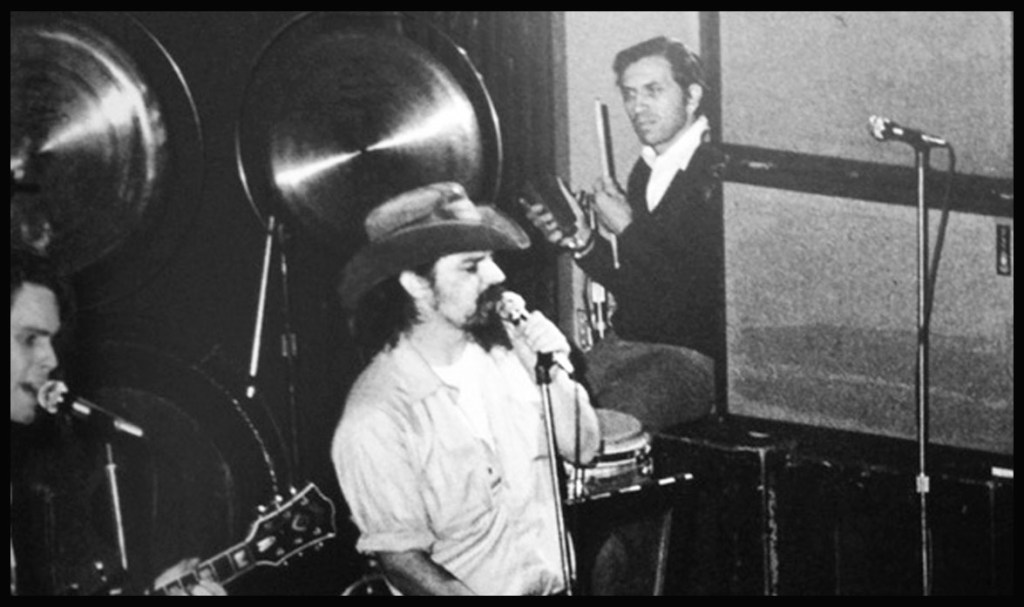
Bill Graham at the side of the Fillmore stage accompanying The Dead with cowbell. From left: Bob Weir, Pig Pen and Bill Graham.

   The band room was guarded during gigs by Dicken Scully whose brother Rock was one of the Dead’s two managers (the other was Danny Rifkin).  Dicken was tall, thin, wore glasses and had long blond hair.  He was a very nice guy to me but was very strict about who got beyond that door.  Lots of people tried to get past Dicken but unless he knew you had a genuine connection to one of the bands playing he was resolutely firm in denying access.

   One thing that hanging around the Fillmore did for me was to feed the fantasy of becoming a performer myself.  I was much too shy to get up on a stage and sing but it was an aspiration which grew as I clearly had the talent and a good singing voice.  On long walks home from the Fillmore I would compose my own songs.  My route home took me down Geary to Van Ness.  I’d then turn left on Polk Street and walk however many blocks to Union.  Then I’d turn right, going up and over Russian Hill until I reached my parents’ apartment.  The walk took me about forty minutes which was just long enough to write a song and once inside I’d scribble the words down on a piece of art work.  I had a big professional drawing board in my bedroom and was constantly doodling.

   Hanging around the Fillmore was not like having a social life for all my real friends were across the Golden Gate Bridge in Mill Valley.  Every opportunity I had to go there was seized upon with enthusiasm.  My mode of transport was hitch hiking.  I’d put my thumb out on Lombard street and within half an hour I would be walking down Miller Avenue.  I’d make my way to one of many houses where, invariably,  I’d get loaded on weed with my friends who were all indulging in this activity.  As I’d walk in, I’d be handed a lit joint and away we’d go.  The music on the record player could be Dylan’s Blonde On Blonde or Revolver by The Beatles.  A lid of grass sat in a plastic bag on a table surrounded by packets of Rizla cigarette papers.  We’d roll skinny little joints, light them and suck the smoke deep into our lungs.  We would then hold our breath as long as we could and finally release the smoke in a mighty dizzy exhalation.  Much of the conversation which followed was whispered by people holding their breath.

   This was the way of life I had embraced.  Being loaded meant that everything was either interesting or funny.  The smallest detail in a work of art became something enormous and recorded music seemed that much more exciting.  One negative side of being stoned so often was my tendency to talk about creative things I might do rather than actually doing them.  

To be continued...

Amazon USA

Amazon UK

The Agonies of Childhood

Whatever illness I suffered as a small child would always grind my life to a halt as I endured the agony of whatever the ailment was.  Nausea was claustrophobically ghastly and while my stomach swirled I couldn’t imagine any fate worse than what I was experiencing at that moment.  A headache would lock my brain in a shell of brittle torment and toothache would do the same to my mouth.  Each of these afflictions took over my soul and stopped my life for however long it lasted.

   Self inflicted wounds like scabs on my knees, though a constant reality throughout my childhood, were not as bad as actual illness.  In our early years at 10 Seymour, when any of my siblings or I became unwell, my mother Beth was the perfect nurse, getting us tucked up in bed, taking our temperature with a thermometer and, if it was necessary, calling on the doctor to pay a visit.

   I don’t remember ever disliking a single one of our visiting doctors.  They were always friendly men who arrived wearing a smart sports jacket over a crisp white shirt with a coloured silk tie and carrying one of those magical looking leather bags which opened outwards on both sides from the top and appeared to have an entire pharmacy within.  Beautiful clean little packets of pills, syringes, and tiny vials, all stored in neat hermetically sealed compartments.  It looked like everything the doctor would ever need was in that magic bag.  I didn’t like having injections but I never suffered from a fear of doctors and if a shot was necessary I simply braced myself and looked the other way. 

   One of the first injections I remember having was the polio shot which was the breakthrough serum developed by Dr Jonas Salk.  It was quite a big deal as there was a serious polio epidemic at that time and when the Salk vaccine was determined to be effective it was decided to give it to first and second graders.  I was in the second grade and my brother Jim was in first.

   The most exciting thing about it was the fact that we got to leave our classroom at Homestead and travel over to Strawberry School.  Any excuse to leave school was always exciting.  It happened early in June, 1955 and my teacher was Mrs Dempster.  We were all herded onto a yellow school bus in the morning along with my brother’s class.  This may have been the very first time I ever went on a field trip, as we called them, and it was exhilarating to be leaving the classroom and going somewhere different.  I didn’t enjoy going to school much.  Mrs Dempster was a scary woman with a habit of administering corporal punishment to a regular selection of students whose parents had ticked the box which gave her permission to spank their children.

   So getting out of that torture chamber, even just for a morning, was a wonderful treat.  We knew we were going to have an injection but that was still a bus ride away which, to a seven year old, was kind of like saying it wasn’t going to happen at all.  The ride to Strawberry School on the other side of Highway 101 was a great novelty and our mood was upbeat.  The sun was shining and all was well.  Once we got to Strawberry we simply stood in a line to get our shot from a nurse in a white uniform.  When the moment arrived I simply grimaced and looked away.  Before I had time to think, it was over.

   But the reality of what was happening was impressed upon us and we all knew that being inoculated was important.  The worldwide polio epidemic was very serious indeed.  Two of the Hallinan boys, Butch and Tuffy had both been struck down by polio and Danny also suffered a milder attack not long before we were all vaccinated.  So even though I was very excited about riding the school bus over to Strawberry, I was aware of the significance of Dr Salk’s breakthrough serum.

   But other conditions plagued me while at school like my eyesight.  I didn’t get glasses until I was in the third grade which meant that much of my early years at school were spent sitting in the front row squinting at the blackboard for I was very short sighted and could barely make out what was written.  I think that my headaches, which were frequent, came about because of this eye strain.  The healthcare plan we had was patchy as my father Blackie didn’t begin working as a ship’s clerk on the San Francisco waterfront until later in the 1950s.  I think we must have been sponsored for Permanente health care by someone else in the Longshore Union because all four of us did make visits to Kaiser Hospital in the city and that is definitely where I had my eyes tested for my first pair of spectacles.  I didn’t like wearing them but had to concede that I could now see what was written on the blackboard.  They also improved my enjoyment of movies at the Sequoia.

   They were horn rimmed glasses and I didn’t like the look of them.  They went back in my shirt pocket when I wasn’t gazing at the blackboard or watching a movie.  I believe this on-again-off-again business contributed to my headaches.  My three best friends, Glen Pritzker, Alex Robertson and Billie Bowen all lived up above Tam High either on or near Morning Sun and one day I went home after school with Alex where we played games and read comic books.  When I left his house to walk home I already had a headache.  It was a hot afternoon and the bright sunshine made it worse.  From Alex’s house I had to first walk down into Homestead Valley and by the time I hit ground level at Reed Boulevard my head was throbbing much worse than usual.  I turned up Ethel to Montford and then began the climb up the big hill on Molino, a task I always found daunting but on this occasion it was doubly awful as my head pulsated with waves of hurt which became worse the closer I got to home.  By the time I finally arrived at 10 Seymour I was walking so slowly as each footstep exacerbated the now very severe pain.  When I entered our house my mother could see that I was not well and before long I was tucked up in the double bed in my parents’ room.  It was still light outside as I lay there in a state of such severe agony that the slightest sound would reverberate through the inside of my skull and I could hear every tiny noise being made in the house.  My sisters chattering with my mother down in the kitchen, cars driving past on Molino which was many yards away from our house.

   When I woke up the next morning I was in my own bed and the pain was gone.  I’m pretty certain that what I experienced was a migraine and, though I was to carry on having headaches up through my early twenties I never had one that bad again.

   The injuries which caused me to have scabs on my knees seemed to be a constant reality throughout my childhood.  One scab in particular was the worst because it existed on my upper lip just under my nose and seemed to take forever to dry up and fall off.  I was cycling to Alto School one morning during the sixth grade and, as brother Jim and I never rode our bikes down the big hill on Molino, I pedalled my bike down Janes Street instead with its twists, turns and hairpin bends.  The street joined Montford at the end and at this time on this stretch there was a long straight wound in the road surface.  I was going at quite a clip and, not noticing this gash in the road, cycled right into it.  My wheels were immediately trapped inside this long slit and as it tapered off to nothing it stopped my front wheel dead and I flew over the handlebars head first onto the pavement.  Ouch!  The shock, pain and embarrassment of this incident was severe and the rest of my ride to school was a bit sombre.  I don’t remember any blood on my upper lip but it was painful and moist.  By the next day however I had a scab which started off the colour of my flesh but after a few days became dark and looked like a Hitler moustache.  It’s my recollection that it stayed on my upper lip for at least a month which was a long time for a twelve year old boy.

   Because I spent so much of my youth playing out on the Pixie Trail I became aware of certain effects the weather would have on my body.  Coming out of the sun on a very hot day into the shade of our house would cause an immediate burst of perspiration on my forehead.  Little individual bubbles of sweat would appear at the same time and I would rush to the bathroom mirror to observe them up close as I made dramatic expressions with my face.  This would put me in mind of films I had seen at the Sequoia like King Solomon’s Mines.  I would stare at myself for the longest time not interfering with the beads of sweat until they gradually grew so large that they burst and ran down my face like tears. 

   One time I was out on the Pixie Trail with my friend Johnny Lem.  There was a high road and a low road and I was down below while John was up above.  We were unable to see one another though we could hear each other’s voice clearly.  He must have thrown a rock which, amazingly, hit me square on the top of my head.  It hurt and I complained loudly and his apology was immediate.  However I didn’t think a great deal of it until I became aware of liquid running down my nose and dripping off its tip.  It was blood.  I was bleeding from the top of my head.  The pain of the rock had gone so I began walking briskly home.  I knew that at this time my mother would be washing dishes at the kitchen sink which overlooked our front porch.  I began to rehearse my performance.  I was fairly confident that I was really okay but this was too good an opportunity to act the part of a seriously wounded man.  I began to limp as I staggered up the hill towards Seymour Avenue.  The blood was now all over my face and continued to drop in dusty splats onto the dirt pathway.  As I approached the wooden turnstile on our road I extended my arm as if I needed to grasp onto it like someone who was dying.  I was playing this one for all it was worth.  I staggered through the stile along our road and turned down our steps towards the front porch where, as I suspected, my mother’s jolly face was visible in the window.  Poor Beth never stood a chance.  The sight of her little boy covered in blood and limping weakly gave her such a shock.  But Beth was a trained nurse and immediately put my head under the tap and within moments the bleeding had stopped, bringing my performance to an end.

   However the agonies of illness were no fun at all.  The only good part was being able to stay home from school and listen to the Art Linkletter Show on the radio.  When I was home sick, Beth would usually make a trip into town and buy me a comic book but regardless of how detailed a description of the comic book I gave her she always got me the wrong one.  So my pedantry gave me as much agony as my ailments in a childhood beset with minor traumas.  That having been said I never ever wanted to be in another family.  The Myers household was definitely where I belonged.

Amazon USA
https://www.amazon.com/dp/B085QN73VQ


Amazon UK
https://www.amazon.co.uk/dp/B085QN73VQ

The Dying Days of 1968

While growing up in Mill Valley, my experience of record shops was limited to Village Music which was small and located in the Sequoia Theatre building on Throckmorton.  In the early 1960s Sara Wilcox who owned and operated it moved up to a more modern unit on East Blithedale.  I had known Sara since I was in the third grade and she would always play whatever my pal Glen Pritzker and I ever wanted to hear.  Party Doll by Buddy Knox?  Sure thing.  Wake Up Little Susie by the Everly Brothers? Of course you can.

   But in 1968 when I was living in San Francisco, I discovered a new, less personal kind of record store.  It stood at the corner of Bay and Columbus and it was called Tower Records.  I had never encountered a store like this before.  It was big and more like a supermarket than a record shop.  It was impersonal, not at all like buying records from Sara.  The record covers were all shrink wrapped in cellophane which was never the case at Village Music.  I would spend a lot of time leafing through the bins.  I had to really want an album before making a purchase.  

   What prompted me to buy Johnny Cash at Folsom Prison I don’t remember but I was fascinated enough to get it and once I had, I listened to it a lot.  Something about him playing to a truly captive audience fascinated me.  Cash seemed to have cultivated a kind of outlaw image which appealed to the convicts.  When he sang: “But I shot a man in Reno, just to watch him die,” they cheered, whooped and hollered.

   Of course I knew Johnny Cash’s records from the 1950’s like I Walk The Line and Ring of Fire but I can’t say that I had followed his career at all and always thought he sang a bit flat.  And that strange quality in his voice was all there on the Folsom Prison disc but something about this record was utterly compelling and I listened to it again and again.  The first song was Folsom Prison Blues which I had never heard before even though Cash had first recorded it in 1955.

   During my senior year at Tam High, the male students all went on an expedition to the prison at San Quentin which was a very sobering experience.  Those young women who were also seniors were not allowed to go on this trip.  We were instructed not to look at or talk to any of the inmates and the only interaction we had was with a prisoner who was working in the library.  We were heckled by a crowd of convicts as we walked through the dining hall.  It was a bit alarming to troop single file through the gas chamber which was much smaller than I had expected.  On the bus back to Mill Valley there wasn’t a lot of casual banter.  I guess it was the memory of this trip which made Johnny Cash at Folsom Prison such a compelling disc to listen to.  Those guys who made up his audience were all doing serious time and cannot have been easy to perform for.  Johnny Cash, however, had some kind of special appeal to these men behind bars.

   His band was very good and included Carl Perkins on lead guitar and his wife June Carter on vocals.  Live albums were becoming popular but this LP had an extra layer of drama attached.

   Another disc I bought at Tower Records was Electric Ladyland by Jimi Hendrix which featured the haunting Voodoo Chile.  I had seen the Jimi Hendrix Experience perform twice on their first trip to San Francisco in 1967.  Once at the Fillmore Auditorium and again one afternoon in Golden Gate Park’s Panhandle where they performed on the back of a flat bed truck.  

   By late 1968 I had moved from the city and was living in a shared house on Medway Road in San Anselmo with two fellow ship’s clerks, Jim Mulligan and Bill Bechtold.  Working on the San Francisco waterfront was a bit of a commute from northern Marin.  I’d catch a Greyhound bus on Central Avenue and ride it all the way to the Ferry Building in time to get to the hiring hall.  I was saving money for my trip to London so I worked a lot.

   On the front I occasionally saw my old school friend Steve who, looking sober and alert seemed to be keeping on the straight and narrow with his drug problem.  Steve had an amphetamine addiction but had been on the wagon for quite some time now.  Someone I didn’t know but saw a lot of when I worked on the north side was the long haired fork lift driver known as the Greek.  He was befriended by my housemate Jim Mulligan who invited him to come up to Medway Road for New Year’s Eve.

   Several of Mulligan’s buddies from New York began appearing and sleeping on the sofa.  One was a guy a bit older than me and for some reason he and I found ourselves in Mill Valley early one evening and decided to hitchhike back to San Anselmo.  It was getting dark as we stood by the gas station at the junction of East Blithedale and Camino Alto with our thumbs out.  A middle aged woman with a little boy in the back seat stopped for us and we got in.  “Have you eaten?” she asked in an unnaturally urgent tone.  “You must eat.  I insist.”  She then turned left on Lomita and drove to her house in Alto where we got out and went inside.  The kid disappeared pretty quick and she gave us each a bottle of beer.  As she chatted with the other guy, I sipped my beer and began to feel very uncomfortable.  She seemed to be making sexual advances to the pair of us.  I couldn’t stop thinking of the possibility that an irate husband might suddenly appear.  My friend had no such worries and was responding to her friendly flirtatious chatter.  I finished my beer, told them both that I had to get back to San Anselmo and set off leaving my friend there.  I got two lifts north and was home by 9pm.

   My friend returned to the house on Medway the next day with tales of the night he spent with the woman and the fact that she had a movie projector to watch porno films on.  As I recall he made repeat visits to her house in Alto.

   A movie which I had to see was Bullitt starring Steve McQueen.  Shot in San Francisco, this picture had made the news during the filming and I knew a ship’s clerk on the front who had a small part in it as a police officer.  Steve McQueen was very cool.  I first saw him in The Blob at the Saturday matinee but he hadn’t made much of an impression in that.  The first time he impressed me was in Never So Few which my father Blackie took me to see at the Sequoia.  He drove Frank Sinatra’s jeep and a combination of his expert athleticism and his nonchalant manner made him very watchable.  He also resembled my future brother-in-law Lonnie Thornton who was living with my sister Katie in the city.  The big selling point of Bullitt was the car chase with McQueen driving a Ford Mustang.

   My next purchase from Tower Records was Beggars Banquet by the Rolling Stones.  I found it a bit of a mixed bag.  Having loved a few of the Stones’ LPs like Aftermath and Between The Buttons, some of the songs on this album appealed to me and others not at all.  I was indifferent to Sympathy For The Devil and thought Street Fighting Man to be reminiscent of Jumping Jack Flash which I hadn’t liked at all.  The only track I really enjoyed was Stray Cat Blues which was odd considering how much of a fan I had been.

   The crash pad dimension of our house intensified in the dying days of 1968.  A lot of hippies who neither Mulligan nor Bechtold actually knew began staying over and my indifference to the song Sympathy For The Devil transformed into hatred as this one long haired guy played it over and over, dancing around the living room to it.  One evening the house was so crowded with strangers that I retreated to my bedroom.  I was soon joined by Bechtold, Mulligan and Geri.  We all wondered who these people were and how we could get rid of them.

   One guy who turned up was a long haired bearded fellow who ate macrobiotic food and soon commandeered our kitchen with sacks of different types of grain.  This was when Bill Bechtold made his joke about getting a grain elevator installed.  This guy used to do his karate exercises out on our front lawn and he had a pretty girl friend with long dark hair.  One day on the waterfront I didn’t get a job at the hiring hall so took the Greyhound bus back to San Anselmo where I arrived about 10am.  As I walked in the door I could smell bacon cooking and entering the kitchen I saw the macrobiotic guy’s girl friend frying the bacon.  She spun around in a state of panic and said: “Please don’t tell him!”

   One regular visitor to the house was a very tall thin caucasian guy with medium length dark hair.  He lived in San Rafael, was soft spoken and seemed friendly.  He didn’t have any regular attachment to anyone living there so I came to the conclusion that he was a drug dealer and nothing in the chats I had with him made me think differently.  Presumably he’d come around to our house to provide somebody with some grass or something stronger.  It was after my doctor told me that I could no longer smoke weed that I began hearing about cocaine from my friends.

   For me the magic of the summer of love had become a distant memory perceived through the thick fog of depression and heavy medication.  Practically every day in the Chronicle would be news of yet another runaway kid found dead from an overdose in a doorway in the Haight Ashbury district.  News from the Vietnam war was equally grim and the turmoil of anti-Vietnam war protests on US campuses was like another war altogether.

   At San Francisco State College a strike was organised by the Black Students Union and the Third World Liberation Front to establish an ethnic studies department at the college.  Ronald Reagan, who was governor of California at this time, expressed his impatience with those running the college and sometime in November Robert Smith resigned as president of SF State and was replaced by S.I. Hayakawa, a professor of semantics.

   I had encountered Mr Hayakawa many times while working at the Bus Depot in my high school years.  A short friendly man of Japanese descent, he and his family lived in Mill Valley up in Blithedale Canyon I believe.  I also had known his son Alan who was among the cast of The Crucible which was directed by Dan Caldwell at Tam High.  For some reason I expected Mr Hayakawa to be politically left of centre but he quickly demonstrated that he was very hardline against the strikers.  The violence on SF State campus escalated alarmingly.  

   I would read reports of the confrontations between student strikers and police at SF State in the Chronicle on the bus into the city then see it on the TV news in the evening.  The SF Police Tactical squad were regularly on the campus and photos of them in their round helmets regularly appeared as they battled and arrested the striking students and faculty members.

   As Christmas approached my parents Blackie and Beth gave up the apartment in North Beach and moved back to their house on Catalpa in Mill Valley.  I spent Christmas there with them but went back to San Anselmo soon after.

   There seemed to be a special significance to the coming of 1969 probably because of the common usage of ’69’ to denote oral sexual intercourse.  However it was another new year’s eve with all the promise of exciting possibilities.  Our house on Medway Road was full of social traffic as the evening began.  There wasn’t a party there but someone in the neighbourhood was having one which all of us were welcome to attend.  Jim Mulligan had invited the Greek, the long haired forklift driver from the waterfront and he brought his guitar with him.  He played it beautifully.  What I knew about the Greek was that he had been in the marine corps and served in Vietnam.  I had seen him driving his forklift truck on the front many times.  His manner on arrival that evening was friendly and gentle.  He was of medium height with a muscular build and had fairly long dark hair which was curly.  He lit a joint and sat in the living room with his guitar which he began playing.  Mulligan and I were enjoying his music.  At about the same time our housemate Geri’s rather boozy boyfriend was trying to make a long distance phone call in the kitchen.  He asked in a slightly aggressive manner for the Greek to keep the noise down.  I think our guest did try to play quietly but he didn’t stop.  Geri’s boyfriend, who was already drunk by 9pm kept shouting from the other room to keep the noise down but the Greek kept on playing.  Finally the drunken boyfriend snapped, ran into the living room and lunged at the Greek.  What then occurred happened very quickly.  Our guest dropped the guitar and threw his right hand out towards the attacking boyfriend who went flying backwards onto the kitchen floor.  That was all I saw and I have no idea what the Greek did.  The drunk boyfriend was now lying on his back, unconscious, on the kitchen floor.

   “Oh man,” said our guest.  “What a drag.  I didn’t want that to happen.”  He quickly picked up his guitar and left our house.  The boyfriend regained consciousness soon after and another visitor came in through the back door, the drug dealer from San Rafael who had someone behind him.  It took me a moment to recognise my school friend Steve from the waterfront as he looked absolutely terrible.  He hadn’t shaved, his hair looked longer and greasy, his eyes were wild and the clothes he wore looked dirty.  The poor soul had clearly fallen off the wagon.

   It was not a joyous new year’s eve for me.  The drama of the Greek knocking out our drunken housemate and the sight of Steve in a clearly drugged up state put a damper on any positive feelings I had as the clock struck midnight and it became 1969.

To be continued: a few delayed departures.

Amazon USA
https://www.amazon.com/dp/B085QN73VQ


Amazon UK
https://www.amazon.co.uk/dp/B085QN73VQ
https://www.amazon.com/Dream-Repairman-Adventures-Film-Editing/dp/097971849X/ref=sr_1_1?crid=2G3KJI477CP21&keywords=dream+repairman&qid=1660498433&s=books&sprefix=dream+repairman%2Cstripbooks%2C151&sr=1-1

1968: The View From San Anselmo

I returned from hitch-hiking in Europe in a very manic state and after an unsuccessful attempt to crawl back into the psychedelic poster business, I went to work again on the San Francisco waterfront and lived at my parent’s apartment in North Beach.  Staying with my parents after all the unhappy experiences I’d been through was problematic so when my brother Jim suggested that it would be better if I moved out, I had to admit he was right.

   I’d become friendly with two ship’s clerks on the front, Jim Mulligan and Bill Bechtold and we decided to look for a rental property together.  Bechtold and Mulligan were both intellectual and witty.  That they were part of the hippy generation was secondary to their educational grounding.  I recall no hip jargon from either of them.  In the summer of 1968 my parents took a trip to England to visit my sister Nell and her family and by the time they returned I had moved out.  Bechtold, Mulligan and I rented a house on Medway Road in San Anselmo.

   My friendship with these two guys was actually a factor in the improvement of  my mental health.  They were both college educated and regularly discussed literature which made a change to the usual chatter with my hippy friends.  

   Mulligan was of medium height with longish hair and a moustache.  He was a very friendly person with a New York accent who always seemed to look on the bright side of things.    Bill Bechtold was very tall with cropped blond hair and a small moustache. I never heard him utter a sloppy sentence.  Not quite as optimistic as Mulligan, he spoke beautifully and with great wit.  He had little patience with self-pity and his description of any indulgence of it was: “to bemoan and lament.”  When hippies descended on our house, decorating the kitchen with macrobiotic food he suggested we get a grain elevator.

   One subject that came up regularly between Mulligan and Bechtold was the anti-intellectual attitudes of many of the ship’s clerks on the waterfront.  Book reading was frowned upon during down-time on a pier.  Bill told us that as he turned up for work one day the head clerk said to him: ‘There’s no reading allowed.’  “I think he suspected I could,” said Bill.

   In addition to Mulligan and Bechtold, we were joined in the house by a young woman named Geri and her boyfriend.  The boyfriend was a manual labourer who would go to work on building sites during the day.  Geri worked in an office and her boyfriend was a pretty heavy boozer, which wasn’t at odds with the lifestyle of Bechtold and Mulligan.  In fact there was a lot of drinking at the house on Medway Road and practically everybody smoked cigarettes.  One of Mulligan’s favourite observations was to describe his craving for a cigarette as ‘oral gratification.’  Weed was also smoked in the house though not by me as I stuck to my doctor’s advice and abstained.  Friends of Mulligan from back east began appearing and crashing on the sofa and as time passed our house gradually became a crash pad.  

   Bechtold was curious about my breakdown because he could see no obvious signs of it in my demeanour.  I guess this indicated that my mental state was improving but I was still socially inept and a bit of a charlatan in group activities.  I felt I was pretending to engage with other people rather than actually doing so.  Again the Jimi Hendrix song I Don’t Live Today described the way I felt.

   There was a house in Strawberry where I had spent a lot of time hanging out in 1967.  It was owned by a very nice middle aged woman who was divorced, had two children and smoked a lot of weed.  There were always young people hanging around her place and I had first met her during that summer before I flipped out.  She was a folk singer under contract to Frank Werber who managed the Kingston Trio.  For some reason Bechtold joined me on a visit one time and she talked about the Beatles in the reverential way that many of us did.  I wasn’t alone in deifying the four Liverpudlians and I think it was this attitude which got on Bechtold’s nerves for he told me later that he found my friend to be naive and shallow.  The Beatles were never discussed by either Mulligan or Bechtold.  And yet the fab four held a magical place in my soul ever since I first encountered them in 1964.

   I was a junior at Tam High when I first heard I Want To Hold Your Hand on the radio then went with a few friends to watch their appearance on The Ed Sullivan Show and that did it.  I came away knowing all four of them by name and for the next year and a half of high school and beyond their music continued to get better and better.  It was in December, 1965 that they released their first concept album Rubber Soul and it was a sign that these four had not run out of steam but were still creating inventive music that everybody seemed to love.  So I definitely idolised John, Paul, George and Ringo and knew all their songs by heart.  I guess that many of my peers did as well.  Of course idolising anyone is a bit ridiculous and I’m sure this was the point Bechtold was making.

   I had brought my record player and several LPs with me to the house on Medway Road.  My relationship with recorded popular music was to continue for many years to come.  Pop music had been a good friend to me through good times and bad but the heady sounds of 1967 which included the Beatles’ Sgt Pepper’s Lonely Heart’s Club Band, had given way to new sounds.  Several of the bands I had known from working at the Fillmore were now becoming big like Jefferson Airplane, The Doors and the Grateful Dead.   While in London earlier in the year I stayed a good deal of the time at my friend Jo Bergman’s flat in Chelsea.  Jo worked for Mick Jagger and the flat she was staying in actually belonged to Marianne Faithful.  Most of the records we listened to there were acetates, pre-release copies.  I remember hearing an acetate of Lady Madonna by the Beatles and Bob Dylan’s bootleg tapes with The Band.  When Jo brought home an acetate of the Stones’ new disc Jumpin’ Jack Flash, one of her American friends said that if they released this now in the states it would go into the top 10.  Well it came out just about the time I moved into the house on Medway Road and did indeed climb to number 3 in the American charts.  I had, by this time, lost much of my interest in the Stones and this record did nothing to restore my enthusiasm.  It had a catchy riff but absolutely no soul and I found the lyrics irritating.

   We had a black and white television set which sat in the living room and was watched by all in the evenings.  Having been deprived of a TV throughout the 1950s, the Myers family finally got one when we moved to our house on Catalpa in 1962.  But I never really got into the habit of watching it.  I found the commercials annoying.  I’d be viewing an old Humphrey Bogart movie only to find it interrupted every few minutes by some blowhard in a suit sitting on a stepladder telling you about his used car dealership on the Bayshore Freeway.  It was a system of rewards and punishments with the commercials being the latter.

   One programme we watched at Medway Road was Rowan and Martin’s Laugh-In.  By 1968 the hippy jargon of the previous year had made its way into the mainstream media and this programme’s title was a play on Be-In, Love-In, Sit-In, etc.  Dan Rowan and Dick Martin were a pair of funny slick nightclub comedians and their writers worked in many acknowledgements of the hippy phenomenon without alienating its audience.  The show consisted of very old fashioned physical gags and up to the minute observations about the drug culture which had spread across the nation like wildfire.  Laugh-In made jokes about the presidential election and the war in Vietnam and some of it was pretty left-leaning.  The look of the show was a blend of the Beach Party movies and psychedelic poster art and two performers who made me laugh a lot were Lily Tomlin and Goldie Hawn.  The only presidential candidate to appear on Laugh-In was Richard Nixon who was filmed saying: “Sock it to me?”

   Laugh-In ran on the NBC network while over on CBS there was The Smothers Brothers Comedy Hour.  Tommy and Dickie Smothers were known to us in the Myers family because we had a few of their LPs from the early 1960s.  Their act was very funny and highly original.  The two siblings were folk musicians whose performance was constantly interrupted by amusing arguments.  The truly funny element was Tommy Smothers reverting to his childhood self with all the stammering inarticulate verbiage that kids actually come out with.  His classic line was “Mom always liked you best!”

   The Smothers discs we had listened to were all recorded in San Francisco nightclubs but now they were big stars on prime time television and their show was every bit as funny as Laugh-In but with a bit more in the way of left wing politics.  Counter culture attitudes and anti-war sentiments were prominent in every programme and the brothers were in a constant battle with CBS executives over the content of their shows.  When Joan Baez appeared as a guest, she dedicated the song she sang to her then husband David Harris, who was going to prison for refusing to be drafted.  The network allowed her dedication to him and the fact he was going to prison but cut out the reason why.

   Bill Bechtold had his draft status adjusted to 1A while we were living in San Anselmo and he too was considering going to prison.  He regularly said that jail held no great horrors for him as it would provide him with lots of reading time.  I had only spent one night in San Rafael jail in 1966 and hated it so completely that I had no such inclinations.  But then by that time I had been disqualified for military service and was 4F.

   It was on the Smothers Brothers show that I first saw Glen Campbell singing Gentle On My Mind, a song written by banjo playing John Hartford.  It was my first indicator that country music was the direction the American record business was headed.

  A performing artist I’d never heard of came to my attention through the rantings of Jim Mulligan.  His hatred for the singer/songwriter/poet Rod McKuen was so intense that he could prattle on about him for hours.  I soon learned that McKuen had written the song When I Was Seventeen for Frank Sinatra as well as many others.  Mulligan would become very animated, expressing his abhorrence of McKuen’s passion for self pity and melancholy.  Though totally unknown to me, McKuen was, by 1968, a true showbiz phenomenon, selling millions of records and filling out concert venues with hordes of devoted fans.  Who knew?  Not me obviously.  His singing voice was gravelly and he said that he sounded like he gargled with Dutch Cleanser.     

   McKuen was later interviewed by Nora Ephron for Esquire magazine in a piece which featured both him and Erich Segal, the author of Love Story.  Ms Ephron did a job on both these two and titled it Mush.  She described them as having the habit of repeating compliments others have paid them, and doing it in a manner that is so blatant it almost seemed ingenuous.  McKuen’s poetry she found to be “superficial, platitudinous and frequently silly.”  She objected to his use of adjectives as nouns: Listen To The Warm, Caught In The Quiet, etc, and her words clearly stung the loner poet as when interviewed by film critic Roger Ebert, he described Ephron as someone who tells lies.  “Don’t get me wrong,” he quickly backtracked.  “I don’t hate her.  I mean, I don’t hate anybody.  In a way, I wish I could hate a little more.  It would make me more of a rounded personality.”  Roger Ebert then found himself agreeing with Nora Ephron’s description of McKuen’s speech patterns, starting with the specific, edging out to the general, back-tracking to tone down any language which might offend and concluding with an apology which seemed self-critical but was really self-praise.  

   Where Mulligan had done all his listening to Rod McKuen I have no idea.  We listened to the Beatles in the house and many other LPs like Blood, Sweat and Tears but nothing by McKuen.  The Beatles released the single Hey Jude which went straight to number one.  Next came The White Album which was a mixed bag, a double LP and unlike Sgt Pepper where all the songs were instantly wonderful, some of it took a bit of getting used to.  I enjoyed Back in the U.S.S.R. with its witty pastiche of the Beach Boys and several of the songs like Blackbird but overall it didn’t coalesce as their previous albums had.  Some of the numbers had an ugly quality.

   One night on the television I saw an NBC special featuring Elvis Presley.  Before I was a Beatles fan, I had been a nine year old Presley fan while at Homestead School in the 1950s.  But Presley had moved away from the kind of rock and roll records I had collected as a kid and by 1968 he had a back catalogue of movies behind him with titles like Girls! Girls! Girls! and Harum Scarum.  When The Beatles met him the first time they asked why he had stopped making the kind of records which had inspired them and he said he was too busy with his movie schedule.

   So I watched with rapt interest what came to be known as the Elvis Comeback Special which featured him performing to a small studio audience.  Dressed in black leather he sang many of his old numbers.  This programme was not at all schmaltzy.  It had a raw quality which stood in stark contrast to all of those bland, formulaic movies with forgettable titles.  It was a ratings success.

   I also saw people I knew from the Fillmore on the TV like The Doors and Jefferson Airplane.  Despite my voting for Hube the Cube, Richard Nixon was elected president.  The year 1968 was drawing to a close and I had been saving my money for the trip to England the following year but my departure would be delayed by a few unexpected surprises.

to be continued – 1969: the final year of the sixties

Amazon USA
https://www.amazon.com/dp/B085QN73VQ


Amazon UK
https://www.amazon.co.uk/dp/B085QN73VQ
Amazon USA
https://www.amazon.com/Dream-Repairman-Adventures-Film-Editing/dp/097971849X/ref=sr_1_1?crid=1BD2T5WNYMXBU&keywords=dream+repairman&qid=1656341009&s=books&sprefix=dream+repairman%2Cstripbooks%2C164&sr=1-1


Amazon UK
https://www.amazon.co.uk/Dream-Repairman-Adventures-Film-Editing/dp/097971849X/ref=sr_1_1?crid=1GH5YLA8CMBS4&keywords=dream+repairman&qid=1656341227&s=books&sprefix=dream+repairman%2Cstripbooks%2C64&sr=1-1

1968: The Presidential Election Campaign

1968: The Presidential Election Campaign

When in the early spring of 1968 I found myself in Paris and ready to take off hitch hiking in a southerly direction, the name of Orléans appealed to me as my first destination.  I was lucky to get a lift all the way there with a truck driver.  He spoke not a word of English and I spoke no French but we managed to get on well and he stopped for lunch at a café where we both ate steak with pommes frites and drank red wine.  He was very good company and having lunch with him provided a window for me onto the French way of life.  

   I met some very interesting folks as I rode south.  One man spoke perfect English and was absolutely scathing about English and American tourists not speaking anything but their native tongue.  “It is lazy,” he railed.  “And it is insulting to the natives of the country they are visiting.”  I guess he was condemning me along with all the rest but he was a very nice guy and drove me all the way to Lyon.

   When I got to Grenoble I met and fell in with a group of English university students, two young women and a young man who took me to this great café which was very cheap and served delicious food.  They were all good conversationalists and my short time with them seemed to bring me out of myself a bit.  My next ride down to Nice was with a beautiful blond caucasian woman who I guessed was in her early thirties.  I thought she was a business person of some description as she was very smartly dressed but the language barrier prevented any conversation so I simply gazed out the window as we zoomed along mountain roads carved out of alarmingly vertiginous cliffs.

   My plan was to hitch across the south coast of France and then on into Spain.  It soon became clear that I’d been lucky with lifts down from Paris as people were not stopping for me along the southern coast.  My meals were mostly a stick of French bread and cheese unlike in Paris where Marc and I ate in great inexpensive restaurants and drank good wine.  But as I trudged through Toulon and Marseille with my bread and cheese, I walked as much as I rode.  I managed to get a lift as far as Barcelona and from there took a train south as I wanted to visit Morocco.  Stupidly I didn’t buy any food for the train to Algeciras, thinking I could get something to eat on board but this was not the case.  I shared a compartment with a large Spanish family who brought out their lunch to eat and immediately offered me some.  I was too embarrassed to accept but when it became clear that I actually had no food, they insisted and I was very grateful as, by this time, I was extremely hungry.

   From Algeciras I took the ferry across the Strait of Gibralter to Tangier but because I had long hair and looked like a hippy they refused me entry and sent me back.  I hitched a ride with an American service family who got me to the rock of Gibralter and by the time I got back to Paris the student rebellion had all but paralysed the country.  I flew back to London on what I later learned was the last flight out before a general strike shut everything down.  

   I returned to San Francisco with big ideas of getting myself back into the psychedelic poster business.  I went to see Bill Graham at the Fillmore who paid me a few hundred dollars on the sales of the four Fillmore posters I had done.  This was before he took over the copyrights and deprived Wes Wilson, Bonnie MacLean and myself of any future royalties.

   The reality was that my mental state was unhealthy and the idea of getting myself back into the poster business proved to be a goal which I was in no condition to reach.  It was at this point that I went to see Doctor Weinberg who prescribed me some sedatives and suggested I get a job.  So I went back to work on the waterfront.  My father Blackie wanted me to stay on the front, get on the B-List, which was a step up from going into the hall each morning, and take art classes at night school.  It was actually a very good plan but I was determined to go back to London and that was that.  I worked as much as I could and saved my money.  

   Though I had followed my father’s wishes and kept my hair short while working on the front there was one clerk who was on the B-list who had shoulder length hair and he simply ignored the cat calls which inevitably occurred when he walked down a pier.  “Are you a boy or a girl?” was a regular refrain.  One guy I noticed on the waterfront was a forklift truck driver who had hippyish long hair but because he was tough nobody gave him a hard time.  His nickname was ‘the Greek’ and I was to make his acquaintance in dramatic circumstances later in the year.  A young man from our neighbourhood in Mill Valley was also working on the front.  His name was Steve and he too had a bad time with drugs but unlike my experience with LSD, which gave me psychological problems, he had become physically addicted to speed.  Steve had cleaned up but looked like he’d seen a ghost when he talked about his time strung out on amphetamines.  

   The presidential campaign began soon after the Republicans chose Richard Nixon as their candidate.  I remember Ronald Reagan, who was then governor of California, making an unsuccessful bid for the candidacy along with Nelson Rockefeller but it was tricky Dick who won in the end.  After the harrowing Democratic convention in Chicago which was beset by violent anti-Vietnam war demonstrations and equally violent police tactics, Hubert Humphrey emerged as the Democratic candidate and both he and Nixon found they were in a three horse race with George Wallace who ran as an independent.

   Wallace was the governor of Alabama and a Democrat who made his name on the international stage as a rabid opponent of racial integration.  According to my father he originally was pretty liberal but lost an election to a white supremacist and vowed never to lose another, hence embracing the cause of racial segregation.

   Every night on the television news during that campaign, a clip of Wallace played from whichever packed auditorium he was in that day.  As there was always a section of the crowd with heckling opponents, he would shout loudly to the baying mass: “You communists and anarchists better have your say because after November 4th you are through in this country!”  At this the crowd of supporters roared its approval.

   Wallace’s campaign garnered a lot of support in the bay area.  His basic appeal was for white segregationists and though we up north didn’t have the kind of segregation they had down south there was a racial divide which operated economically.  Mill Valley was a case in point.  By the time I graduated from Tam High there were only two families of colour who lived there.  Whenever a black person would try to buy a house in Mill Valley, the realtor would jack the price up so high it became unaffordable.  Rumour had it that the first black teacher at Tam High, Mr Marshall, tried to buy a house in our town and was kept out by the prohibitive price hike.

   So there were no men in white Klan uniforms burning crosses on people’s lawns but the end result was the same.  The majority of black people in Marin County all lived in Marin City, not Mill Valley, Sausalito or Tiburon and throughout my time at Tam High there were regular disturbances involving white and black students.  As the grade schools I had gone to were full of white children, the only black people I ever met as a kid were friends of my parents.

   I was always curious about the far right and went with an Australian friend to hear George Wallace speak at the Cow Palace.  It was a spooky experience.  The place was packed solid with white people from all walks of life.  The hecklers occupied a relatively small section but they were very loud and gave Wallace his cue to repeat the mantra I’d heard every night on the news:  “You anarchists and communists…etc.”

   By this time I was reading Rolling Stone magazine and I saw a piece about a recording session that Elvis Presley was doing in Memphis and it stated that the studio was decorated with Wallace for President posters.  Elvis was always very careful not to voice his political opinions and it is true that he had many close friendships with black artists.  Memphis photographer Ernest C Withers, who was black, photographed Presley a few times and said of him: “I was there one time when a reporter asked him why he’d called a black man ‘mister.’  Not too many white people did that back then.  And Elvis said, ‘I called him mister because he’s a man.’”

  I’ve seen photos of Elvis shaking hands with George Wallace but, years later, when the politician was in a wheelchair after an assassination attempt.

   Another celebrity who was questioned by the media about possible sympathy for the governor of Alabama was actor John Wayne who stated: “The only Wallace I know is Hal Wallis.”  It was claimed that Wayne had contributed $30,000 to Wallace’s campaign but the Duke denied that, saying that he was a Nixon supporter.

   Nixon seemed a reborn candidate in 1968.  After his humiliating defeats, first as president against John Kennedy in 1960 and then as governor of California in 1962 when he lost to the incumbent Pat Brown.  He famously told reporters: “You won’t have Nixon to kick around anymore.”

   But this time he’d been groomed by Madison Avenue executives who sold him like soap powder.  Chief among his advisors were Bob Haldeman, an ad executive at J. Walter Thompson and John Ehrlichman, a corporate lawyer.  Both these men later went to federal prison for their roles in the Watergate conspiracy.  Nixon made speeches about the war in Vietnam which sounded meaningful but said nothing.  He concentrated instead on law and order.  He held televised Q&A sessions in which paid actors asked him scripted questions.  The ghost of the 1960 presidential debate where Kennedy looked cool and Nixon appeared sweaty and unshaven had clearly motivated his campaign managers to control every aspect of his presidential bid.  His handlers made certain that no journalist capable of making him look foolish got anywhere near him and his campaign was aided by President Johnson’s decision not to run again.  

   Johnson’s bombing campaign of North Vietnam had, by this time, polarised opinion in the US and Hubert Humphrey supported Johnson’s Vietnam policy.  And though Richard Nixon’s carefully worded speeches on the subject sounded critical of that policy and convinced floating voters that he would end the war, his words were ambiguous.  I remember his TV ads in which he said over a soundtrack of dramatic music: “Never has so much military, economic and diplomatic power been used so ineffectively as in Vietnam.  I pledge to you we shall have an honourable end to the war in Vietnam.”  

   It is true that the Vietnam war had divided the nation.  When I was still at Tam High School I recall those students who were gung-ho and couldn’t wait to sign up.  Although I was against the war I didn’t really get involved in the anti-Vietnam protests.  So here we were in the midst of a presidential campaign with Hube the Cube advocating Johnson’s policy, Nixon criticising it with great ambiguity and Wallace barely mentioning the war at all.

   Both my parents had utter contempt for Nixon who had made his name as a junior congressman on the House Un-American Activities Committee (HUAC) and played a key role in the prosecution of Alger Hiss.  Anti-Communism in the 1950s was an easy bandwagon for opportunist politicians like him to jump on and boy, did he jump on it.  There was a poster from the 1950s which had a picture of Nixon and the slogan: “Would you buy a used car from this man?”  A similar poster appeared after Ronald Reagan’s victory as governor of California showing Reagan as a bad-guy cowboy from one of his westerns saying: “Thanks for the votes, suckers!”

   While all this politics was unfolding I was finding that living at home with Blackie and Beth was becoming problematic.  In 1966 my brother Jim had joined the Army.  He’d done his basic training near Seattle and was now stationed at Fort Ord.  While Blackie and Beth were in London seeing my sister Nell and her family, brother Jim paid a visit and suggested it would be a good thing for all concerned if I moved out.  

   I had become friends with two clerks on the front who were close to my age.  They were Jim Mulligan and Bill Bechtold and we agreed to look for a place together.  We wound up renting a house in San Anselmo on Medway Road.  It was an ordinary suburban house with a lawn in front and a swimming pool in the back.  That sounds glamorous but it definitely was not.  The pool was very small and a bit derelict.  The surround was wooden and worn and one of the first alarming sights I had by the pool was the presence of a large can of ‘Black Widow Poison’ with a vivid illustration of the spider in question.  Nobody ever swam in that pool.

To be continued: next time, the view from San Anselmo.

Amazon USA
https://www.amazon.com/dp/B085QN73VQ


Amazon UK
https://www.amazon.co.uk/dp/B085QN73VQ

https://www.amazon.co.uk/Dream-Repairman-Adventures-Film-Editing/dp/097971849X/ref=sr_1_1?crid=CS3RQFM6TSXW&keywords=dream+repairman&qid=1654179734&s=books&sprefix=%2Cstripbooks%2C84&sr=1-1

1968 – Working on the Waterfront

1968 – Working on the Waterfront

1968 was a year of many parts for me.  I had turned 21 while staying with friends in London on a trip which included hitch hiking around Europe and even finding myself in Paris during the student riots of that year.  I was in the early stages of recovery from a nervous breakdown.  A bad psychedelic experience in the summer of the previous year resulted in me being picked up by the Highway Patrol on the Tiburon bypass and incarcerated in Napa State Hospital for three weeks.  This was followed by months of group therapy, heavy medication and an ultimate descent into deep depression.  So, for me, not much about the following year, 1968, was very joyful.  Certain things, however, were interesting.

   For example I voted in my first presidential election.  I could never have voted for either Richard Nixon or George Wallace so it was Hubert Humphrey, or ‘Hube the Cube’ as my sister Katie used to call him, who got my vote.

   I was by this time working on the San Francisco waterfront as a ship’s clerk, a job I got through my father Blackie.  I was saving my money to return to London which had a magnetic pull for me.  Secretly I wanted to be a singer but I was so buried inside myself that I could only daydream about being on a stage in front of an audience.  However, on my trip to London I had met a young American guitarist and vocalist with whom I struck up a song writing partnership.  He was Marc Sullivan, the son of Elliott and Norma Sullivan.  Elliott was a blacklisted American actor who was an old friend of my father’s.  I had known that Marc had an experience  similar to mine with LSD and this provided a bit of common ground.  So the possibility of writing songs with Marc made a trip back to London something I had to do.

   It was the dream of living in London which kept me going all those months I worked on the waterfront.  Having a good paying job was therapeutic for me as I gradually came back from being very crazy indeed.  The heavy medication which had slowly brought me down from my wild eyed state, kept me going down into the deepest and darkest psychological place I had ever been.  The loud mouthed wise guy I had been as a teenager was locked away somewhere else and I found myself barely able to talk to people.  Jimi Hendrix’s song I Don’t Live Today described perfectly the state I was in.  

   When I had returned from my European trip and was very jittery, I went to see Dr Weinberg who had run the day clinic I’d attended.  “I can put you on the couch and charge you twenty five bucks an hour John,” he told me.  “But I don’t think that’s what you need.  What you need is a job.”  He did, however, prescribe me some tranquillisers which calmed my frazzled nerves.  I was living at my parents’ apartment on Russian Hill and that’s when I started working on the front again.

   Most weekdays I’d get up early and make my way to the hiring hall near the Ferry Building.  The place was packed with men smoking cigarettes.  Though I smoked during this time I could never face a cigarette until after lunch so I found this fog of tobacco smoke disgusting.  If the dispatcher called out my name, I’d go up and be told to report to a pier on the north or south side.  The Ferry Building was the central point of the waterfront and all the piers to the north of it were odd numbers and those to the south even.  I had cut my long hair short to please Blackie as there was a considerable prejudice against men with long hair on the front at this time.

   The job involved doing the paper work of whatever transaction you were assigned to.  One day a teamster arrived at pier 27 to collect forty sacks of coffee beans, so the head clerk handed me the relevant paper work, told me and the teamster where on the pier they were located and off we went.  When I got there I found a team of longshoremen waiting by the sacks which were stacked on pallets.  The teamster drove his truck down the pier to where the pallets were and the longshoremen hauled the sacks up onto his truck.  Every stevedore carried a hook which was an essential tool for jobs like this.  With the hook in one hand he would drive it into one side of the sack then grab the other side with his hand and swing the heavy load up onto the truck.  Every movement of goods had to be checked off by a ship’s clerk.  Sometimes I went down into the hold of a ship with a team of stevedores to load or unload cargo.  If they were unloading, they would stack whatever it was onto a pallet which was then lifted out of the hold by the ship’s winch and over onto the dock.  A waiting forklift truck would then drive it to a pre-determined location on the pier.

   The world of the San Francisco waterfront in 1968 was a totally male environment.  I don’t remember any women ever working on the Embarcadero except in bars and coffee shops.  Today this is different as my nephew Matt Thornton and his wife Eileen are both ship’s clerks and belong to the ILWU.  However all their work is over in the east bay as the piers on the Embarcadero are no longer in use. 

   One reality of an all-male environment was a lot of swearing and quite a few dirty jokes.  The language of the longshoremen was always entertaining.  I was down in the hold of a ship with a team unloading large boxes and when the pallet was full, one of the guys would holler up to the winch driver to lift it out.  The guy operating the winch on this day was not experienced and he didn’t lift the pallet evenly.  It swayed from side to side causing a few of the boxes to fall off.  He had to lower it back down again so the team could re-stack the pallet.  It was still swaying a bit but he managed to lift it out of the hold and get it down to the dock where a forklift truck removed it.  The dockside team then slotted the winch’s two bars onto an empty pallet which the winch driver lifted up above the ship’s deck and over the hold but again it was swinging and banged against the side as he lowered it.  The most senior of the three longshoremen shouted angrily up to the driver that he had to be more careful with the pallets or one of them could get hurt.  I’m sure this guy tried to be more careful but as I recall the loads kept swinging from side to side.  Eventually the head longshoreman was more amused than angry and shouted up to the winch driver: “Man, I’d hate to see you in bed with your old lady.”  At this the other men fell about laughing.

   I remember working with two longshoremen who were joshing each other as they hauled big sacks of cocoa beans.  The first guy complained about something the other had done.  “I can’t help it,”  he replied.  “I was born that way.”  “You weren’t born,”  said the first man.  “Somebody turned over a rock and there you were.” 

   The waterfront was an exciting place to be.  I remember walking down a long pier stacked high with goods on pallets when an earthquake struck.  Suddenly these enormous stacks were swaying back and forth like long grass in a breeze.  It only lasted a brief moment but a very long moment it was.  That none of the loads came tumbling down was a miracle.  I didn’t realise it at the time, but I was participating in a way of life that would soon no longer exist.  Containerisation is now the way that freight is moved across the world.  

   Because of my parents’ left wing politics, I expected the people who worked on the front to be of the same persuasion but that was not the case.  Most of the men working on the front were very conservative politically.  They supported their union, the ILWU and its president Harry Bridges, but that was because Harry and his officials were tough negotiators who got the longshore workers good wages and conditions.  The war in Vietnam was raging at this time and most of the guys on the waterfront were all for it.  They were also ferociously opposed to the student radicals in the Free Speech movement over at UC Berkeley.  When Mario Savio, who had led the student rebellion at Berkeley. tried to work on the front as a ship’s clerk, he was hounded out.

   I first worked on the waterfront in 1966 and one day I was assigned to pier 50 on the south side.  There were only three of us on the pier that day: the head clerk, a man in his late fifties, another guy who was about thirty and myself who was nineteen.  On the previous day, rioting had broken out in Hunters Point after a white police officer had shot dead a twelve year old boy who was black.  I said something complaining about police brutality and racism.  Both these men were instantly infuriated by my voicing such opinions and started shouting angrily at me.  “When I was a kid,” bellowed the older man, “Our police officer would come down the street and if we couldn’t give him a good explanation of what we were doing he’d knock us to the ground.”  The younger man ranted about law and order and it immediately became clear that I was not dealing with people steeped in the finer points of political debate.  And as we were were the only three clerks working that day I was totally out-gunned.  So I simply shut up and stopped talking.  Interestingly these two guys became very friendly towards me as the day progressed.  It was as though they had forgotten completely about our disagreement.

   But by 1968 I was a different person altogether.  My flipping out in the summer of ’67 and subsequent depression, meant that I had neither the will nor the confidence to speak my mind.  It also meant that I was no longer able to participate in the dope smoking activities of my generation.  Dr Weinberg had told me when I first met him that I would no longer be able to smoke marijuana.  Naturally I didn’t believe him but it soon became clear that he was right as every time I got high I became paranoid.

   One positive aspect of my condition was that it made me 4-F with the draft board.  In June I went over to Oakland for my Army physical.  There was only one person I knew from Tam High there and the poor fellow did not look at all happy about going into the Army.  After the physical was over I went to a desk where a uniformed officer sat.  I presented my papers.  With his right hand he raised a rubber stamp up over his shoulder as he rapidily said: “Is there any reason why you cannot be inducted into the United States Army?”  In this brief moment of time before his hand came down I scrambled quickly to produce the letter from Dr Weinberg.  Like a cartoon character this guy morphed from a fairly neutral facial expression to one of granite faced displeasure as he read Dr Weinberg’s words.  It was like watching his face melt into a frown.  I was held over for 24 hours to have further examination the next day.  I have no memory of that experience.  The only thing I do remember was the Chronicle’s headline the next morning that Bobby Kennedy had been assassinated in Los Angeles.

   While hitch hiking in Europe earlier that year it was on the rock of Gibralter that I learned of Martin Luther King’s assassination.  One aspect of my mental condition was a kind of emotional detachment which meant that I didn’t react to either of these utterly shocking events as I would have done before my breakdown.  I remember in 1966 my friend Gregg Parker talking about Bobby Kennedy as someone who was gravitating towards an anti Vietnam war position and that he felt he was smart enough to see that it would be a good platform on which to run for the presidency in 1968.  Martin Luther King had made his opposition to the Vietnam war a regular feature of his civil rights struggle.  So the violent deaths of both these men came at a time when I was emotionally numb.  

   My visit to the rock of Gibralter was in marked contrast to all the other places I’d been to in Spain.  For starters I saw British bobbies patrolling and was also surprised to see wild monkeys roaming around the place.  I purchased a Daily Mirror along with the first white chocolate bar I’d ever encountered.  The paper’s headline informed me that Martin Luther King had been assassinated in Memphis.  

   My hitch hiking trip had begun in Paris where I was staying with my friend Marc Sullivan who was living with his girl friend in an apartment on the Rue de la Harpe.  Marc was working with a folk band called Les Troubadours.  The flat was a transit hub for travelling folk musicians so a lot of hanging out happened there.  In California most hippies smoked marijuana but over on this side of the world it was hashish and the way that joints were rolled was completely different.  The imbiber would pull a few Rizla papers out of its packet and, licking them together, would make a much larger rolling surface.  Then the tobacco from an ordinary  cigarette would be crumbled onto the paper.  Next they’d take the nugget of hash and pass it over a flame, then rub the bits onto the tobacco.  With a tiny cardboard filter, they’d roll up this enormous joint.  The downside of this process was having to inhale the tobacco smoke along with the hash.  As I was now adhering to Dr Weinberg’s advice, I never indulged.  

   Marc had a motorbike and one day I rode on the back with him.  This was during the student uprising and we soon found ourselves in a back street full of police vehicles.  We both had long hair and looked like hippies so the police stopped us.  At this time I didn’t speak a word of French so Marc did all the talking.  He must have convinced them that we were not student radicals and they let us go on our way.  

   After about a week I’d had enough of hanging out and set off to hitch hike south.  Hitch hiking back in the bay area had been a reliable means of transport for me throughout the 1960s and, in addition to getting where I wanted to go, it also offered the opportunity to meet people from very different walks of life.  One time I got a lift from the city into Mill Valley with a nice guy who was a few years older than me and he was talking about hitch hiking around Europe.  As we came down Waldo Grade he described it as the first time he had ever been all alone and that fact had brought him to tears.  He was describing his loneliness as an important turning point in his life and it made an impression on me.  So here I was in Paris with a map of youth hostels to stay in and I picked as my first destination Orléans because I loved the name.  

To be continued: next time – the presidential election of 1968.

Amazon USA
https://www.amazon.com/dp/B085QN73VQ


Amazon UK
https://www.amazon.co.uk/dp/B085QN73VQ

https://www.amazon.co.uk/Dream-Repairman-Adventures-Film-Editing/dp/097971849X/ref=sr_1_1?crid=2M0PVA5PZVVE6&keywords=dream+repairman&qid=1652286958&s=books&sprefix=dream+repairman%2Cstripbooks%2C94&sr=1-1