Of Monsters and Magazines…

Of Monsters and Magazines…

Movies of all kinds were a passion of mine while growing up in Mill Valley but films with a fantastic dimension held a special fascination for me.  Giant monsters running amok in great cities or flying saucers attacking earth would hold me spell bound in a packed Saturday matinee at the Sequoia.

   And yet when I would come away from seeing something like The Day The Earth Stood Still or When Worlds Collide there was no way of holding onto the intense images I had seen.  I remember wishing there was a magazine which catered to the likes of me who loved seeing giant monsters on the screen.  But no such magazine existed.   

   My sister Nell bought Screen Stories every month but they hardly paid any attention to horror movies which, in spite of their huge popularity at the boxoffice, were considered very lowbrow by the media.  

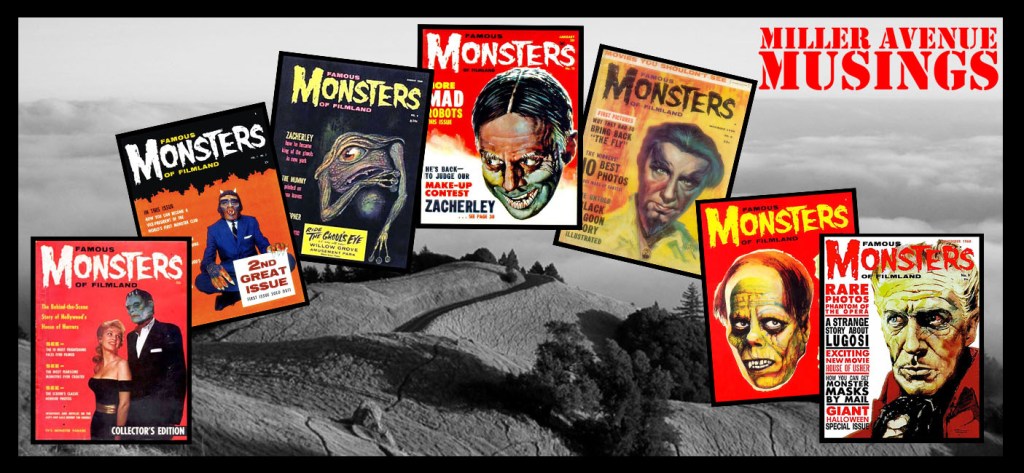
   It was on a trip into the city with my mother Beth and brother Jim that something life changing happened.  We were making a visit to Kaiser Hospital and had taken a cab down to the Bus Depot.  While Beth bought tickets, I gazed over at the magazine rack and there it was.  The very first copy of Famous Monsters of Filmland.  I was stunned.  The cover wasn’t great.  A pretty blonde woman on the arm of a man wearing a rubber mask of Universal’s Frankenstein’s monster.  At the bottom of the cover were the words: Collector’s Edition.  

   Inside it was wonderful, full of exciting stills from different sci-fi/horror movies.  I was immediately smitten and thank goodness my mother coughed up the 35c that it cost.

   For the entire bus ride to the city I hardly noticed the familiar sights as we passed them: The Ondine restaurant in Sausalito, The Golden Gate Bridge, The Palace of Fine Arts.  As the bus drove past all these visual delights, the only things I saw were the wonderful photos in this magazine and because it was about a subject I loved, I read the words too.

   The editor, Forest J. Ackerman, went in for the most appalling puns but he clearly knew what he was writing about.  The Creature From The Black Lagoon became ‘Blackie Lagoon.’  He and the publisher also knew a thing or two about marketing for I soon became enslaved to this magazine.  

   I think that Famous Monsters and Mad Magazine were the only constant passions for me in those days, although I also devoured comic books like Uncle Scrooge, Superman and Classics Illustrated.  

   And I was terribly serious about collecting them.  I remember a particular piece of art deco furniture that served as the place all my comics and mags were stacked in chronological order.  Nobody was allowed to bend the covers back or use them as table mats. 

   It may well be that Famous Monsters inspired me to begin my first movie scrapbook.  I began to save clippings of movie ads from the Chronicle and the film that started me off was 7th Voyage of Sinbad.  I had seen a large poster display for this movie in the lobby of the Paramount theatre and the sight of a giant Cyclops with a horn on its head, a large fire breathing dragon and a big two headed bird convinced me I had to see this film.

   On Sundays the Chronicle had a pink section with all the arts news and it featured a big photo of the Cyclops leaning down to pick up a prostrate Sinbad on a beach.  There was also a large ad for the movie with production illustrations by the special effects man Ray Harryhausen.  That was it.  I decided I would begin my scrapbook with this movie.  

   As the days passed I clipped every ad and article about the film and threw them into my newly purchased scrapbook.  Cutting them out and pasting them in was a job for later.

   The ad in the Chronicle was my first introduction to the name of Ray Harryhausen though I was already a fan of those movies he had made:  Earth Vs The Flying Saucers and 20 Million Miles to Earth were the ones I’d seen at the Saturday matinee but I’d had the entire plots of The Beast From 20,000 Fathoms and It Came From Beneath The Sea acted out for me in great detail by Danny Hallinan.  

   The run-up to Christmas was always an exciting time.  Though my family was financially poor, many of my parents’ best friends were actually millionaires and the generosity of these people saw us though the tough times of my father’s political blacklisting.

   One set of friends back east were Ruth and Luke Wilson who always sent a big box of presents for us all and individual cheques for each of us kids.  Each cheque was for $25 which, in 1958, was more than enough for us to do our Christmas shopping.

   My brother Jim and I made our seasonal shopping trip into the city, catching a Greyhound bus which took us to the big depot at 7th and Market.  Our first port of call were the stores near Union Sqaure: Macy’s, I. Magnin and the City of Paris.  Going to see the tree at City of Paris was a must as it was the biggest in San Francisco.  It had to be lowered into the store by a crane through the skylight. 

   There was also shopping at the big Woolworth’s by the cable car turntable at Powell and Market.  We had lunch at Manning’s on Market and then it was time for the movie at the St Francis which was 7th Voyage of Sinbad.

   This movie grabbed me from the very beginning with Bernard Herrmann’s wonderful Arabian Nights score.  Had this film disappointed me, my scrapbook might never have come to life but that was not the case.    

   Kerwin Mathews’ performance as Captain Sinbad was a solid core to the adventures which unfolded.  Equally impressive was Torin Thatcher who ate the furniture as Sokura the evil magician but the real stars of this wonderful movie were Harryhausen’s magical monsters.

   I was back to see it again the following week and when it finally made its way to the Sequoia I saw it again and now I was able to read about it in Famous Monsters.

   Reading a magazine regularly was a special experience and the people who produced them used a great deal of psychology in keeping their readers coming back.  The cover was always important as it had to hook you.  MAD always had great covers and the Famous Monsters covers got better as they started using Basil Gogos to paint the art work. 

   So whenever school friends would come back to our house they would always lose themselves reading my comics and magazines.  One friend who I first met at Alto in the sixth grade was Craig Bird.  Craig was big, had a greaser hairdo and was also tough.  He had an older brother who had a different last name: Bob Tomei.  Bob was about four years older than Craig and within the ‘greaser’ hierarcy of Mill Valley Bob Tomei was considered very cool.  He had a steady job at our local Safeway and he drove a souped up car of some kind.  He had a reputation as a hard guy and when he would pull into the parking lot at C’s Drive-In, he’d pop his hood and the greasers would gather around to admire his engine.  

   It was when we got to Tam High that Craig started making noises about borrowing my Monster magazines for his brother Bob to read.  I think he mentioned it a few times and finally I said he could.  I told Craig that the covers must not be bent back and he assured me they wouldn’t be.

  It was a weekday afternoon when the shiny vehicle of Bob Tomei drove up Seymour Avenue just in front of our house.  He stayed behind the wheel as brother Craig got out of the car and came in to collect the magazines.  Bob didn’t speak but did nod his head to me from behind the wheel.  Then they reversed down our road and were gone.

   I think he had my magazines for about a week.  Craig returned them to me unmolested.  We were both sophomores by this time and socially we didn’t have all that much to do with each other.  Craig was a greaser and I wasn’t but we still liked each other.  One of my proudest moments was the time that he and about five other kids from our sixth grade class went into the city to see House On Haunted Hill at the RKO Golden Gate and every time Craig got scared he would run out to the lobby.  I was, by this time, a seasoned horror movie veteran and never closed my eyes or looked away and the sight of this big tough guy dashing up the aisle made me swell with an inner satisfaction.

   By the time we were sophomores Craig had become very ‘back parking lot’ meaning he hung out by the Canteen at break time with other greasers.  There was a standard gag at rallies in Meade Theatre where, in the midst of the show, a car would screech to a halt by the stage and several tough guys dressed as 1920s gangsters with guns would take the stage and Craig was always one of them.

   During the football season at Tam High the big social event on Friday nights was to go to the game up at the College of Marin which is where I found myself and who should I see walking along but Bob Tomei with his arm around a pretty young woman.  So I said hello.  He looked at me in puzzlement, clearly not knowing who I was so I said my name and added: “I’m the one who lent you the monster magazines.”  He smiled and walked on.  I thought nothing more of it.

   There was a wall in the back parking lot where most of my friends would congregate at break time and when I arrived during our morning recess who should be there but Craig Bird regaling my friends about how I had embarrassed his brother at the football game.

   “There’s my brother Bob,” he said loudly, “Out with a girl and suddenly this little midget comes up saying ‘I’m the guy who lent you the monster magazines!’  He was just so embarrassed!”

   I stood there, feeling my face go bright red and listened to Craig denounce me over and over.  I then crept away feeling mortified.  

   It never occurred to me to be embarrassed about my passion for monster movies.  The likes of George Lucas and Steven Spielberg have made it easier for modern day kids to love fantasy films but back in the 1950s it seemed to be a dark secret not to be discussed.  Silly me for not realising that.

Amazon USA
https://www.amazon.com/dp/B085QN73VQ


Amazon UK
https://www.amazon.co.uk/dp/B085QN73VQ
A Daily Dose of ‘Dick Tracy’…

A Daily Dose of ‘Dick Tracy’…

There was a daily ritual in the Myers house which all four children and both of my parents participated in which was reading the funnies in the Chronicle.

   We took the Chronicle because it was not a Hearst publication like the Examiner.  The name William Randolph Hearst had the same resonance within our home as Satan in a house of god.  This didn’t mean that my parents liked the Chronicle but it was considered the lesser evil.

   The paper was delivered every morning by a big van which would speed up Seymour Avenue and the driver would throw it, rolled up in wax paper, down towards our porch.

   The different sections would be seized upon.  Blackie and Jimmy liked the green Sports pages while I was a huge fan of the Peanuts section which had the movie ads in it.  Even though each family member would gravitate to different parts of the paper, each one of us would read the comic strips. 

   The Chronicle ran about eight or nine strips stacked top to bottom on a full page which was a moveable feast.  Sometimes it was at the back of the Peanuts section, sometimes in sports and occasionally it would turn up behind the want ads in Herb Caen. 

   It was a fairly diverse collection.  Gordo was a light hearted strip featuring a Mexican guy wearing a sombrero.  Steve Roper was a caucasian photo journalist with a silver haired sidekick named Mike Nomad who sported a crew cut.  Dondi was a little orphan boy of European origin who was always saying: “Goshes Uncle Ted.” A few others were to be found in separate places like Dennis The Menace and Peanuts.

   It was the case that the daily doings of Peanuts were regularly discussed around the Myers dinner table.  Lucy’s introduction of the lemonade-like stand bearing the legend: ‘Psychiatric Help 5¢’ was a source of much amusement at 10 Seymour but the one strip which all our family followed with intensity was Dick Tracy.

   The curious thing about Tracy was that the drawings were so eccentric.  Chester Gould’s visual representations were not what you would think of as great art but his contorted characters, bizarre plot twists and surprises made the strip unmissable.

   As a budding cartoonist I was constantly copying all the comic strip characters and doing Dick Tracy was odd because you hardly ever saw him looking directly at you.  He was mostly in profile with his hat on and his nose was shaped like a box.  His chin was also square and his eyes and mouth were simply horizontal lines

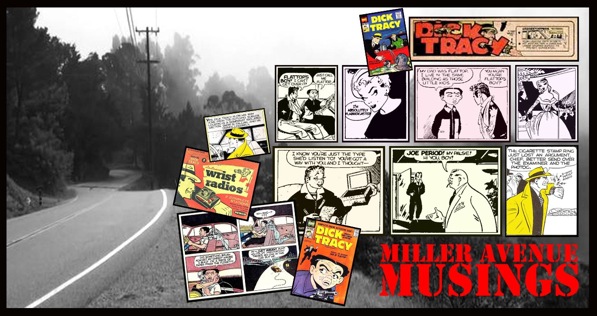
   A source of wonderment for me was his Two Way Wrist Radio.  Tracy was constantly talking into it to communicate with Sam Ketchum or his chief.  This, to my young mind, was an absolutely fantastic concept and I was always pretending to have one on my wrist as I walked home from school.  The big problem for a nine year old was finding things to say into it so I doubtlessly repeated myself a lot. 

   I also had a fascination with the kind of microphones you would see inside police cars, whether they were Mill Valley squad cars or the ones that Tracy and his colleagues travelled in.  These were shaped like a slightly flattened avocado and were connected to the radio by a spiral cord.  There was a button on the side which the officer would press down when speaking into it. 

   It was early in 1956 that we first encountered Joe Period, an absolutely peculiar looking young fellow who was, we soon learned, a ‘wheel man,’ meaning he drove fast cars for criminal gangs.

   Joe was called upon by Mr. Pocketclip, an equally bizarre looking bastard, to set him up with a night club singer named Julie Marrlin.  Pocketclip was a big, rotund seventy year old and the young singer was probably in her twenties but he was lovesick over her though she wouldn’t return his calls.  It transpired that Pocketclip was a disbarred attorney who had defended her hoodlum husband, unsuccessfully, and the state had executed him.  So for him to get to first base with this girl he hired young Joe Period to set him up with her.

   Now at this time in American history a character like Joe Period, in real life, would have probably looked a bit like James Dean but Period was weirder looking than that.  His hair was full of Brylcreem but instead of the Elvis style pompadour, the hair on top was oddly short so that it looked like the upper part of his head was flat.  His eyes resembled two fish swimming towards each other and his mouth was like those on the women Gould drew. 

   It’s fair to say that Chester Gould was not one to worry too much about human anatomy.  The contortions he put his characters through defied most of the natural laws.  What he was pretty good at was perspective and drawing cars but everything else, like hands and legs, had an amateur look about them.

   As the days and weeks passed we would discuss the daily antics of Tracy and his villains.  A policewoman named Lizz joined the force about the same time as Joe Period turned up and she was one of the artist’s more attractive creations.  Perhaps it’s a testament to Gould’s talent and ability that he was actually capable of drawing people who looked beautiful as well as ugly.

   Tracy appeared Monday to Saturday in a strip of usually four boxes but on Sundays the funny papers were all in full colour and three times the size.  Seeing them in colour in their own section was a very exciting thing for me and an added feature with the Sunday spread was the ‘Crimestopper’s Textbook’ in which Tracy would give rookie cops and others advice like: “Make your search thorough!  Dismantled sawed-off shotguns have been discovered concealed on the person.”

   Through a series of compelling incidents, Joe Period wound up murdering the girl singer and becoming the object of a huge manhunt.  We eventually found him shivering inside a giant pickle vat in a rail yard where he was found and confronted by policewoman Lizz. 

   It was at this stage that we met the son of Flattop.  I had no idea who Flattop Senior was but here was yet another of Gould’s ludicrous creations. 

   A ‘flattop’ to my young mind, was the kind of crew cut that certain men had. It required a particular type of hair which was stiff enough to stand straight up on top.  Steve Roper’s sidekick Mike Nomad had a flattop and years later when I was at Tam High my algebra teacher Mr.  Davlin had one.  So it could be that when Chester Gould created the character in the 1940s, this style of haircut had not yet been invented and the concept of having a head with a flat top was what he meant.

   The top of his head was, indeed, flat with a thin layer of dark hair which had a noticeable middle parting.  It then flowered out on either side with slightly broccoli shaped curls around ears that stuck out like Alfred E. Neuman’s.  The face which supported this hairdo was shaped like a teacup.  Two thick dark eyebrows sat just below the hairline above his hooded orbs.  His nose was very similar to that of Dennis the Menace and his mouth was shaped like a two lipped lemon.  The closest human equivalent was Edward G. Robinson.

   Somehow Flattop Junior managed to outwit Lizz and took Joe Period off in his super duper car which not only had fuel injection but also a Hi-Fi, TV, Police radio and a hot plate for cooking bacon and eggs.  They managed to outwit the law by using back roads and tuning into the police radio broadcasts but Period was undone when they broke into Nothing Yonson’s club to kill him for a double cross and made off with the contents of his safe.  This, however was where Flattop double crossed Period and escaped with the money while the hapless Joe was taken into custody. 

   I guess Gould never felt confidant in his ability to convey all the information through his cartoons because every time Tracy talked into his 2 way wrist radio a little sign with an arrow would appear reminding you what it was.  Also when Lizz was kicking Joe Period around with her martial arts down in the pickle vat another little sign with an arrow appeared reading: ‘Judo Hold.’

   When Joe Period arrived at prison the first visitor was his mother who explained, for the benefit of we who didn’t know, that she had failed her son by going out to work and drinking in bars with his father rather than looking after him.  So overcome with shame was Mrs. Period that she wore a veil which prevented us from seeing if her eyes also looked like two fish swimming towards each other.

   Flattop was smart, unlike Joe Period, who wasn’t very bright.  Young table top was something of a boy genius with a passion for painting and electronics.  He’d done all the work on his car himself  but was destined to follow in his father’s criminal footsteps.

   The morality of Chester Gould’s world was pretty straight forward: Crime Doesn’t Pay!  It was, however, the criminals which made the strip compelling, not Tracy, Sam Ketchum or any of the so called good guys.   

   Certain expressions used in Tracy bothered me.  References to ‘the chair’ or ‘being fried’ was upsetting to me because of the way the Rosenbergs had been executed.  These comical looking characters threw these phrases around all the time. 

   Another quality which crept into Gould’s comic strip was a kind of surrealism which manifested itself with Flattop after he ditched Joe Period.  He hired a garage to stash his car and got a room where the landlady had a young daughter named Skinny who took a shine to him.  He got angry at the girl, chased her up on the roof and threw her off, killing her.  Jumping in his car to make a getaway, he was soon aware that the girl’s ghostly figure was clinging to him and wouldn’t let go. 

   Our summer vacations were usually spent camping further north at sites like Lassen and often we would go for a couple of weeks without our daily dose of Dick Tracy which meant catching up on our return to Mill Valley.  The family addiction to Gould’s strip lasted through the rest of the 1950s but by the early 60s it became, for me at least, more and more ridiculous and I lost interest. 

   My earliest exposure to the box nosed Tracy occurred before we got to Mill Valley.  The very first comic book I ever saw was on a carousel rack in a Rexall drug store in White Bear Lake, Minnesota in 1951 and it was a Dick Tracy.  My mother Beth didn’t buy it for me so seeing its brightly coloured cover stayed lodged in my memory.

   I found many features of the daily Chronicle enjoyable including the news.  I didn’t follow real life crime stories in the paper but was drawn to politics.  As most of our family chat at suppertime was political it made a nice contrast when we’d discuss the daily doings of Chester Gould’s ridiculous creation.  Even Beth knew the names of Joe Period and Flattop as we all contemplated where the action would go next. 

   I often think of my childhood preoccupation with Dick Tracy’s two-way wrist radio when I use my iPhone.  The many amazing things this modern device can do would have truly astonished my young self as I was wandered aimlessly home from Homestead School talking into the imaginary radio on my wrist. 

Amazon USA
https://www.amazon.com/dp/B085QN73VQ


Amazon UK
https://www.amazon.co.uk/dp/B085QN73VQ