
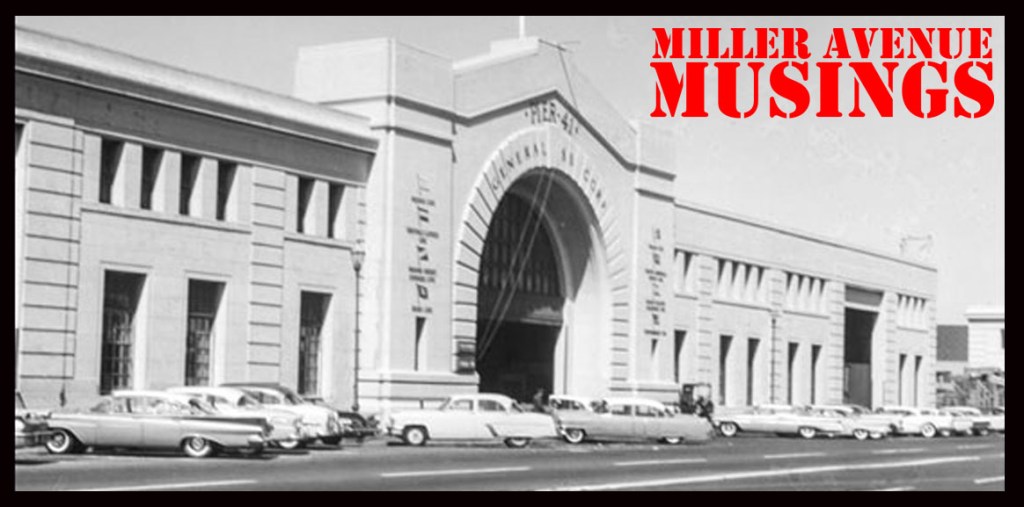
Sad to learn the news of Bob Weir’s death while writing this.
My brain was still a bit like scrambled eggs but I felt ready to go back to work. On my first day back on the waterfront, I got up early, dressed up warm and caught a bus down to the Embarcadero. I felt nervous inside but I soon learned that it didn’t show.
The hiring hall for local 34 was just north of the Ferry Building on the bayside. You’d enter from the street into an outer room, then through a door, across a walkway and through another door into the hall itself. I had to be there by 7am and as I came in, the air was practically amber with tobacco smoke. It was packed with men who were mostly all smoking. I was, at this time, a smoker but I could never face my first cigarette until after lunch so entering the hall at such an early hour was a truly disgusting experience.
Johnny Aitken, the dispatcher, stood on a big platform behind a glass panel on an elevated stage. On the wall behind him was a blackboard with pier numbers written in chalk. First the union book members would choose their jobs, then the guys on the B-list would take their’s and what was left over would go to those men present whose names were either called out over the microphone by Aitken or not. Blackie knew Johnny Aitken well. His nickname for John was “Oh my achin’ back,” as he always had a complaint to share.
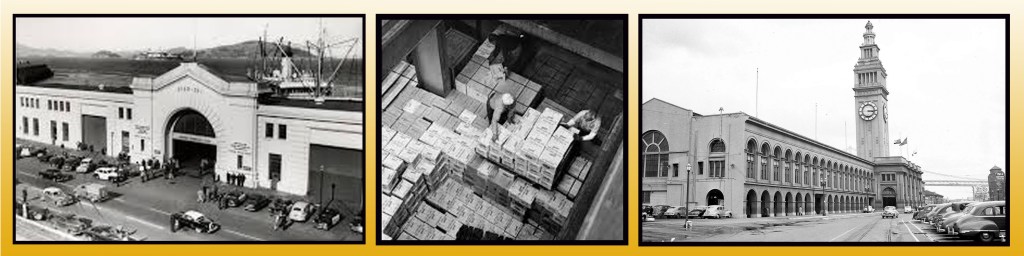
There were 50 piers on the Embarcadero. The ones to the north of the ferry Building were all odd numbers and to the south even numbers. The president of Local 34 was Jimmy Herman who I had known for years. He used to always be up at the Hallinan mansion in Ross on Sundays when he would play some card game with Vin and Vivian. So I shuffled around the hiring hall until I heard Johnny Aitken call out my name. I went up to the window and he told me: “Pier 27, R&D.” Start time was 8am so I’d be able to catch a muni bus and maybe have a cup of coffee at a cafe near the dock. R&D stood for “receive and delivery,” which was a job I knew how to do.
So I made my way out of the smoke filled hall, walked back to the ferry building and caught a north bound muni bus to pier 27. There was a cafe nearby so I went in to have a cup of coffee and a glazed donut. As I sat down I was approached by someone with a friendly face. A guy named Steve, who I’d known from my time at Homestead School, came over and said hello. I’d never been close friends with Steve but he was the same age as me and lived in our neighbourhood halfway down the big hill on Molino. His house was on Sunrise, which started at Janes and ran across to Molino. He too was working as a clerk and we were both doing R&D at pier 27 so it was good to have a friendly comrade.
The big hill, which Steve’s family house sat on, was the one that our mother Beth begged Jim and I never to ride our bikes down. To be fair to Beth, it was very steep and because she’d made such a big deal out of it, we never did. Oddly, we always referred to that hill as Molino as if that was its only manifestation, but the road of that name ran from the bottom of the hill up past the playground and Seymour Avenue then took a right just beyond Mirabel, where it continued past the Collett house and the Symmes house before descending, snake like, into Old Mill. As both my sisters went to Old Mill, I would guess they walked to school that way. Ethel was the street we took when we were headed downtown. There was a generous abundance of public steps on the lower slopes of Mount Tamalpais and on Ethel we had two to choose from. The first would take us down to Miller by Brown’s Furnishing and the next one brought us down to Throckmorton by the pet store.
The social centre of our neighbourhood was the playground at Molino and Janes. It was where all the kids played. I don’t recall Steve being there much at all. Though I never enjoyed playing baseball at school, I did at the playground. I guess it was a safe place, unlike school where I was treated as the little guy who was no good at sports. Towards the end of our time in that part of town I remember Johnny Lem, Jimmy Brown, Bobby Patterson, Augie Belden and Marvin Lundwall whose house stood at the very top of that hill. Just across the road from the playground lived Bill and Kelly Giles and Shannon Pixley.
A Russian family named the Popovs moved into a house on Janes in the early ‘60s. They had two young boys named Oleg and Boris, neither of whom we ever had anything to do with. I remember sitting on the swing early one evening and hearing a young boy’s voice singing the title song of the Disney television programme Zorro. It was Oleg, trotting on his imaginary horse around the upper rim of the playground as he sang. But that was when I was still in junior high at Edna Maguire which was a world away from my adventures in 1967.
So I didn’t have much history to reflect on with Steve who I would be working with at Pier 27 throughout that week. All the jobs on the pier were done by union members and the boss for the day seemed a very nice guy. There was a little room where the clerks all sat waiting for instructions and it wasn’t long before I was given a job. A teamster arrived in his truck to collect 40 sacks of coffee beans. The burlap sacks of coffee beans were piled on pallets at a location on the pier which was written on the paper work the boss had given me. So I walked down to the location where I found the coffee beans and two longshoremen waiting by them. The teamster drove his truck onto the pier and pulled up by the pallets. A fork lift truck, driven by another longshoreman arrived and he lifted the top pallet off the pile, lowered it down and manoeuvred it to a position behind the truck. He then raised his forks high enough to place the pallet on the back of the truck. The two guys on the pier then climbed up onto the truck along with the teamster. An essential tool for this work was the hook which each stevedore had in his possession. They would jab the hook into the burlap sack with one hand and with their other hand grab hold of the burlap and lift, swinging the heavy bag off the pallet and onto the floor of the truck in the place the teamster had indicated. There were probably about eight sacks on a pallet so the it would take a bit of time. My job was to make sure that the paperwork matched the transaction which was occurring. At ten o’clock we all had a fifteen minute coffee break. Each operation which occurred in the workplace had been haggled about in negotiations with the union.
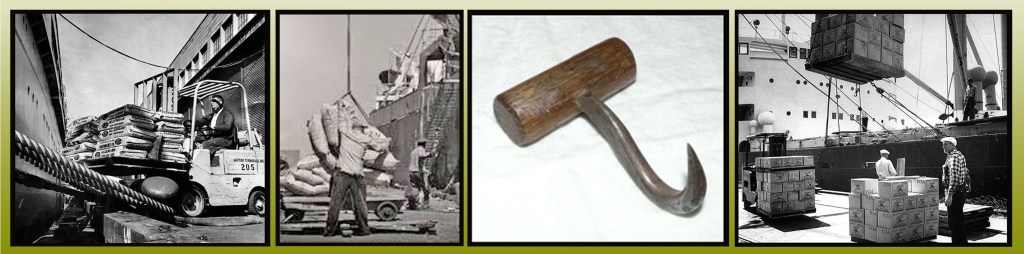
On the left a stevedore driving a forklift, winching sacks onto a pallet, a longshoreman’s hook and more winching.
Steve and I went for coffee together and later for lunch. Over lunch he told me that he had a problem with drugs. He had become strung out on Methedrine. But he seemed sober and on the wagon. What he described was full blown addiction and it sounded bad. I didn’t ask if he was using needles but my feeling was that he did. I had tried speed, as it was called, orally once. The high was exciting but the comedown was terrible so I never tried it again. It was like the worst kind of hangover and I guess that’s how Steve got hooked. To avoid the hangover, you take some more and after a bit your body gets used to it. My only experience of addiction was with cigarettes and I would always quit after six months but it was tough stopping. The other thing about speed was that it made you talk a lot.
I was under doctor’s orders not to smoke grass but I only took that advice so seriously. One day I didn’t get a job at the hall and paid a visit to a friend who had an apartment near California Street. He was having a day off from his job in an office so he rolled a joint, lit it and offered me a toke. Out of habit I took it, inhaled the smoke and held it down in my lungs. He had a pretty good record collection and as I exhaled, I leafed through the LP covers which were leaning against the wall near the record player. I chose Otis Redding and put it on the turntable.
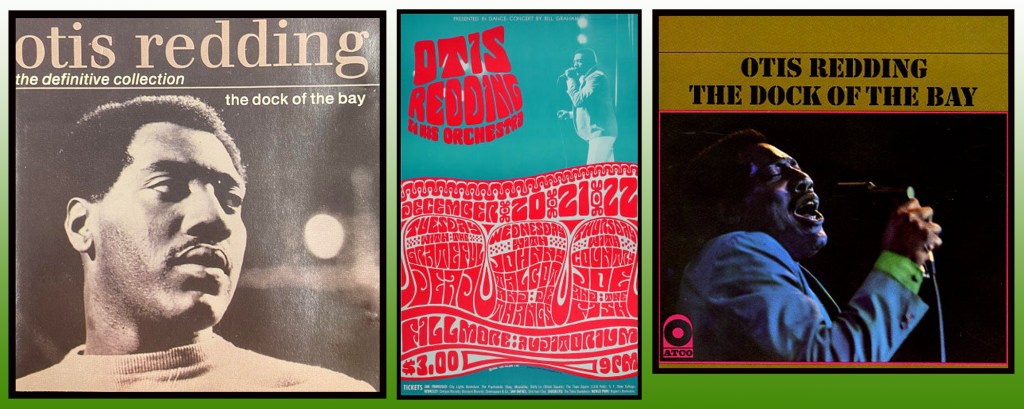
3 images of the late Otis Redding. In the centre is Wes Wilson’s poster for the weekend gig Redding did at the Fillmore Auditorium in 1966.
I had heard the song Dock Of The Bay on the radio but never listened to it with the intensity that a head full of ganja can provide. I hadn’t realised that Redding was singing about San Francisco bay. The lyrics told me that he left his home in Georgia, headed for the Frisco bay. It was soulful, beautiful and very sad. I was terribly moved. I was feeling lonely and regularly ate my lunch sitting on just such a dock. I listened to it over and over. This would have been either just before or after Otis Redding was killed in a plane crash in Wisconsin.
The weed my friend shared with me was strong and I was very stoned. I started thinking about the hallway outside his door and the stairs down to the front door and I suddenly realised That I was feeling paranoid. Not wishing to alarm my friend I got up and walked around the spacious apartment. I looked out the window, walked into the kitchen and seeing a sink full of dirty dishes, I set about washing them. This activity, bringing order out of chaos, brought me back to earth and I realised that Dr Weinberg’s statement that I couldn’t smoke dope anymore was true. I was now disqualified as a hippie.
One aspect of my madness was that I lost all interest in the various entertainments I had always been passionate about such as going to the movies. Popular music I stayed in touch with but I missed a whole lot of movies which came out during that time. I never saw In the Heat of the Night, Barefoot in the Park or The Family Way.
The press advertising for the movie The Graduate did not connect with me when it came out in December of 1967. Somehow the ads in the Chronicle didn’t appeal to my sensibilities. Perhaps it was because I didn’t know who Dustin Hoffman was as he was completely unknown to me at that time. For whatever reason I had no interest in seeing The Graduate which is odd in retrospect, as this movie was to have a profound effect on me.
It wasn’t until I heard about The Graduate from a fellow ship’s clerk early the following year that my interest was aroused. It was a bit peculiar because this particular guy I worked with was not someone I would describe as a bright bulb. He had been born and bred in San Francisco, was in his early twenties, and had never ever been out of the city. At no point in his young life had he gone across either of the two bridges which took you to Marin County or the east bay. This provincial attitude had not impressed me. And yet what he had to say about The Graduate made me want to see it.
During the time I worked for Bill Graham, my first job was painting signs on the wall at the Fillmore Auditorium and later I began designing posters. One of the perks of working for Bill was getting into his dance concerts for free and as he booked a few bands which interested me, I would often hang around after my work was done to watch the evening’s show begin. While painting signs at the Fillmore during the day, I got to know most of the musicians from the bands that regularly appeared: Jefferson Airplane, the Grateful Dead and the Quicksilver Messenger Service. The Dead was managed by two guys named Danny Rifkin and Rock Scully. Rock had a younger brother named Dicken. He looked like Rock and was tall like him but had blonde hair in contrast to his brother’s black hair. Dicken’s job at the Fillmore was to sit on a stool in front of the entrance to the band room on concert nights and keep people out who had no business going in. I became friendly with Dicken and would hang out with him. He was a formidable presence on his stool and suffered no foolishness from those who tried to talk their way past him. I think he was a student but to be honest it never came up.
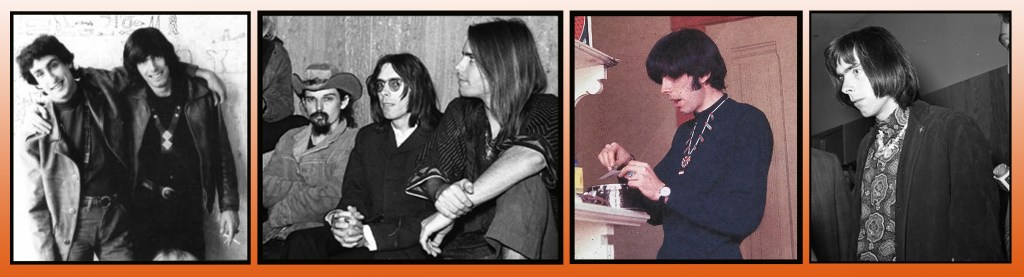
Left: Danny Rifkin & Rock Scully, Pig Pen, Rock Scully & Bob Weir, Rock at home and in front of the press.
Most of the people I hung out with at the Fillmore were considerably older than my nineteen years and I felt like a kid in a world of adults. It’s just that all these adults had long hair and smoked dope. I behaved like an adult but I was really just a kid. I also didn’t have a girlfriend at this time and nothing about that environment encouraged me to take steps to remedy that situation.
The band room was open to those of us who worked for Bill and I would hang around the entrance, smoking cigarettes and chatting to Dicken and this pair of beautiful young brunette women who were fashion models and twins. I did, on occasion, meet and dance with young women at the Fillmore, but more often than not, I was too shy to even do that. There was one very attractive young woman I danced with who, while we were moving about the dance floor, casually asked if she could punch me. Being somewhat perplexed by her request I stupidly said yes and the next thing I knew I was doubled up on the floor after she slugged me in the stomach. “Get up!” she shouted. As I did she socked me on the jaw. I suffered a few more blows before I finally staggered away from her.
But the reality was that most of the young women I wanted to dance with I was terrified to even talk to. I was suffering from the age old problem of hesitation. In dealings with the opposite sex, once you hesitate…you’re finished.
When I finally went to see The Graduate in early 1968 at the Metro, I was stunned by Dustin Hoffman’s performance which embodied all the demons which had been in charge of my soul for some time. Benjamin Braddock was every bit a victim of hesitation as was I.
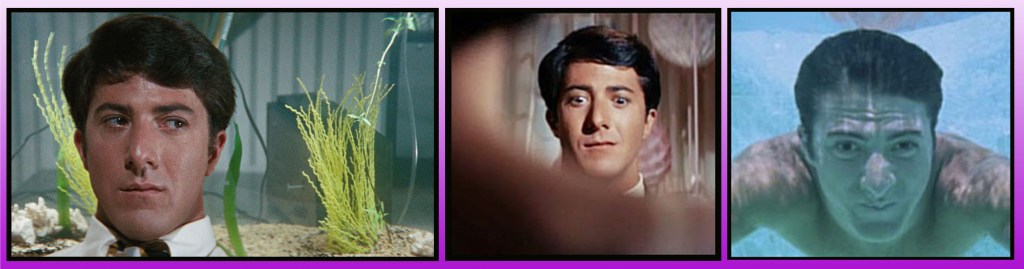
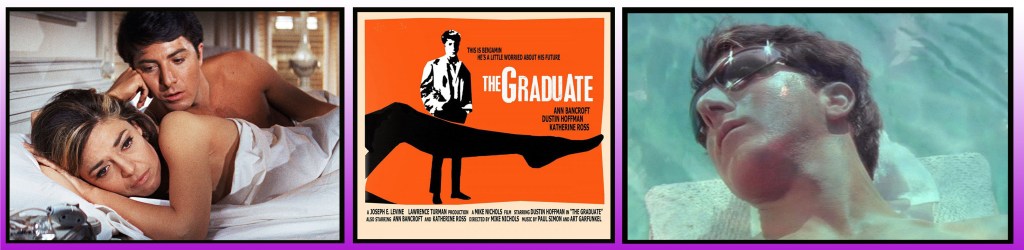
Images of Dustin Hoffman and Anne Bancroft from The Graduate.
The emotional panic which paralysed him as he tried to book the hotel room for his first fling with Mrs Robinson was like watching myself. I had never seen this portrayed on screen before. Men in movies were mostly over confident with women or total buffoons but nothing in between. As this was precisely the reality which had me in its grip, I recognised it immediately. Not only was the movie highly entertaining but it brought this paralysis into focus and sent me a message that I was not alone. Other men suffered in a similar way.
To be continued…
Amazon USA
https://www.amazon.com/dp/B085QN73VQ
Amazon UK
https://www.amazon.co.uk/dp/B085QN73VQ

 Miller Avenue Musings
Another good one John…do please keep them coming…I love them – so evocative of the times, even though I lived 6,000 miles away…the films and the music was shared ‘stuff’.
LikeLike