By the summer of 1967 my thinking was pretty muddled. My use of marijuana was ridiculously constant as was my smoking of ordinary cigarettes and my lifestyle was truly unhealthy. I still harboured an ambition to have a good trip on LSD. I had struck up a kind of business partnership with Tom Connell to produce psychedelic posters and this gave me a confidence for the future. The war in Vietnam was happening on the other side of the world yet it was a presence in my consciousness. I was a 20 year old male American and like many of my fellow Tam High graduates, I knew that eventually I would be called up by the draft board. I had no game plan for this.
My good friend Ed Smith, who was drafted that year, told me many years later that the options seemed to be: going to college, going to Canada, going to jail or going in the army and quite probably to Vietnam. People who were politically active like Ringo Hallinan added another option: fighting to end the war.
Vietnam was now a major preoccupation in the media. Daily graphic horror stories of bloodshed on both sides filled television screens across the land as the American war escalated. David Harris, president of the student body at Stanford dropped out to fight the war and eventually went to prison for refusing to fight in Vietnam. He was romantically linked to folk singer Joan Baez who was still politically engaged unlike her previous pal Bob Dylan who was now a hero to the dope smoking hippie movement.
My brother Jim, partly as a way of dealing with Eddie Smith’s four choices and partly as an act of rebellion against my parents’ left wing politics, had joined the army. He waited for his 18th birthday so that he didn’t need their permission. I remember tearfully trying to talk Jim out of it but he had made his decision and stubbornly stuck to it. It must have been a very bitter pill for Blackie and Beth that Jimmy joined the army but they seemed to accept it.
My parents and all their close friends were adamantly opposed to the Vietnam war just as they had been against the war in Korea. The analysis on the left was that the second world war had shown the political establishment that war was good for business. So to keep the economy on a war footing they chose the Russians as the new enemy for Americans to fear. They set about convincing the American public with powerful propaganda which was aided by the televised congressional witch hunts of HUAC and later Senator McCarthy. The prosecutions and convictions of the Hollywood 10, Alger Hiss and the execution of the Rosenbergs augmented the feeling of terror in the land. But that was in the 1950s. Now in the mid-60s there was a new generation that questioned American imperialism and capitalism itself.
On the waterfront Blackie steadfastly refused to work across the bay in Oakland at the military bases and he was always very disappointed when those ship’s clerks who he had sponsored to work on the front took the highly lucrative labour across the bay once they made the B List. Some of these clerks would work as many as seven days a week. Black described them as “hungry.”
So when brother Jim made a stopover in Seattle en route to his posting in Korea, I flew up and had a good visit with him. I was very relieved that he was not being sent to Vietnam. I stayed overnight in his hotel room and after breakfast the next day we said our goodbyes. I then took the shuttle to the airport to fly back to San Francisco.
As I boarded my flight and turned right to enter the cabin I saw that the plane was packed with uniformed American army personnel. I was suddenly seized with panic. Here I was, a long haired hippie amongst all these crew-cut soldiers. My reaction was, of course, ludicrous. They were all young Americans about my age and I’m sure I would have got on fine but my thinking at the time was that they would be hostile. I turned to the stewardess and asked if I could take a later flight. She said yes and I made my way back to the departure lounge where I was told the next flight would be in a few hours.
At this time of my life I’d had very little experience of airports and while, later on, I would be sure to take a book to read, I had nothing to occupy my time. Perhaps it was this which made me approachable. A very friendly young man introduced himself to me and engaged me in conversation. He was a devout Christian and spent the next few hours doing his very best to convert me. We spoke of many things profound and light. It wasn’t at all dull, as conversations go, but by the time my flight was boarding, I was still an atheist.
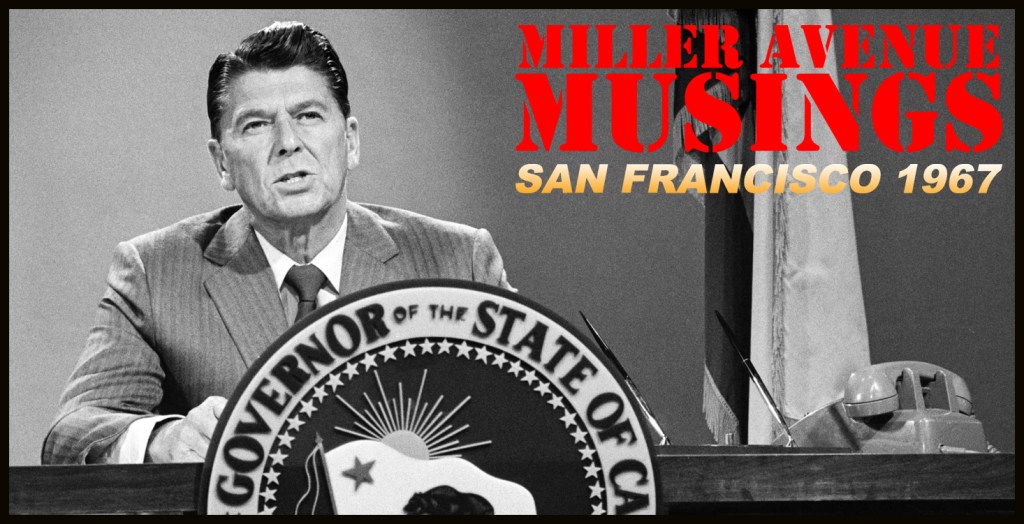
As the summer of 1967 rolled on, the state of California, which had been Democrat controlled for as long as I could remember was now in the hands of an extremely conservative administration. The previous November had seen the election of Ronald Reagan as governor which was the first time a politician from the extreme right had broken through.

Reagan, a movie actor, had been a lifelong Democrat and FDR supporter up until the post-war period. When the House UnAmerican Activities Committee came to Hollywood in 1947, he jumped on the anti-Communist bandwagon and named names. My father Blackie had met Reagan during his years as a trade union organiser and described him as a phoney. In Blackie’s rather strict moral code, being a phoney was bad enough but to be a fink, naming people to the Committee, put him beyond the pale. He detested Ronald Reagan.
The new governor of California had become a darling of the extreme right wing of the Republican Party. In 1964 Barry Goldwater ran for president on a pro-Vietnam War platform and who should be there to make a televised speech on his behalf but Reagan. Goldwater lost big to incumbent Lyndon Baines Johnson but Reagan’s speech at the Republican convention put the faded movie star on the conveyer belt which ultimately took him to the governor’s mansion.
He was up against Pat Brown who had been governor for many years and had even beat Richard Nixon in the previous election. In eighth grade my class took a field trip from Edna Maguire School to Sacramento and while we were having lunch on the lawn by the capitol building, I suddenly spotted Governor Brown walking on the lawn. At this time Vin Hallinan was defending a prisoner on Death Row named Alex Robillard. So I walked up to Brown and asked him what was going to happen to Robillard. The governor put his hand on my head, gazed up at the sky and said: “Well son, I’m afraid he’s going to have to die.”
Reagan’s campaign stressed law and order which, after the Watts riots in 1965, was a popular stance with white middle class voters. His support for the Vietnam war and his promise to lower taxes also appealed to them. The California electorate swung his way after Brown made the mistake of comparing Reagan to John Wilkes Booth, the ex-actor who had assassinated President Lincoln. According to the Independent Journal, more than half of Marin County voters came out for Reagan.
Once in office in Sacramento the new governor began cutting budgets and getting bullish about the student demonstrations on the UC campus at Berkeley. He targeted Berkeley in particular as it was where the Free Speech movement led by Mario Savio had made headlines in newspapers coast to coast.
My flight from Seattle was incident-free and when we landed, I returned to my parents’ apartment on Russian Hill. I had become more than a bit remote from my parents Blackie and Beth. The wayward approach I seemed to take in my lifestyle must have mystified them. But my wayward approach had its genesis in their lack of interest in my education when I was younger. I never learned how to work at things I was not interested in which seems to be a necessary part of the educational process. During my time at Tam High, my then girlfriend Janice Kaufman asked me what I planned to do with my life and quite frankly there was no plan at all. When I graduated all my friends went off to college or joined the army and I went to sea. I was seeking adventure.
Tom Connell had suggested that I design a logo of my signature and I got down to work on it. I remember the time that I changed my signature which read: John H. Myers from a ‘J’ with a rounded top to one in the style of John Hancock. It was while I was in high school and my algebra teacher, Mr Davlin, used to read off the names of the marked homework sheets as he handed them back and when he got to mine he’d always say something like: “John H. Misshmeervuh.”
It wasn’t long before I was back in Mill Valley getting high. I made my way to the lady folksinger’s house in Strawberry. She was always welcoming of a house full of young dope smoking fools. It was with her and a few others that I attended another rock concert at the Mountain Theatre up on Mount Tam. Top of the bill was Eric Burdon of The Animals. The audience wasn’t as big as it had been for The Doors so there was plenty of room to move around. The Master of Ceremonies was a British guy, possibly in his 50s with longish grey hair and a beard. My folksinger friend told me that he operated an English style pub in Tiburon.
At some point in the proceedings a long haired fellow walked up to the microphone on the stage and spoke, amplified, to the audience: “Eric Burdon is on STP. It’s beautiful.” This was the first time I had ever heard of this drug. STP was a well known oil product for cars but clearly the hippie fellow was talking about a psychedelic.
The front page of the Chronicle always had a story about LSD at this time. One such article on the front page was all about a guy named Owsley who was supposed to be manufacturing the strongest acid in the Bay Area. LSD had been made illegal in the state on 6th October, 1966.

Owsley Stanley III pictured with Jerry Garcia and Phil Lesh.
Eric Burdon finally did appear and I don’t recall being very taken by his performance but I got chatting with a pretty young hippie woman and wound up that evening at her apartment in the Haight-Ashbury and who should be there but the older English guy who had been presenting the concert at the Mountain Theatre. He was very engaging and clearly was having a fine time with his pick of beautiful young women. In fact the whole scene in the Haight seemed to be a bit of a candy store for older men in search of younger female company. I got the impression that this guy had been able to re-invent himself in America and the hippie thing, which was only a few years old, must have seemed like the icing on the cake. I stayed the night and made my way back to North Beach in the morning.
At this time most of the San Francisco bands lived in the Haight district. The Quicksilver Messenger Service had a house there as did Jefferson Airplane and the Grateful Dead.

Jefferson Airplane in the Haight district.

The Grateful Dead in the Haight Ashbury.
I remember being surprised one day at the Fillmore as the Dead arrived at the band room with a huge entourage and among them was a schoolmate of mine from Tam High, named Susila Ziegler. I knew her as Suzanne. She was a beautiful blonde who lived, I think, up in Scott Highlands so it was surprising to see her in the very bohemian company of the Dead. “I’m Bill’s old lady,” she told me meaning Bill Kreutzman, the drummer of the band. There was another person who I saw regularly with the Dead who was very loud and used to construct meaningless sentences a lot: “There are ball bearings in my soup!” I kept seeing this guy a lot as he was always coming and going with the Dead and one day I was talking with Bill Graham when he walked by. “Do you know who that is?” he asked. I answered I didn’t and he told me it was Owsley.
The previous year I remember seeing author Ken Kesey at the time he was famously on the run from the law. He was standing by the Merry Pranksters bus which was parked on the corner of Steiner Street. I recognised him from photos in the Chronicle. He had very short hair and was dressed casually but was wearing brogues which were an unnaturally bright orange colour.
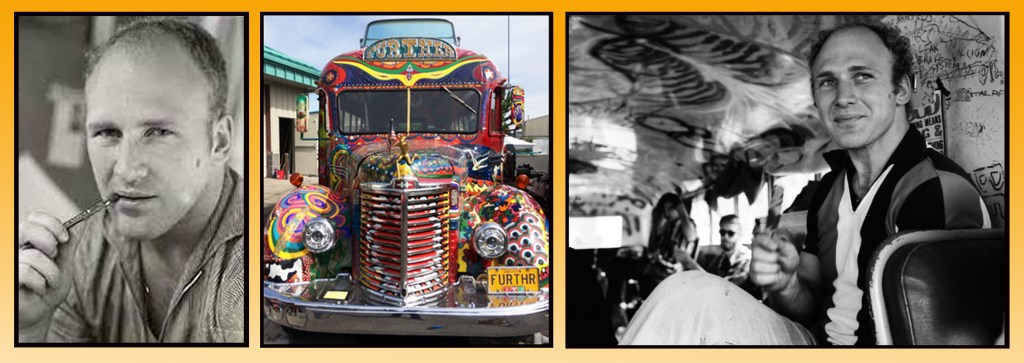
From left: author Ken Kesey, Merry Pranksters bus and Kesey inside it.
Kesey had been involved in The Trips Festival which was the very first manifestation of the psychedelic dance concerts which Bill Graham and Chet Helms later produced. The venue for The Trips Festival was the Longshoreman’s Hall down near Fisher-man’s Wharf. It was early in 1966 and I attended. It was the first time I ever saw Bill Graham who struck me as having a very serious face juxtaposed with a Frankie Avalon hairdo. This was where the first light shows were tried out, later to be perfected at the Fillmore and Avalon Ballrooms.
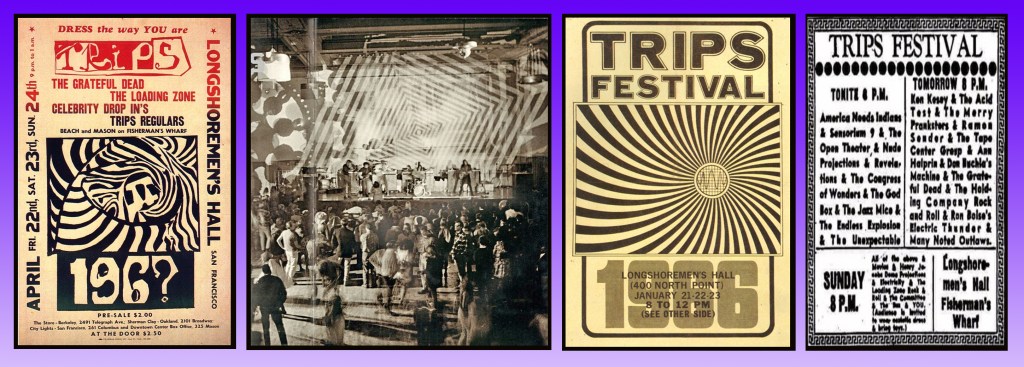
Early poster art for The Trips Festival and a photo of Quicksilver Messenger Service playing at it.
But that was back at the beginning of the scene and now was the summer of 1967. I had not a clue that I was on the brink of the biggest disaster of my young life.
To be continued…

Amazon USA
https://www.amazon.com/dp/B085QN73VQ
Amazon UK
https://www.amazon.co.uk/dp/B085QN73VQ

 Miller Avenue Musings